
目錄:
太長不看
發酵是日本料理背後的核心功臣,尤其是麴菌的作用。認識麴,比追逐「發酵」這個流行詞更重要。發酵是日本料理中安靜的基石之一。早餐的納豆、一碗味噌湯、米飯旁的漬物,以及讓日常食物嚐起來比食材清單更深刻的調味料中,你都遇得到它。它不是單一風味,也不是單一產品。它是一系列把大豆、米、大麥、蔬菜與水果轉變成更具香氣、鮮味、酸度或保存力的技術家族。
以我的觀點而言,大約十年前,發酵在日常對話中變得不那麼顯眼。它從未從日本廚房消失,但我現在透過注重健康的烹調、專賣店、試飲與工作坊更加注意到它。這股重新受到的關注很有用,因為它幫助我們超越時髦的標籤,去理解這些食物為何能如此長久地留在日常生活中。
為何發酵在日本料理中如此重要
發酵始於精心管理的微生物作用於食物。在日本烹調中,重要的菌群包括麴黴、酵母菌、乳酸菌、納豆菌與醋酸菌。它們的作用可以保存食物,並產生胺基酸及其他讓風味更複雜的化合物。麴(Kōji),即以米、大麥或大豆培育米麴菌(Aspergillus oryzae)而成的產物,對味噌、醬油、味醂與清酒尤其核心。[1]

The image shows a close-up view of a refrigerated display case in a Japanese food shop, filled with neatly stacked packages of koji (fermented grain used for making miso, amazake, and other fermented foods). No people are visible; the frame is entirely occupied by the merchandise. Main content and arrangement The display consists of rectangular, vacuum-sealed blocks of grain, each wrapped in clear plastic and labeled with a white sticker. They are arranged in roughly vertical columns, with the color of the grain changing from left to right: Left columns: pale, whitish packages labeled “米こうじ” (rice koji). Several packages in this section are stacked about four to five high. Center columns: slightly darker, tan-colored packages labeled “麦こうじ” (barley koji). Right columns: darker brown packages labeled “玄米こうじ” (brown rice koji). Each label contains Japanese text including the product name, what appears to be production date information (for example, "20.9.8" can be read on some labels), producer and origin details, a barcode, and small red stamps or markings. The labels on the front-facing packages in the lower left indicate a 500 g weight. Signage and pricing Two printed signs are visible at the top of the display: A black sign on the upper left with red and white text advertising rice, barley, and brown rice koji (“米・麦 玄米”) at "500g ¥1,000 (税込)", meaning 500 g for 1,000 yen tax included. A white sign at the upper right with similar pricing ("¥1,000(税込)") and the text “香川こづち” plus “いつでも米・麦 玄米”. The word “香川” (Kagawa) suggests the product or shop may be associated with Kagawa Prefecture, though this is an inference from the text rather than a confirmed location. Other visible elements Near the top center-left there is a round analog dial, likely a temperature gauge for the refrigerated case, with small colored markings around its edge. The right edge of the frame shows additional products partially cut off: a dark packaged item with Japanese characters (possibly miso or another fermented product, with text resembling “田舎...” which often refers to "country-style" miso), and a label that appears to include “醤油こうじ” (soy sauce koji), suggesting the shop sells other koji-based items. A sheet of clear plastic film or wrap covers part of the display, creating bright diagonal reflections and glare across the middle and lower portions of the image, which slightly obscures some packages. Lighting and composition The scene is brightly lit with cool, typical supermarket-style lighting. The camera angle is straight on or slightly from above, and the products fill the entire frame. The overall impression is of a specialty or health-food store section dedicated to koji for home fermentation use.
The image shows a close-up view of a refrigerated display case in a Japanese food shop, filled with neatly stacked packages of koji (fermented grain used for making miso, amazake, and other fermented foods). No people are visible; the frame is entirely occupied by the merchandise.
Main content and arrangement
The display consists of rectangular, vacuum-sealed blocks of grain, each wrapped in clear plastic and labeled with a white sticker. They are arranged in roughly vertical columns, with the color of the grain changing from left to right:
- Left columns: pale, whitish packages labeled “米こうじ” (rice koji). Several packages in this section are stacked about four to five high.
- Center columns: slightly darker, tan-colored packages labeled “麦こうじ” (barley koji).
- Right columns: darker brown packages labeled “玄米こうじ” (brown rice koji).
Each label contains Japanese text including the product name, what appears to be production date information (for example, "20.9.8" can be read on some labels), producer and origin details, a barcode, and small red stamps or markings. The labels on the front-facing packages in the lower left indicate a 500 g weight.
Signage and pricing
Two printed signs are visible at the top of the display:
- A black sign on the upper left with red and white text advertising rice, barley, and brown rice koji (“米・麦 玄米”) at "500g ¥1,000 (税込)", meaning 500 g for 1,000 yen tax included.
- A white sign at the upper right with similar pricing ("¥1,000(税込)") and the text “香川こづち” plus “いつでも米・麦 玄米”. The word “香川” (Kagawa) suggests the product or shop may be associated with Kagawa Prefecture, though this is an inference from the text rather than a confirmed location.
Other visible elements
- Near the top center-left there is a round analog dial, likely a temperature gauge for the refrigerated case, with small colored markings around its edge.
- The right edge of the frame shows additional products partially cut off: a dark packaged item with Japanese characters (possibly miso or another fermented product, with text resembling “田舎...” which often refers to "country-style" miso), and a label that appears to include “醤油こうじ” (soy sauce koji), suggesting the shop sells other koji-based items.
- A sheet of clear plastic film or wrap covers part of the display, creating bright diagonal reflections and glare across the middle and lower portions of the image, which slightly obscures some packages.
Lighting and composition
The scene is brightly lit with cool, typical supermarket-style lighting. The camera angle is straight on or slightly from above, and the products fill the entire frame. The overall impression is of a specialty or health-food store section dedicated to koji for home fermentation use.
圖片中的可見文字
**価格札(中央上)**
自家製米こうじ
米 麹
500g ¥1,000(税込)
**価格札(右上)**
自家製米こうじ 契約ならんで `[uncertain: 契約ならんで]`
米・麦 玄米
100g ¥1,000(税込) `[uncertain: 100g ¥1,000]`
**計器(左上・文字盤の数字)**
50 40 30 20
**各パッケージのラベル(繰り返し)**
左の列(上から下へ):
- 米こうじ
- 米こうじ
- 米こうじ
- 米こうじ
- 米こうじ
- 米こうじ
- 米こうじ
- 米こうじ
第2列(上から下へ):
- 米こうじ
- 米こうじ
- 米こうじ
- 米こうじ
- 米こうじ
- 米こうじ
- 米こうじ
第3列(上から下へ):
- 米こうじ
- 米こうじ
- 麦こうじ
- 麦こうじ
- 米こうじ
- 麦こうじ
- 麦こうじ
第4列(上から下へ):
- 麦こうじ
- 麦こうじ
- 麦こうじ
- 麦こうじ
第5列(上から下へ):
- 玄米こうじ
- 玄米こうじ
- 玄米こうじ
- 玄米こうじ
- 玄米こうじ
右上(上から下へ):
- 麦こうじ
- 玄米こうじ
- 麦こうじ
**ラベルの小さな印字(読み取れる部分のみ)**
品名:米麹(米) 内容量:500g
原材料名:米(国産) `[uncertain: 原材料名:米(国産)]`
栄養成分表示(100g当たり) `[uncertain]`
2 9 8.04.12 12時まで `[uncertain: 2 9 8.04.12]`
賞味期限 `[uncertain]`
TEL `[uncertain: 0942-**-****]`
**右端の商品ラベル**
万能調味料
醤油こうじ
塩 `[uncertain]`
ゆきんこ娘 `[uncertain: ゆきんこ娘]`
田舎みそ `[uncertain: 田舎みそ]`
**右端の縦書き文字**
逸 `[unreadable]`
か `[uncertain: か]`
日本溫暖潮濕的氣候促成了許多在地發酵傳統的發展,但氣候並非唯一的因素。人們一代一代地磨鍊配方、鹽度、容器與熟成時間。這就是為什麼甜白味噌、深色豆味噌、酸爽的米糠漬與細膩的清酒,可以同屬日本發酵,卻嚐起來截然不同。
發酵食品可以成為均衡整體飲食中有價值的一部分,但它們不是神奇藥物。MAFF討論的研究顯示,日本傳統發酵食品可能有助於新陳代謝與腸道環境,但每個人反應不同,其餘的飲食也很重要。鹽分也需要注意:味噌、漬物與梅乾可能鈉含量較高,所以我將它們視為多樣化餐點中的風味成分,而非可以無限量食用的東西。[2]
麴:味噌、甘酒與更多產品背後的安靜起點
麴不是單一完成品,也不是單一風味。它是以麴黴培育的穀物或豆類,它為生產者提供讓日本發酵如此多變的酵素。在店裡,你可能會看到以精白米製作的米麴(kome kōji)、使用整粒糙米製作的糙米麴(genmai kōji),以及以大麥製作的麥麴(mugi kōji)。在味噌生產中,米麴、麥麴與大豆麴是經典基礎,每一種都會改變最終的香氣、甜度與深度。[3]
最親切認識麴的方式之一是米麴甘酒(kome kōji amazake),這是一種由米與米麴製成的甜飲。它不同於用酒粕(sake kasu)製作的甘酒,所以值得閱讀標籤,而不是假設每一瓶都一樣。[4]
我尤其感到興奮的是這種食材能走多遠。麴如今也被日本以外的地方探索,包括高級餐飲廚房中的醃漬、醬汁、熟成與新的鮮味調味料。這種現代創意仍然始於你在小型日本味噌店看到的那種耐心培育。[5]
發酵、醃漬,並不一定相同
這個區別值得說明,因為英文的「pickle」可以隱藏很多事。漬物(Tsukemono)意思是醃漬的東西,通常是蔬菜,但並非每一種漬物都是主動發酵的。快速用醋醃的黃瓜仍然是漬物。相對地,米糠漬(nukazuke)在活的米糠床中熟成,乳酸發酵是過程的一部分。[6]
一個非常日本式的細節是,找到米糠床(nukadoko)的基底有多容易。當糙米(genmai)在投幣式精米機(koin seimaiki)被精磨成白米時,會產生米糠(kome nuka)。這不是稻殼(momigara)。在有些機器或附近的米店,會有一個容器裝著標示為免費、可帶回家的米糠,這對開始製作米糠床非常完美。請務必先看標示或詢問,因為各場所的領取規則不同。MAFF指出,米糠是糙米精磨後富含營養的副產品,也是米糠漬的基礎。[7]例如,某個JA分會就明確在其投幣式精米機旁提供免費米糠。[8]
同樣實際的做法也適用於其他地方。鹽漬(shiozuke)用鹽,醋漬(suzuke)用醋,粕漬(kasuzuke)用酒粕,醬油漬(shoyuzuke)用醬油,芥末漬(karashizuke)用芥末。有些方法會隨著時間促進發酵,其他則主要著重於調味與保存。了解其中的差異,會讓一盤日式早餐或超市貨架容易讀得多。
| 方法 | 日文用語 | 典型基底 | 發生什麼事 |
|---|---|---|---|
| 麴發酵 | 麹、 kōji | 米、大麥或大豆 | 經管理的培育與熟成,創造味噌、清酒、醬油等產品的基礎。 |
| 米糠漬 | ぬか漬け、 nukazuke | 蔬菜與米糠床 | 活的 nukadoko 可以發展乳酸發酵。 |
| 鹽漬 | 塩漬け、 shiozuke | 蔬菜與鹽 | 鹽會抽出水分並保存;可能發酵,但不保證。 |
| 醋漬 | 酢漬け、 suzuke | 蔬菜與醋 | 通常是快速醃漬與調味,不是主動發酵。 |
| 酒粕漬 | 粕漬け、 kasuzuke | 蔬菜或魚與酒粕 | 使用發酵過的食材,但醃漬步驟本身不一定是主動發酵。 |
| 醬油漬 | 醤油漬け、 shoyuzuke | 蔬菜或海鮮與醬油 | 通常是一種借用醬油發酵深度的調味與保存方法。 |
你最常遇到的日本發酵食品
你可以列出一張很長的清單,但這些是大多數訪客最先注意到的食物與調味料。請把這裡當作一張地圖,而不是它們各自故事的替代品。
味噌
味噌(miso)是發酵大豆醬,通常由大豆、鹽,以及米麴、麥麴或大豆麴製成。它是湯品、醃漬、塗醬與許多家常菜的安靜骨幹。確切的材料與熟成會改變其顏色、鹹度、甜度與深度。我詳細的味噌指南說明了各種類與使用方法。
大多數日常味噌是為了穩定保存而製作,通常經過加熱處理以停止進一步的作用,讓風味保持一致。未加熱、常標示為生味噌(nama miso)的產品,仍然是一個小眾領域。它可能會繼續在香氣上發展,需要更小心地冷藏保存。嚐起來很有趣,但它並不自動「更好」,也不是健康萬靈丹。我會選擇它,是因為它活潑、持續變化的風味,以及與其他味噌比較的經驗。
如果你人在東京,想實際品嚐而不是只閱讀,我可以在我的東京味噌之旅中安排這種比較。依實際情況,我們可以拜訪專賣店、比較不同風格、品嚐味噌料理,或加入實作工作坊。東京的專賣店確實有舉辦預約制的味噌工作坊,所以這是這座城市飲食文化中真實的一部分,不是虛構的觀光活動。[9]
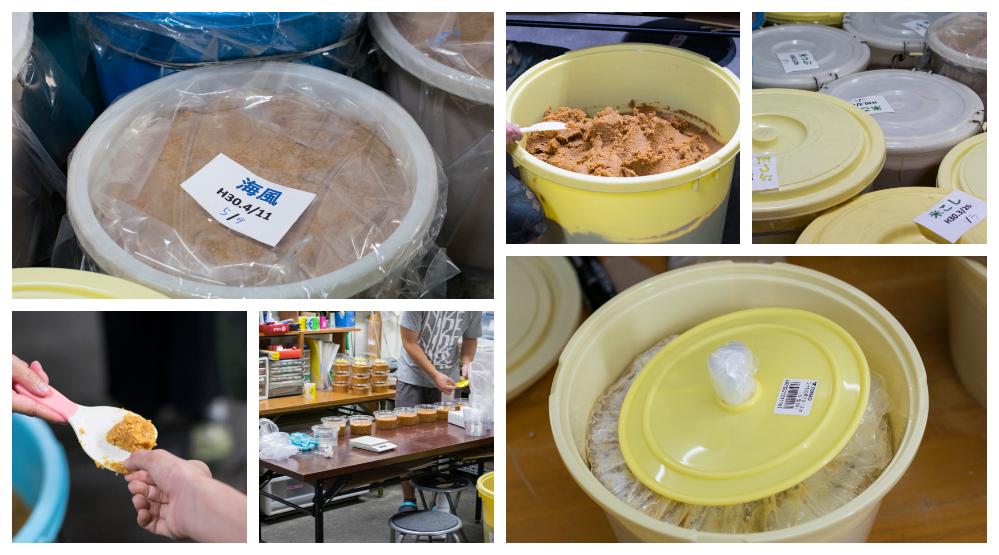
A six-photo collage from a miso workshop in Japan, built around big buckets of fermenting soybean paste. The largest frame shows an open white bucket packed with dense brown miso, its surface sealed under plastic wrap and marked with a handwritten Japanese label carrying a date. Next to it, rows of white and yellow lidded tubs hold other batches, one labeled in Japanese as rice koji. The remaining close-ups stay tight on the paste: a yellow bucket filled with smooth, caramel-colored miso with a small spoon resting in it, and a large yellow tub with its lid pushed aside to reveal plastic-wrapped miso inside. Two frames bring people in. One shows a hand offering a scoop of miso on a white spatula with a pink handle, held out over a blue bucket for a taste. In the other, a man in a gray t-shirt stands at a long table portioning miso into neat rows of small plastic containers, with shelves and a whiteboard behind him.
A six-photo collage from a miso workshop in Japan, built around big buckets of fermenting soybean paste. The largest frame shows an open white bucket packed with dense brown miso, its surface sealed under plastic wrap and marked with a handwritten Japanese label carrying a date. Next to it, rows of white and yellow lidded tubs hold other batches, one labeled in Japanese as rice koji. The remaining close-ups stay tight on the paste: a yellow bucket filled with smooth, caramel-colored miso with a small spoon resting in it, and a large yellow tub with its lid pushed aside to reveal plastic-wrapped miso inside.
Two frames bring people in. One shows a hand offering a scoop of miso on a white spatula with a pink handle, held out over a blue bucket for a taste. In the other, a man in a gray t-shirt stands at a long table portioning miso into neat rows of small plastic containers, with shelves and a whiteboard behind him.
圖片中的可見文字
海風
H30.4.11
納豆
納豆(natto)是將煮熟的大豆以納豆菌發酵而成。黏稠的絲、強烈的香氣與鹹鮮風味起初可能讓人意外,但對許多人來說,它是熟悉的早餐夥伴,常放在熱騰騰的白飯上,搭配芥末、醬油與青蔥。如果你好奇,我的納豆文章提供了一個實際的初次嘗試方式,而不假設每個人都會立刻愛上它。

The image shows a Japanese home-cooked meal arranged on a table covered with a white tablecloth featuring a light orange/beige plaid (checkered) pattern. The photo is taken from above at a slight angle, and several dishes partially enter the frame, suggesting a shared family-style meal. Main subject (center): A round ceramic bowl, cream-colored with irregular green brushstroke bands around the rim and inner wall, filled with what appears to be natto (fermented soybeans). The beans are glossy, amber-brown, and sticky-looking, mixed with plenty of chopped green onion and a light brown seasoning sauce. A spoon or small spatula with a bright pink handle and a flat metal end rests in the bowl, angled toward the upper right. Some sauce smears are visible on the inner sides of the bowl. Surrounding dishes: Upper right: A white bowl containing a simmered dish (likely nimono), with chunky pieces of potato, orange carrot slices, and what appears to be meat, all in a glossy brown broth. Upper left: A small plate with a traditional blue-and-white floral arabesque-style pattern, on which a pair of chopsticks rests. The chopstick tops are decorated with blue and white designs. Left of center: A small white plate with concentric brown rings near its rim, mostly empty, with a few small food crumbs on it. Bottom right corner: A partially visible plate, white with a yellow floral motif near the edge, holding pale sliced pieces that could be potato, sausage, or a similar ingredient (not clearly identifiable). Lighting and atmosphere: The scene is lit with warm indoor lighting, giving the food a homey, casual appearance. No people, text, or brand names are visible. The overall impression is of a typical Japanese weekday dinner, with the seasoned natto bowl as the focal point of the photograph.
The image shows a Japanese home-cooked meal arranged on a table covered with a white tablecloth featuring a light orange/beige plaid (checkered) pattern. The photo is taken from above at a slight angle, and several dishes partially enter the frame, suggesting a shared family-style meal.
Main subject (center): A round ceramic bowl, cream-colored with irregular green brushstroke bands around the rim and inner wall, filled with what appears to be natto (fermented soybeans). The beans are glossy, amber-brown, and sticky-looking, mixed with plenty of chopped green onion and a light brown seasoning sauce. A spoon or small spatula with a bright pink handle and a flat metal end rests in the bowl, angled toward the upper right. Some sauce smears are visible on the inner sides of the bowl.
Surrounding dishes:
- Upper right: A white bowl containing a simmered dish (likely nimono), with chunky pieces of potato, orange carrot slices, and what appears to be meat, all in a glossy brown broth.
- Upper left: A small plate with a traditional blue-and-white floral arabesque-style pattern, on which a pair of chopsticks rests. The chopstick tops are decorated with blue and white designs.
- Left of center: A small white plate with concentric brown rings near its rim, mostly empty, with a few small food crumbs on it.
- Bottom right corner: A partially visible plate, white with a yellow floral motif near the edge, holding pale sliced pieces that could be potato, sausage, or a similar ingredient (not clearly identifiable).
Lighting and atmosphere: The scene is lit with warm indoor lighting, giving the food a homey, casual appearance. No people, text, or brand names are visible. The overall impression is of a typical Japanese weekday dinner, with the seasoned natto bowl as the focal point of the photograph.
圖片中的可見文字
No visible text found in the image.

The image shows retail packages of what appears to be a Japanese natto (fermented soybean) making kit, displayed for sale in a shallow round basket made of woven bamboo. The photo is taken from above at a slight angle, showing about eight to ten identical clear plastic bags arranged loosely in the tray. The packages Each bag contains two long bundles of dried rice straw bound with thin purple bands, and beside them a column of small, round, light-tan soybeans is visible through the plastic. The straw-and-beans arrangement suggests the straw serves as the traditional fermenting medium, consistent with a homemade natto kit rather than ready-to-eat natto. Labeling (visible Japanese text) A large pink circular sticker with a dotted pattern sits on the front of each package, with prominent white characters reading "納笑豆", a wordplay combining 納豆 (natto) with 笑 (smile/laugh). Around the circle, smaller text reads 手作りキット (handmade kit), 信州産大豆から (from Shinshu-grown soybeans), and 発酵おうち時間 (fermenting at home / at-home fermentation time). A small cream-colored vertical tag on the bags reads 信州産 ナカカセンナリ, apparently identifying the soybean variety (Nakakasennari) and its Shinshu (Nagano) origin. Each bag also carries a small white sticker shaped like a map outline; text on it appears to include 長野県 (Nagano Prefecture), suggesting the map depicts Nagano. One package shows partially visible vertical bullet-point text (including fragments such as 天然の..., 糸引き..., 味..., 市販...), likely describing product features, and a line near the bottom reads 美しい納豆の作り方はこちら ("for how to make beautiful natto, see here"), pointing to instructions. Setting and composition The basket sits on a surface covered with green artificial turf-like material, and a light wooden frame or box edge is visible in the background at the top. Bright indoor lighting creates strong white reflections on the crinkled plastic wrap. The pink circular labels are the most visually striking element, standing out against the natural beige tones of the straw, soybeans, and bamboo basket. Overall, the image conveys a specialty or regional food product: a do-it-yourself natto fermentation kit made with Shinshu (Nagano-grown) soybeans and rice straw, presented as an attractive artisanal item. This aligns with the stated context of a blog about Japanese fermentation culture, though that context is not itself printed in the image.
The image shows retail packages of what appears to be a Japanese natto (fermented soybean) making kit, displayed for sale in a shallow round basket made of woven bamboo. The photo is taken from above at a slight angle, showing about eight to ten identical clear plastic bags arranged loosely in the tray.
The packages
Each bag contains two long bundles of dried rice straw bound with thin purple bands, and beside them a column of small, round, light-tan soybeans is visible through the plastic. The straw-and-beans arrangement suggests the straw serves as the traditional fermenting medium, consistent with a homemade natto kit rather than ready-to-eat natto.
Labeling (visible Japanese text)
- A large pink circular sticker with a dotted pattern sits on the front of each package, with prominent white characters reading "納笑豆", a wordplay combining 納豆 (natto) with 笑 (smile/laugh).
- Around the circle, smaller text reads 手作りキット (handmade kit), 信州産大豆から (from Shinshu-grown soybeans), and 発酵おうち時間 (fermenting at home / at-home fermentation time).
- A small cream-colored vertical tag on the bags reads 信州産 ナカカセンナリ, apparently identifying the soybean variety (Nakakasennari) and its Shinshu (Nagano) origin.
- Each bag also carries a small white sticker shaped like a map outline; text on it appears to include 長野県 (Nagano Prefecture), suggesting the map depicts Nagano.
- One package shows partially visible vertical bullet-point text (including fragments such as 天然の..., 糸引き..., 味..., 市販...), likely describing product features, and a line near the bottom reads 美しい納豆の作り方はこちら ("for how to make beautiful natto, see here"), pointing to instructions.
Setting and composition
The basket sits on a surface covered with green artificial turf-like material, and a light wooden frame or box edge is visible in the background at the top. Bright indoor lighting creates strong white reflections on the crinkled plastic wrap. The pink circular labels are the most visually striking element, standing out against the natural beige tones of the straw, soybeans, and bamboo basket.
Overall, the image conveys a specialty or regional food product: a do-it-yourself natto fermentation kit made with Shinshu (Nagano-grown) soybeans and rice straw, presented as an attractive artisanal item. This aligns with the stated context of a blog about Japanese fermentation culture, though that context is not itself printed in the image.
圖片中的可見文字
**中央のパッケージ(本体ラベル):**
納笑つと豆
「手作りキット」
信州産
稲わら
発酵おうち時間
(わらに付けられた札:)
信州産
ナカセンナリ
**パッケージ裏面のグレー部分(一部見えているテキスト):**
天然の
●糸引
●味 [unreadable]
ロの [uncertain: 口の]
市販
ご [unreadable]
○ [unreadable]
○ [unreadable]
○ [unreadable]
○ [unreadable]
**パッケージ下部のテキスト:**
笑つと納豆の作り方はこちら
**地図ステッカー(長野県の形):**
長野県
信州 [uncertain]
**左側のパッケージ(一部見えている部分):**
納 [unreadable]
発酵お [uncertain: 発酵おうち時間]
[unreadable]ち [uncertain]
時 [uncertain]
(わらに付けられた札:)
信州産
ナカセンナリ
**右上のパッケージ(一部見えているラベル):**
納笑
つと [uncertain]
[unreadable]
漬物與澤庵
漬物涵蓋了日本漬物的廣闊世界。它們為米飯、烤魚或套餐增添對比:鹹味、脆度、酸度、色彩,以及在味覺之間重置。澤庵(takuan)是你常在壽司或米飯旁看到的鮮黃色醃蘿蔔。它屬於更大的漬物家族,但因為夠常見,值得擁有自己的澤庵指南。
梅乾
梅乾(umeboshi)是以鹽醃漬的梅子果實,極度酸鹹,常塞入飯糰或搭配米飯。它的紅色通常來自紫蘇。它是少數能快速展現日本發酵與保存如何在小小一份中具有強大力量的食品。關於保存、風味與實際食用方式,請見我的梅乾文章。
清酒、醬油、味醂與其他日常調味料
當它不明顯出現在盤中時,發酵也存在。清酒(日本酒)使用米、水、酵母與麴;醬油(shoyu)與味醂(mirin)則為烹調帶來鹹味、甜味、香氣與鮮味。清酒是酒精,不是健康食品,所以我把它當作需要負責任享用的東西。如果你想了解更完整的故事,可以從我的清酒指南與味醂指南開始。
鹽辛
鹽辛(shiokara)是同一保存傳統中一個刻意具有挑戰性的例子:海鮮,通常包含以鹽醃漬發酵的內臟,香氣強烈,鹹鮮味集中。通常與米飯一起少量食用,或作為下酒菜。你不必愛上它,也能理解它為何屬於日本發酵更大故事的一部分。[10]
芋燒酎
芋燒酎(imojōchū)是以地瓜蒸餾而成的烈酒,通常在生產過程中使用麴。它不是清酒,它更強烈、更具大地風味的性格,讓你在酒單上同時看到兩者時值得記住這個區別。與清酒一樣,請為了風味與文化享受它,而不是作為健康產品。
在日常生活中嘗試日本發酵
從小事開始,選擇一個合理的脈絡。點一份附味噌湯與漬物的套餐,早餐試一小份納豆配白飯,或買兩包不同的味噌,用同樣簡單的出汁湯底比較。與其背誦術語,你會從這種並排品嚐中學到更多。
一間好的日本超市是最容易開始的地方之一。比較冷藏區的味噌,拿一小盒納豆,看看漬物的標籤。如果你特別對未加熱味噌感興趣,請尋找「生」(nama)字樣,然後閱讀保存說明,而不是只靠一個字。冷藏產品、較短的保存期限,以及關於持續熟成的註記,都是有用的線索。
如果你偏好有脈絡的品嚐,拜訪生產者會讓差異清晰許多。在東京與近郊,我的東京味噌之旅可以依實際情況包含專賣店、對比味噌風格、味噌料理或工作坊。埼玉醬油之旅則從另一個角度追隨同樣的理念:麴、鹽、大豆、小麥與時間如何成為你每天使用的調味料。如果你正在控制鈉攝取、有過敏、懷孕相關飲食建議或服藥中,請閱讀標籤並遵循合格醫療專業人士的建議。
最好的起點,是那個你真的會經常享受的起點。日本的發酵不只是找到最強烈的納豆或最稀有的味噌,而是注意一小匙醬、一小口漬物或一滴醬油如何改變一頓平凡的餐。你最喜歡的日本發酵食品是什麼? 在留言中告訴我。
資料來源:
- 農林水產省:日本發酵的世界(日文): https://www.maff.go.jp/j/pr/aff/2211/spe1_01.html...
- MAFF關於發酵、健康與個體差異的訪談(日文): https://www.maff.go.jp/j/pr/aff/2211/spe1_01.html...
- MAFF味噌與醬油原料指南(日文): https://www.maff.go.jp/j/keikaku/syokubunka/tradit...
- MAFF日本傳統飲品簡介: https://www.maff.go.jp/e/policies/market/dento_syo...
- 《國家報》談麴在當代國際烹調中的應用(西班牙文): https://elpais.com/gastronomia/2025-07-22/el-koji-...
- MAFF發酵米糠漬指南(日文): https://www.maff.go.jp/j/heya/kodomo_sodan/0102/04...
- MAFF漬物傳統食品指南(日文): https://www.maff.go.jp/j/keikaku/syokubunka/tradit...
- JA Asakano投幣式精米機公告(日文): https://www.ja-asakano.or.jp/archives/2794...
- Sano Miso工作坊資訊(日文): https://sanomiso.com/workshop/...
- MAFF日本發酵食品簡介(PDF,英文): https://www.maff.go.jp/j/keikaku/syokubunka/tradit...
評論
您好,請問在法國的亞洲雜貨店可以找到麴菌(KOJI)嗎?謝謝。
Hello Marie, 我對法國的亞洲雜貨店不太熟悉,所以沒辦法回答你的問題。 此致 Ryusei