Mục lục:
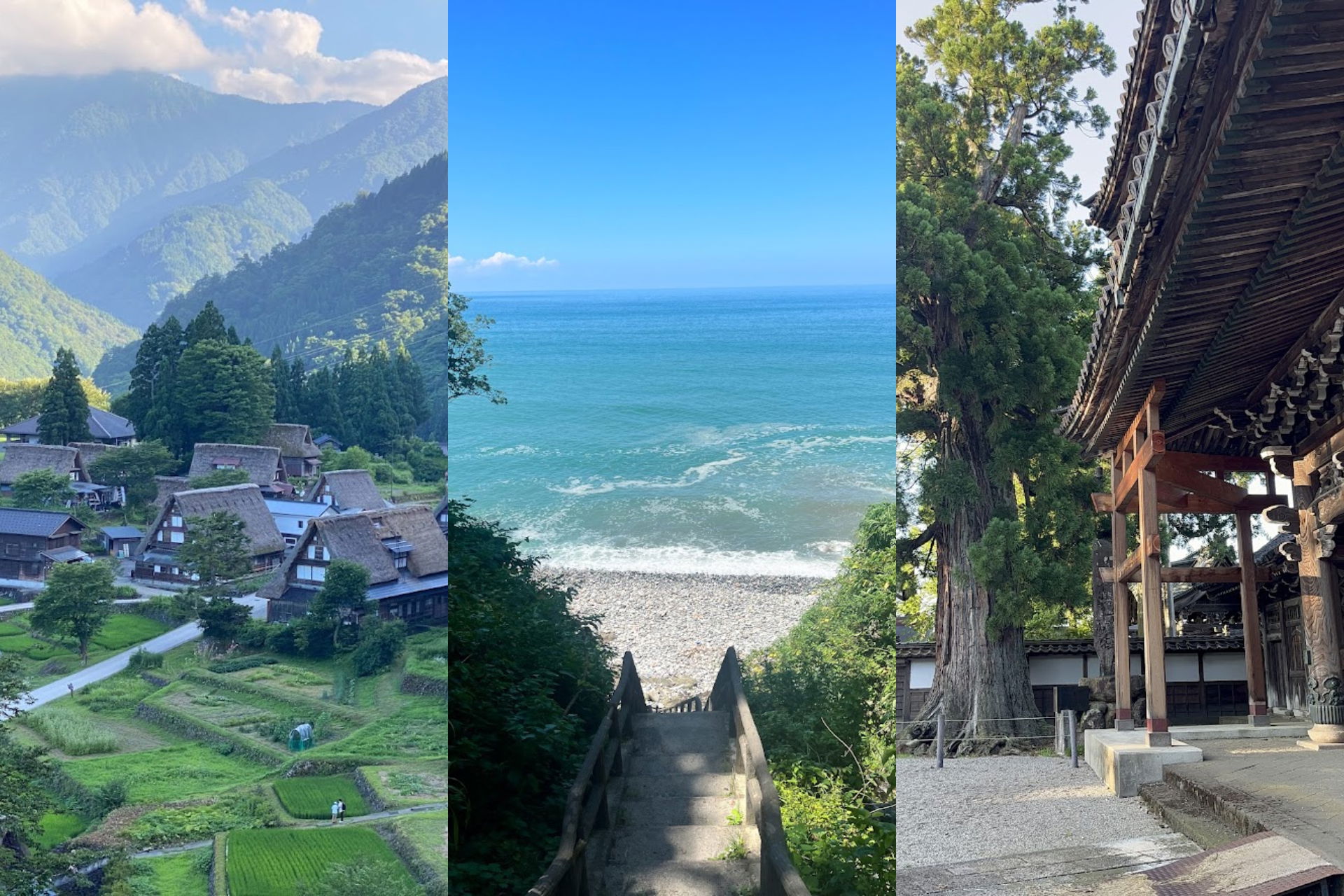
Trong bài viết này về tỉnh Toyama, tôi sẽ chia sẻ với bạn rất nhiều mẹo và thông tin về cách di chuyển đến đó, chỗ ở cũng như các hoạt động thú vị tại nơi đây. Toyama là một điểm đến du lịch không thể so sánh với khung cảnh ngoạn mục, những bãi biển sỏi độc đáo, các làng cổ lịch sử và thiên nhiên tươi đẹp trong mọi mùa.
Từ Tokyo đến Toyama
Bằng ô tô
Có nhiều cách để đến Toyama. Lựa chọn tốt nhất chắc chắn là đi bằng ô tô. Bạn có thể thuê xe từ nhiều công ty cho thuê xe hơi ở Tokyo. Ngoài ra còn có các lựa chọn khác như tàu cao tốc ( Shinkansen[/link] ), nhưng phương án này không được khuyến khích bằng ô tô vì bạn sẽ kém linh hoạt hơn tại nơi đây. Nếu chọn lái xe, hành trình mất khoảng 5 tiếng rưỡi. Trong suốt chuyến đi, bạn có thể tận hưởng khung cảnh đẹp mắt và dừng chân tại nhiều điểm nghỉ ngơi khác nhau để thư giãn. Phí cầu đường phát sinh trong suốt hành trình, nhưng bạn có thể tìm hiểu trước về chi phí. Ví dụ, bạn có thể dùng Google Maps để ước tính phí cầu đường.
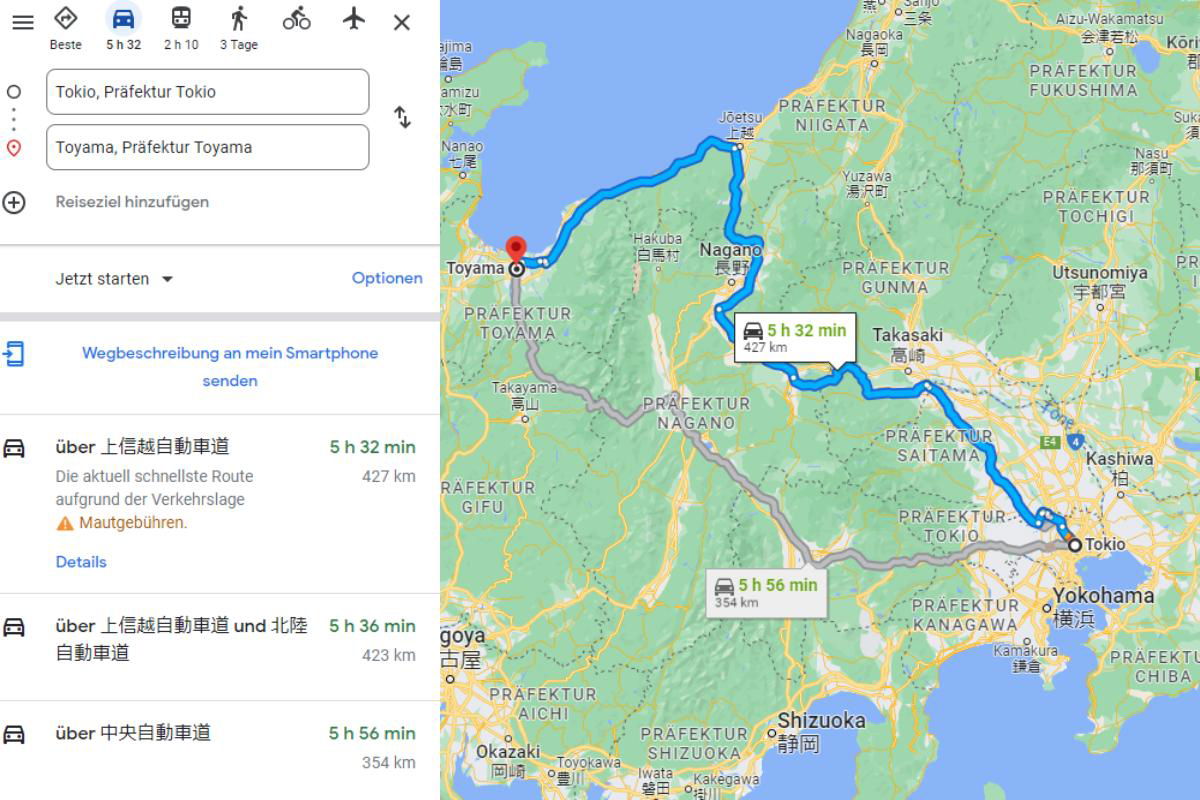
A Google Maps route screenshot in German shows a driving route from Tokio to Toyama. The left panel lists the starting point and destination input fields, plus three route options with travel times and distances: the fastest route via the Jōshin-etsu Expressway takes 5 hours 32 minutes and covers 427 km, with a note about toll charges. Two alternatives come in at 5 h 36 min and 5 h 56 min. The map itself covers central Japan, with the highlighted blue route winding north from Tokio through Gunma and Nagano before reaching Toyama on the coast. A second, shorter route (354 km, 5 h 56 min) is shown in gray along a more southern path. Prefecture labels like Nagano, Gunma, and Niigata are visible, and mode-of-travel icons at the top show the car option selected alongside train, walking, cycling, and flight.
A Google Maps route screenshot in German shows a driving route from Tokio to Toyama. The left panel lists the starting point and destination input fields, plus three route options with travel times and distances: the fastest route via the Jōshin-etsu Expressway takes 5 hours 32 minutes and covers 427 km, with a note about toll charges. Two alternatives come in at 5 h 36 min and 5 h 56 min.
The map itself covers central Japan, with the highlighted blue route winding north from Tokio through Gunma and Nagano before reaching Toyama on the coast. A second, shorter route (354 km, 5 h 56 min) is shown in gray along a more southern path. Prefecture labels like Nagano, Gunma, and Niigata are visible, and mode-of-travel icons at the top show the car option selected alongside train, walking, cycling, and flight.
Văn bản nhìn thấy trong hình
Beste
5 h 32
2 h 10
3 Tage
Tokio, Präfektur Tokio
Toyama, Präfektur Toyama
Reiseziel hinzufügen
Jetzt starten
Optionen
Wegbeschreibung an mein Smartphone senden
über 上信越自動車道
5 h 32 min
427 km
Die aktuell schnellste Route aufgrund der Verkehrslage
Mautgebühren.
Details
über 上信越自動車道 und 北陸自動車道
5 h 36 min
423 km
über 中央自動車道
5 h 56 min
354 km
Aizu-Wakamatsu
会津若松
Kōr
PRAFEKTUR FUKUSHIMA
Nagaoka
長岡
Sanj
PRAFEKTUR NIIGATA
Jōetsu
上越
Nanao
七尾
Yuzawa
湯沢町
Nasu
PRAFEKTUR TOCHIGI
Hakuba
白馬村
Nagano
長野
Toyama
PRAFEKTUR TOYAMA
Utsunomiya
宇都宮
PRAFEKTUR GUNMA
Takasaki
高崎
5 h 32 min
427 km
Takayama
高山
PRAFEKTUR NAGANO
PRAFEKTUR SAITAMA
Kashiwa
柏
PRAFEKTUR TOKIO
Tokio
RAFEKTUR GIFU
5 h 56 min
354 km
goya
古屋
Yokohama
横浜
PRAFEKTUR KANAGAWA
Kamakura
鎌倉
PRAFEKTU
CHIBA
Shizuoka
静岡
PRAFEKTUR AICHI
Okazaki
岡崎
Toyokawa
豊川
PRAFEKTUR SHIZUOKA
Iwata
磐田
Kakegawa
掛川
Bằng tàu hỏa
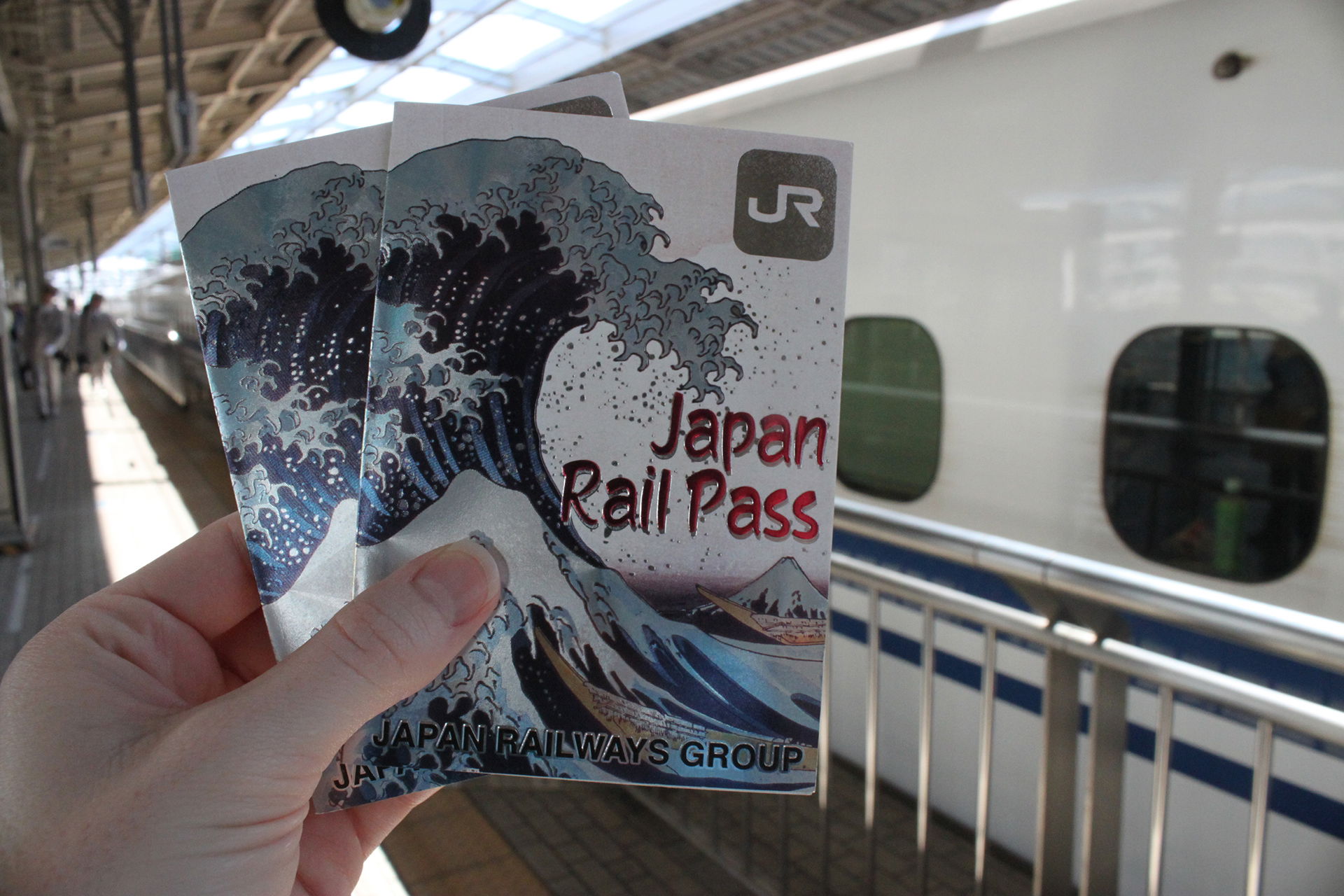
Về cơ bản, bạn có thể di chuyển đến Toyama bằng tàu cao tốc, Shinkansen[/link] . Thời gian di chuyển khoảng 2 tiếng rưỡi, nhanh hơn đáng kể so với đi ô tô. Chi phí khoảng 12.750 Yên mỗi lượt đi theo Google Maps. Ngoài ra, với tư cách là khách du lịch, bạn có thể sử dụng Japan Rail Pass . Tuy nhiên, Shinkansen chỉ chạy thẳng đến thành phố Toyama. Vì vậy, nếu muốn khám phá toàn bộ tỉnh Toyama, bạn nhất định cần một chiếc xe tại nơi đây vì giao thông công cộng gần như không có. Xe ô tô cuối cùng không chỉ mang lại sự linh hoạt hơn mà còn cho phép bạn khám phá trọn vẹn tỉnh này và tận hưởng những cảnh quan thơ mộng của vùng đất.
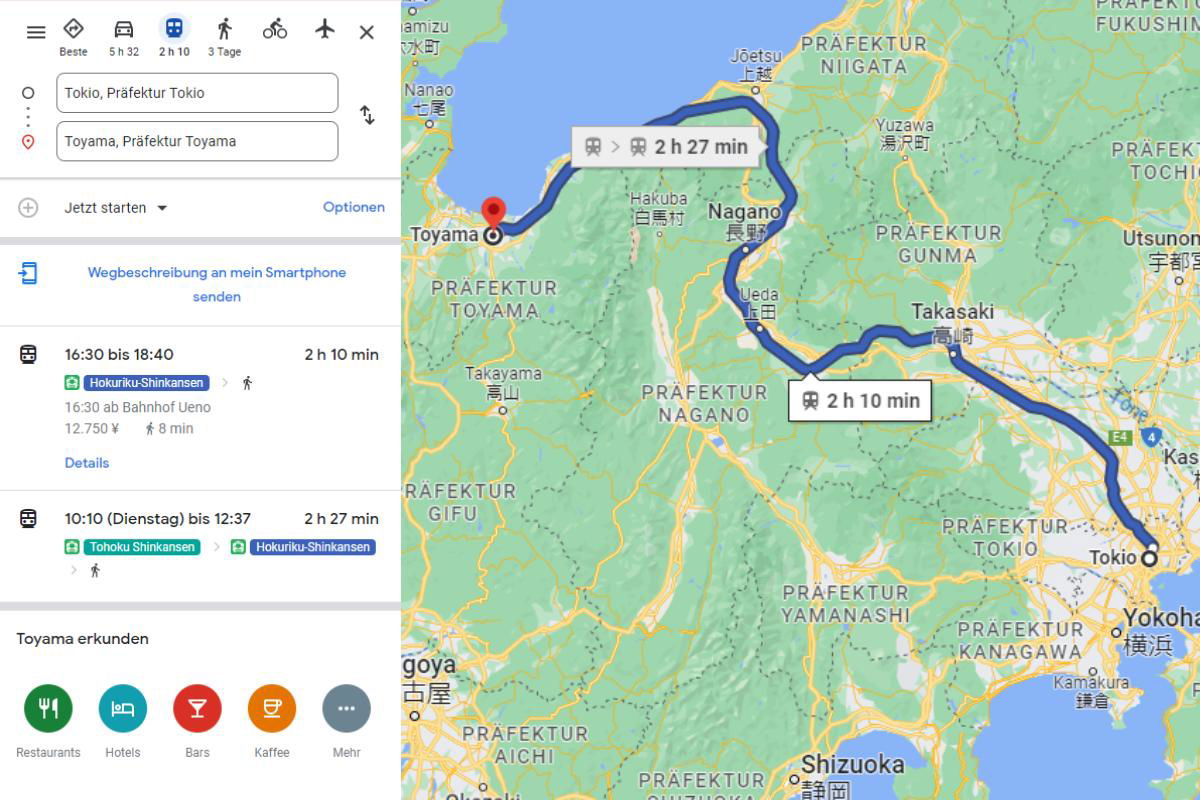
This is a Google Maps screenshot, set to German, showing train directions from Tokio to Toyama. A blue route line traces the path across central Japan, running from Tokyo northwest through Takasaki and Ueda to Nagano, then north past Jōetsu before ending at a red pin in Toyama on the coast. White badges on the map mark travel times of 2 h 27 min and 2 h 10 min, and prefecture labels such as Präfektur Nagano, Präfektur Toyama, and Präfektur Gunma cover the green terrain. The left sidebar lists the two route options. The faster one runs from 16:30 to 18:40, takes 2 h 10 min on the Hokuriku-Shinkansen departing from Bahnhof Ueno, costs 12.750 ¥, and includes an 8-minute walk. The second leaves at 10:10 on Tuesday and arrives at 12:37, taking 2 h 27 min with a transfer from the Tohoku-Shinkansen to the Hokuriku-Shinkansen. Above the routes are mode selectors with driving at 5 h 32 and transit at 2 h 10, the address fields for origin and destination, and a link to send the directions to a smartphone. At the bottom, a "Toyama erkunden" section offers category buttons for Restaurants, Hotels, Bars, Kaffee, and Mehr.
This is a Google Maps screenshot, set to German, showing train directions from Tokio to Toyama. A blue route line traces the path across central Japan, running from Tokyo northwest through Takasaki and Ueda to Nagano, then north past Jōetsu before ending at a red pin in Toyama on the coast. White badges on the map mark travel times of 2 h 27 min and 2 h 10 min, and prefecture labels such as Präfektur Nagano, Präfektur Toyama, and Präfektur Gunma cover the green terrain.
The left sidebar lists the two route options. The faster one runs from 16:30 to 18:40, takes 2 h 10 min on the Hokuriku-Shinkansen departing from Bahnhof Ueno, costs 12.750 ¥, and includes an 8-minute walk. The second leaves at 10:10 on Tuesday and arrives at 12:37, taking 2 h 27 min with a transfer from the Tohoku-Shinkansen to the Hokuriku-Shinkansen. Above the routes are mode selectors with driving at 5 h 32 and transit at 2 h 10, the address fields for origin and destination, and a link to send the directions to a smartphone. At the bottom, a "Toyama erkunden" section offers category buttons for Restaurants, Hotels, Bars, Kaffee, and Mehr.
Văn bản nhìn thấy trong hình
Beste
5 h 32
2 h 10
3 Tage
Tokio, Präfektur Tokio
Toyama, Präfektur Toyama
Jetzt starten
Optionen
Wegbeschreibung an mein Smartphone
senden
16:30 bis 18:40 2 h 10 min
Hokuriku-Shinkansen
16:30 ab Bahnhof Ueno
12.750 ¥ 8 min
Details
10:10 (Dienstag) bis 12:37 2 h 27 min
Tohoku Shinkansen
Hokuriku-Shinkansen
Toyama erkunden
Restaurants
Hotels
Bars
Kaffee
Mehr
PRÄFEKTUR FUKUSHIM
水町
PRÄFEKTUR NIIGATA
Jōetsu
上越
Nanao
七尾
Yuzawa
湯沢町
2 h 27 min
PRÄFEKT
TOCHI
Hakuba
白馬村
Nagano
長野
Toyama
Utsunom
宇都
PRÄFEKTUR TOYAMA
PRÄFEKTUR GUNMA
Ueda
上田
Takasaki
高崎
2 h 10 min
E4
4
Kas
Takayama
高山
PRÄFEKTUR NAGANO
RÄFEKTUR
GIFU
PRÄFEKTUR TOKIO
Tokio
PRÄFEKTUR YAMANASHI
goya
古屋
PRÄFEKTUR AICHI
Oki
PRÄFEKTUR KANAGAWA
Yokoha
横浜
Kamakura
鎌倉
Shizuoka
静岡
PRÄFEKTUR
SHIZUOKA
Chỗ ở của chúng tôi: APA Hotel Takaoka Ekimae
Chúng tôi chọn lưu trú ở Takaoka vì vị trí thuận tiện và chi phí chỗ ở tương đối rẻ. Ở đây chúng tôi ngủ tại APA Hotel Takaoka Ekimae * và trả khoảng 7.000 Yên mỗi đêm cho hai người (chi phí theo Google Maps). Đây là khách sạn 3 sao tọa lạc ngay tại ga Takaoka. Chuỗi khách sạn này luôn mang tiêu chuẩn đồng nhất và chúng tôi có thể giới thiệu nó cho bất kỳ ai đang tìm kiếm chỗ ở thoải mái với giá cả phải chăng.
Google Maps: https://goo.gl/maps/pPg5kNtkN3yHaM7M9
Booking.com: Takaoka Eki APA Hotel
*Liên kết tiếp thị liên kết
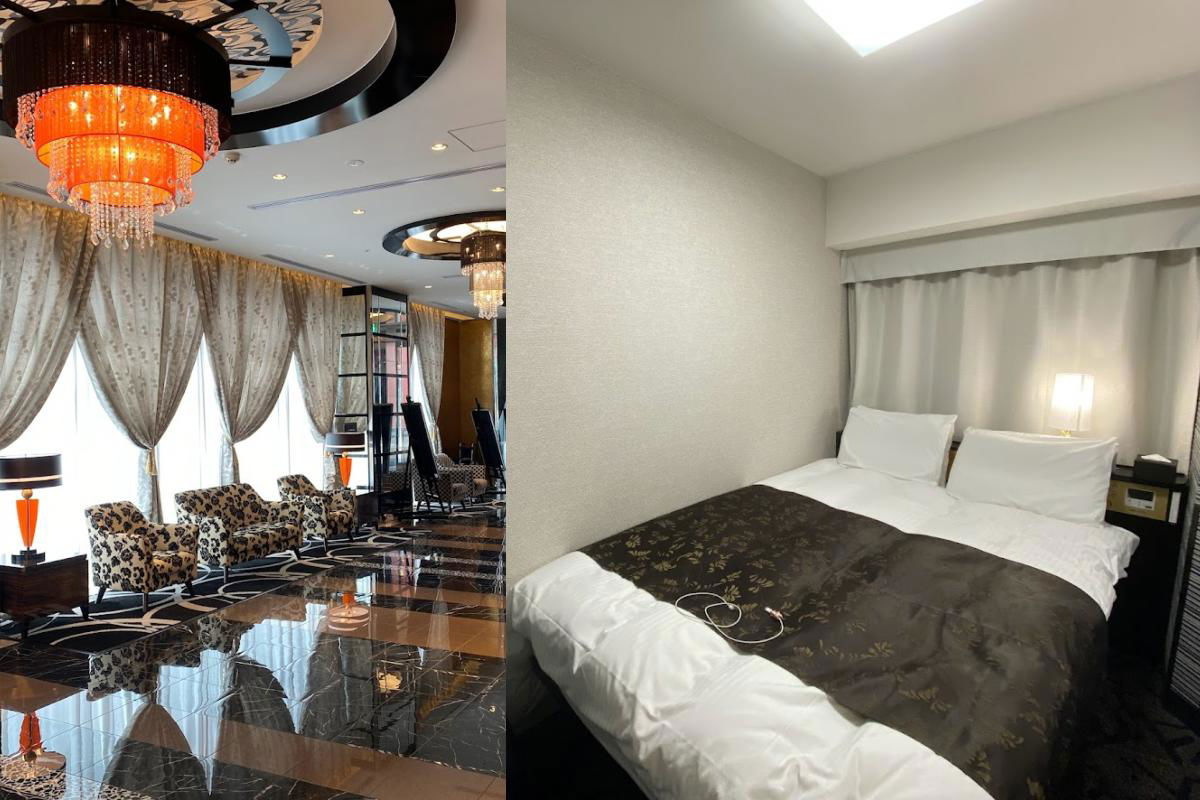
A side-by-side look at a Japanese business hotel. On the left, the lobby goes for glamour: a large chandelier with glowing orange shades and hanging crystals, mirrored circular ceiling panels, floor-to-ceiling patterned curtains, and leopard-print armchairs arranged on a highly polished black and beige marble floor that reflects everything above it. On the right, a guest room is far simpler, with a double bed dressed in white linens and a dark brown throw with a gold leaf pattern, pillows propped against a white curtain that runs behind the headboard, and a small lit lamp on the nightstand beside it. The pairing captures the hotel's split personality: a showy entrance area and a plain, functional room, in this case the APA Hotel Takaoka Ekimae in Toyama.
A side-by-side look at a Japanese business hotel. On the left, the lobby goes for glamour: a large chandelier with glowing orange shades and hanging crystals, mirrored circular ceiling panels, floor-to-ceiling patterned curtains, and leopard-print armchairs arranged on a highly polished black and beige marble floor that reflects everything above it. On the right, a guest room is far simpler, with a double bed dressed in white linens and a dark brown throw with a gold leaf pattern, pillows propped against a white curtain that runs behind the headboard, and a small lit lamp on the nightstand beside it. The pairing captures the hotel's split personality: a showy entrance area and a plain, functional room, in this case the APA Hotel Takaoka Ekimae in Toyama.
Văn bản nhìn thấy trong hình
No text is clearly readable in the image.
Ngôi làng lịch sử Gokayama
Ở tỉnh Toyama có ngôi làng Gokayama thơ mộng, nổi tiếng với ý nghĩa lịch sử của mình. Nó nằm ở một vùng núi hẻo lánh và sở hữu nhiều ngôi nhà nông nghiệp truyền thống được xây dựng theo phong cách kiến trúc Gasshō độc đáo. Phong cách đặc biệt này ăn sâu vào văn hóa địa phương và là điểm thu hút lớn đối với du khách đến vùng này mỗi năm. Gokayama có sức quyến rũ riêng trong mọi mùa: vào xuân và hạ, bạn bị mê hoặc bởi cảnh quan xanh mướt, còn mùa thu mang đến một bức tranh lá cây đầy màu sắc. Những tháng mùa đông bao phủ ngôi làng trong khung cảnh tuyết như truyện cổ tích toát lên một sức hút khó cưỡng. Đáng chú ý, trải nghiệm ấn tượng này hoàn toàn miễn phí tham quan.
Khi đến đó, chúng tôi lấy lại sức với Udon , được chế biến từ nguyên liệu địa phương như đậu phụ, nấm và nhiều loại rau củ khác nhau. Một món đá bào - Kakigori - tất nhiên không thể bỏ lỡ. Món đá được phục vụ cùng Mochi và đậu đỏ.
Ở đây tôi cũng khuyên bạn nên di chuyển bằng ô tô. Có tuyến xe buýt công cộng từ Takaoka, nhưng thời gian di chuyển rất lâu.
Google Maps: https://maps.app.goo.gl/dSzJTKPkB6s74V5TA


Chùa Johanabetsuin-Zentokuji
Trên đường trở về từ làng Gokayama, chúng tôi ghé thăm chùa Zentokuji ở Nanto. Ngôi chùa Phật giáo này trên 500 năm tuổi và gây ấn tượng với kiến trúc đẹp mắt. Đặc biệt đáng chú ý là bộ phận chạm khắc gỗ được thiết kế tinh xảo của ngôi chùa, chắc chắn rất đáng để ghé thăm.
Giờ mở cửa hàng ngày: 09:00 - 17:00
Google Maps: https://goo.gl/maps/fRSv416vu2PwHzxV6
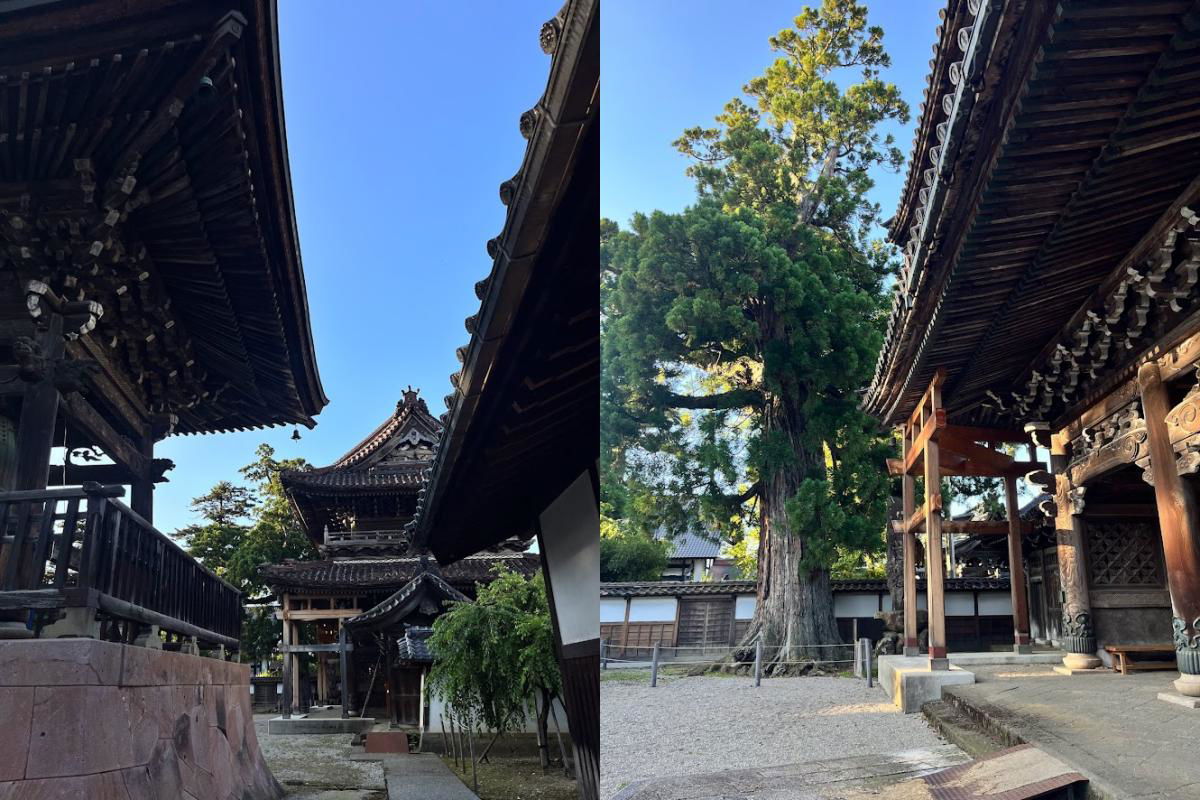
A two-photo side-by-side view of Zentokuji, a Buddhist temple in Toyama, Japan, shot on a clear sunny day. The left photo looks across the temple grounds from the edge of a wooden veranda toward the main hall, a dark timber structure with a layered tiled roof and carved details, framed by the deep eaves of adjacent buildings under a bright blue sky. The right photo shows a different angle along the temple corridor, where a massive old cedar tree towers over the grounds, its trunk thicker than anything around it and roped off near the base. Warm late-afternoon light hits the intricately carved wooden beams and pillars of the covered walkway on the right, contrasting with the deep green of the tree filling the background.
A two-photo side-by-side view of Zentokuji, a Buddhist temple in Toyama, Japan, shot on a clear sunny day. The left photo looks across the temple grounds from the edge of a wooden veranda toward the main hall, a dark timber structure with a layered tiled roof and carved details, framed by the deep eaves of adjacent buildings under a bright blue sky.
The right photo shows a different angle along the temple corridor, where a massive old cedar tree towers over the grounds, its trunk thicker than anything around it and roped off near the base. Warm late-afternoon light hits the intricately carved wooden beams and pillars of the covered walkway on the right, contrasting with the deep green of the tree filling the background.
Văn bản nhìn thấy trong hình
No clearly readable text is present in the image.
Câu cá ở Toyama
Vì tỉnh Toyama nằm ngay bên Biển Nhật Bản, đây là nơi hoàn hảo để câu cá. Có rất nhiều điểm câu mà bạn có thể khám phá và tận hưởng. Nếu đến bằng ô tô, bạn có thể mong chờ nhiều bãi đỗ xe giá rẻ hoặc thậm chí miễn phí. Về cơ bản, tôi khuyên bạn nên đến bằng ô tô vì nhiều điểm câu cá không thể tiếp cận bằng phương tiện công cộng. Ngay tại điểm câu cá của chúng tôi còn có cả những bồn ngâm chân miễn phí!
Trong chuyến câu cá, chúng tôi đã bắt được một số con cá hấp dẫn, bao gồm một con cá trắng Nhật Bản, một con cá bơn và một con bạch tuộc. Câu cá là một trải nghiệm khó quên mà chúng tôi sẽ nhớ mãi. Nhưng điều tuyệt vời nhất vẫn còn phía trước: chúng tôi tự nhiên mua một bếp gas nướng giá 2.500 Yên và biến những con cá vừa câu được thành món cá chiên. Hương vị ngon đến khó tin khiến chúng tôi càng yêu thích Toyama hơn nữa.
Để bữa tối trở nên hoàn hảo, chúng tôi mua một hộp bento từ konbini.
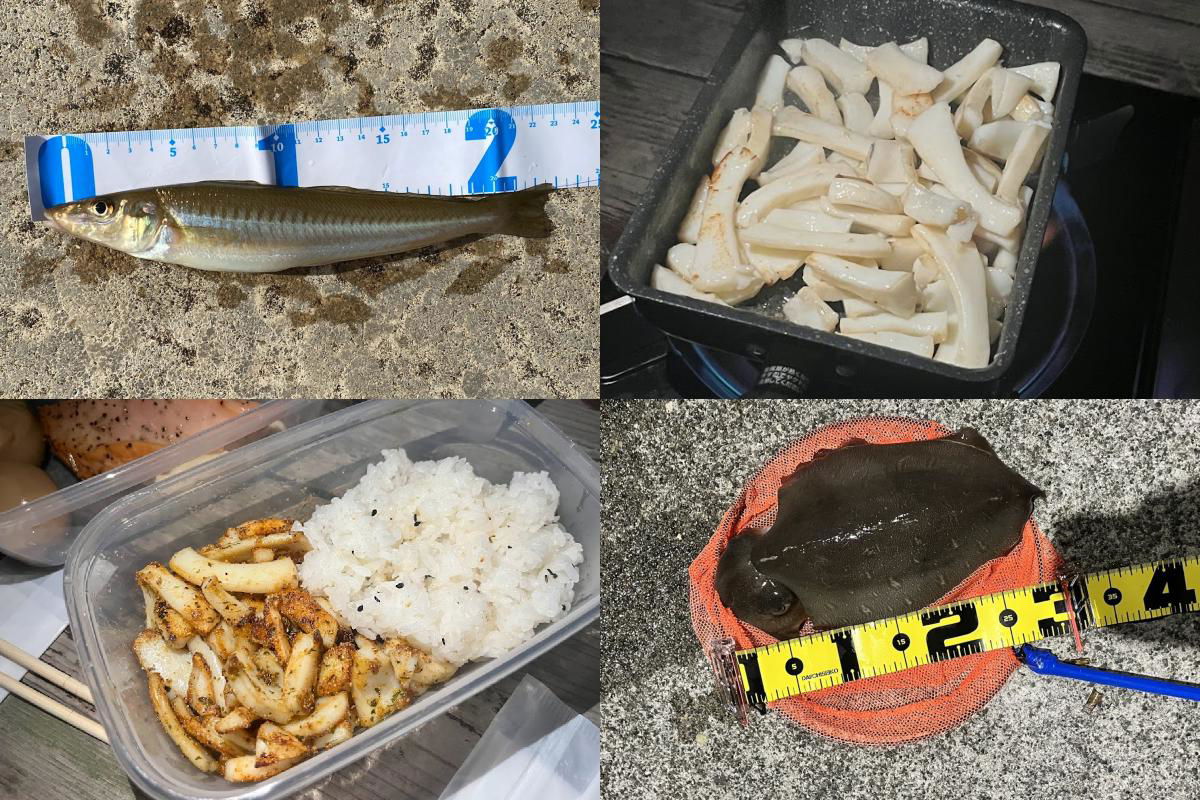
A four-photo collage from a fishing trip in Toyama, Japan. In the top left, a slender silver-green fish about 22 cm long lies on wet sand beside a white and blue measuring tape. The top right shows strips of white fish meat grilling in a black square pan on a portable gas stove. The bottom left panel shows the finished meal packed in a clear plastic container: seasoned, golden-grilled fish pieces next to a mound of white rice sprinkled with furikake. In the bottom right, a dark flatfish rests in an orange landing net on wet gravel, stretched out with a yellow measuring tape that reads roughly 36 cm.
A four-photo collage from a fishing trip in Toyama, Japan. In the top left, a slender silver-green fish about 22 cm long lies on wet sand beside a white and blue measuring tape. The top right shows strips of white fish meat grilling in a black square pan on a portable gas stove.
The bottom left panel shows the finished meal packed in a clear plastic container: seasoned, golden-grilled fish pieces next to a mound of white rice sprinkled with furikake. In the bottom right, a dark flatfish rests in an orange landing net on wet gravel, stretched out with a yellow measuring tape that reads roughly 36 cm.
Văn bản nhìn thấy trong hình
1 5 10 15 17 20 22 2
1 5 2 3 4 25 30 35 5 15
Vách đá Oyashirazu
Bờ biển hướng ra Biển Nhật Bản mang đến một khung cảnh ngoạn mục được bao quanh bởi những vách đá gồ ghề. Những vách đá này phủ xanh bởi thực vật sum suê và một cầu thang dẫn xuống bãi biển sỏi độc đáo. Điều đặc biệt của bãi biển này là những viên đá tròn được nước bào mòn tròn trịa qua nhiều năm. Khi những viên đá chuyển động dưới tác động của sóng, chúng tạo ra âm thanh "lạch cạch" độc đáo.
Sự kết hợp giữa tiếng sóng gầm thét và tiếng kêu của những viên đá tạo nên một bầu không khí êm dịu và thư thái vô cùng khó tả. Nơi đây ở Toyama là một trong những địa điểm yêu thích của tôi.
Google Maps: https://goo.gl/maps/TMf1fsvv8ukeUWQt9
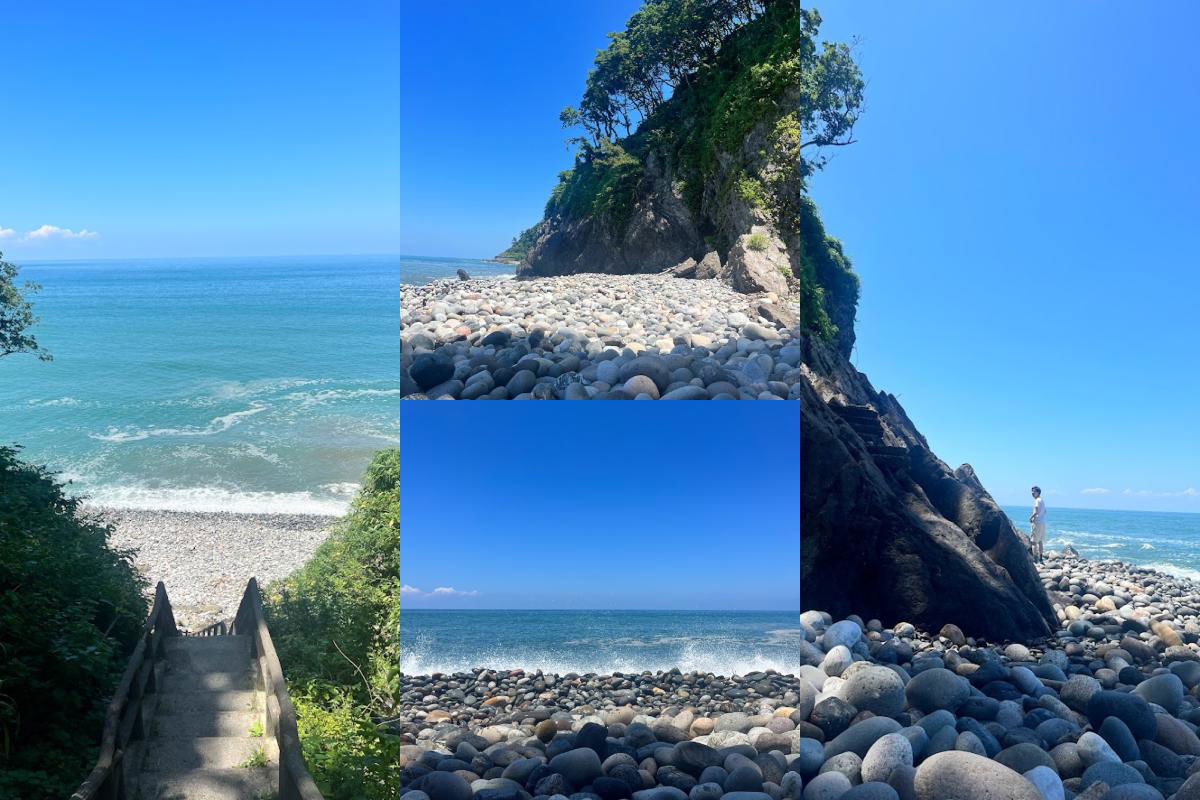
A four-photo collage of the Oyashirazu coast in Toyama Prefecture, where steep cliffs drop straight to a pebble beach on the Sea of Japan. On the left, a narrow concrete staircase with a simple handrail descends between thick green shrubs toward the shore, opening onto pale pebbles and turquoise water with small waves breaking under a clear blue sky. The top middle photo looks along the beach to a rocky cliff crowned with dense trees. Below it, waves wash up onto a shore of smooth, rounded stones in shades of grey, white, and rust. The right photo shows the cliff at close range: a dark, rugged rock face with steps carved into it, and a person in a white shirt and light shorts standing on the pebbles beneath it, facing the sea.
A four-photo collage of the Oyashirazu coast in Toyama Prefecture, where steep cliffs drop straight to a pebble beach on the Sea of Japan.
On the left, a narrow concrete staircase with a simple handrail descends between thick green shrubs toward the shore, opening onto pale pebbles and turquoise water with small waves breaking under a clear blue sky. The top middle photo looks along the beach to a rocky cliff crowned with dense trees. Below it, waves wash up onto a shore of smooth, rounded stones in shades of grey, white, and rust. The right photo shows the cliff at close range: a dark, rugged rock face with steps carved into it, and a person in a white shirt and light shorts standing on the pebbles beneath it, facing the sea.
Văn bản nhìn thấy trong hình
No clearly readable text is present in the image.
Một đặc sản từ Toyama: Masuzushi
Chúng tôi hòa mình vào khung cảnh và thưởng thức sushi tươi ngon. Người ta nói rằng cá từ Biển Nhật Bản có vị tươi ngon hơn ở nơi khác, điều mà chúng tôi có thể xác nhận. Chúng tôi đã thử sushi với trứng cá và hai loại cá hồi từ siêu thị địa phương, ngoài ra còn thử cả một đặc sản thực thụ của tỉnh Toyama.
Đó chính là Masuzushi, một loại sushi ép làm từ cá trout và cơm được ướp muối, gói trong lá tre và đóng gói trong hộp gỗ gọi là Wagemono. Với con dao tre nhỏ được cung cấp, chiếc sushi tròn được cắt thành từng miếng hình quạt.
Vị của cá trout khá chua do quá trình ướp và mang đến cho đặc sản này một nét hương vị đặc biệt. Bao bì bằng gỗ của Masuzushi không chỉ đẹp mắt mà còn tiện dụng để vận chuyển và thưởng thức trên đường đi.
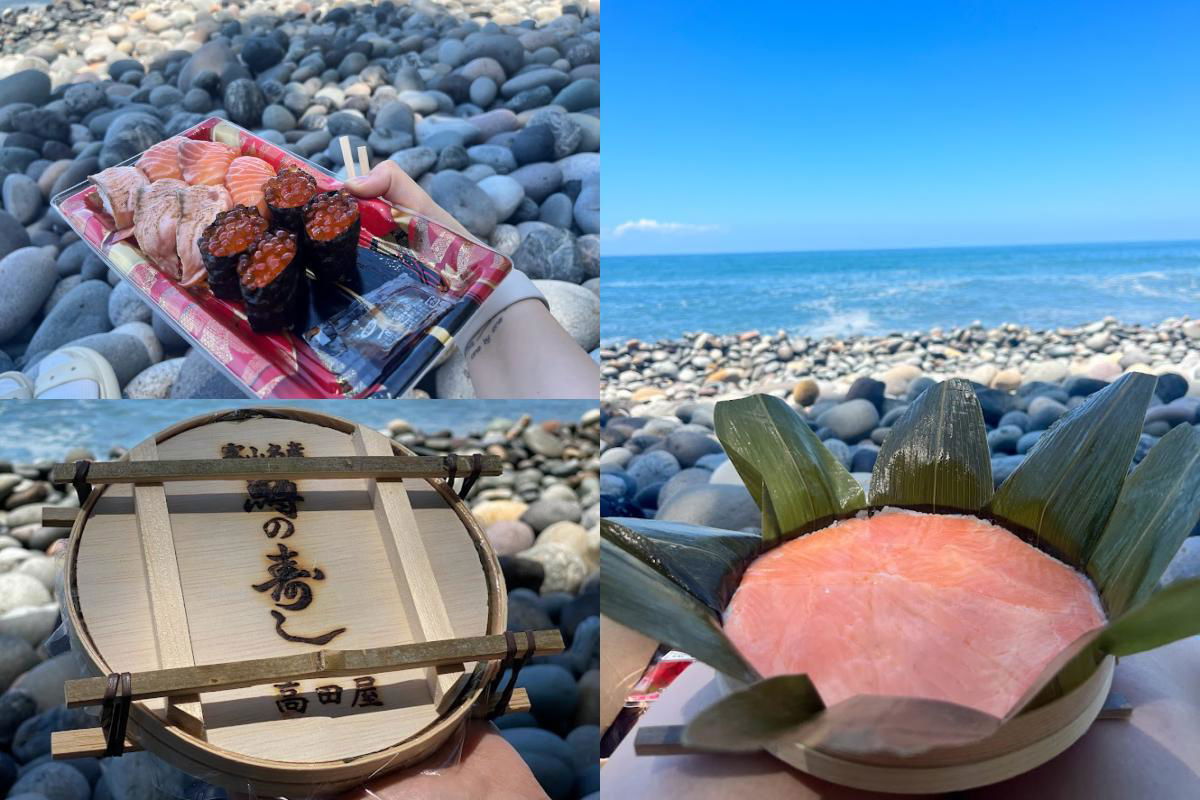
A four-photo collage of a sushi picnic on a pebble beach in Toyama. In the top left, a hand holds up a plastic takeout tray of nigiri: salmon slices, seared salmon, and ikura gunkan rolls filled with orange salmon roe. Smooth grey and white stones fill the whole background. The top right photo shows the setting itself, a deep blue sky over a choppy sea washing onto the rocky shore. The bottom two photos feature Masu no Sushi from Takadaya, a round cedar box of pressed trout sushi that is a Toyama specialty. One shot shows the wooden lid, its burned-in Japanese calligraphy naming the dish and the shop. In the other, the box is open and held above the pebbles, revealing a disc of pale pink fish pressed over rice and framed by folded bamboo leaves.
A four-photo collage of a sushi picnic on a pebble beach in Toyama. In the top left, a hand holds up a plastic takeout tray of nigiri: salmon slices, seared salmon, and ikura gunkan rolls filled with orange salmon roe. Smooth grey and white stones fill the whole background. The top right photo shows the setting itself, a deep blue sky over a choppy sea washing onto the rocky shore.
The bottom two photos feature Masu no Sushi from Takadaya, a round cedar box of pressed trout sushi that is a Toyama specialty. One shot shows the wooden lid, its burned-in Japanese calligraphy naming the dish and the shop. In the other, the box is open and held above the pebbles, revealing a disc of pale pink fish pressed over rice and framed by folded bamboo leaves.
Văn bản nhìn thấy trong hình
鮭の壽し
高田屋
Kết thúc chuyến đi Toyama
Toyama là một tỉnh xinh đẹp ở Nhật Bản, đặc biệt chinh phục những người yêu thiên nhiên và đam mê câu cá. Tuy nhiên, tôi mạnh mẽ khuyên bạn nên di chuyển bằng ô tô vì Toyama không có mạng lưới giao thông công cộng phát triển. Cảnh quan độc đáo, ngôi làng lịch sử Gokayama và cảnh quan ven biển quanh vách đá Oyashirazu là những nơi chắc chắn đáng để ghé thăm. Đây cũng là điểm đến câu cá nổi tiếng với nhiều khả năng ẩm thực. Dù vào mùa ấm hay mùa lạnh - Toyama luôn thể hiện vẻ đẹp tốt nhất của mình và thuyết phục bạn ghé thăm tỉnh này nhiều lần để khám phá nó theo nhiều cách khác nhau.


Bình luận