
목차:
일본은 그 길이 덕분에 전체적으로 여섯 개의 기후 지역으로 나뉠 수 있으며, 아열대부터 냉온대까지 다양합니다. 이 때문에 일본 여행을 언제 가는 것이 가장 좋은지에 대해 명확한 답을 내리기 어렵습니다. 우기, 높은 습도, 태풍은 물론, 시베리아 바람도 일본 날씨의 특징입니다. 결국 여행 때 어떤 온도를 선호하고, 일본에서 무엇을 보고 싶은지에 따라 달라집니다.
더 쉽게 이해할 수 있도록, 여섯 개의 구분을 세 개로 요약하면 다음과 같습니다:
- 홋카이도 및 혼슈 북부
- 도쿄, 오사카, 교토 중심의 중부 일본
- 혼슈 남부 및 오키나와
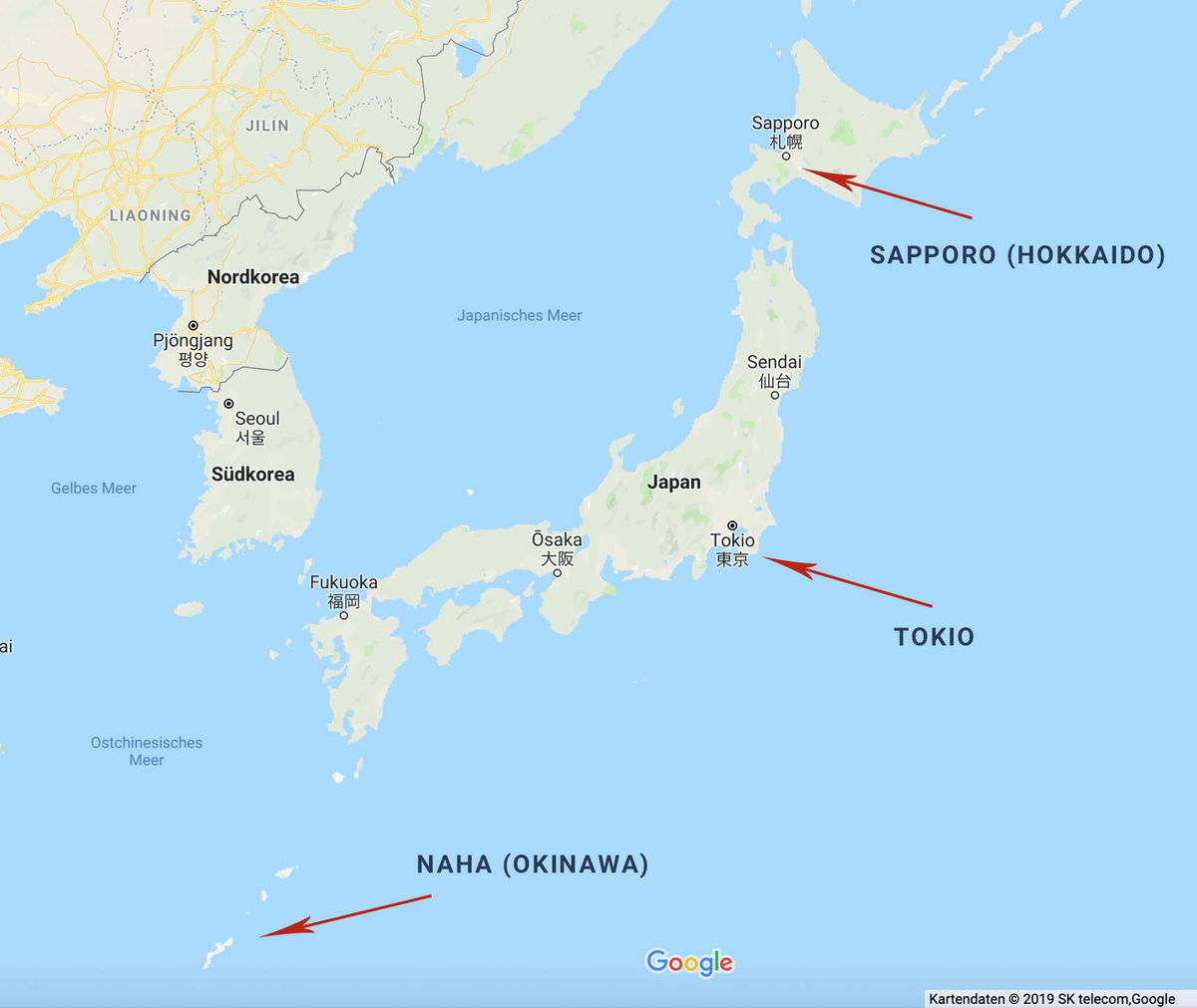
The image is a Google Maps screenshot of Japan and the Korean Peninsula, with three red arrows calling out cities spread across the country's full north-south span. The top arrow points to Sapporo (Hokkaido) on the northern island, the middle arrow marks Tokio on the main island of Honshu, and the third arrow points far to the southwest toward Naha (Okinawa), whose small islands sit near the bottom of the frame. The map's interface language is German, so the sea and country labels read "Japanisches Meer," "Nordkorea," "Südkorea," "Gelbes Meer," and "Ostchinesisches Meer." Other Japanese cities marked with dots include Sendai, Ōsaka, and Fukuoka, and Seoul and Pjöngjang appear on the Korean peninsula. The overall effect is a simple overview map showing how widely separated Japan's northern, central, and subtropical southern regions are.
The image is a Google Maps screenshot of Japan and the Korean Peninsula, with three red arrows calling out cities spread across the country's full north-south span. The top arrow points to Sapporo (Hokkaido) on the northern island, the middle arrow marks Tokio on the main island of Honshu, and the third arrow points far to the southwest toward Naha (Okinawa), whose small islands sit near the bottom of the frame.
The map's interface language is German, so the sea and country labels read "Japanisches Meer," "Nordkorea," "Südkorea," "Gelbes Meer," and "Ostchinesisches Meer." Other Japanese cities marked with dots include Sendai, Ōsaka, and Fukuoka, and Seoul and Pjöngjang appear on the Korean peninsula. The overall effect is a simple overview map showing how widely separated Japan's northern, central, and subtropical southern regions are.
이미지에 보이는 텍스트
JILIN
LIAONING
Nordkorea
Pjŏngjang
평양
Seoul
서울
Südkorea
Gelbes Meer
Japanisches Meer
Sapporo
札幌
SAPPORO (HOKKAIDO)
Sendai
仙台
Japan
Ōsaka
大阪
Tokio
東京
Fukuoka
福岡
TOKIO
Ostchinesisches
Meer
NAHA (OKINAWA)
Google
Kartendaten © 2019 SK telecom,Google
남부 일본 (오키나와, 후쿠오카; 아열대)

A sweeping view of a tropical beach in Okinawa, seen from an elevated spot. A long crescent of pale sand curves around a bay of clear turquoise water, with a handful of people scattered along the shore. Palm trees and dense green foliage fill the foreground, where rows of wooden lounge chairs and closed beach umbrellas sit on a terrace overlooking the sand. Across the water, small rocky islets covered in trees rise from the shallows, and hazy green mountains stretch along the horizon under a soft, overcast sky.
A sweeping view of a tropical beach in Okinawa, seen from an elevated spot. A long crescent of pale sand curves around a bay of clear turquoise water, with a handful of people scattered along the shore. Palm trees and dense green foliage fill the foreground, where rows of wooden lounge chairs and closed beach umbrellas sit on a terrace overlooking the sand. Across the water, small rocky islets covered in trees rise from the shallows, and hazy green mountains stretch along the horizon under a soft, overcast sky.
이미지에 보이는 텍스트
**Empty response**
특히 오키나와는 해변을 사랑하는 사람들과 추위를 피하고 싶은 이들에게 진정한 천국입니다. 1월 평균 기온도 17도에 달합니다.
현지 주민과 여행객 모두에게는 거의 일 년 내내 하얀 모래사장이 열려 있지만, 11월에서 2월 사이에는 해변이 대체로 닫힙니다. 하지만, 반드시 우기와 태풍 시즌을 염두에 둬야 합니다. 우기는 5월에 시작해 6월 중순에 끝나고, 태풍 시즌은 7월부터 9월까지 이어집니다.
연초에 남부 일본을 방문하면, 따뜻하고 습한 기후 덕분에 지역에 따라 1월부터 첫 벚꽃을 감상할 수 있습니다.
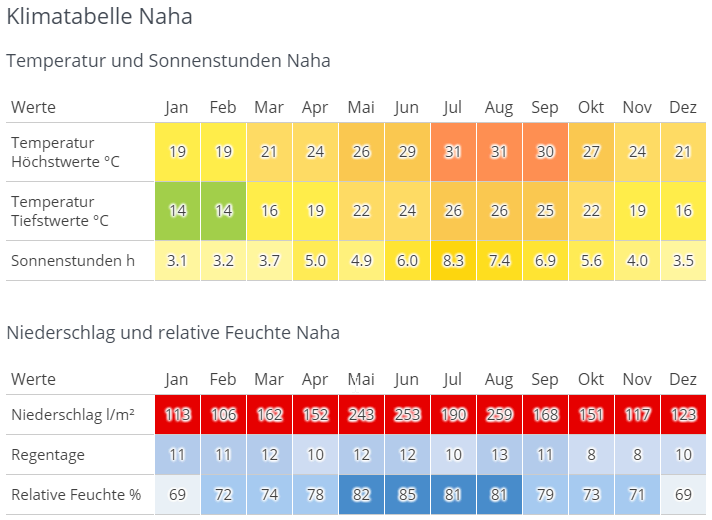
A German-language climate table for Naha on Okinawa, titled Klimatabelle Naha. The first section covers temperature and sunshine hours by month, January through December. Average highs climb from 19 °C in January and February to 31 °C in July and August, while lows range from 14 °C in winter to 26 °C at the height of summer. Sunshine peaks at 8.3 hours a day in July. The cells are color coded, shifting from green and yellow in the cooler months to orange in summer. The second section covers precipitation and relative humidity. Rainfall is substantial all year, from a low of 106 l/m² in February to a high of 259 l/m² in August, and every monthly value is marked in red. Rain days stay modest at 8 to 13 per month. Relative humidity runs from 69 percent in January and December up to 85 percent in June, shown in shades of blue.
A German-language climate table for Naha on Okinawa, titled Klimatabelle Naha. The first section covers temperature and sunshine hours by month, January through December. Average highs climb from 19 °C in January and February to 31 °C in July and August, while lows range from 14 °C in winter to 26 °C at the height of summer. Sunshine peaks at 8.3 hours a day in July. The cells are color coded, shifting from green and yellow in the cooler months to orange in summer.
The second section covers precipitation and relative humidity. Rainfall is substantial all year, from a low of 106 l/m² in February to a high of 259 l/m² in August, and every monthly value is marked in red. Rain days stay modest at 8 to 13 per month. Relative humidity runs from 69 percent in January and December up to 85 percent in June, shown in shades of blue.
이미지에 보이는 텍스트
# Klimatabelle Naha
## Temperatur und Sonnenstunden Naha
| Werte | Jan | Feb | Mar | Apr | Mai | Jun | Jul | Aug | Sep | Okt | Nov | Dez |
|---|---|---|---|---|---|---|---|---|---|---|---|---|
| Temperatur Höchstwerte °C | 19 | 19 | 21 | 24 | 26 | 29 | 31 | 31 | 30 | 27 | 24 | 21 |
| Temperatur Tiefstwerte °C | 14 | 14 | 16 | 19 | 22 | 24 | 26 | 26 | 25 | 22 | 19 | 16 |
| Sonnenstunden h | 3.1 | 3.2 | 3.7 | 5.0 | 4.9 | 6.0 | 8.3 | 7.4 | 6.9 | 5.6 | 4.0 | 3.5 |
## Niederschlag und relative Feuchte Naha
| Werte | Jan | Feb | Mar | Apr | Mai | Jun | Jul | Aug | Sep | Okt | Nov | Dez |
|---|---|---|---|---|---|---|---|---|---|---|---|---|
| Niederschlag l/m² | 113 | 106 | 162 | 152 | 243 | 253 | 190 | 259 | 168 | 151 | 117 | 123 |
| Regentage | 11 | 11 | 12 | 10 | 12 | 12 | 10 | 13 | 11 | 8 | 8 | 10 |
| Relative Feuchte % | 69 | 72 | 74 | 78 | 82 | 85 | 81 | 81 | 79 | 73 | 71 | 69 |
중부 일본 (도쿄, 오사카, 교토; 온대)
중부 일본의 기온은 대체로 독일보다 약간 높습니다. 봄과 가을에는 온화한 15~20도의 날씨가 많고, 대체로 맑고 쾌청합니다. 특히 4~5월 및 10~11월이 날씨가 가장 좋습니다.
남부처럼 중부 일본에도 우기가 있는데, 6월과 7월엔 집중호우가 쏟아집니다. 이후 높아진 기온과 극심한 습도는 9월까지 이어집니다. 특히 8월에는 30도 이상의 날씨가 보통이며, 높은 습도로 인해 더 답답하게 느껴집니다.
12월부터는 쌀쌀해지며, 산악 지역에서는 -5도에서 10도 사이의 기온과 함께 눈이 내리기도 합니다.
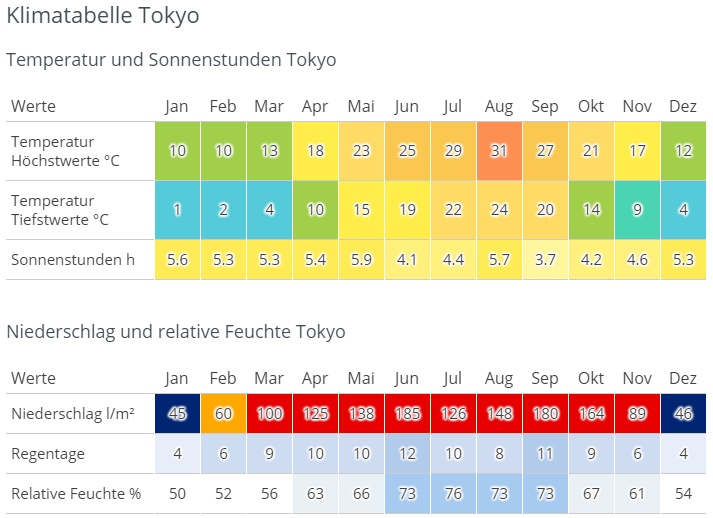
A German-language climate table for Tokyo, headed "Klimatabelle Tokyo," laid out as two color-coded tables with columns for each month from Jan to Dez. The first table, "Temperatur und Sonnenstunden Tokyo," has three rows. Average daily highs climb from 10 °C in January and February to a peak of 31 °C in August, then fall back to 12 °C in December. Lows run from 1 °C in January up to 24 °C in August. Sunshine hours stay between roughly 3.7 (September) and 5.9 per day (May). Each temperature cell is shaded on a scale from blue for the coldest months through green and yellow to red for the hottest. The second table, "Niederschlag und relative Feuchte Tokyo," covers rain. Monthly precipitation is lowest in January and December at 45 and 46 l/m² and highest in June at 185, with August (148) and September (180) also very wet. Rain days range from 4 per month in winter to 12 in June. Relative humidity sits near 50 to 56 percent in winter and reaches 76 percent in July. These cells use a blue-to-red shading, so the rainy summer months stand out in strong red while winter months are dark blue.
A German-language climate table for Tokyo, headed "Klimatabelle Tokyo," laid out as two color-coded tables with columns for each month from Jan to Dez.
The first table, "Temperatur und Sonnenstunden Tokyo," has three rows. Average daily highs climb from 10 °C in January and February to a peak of 31 °C in August, then fall back to 12 °C in December. Lows run from 1 °C in January up to 24 °C in August. Sunshine hours stay between roughly 3.7 (September) and 5.9 per day (May). Each temperature cell is shaded on a scale from blue for the coldest months through green and yellow to red for the hottest.
The second table, "Niederschlag und relative Feuchte Tokyo," covers rain. Monthly precipitation is lowest in January and December at 45 and 46 l/m² and highest in June at 185, with August (148) and September (180) also very wet. Rain days range from 4 per month in winter to 12 in June. Relative humidity sits near 50 to 56 percent in winter and reaches 76 percent in July. These cells use a blue-to-red shading, so the rainy summer months stand out in strong red while winter months are dark blue.
이미지에 보이는 텍스트
# Klimatabelle Tokyo
## Temperatur und Sonnenstunden Tokyo
| Werte | Jan | Feb | Mar | Apr | Mai | Jun | Jul | Aug | Sep | Okt | Nov | Dez |
|---|---|---|---|---|---|---|---|---|---|---|---|---|
| Temperatur Höchstwerte °C | 10 | 10 | 13 | 18 | 23 | 25 | 29 | 31 | 27 | 21 | 17 | 12 |
| Temperatur Tiefstwerte °C | 1 | 2 | 4 | 10 | 15 | 19 | 22 | 24 | 20 | 14 | 9 | 4 |
| Sonnenstunden h | 5.6 | 5.3 | 5.3 | 5.4 | 5.9 | 4.1 | 4.4 | 5.7 | 3.7 | 4.2 | 4.6 | 5.3 |
## Niederschlag und relative Feuchte Tokyo
| Werte | Jan | Feb | Mar | Apr | Mai | Jun | Jul | Aug | Sep | Okt | Nov | Dez |
|---|---|---|---|---|---|---|---|---|---|---|---|---|
| Niederschlag l/m² | 45 | 60 | 100 | 125 | 138 | 185 | 126 | 148 | 180 | 164 | 89 | 46 |
| Regentage | 4 | 6 | 9 | 10 | 10 | 12 | 10 | 8 | 11 | 9 | 6 | 4 |
| Relative Feuchte % | 50 | 52 | 56 | 63 | 66 | 73 | 76 | 73 | 73 | 67 | 61 | 54 |
북부 일본 (아오모리, 홋카이도; 냉온대)
북부 일본은 모든 겨울 스포츠 애호가와 등산객들에게는 꿈과 같은 장소입니다. 12월부터 3월까지 전 지역에 눈이 내리며, 때로는 수 미터까지 쌓이고 기온은 좀처럼 0도를 넘지 않습니다. 여름(6월~8월)에는 약 25도의 쾌적한 날씨를 즐기며 자연을 만끽할 수 있습니다.
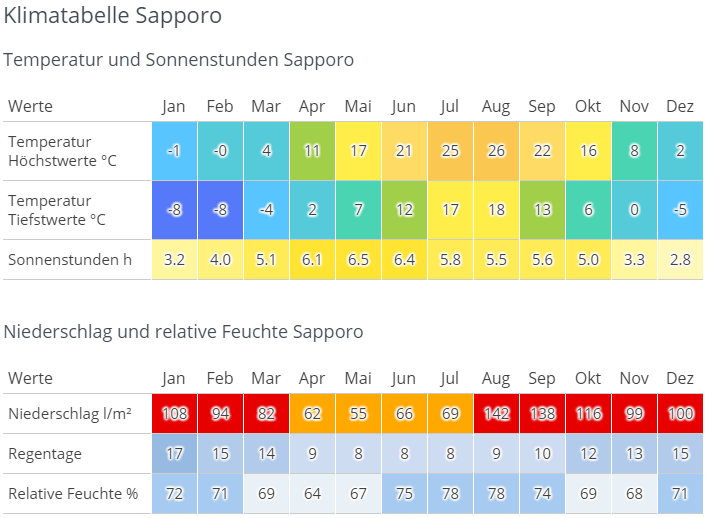
A German-language climate chart for Sapporo on Japan's northern island of Hokkaido, built as two color-coded tables spanning all twelve months. The first table covers temperature and sunshine, with cells shaded from blue in the cold months to yellow and orange in the warm ones. Daily highs sit at -1 and 0 °C in January and February, climb through a mild spring to 21 °C in June, peak at 26 °C in August, and fall back to 2 °C by December. Lows range from -8 °C in midwinter to 18 °C in summer. Sunshine stays modest year round, from 2.8 hours in December up to 6.5 in May. The second table covers moisture. Precipitation bottoms out at 55 liters per square meter in May and peaks at 142 in August and 138 in September, with the wettest cells highlighted in red. Rain days run from 8 in summer to 17 in January, and relative humidity stays between 64 and 78 percent, highest in July and August.
A German-language climate chart for Sapporo on Japan's northern island of Hokkaido, built as two color-coded tables spanning all twelve months. The first table covers temperature and sunshine, with cells shaded from blue in the cold months to yellow and orange in the warm ones. Daily highs sit at -1 and 0 °C in January and February, climb through a mild spring to 21 °C in June, peak at 26 °C in August, and fall back to 2 °C by December. Lows range from -8 °C in midwinter to 18 °C in summer. Sunshine stays modest year round, from 2.8 hours in December up to 6.5 in May.
The second table covers moisture. Precipitation bottoms out at 55 liters per square meter in May and peaks at 142 in August and 138 in September, with the wettest cells highlighted in red. Rain days run from 8 in summer to 17 in January, and relative humidity stays between 64 and 78 percent, highest in July and August.
이미지에 보이는 텍스트
# Klimatabelle Sapporo
## Temperatur und Sonnenstunden Sapporo
| Werte | Jan | Feb | Mar | Apr | Mai | Jun | Jul | Aug | Sep | Okt | Nov | Dez |
|---|---|---|---|---|---|---|---|---|---|---|---|---|
| Temperatur Höchstwerte °C | -1 | -0 | 4 | 11 | 17 | 21 | 25 | 26 | 22 | 16 | 8 | 2 |
| Temperatur Tiefstwerte °C | -8 | -8 | -4 | 2 | 7 | 12 | 17 | 18 | 13 | 6 | 0 | -5 |
| Sonnenstunden h | 3.2 | 4.0 | 5.1 | 6.1 | 6.5 | 6.4 | 5.8 | 5.5 | 5.6 | 5.0 | 3.3 | 2.8 |
## Niederschlag und relative Feuchte Sapporo
| Werte | Jan | Feb | Mar | Apr | Mai | Jun | Jul | Aug | Sep | Okt | Nov | Dez |
|---|---|---|---|---|---|---|---|---|---|---|---|---|
| Niederschlag l/m² | 108 | 94 | 82 | 62 | 55 | 66 | 69 | 142 | 138 | 116 | 99 | 100 |
| Regentage | 17 | 15 | 14 | 9 | 8 | 8 | 8 | 9 | 10 | 12 | 13 | 15 |
| Relative Feuchte % | 72 | 71 | 69 | 64 | 67 | 75 | 78 | 78 | 74 | 69 | 68 | 71 |
독일 기후 vs. 일본 기후
두 나라 모두 네 계절이 뚜렷하다는 공통점이 있습니다. 북부 일본은 독일 기후와 가장 흡사하지만, 중부 일본은 평균 기온이 약간, 남부 일본은 확실히 더 높습니다. 반면 일본의 높은 습도와 우기는 독일에서는 찾아볼 수 없습니다.
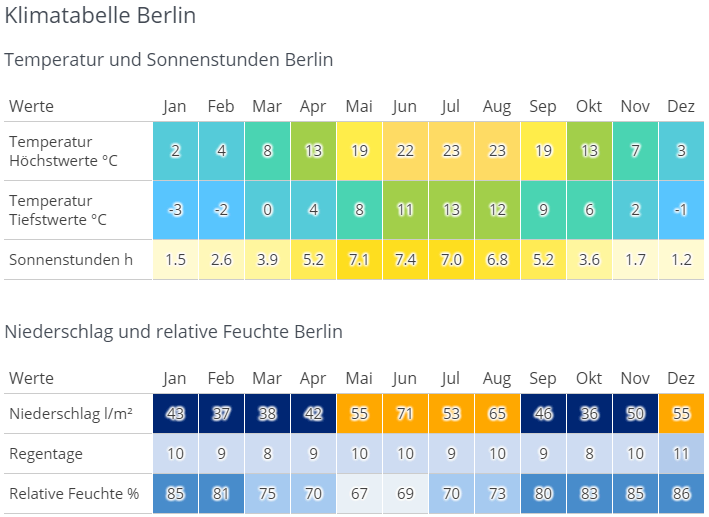
A German-language climate chart for Berlin ("Klimatabelle Berlin") presented as two color-coded tables covering all twelve months. The first table, "Temperatur und Sonnenstunden Berlin," shows three rows: average highs ranging from 2°C in January to 23°C in July and August, average lows from -3°C in January to 13°C in July, and sunshine hours peaking at 7.4 in June. Cells are shaded on a blue-to-yellow gradient so warm months stand out in yellow and cold months in blue-green. The second table, "Niederschlag und relative Feuchte Berlin," covers precipitation in liters per square meter (highest at 71 in June), rainy days per month (mostly 8 to 11), and relative humidity, which is highest in the winter months at 85–86% and lowest in May at 67%. Precipitation cells use a dark-blue-to-orange scale, with the wettest months highlighted in orange.
A German-language climate chart for Berlin ("Klimatabelle Berlin") presented as two color-coded tables covering all twelve months.
The first table, "Temperatur und Sonnenstunden Berlin," shows three rows: average highs ranging from 2°C in January to 23°C in July and August, average lows from -3°C in January to 13°C in July, and sunshine hours peaking at 7.4 in June. Cells are shaded on a blue-to-yellow gradient so warm months stand out in yellow and cold months in blue-green.
The second table, "Niederschlag und relative Feuchte Berlin," covers precipitation in liters per square meter (highest at 71 in June), rainy days per month (mostly 8 to 11), and relative humidity, which is highest in the winter months at 85–86% and lowest in May at 67%. Precipitation cells use a dark-blue-to-orange scale, with the wettest months highlighted in orange.
이미지에 보이는 텍스트
# Klimatabelle Berlin
Temperatur und Sonnenstunden Berlin
| Werte | Jan | Feb | Mar | Apr | Mai | Jun | Jul | Aug | Sep | Okt | Nov | Dez |
| --- | --- | --- | --- | --- | --- | --- | --- | --- | --- | --- | --- | --- |
| Temperatur Höchstwerte °C | 2 | 4 | 8 | 13 | 19 | 22 | 23 | 23 | 19 | 13 | 7 | 3 |
| Temperatur Tiefstwerte °C | -3 | -2 | 0 | 4 | 8 | 11 | 13 | 12 | 9 | 6 | 2 | -1 |
| Sonnenstunden h | 1.5 | 2.6 | 3.9 | 5.2 | 7.1 | 7.4 | 7.0 | 6.8 | 5.2 | 3.6 | 1.7 | 1.2 |
Niederschlag und relative Feuchte Berlin
| Werte | Jan | Feb | Mar | Apr | Mai | Jun | Jul | Aug | Sep | Okt | Nov | Dez |
| --- | --- | --- | --- | --- | --- | --- | --- | --- | --- | --- | --- | --- |
| Niederschlag l/m² | 48 | 37 | 38 | 42 | 55 | 71 | 53 | 65 | 46 | 36 | 50 | 55 |
| Regentage | 10 | 9 | 8 | 9 | 10 | 10 | 9 | 10 | 9 | 8 | 10 | 11 |
| Relative Feuchte % | 85 | 81 | 75 | 70 | 67 | 69 | 70 | 73 | 80 | 83 | 85 | 86 |
일본 날씨에 영향을 주는 요인
일본은 여러 위도를 걸쳐 분포해 있기 때문에, 다양한 바람과 기류의 영향을 받습니다. 겨울철 북부 일본에서는 시베리아 바람이 눈과 혹한을 가져옵니다. 반대로 여름엔 남쪽의 열대성 기류로 인해 몬순 비와 무더위가 나타납니다. 여기에 남부와 북동부의 따뜻한 해류, 차가운 해류도 기후 차이를 더욱 뚜렷하게 만듭니다.
또한, 일본에서는 일반적으로 가뭄이 거의 없습니다. 연중 언제든 비가 내릴 수 있으며, 가장 많은 강수량은 중부 일본, 가장 적은 강수량은 북부에 해당합니다.
일본 여행을 어떻게 계획하나요?
겨울 스포츠
홋카이도 및 혼슈 북부 지역에는 엄청난 눈과 세계적으로 유명한 스키장이 많이 있습니다. 초보자부터 숙련자까지 모두 즐길 수 있습니다!
해변 휴양
남부 일본 해변에서는 이미 3월부터 쉴 수 있으며, 특히 오키나와는 하와이 못지않은 인기 휴양지입니다. 특히 수영이 목적이라면 한여름은 피하는 것이 좋습니다. 이때는 비가 자주 내릴 수 있지만, 다이빙이나 스노클링은 여전히 가능합니다.
메트로폴리스 도쿄
봄과 가을이 특히 적합한 시기이며, 여름엔 도쿄 도심이 매우 뜨거워지고 겨울엔 추워질 수 있습니다.
자연 속에서 힐링
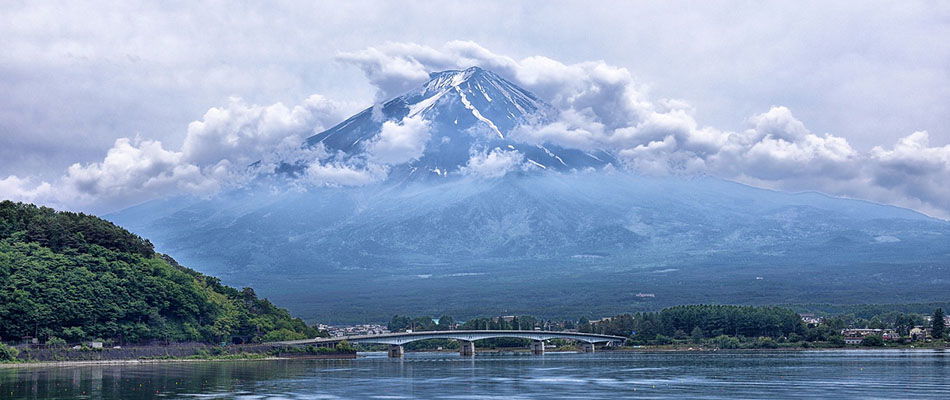
Mount Fuji fills the frame, its snow-streaked summit half swallowed by thick white clouds that drift across the peak and trail down the slopes. The mountain's blue-grey lower flanks stretch down toward a calm lake in the foreground, where a long, low road bridge crosses the water. A densely forested green hill rises on the left bank, and low buildings and trees line the far shore beneath the mountain. It is a classic view of Japan's tallest peak from one of the lakes at its foot, with the spring or early summer snowline still visible above the clouds.
Mount Fuji fills the frame, its snow-streaked summit half swallowed by thick white clouds that drift across the peak and trail down the slopes. The mountain's blue-grey lower flanks stretch down toward a calm lake in the foreground, where a long, low road bridge crosses the water. A densely forested green hill rises on the left bank, and low buildings and trees line the far shore beneath the mountain. It is a classic view of Japan's tallest peak from one of the lakes at its foot, with the spring or early summer snowline still visible above the clouds.
이미지에 보이는 텍스트
No clearly readable text.
특히 등산을 좋아한다면, 여름철 홋카이도를 추천합니다. 멋진 풍경과 온화한 기온을 동시에 즐길 수 있습니다.
더위를 싫어하는 여행자를 위한 팁
30도 이상의 더위와 높은 습도를 견디기 힘들다면, 여름철 중부 및 남부 일본 여행은 최대한 피하는 것이 좋습니다.
4계절의 매력
봄
일본의 봄을 대표하는 것은 역시 벚꽃입니다. 해마다 수많은 관광객들이 온화한 날씨 속 화사한 벚꽃물결을 즐기기 위해 일본을 찾습니다. 신혼여행객에게 특히 인기 있는 계절이기도 합니다!

여름
해변과 산 외에도 수많은 여름 축제들이 열려, 더운 여름을 재밌게 보낼 수 있습니다. 불꽃놀이도 감상할 수 있죠.

가을
가을에는 쾌적한 기온과 더불어 단풍의 절경이 기다리고 있습니다. 일본 전역이 붉고 황금빛, 주황빛으로 물듭니다.
겨울
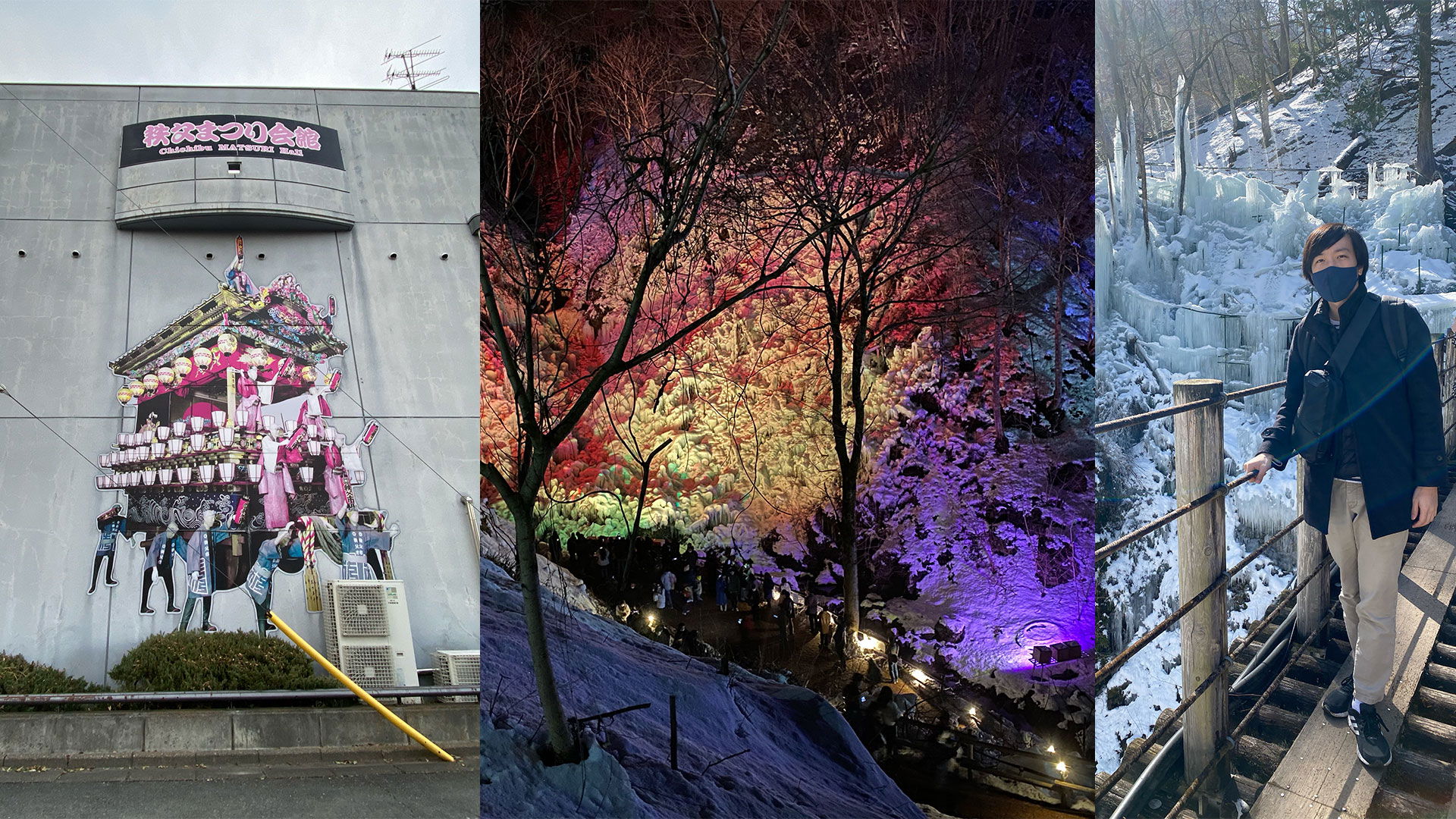
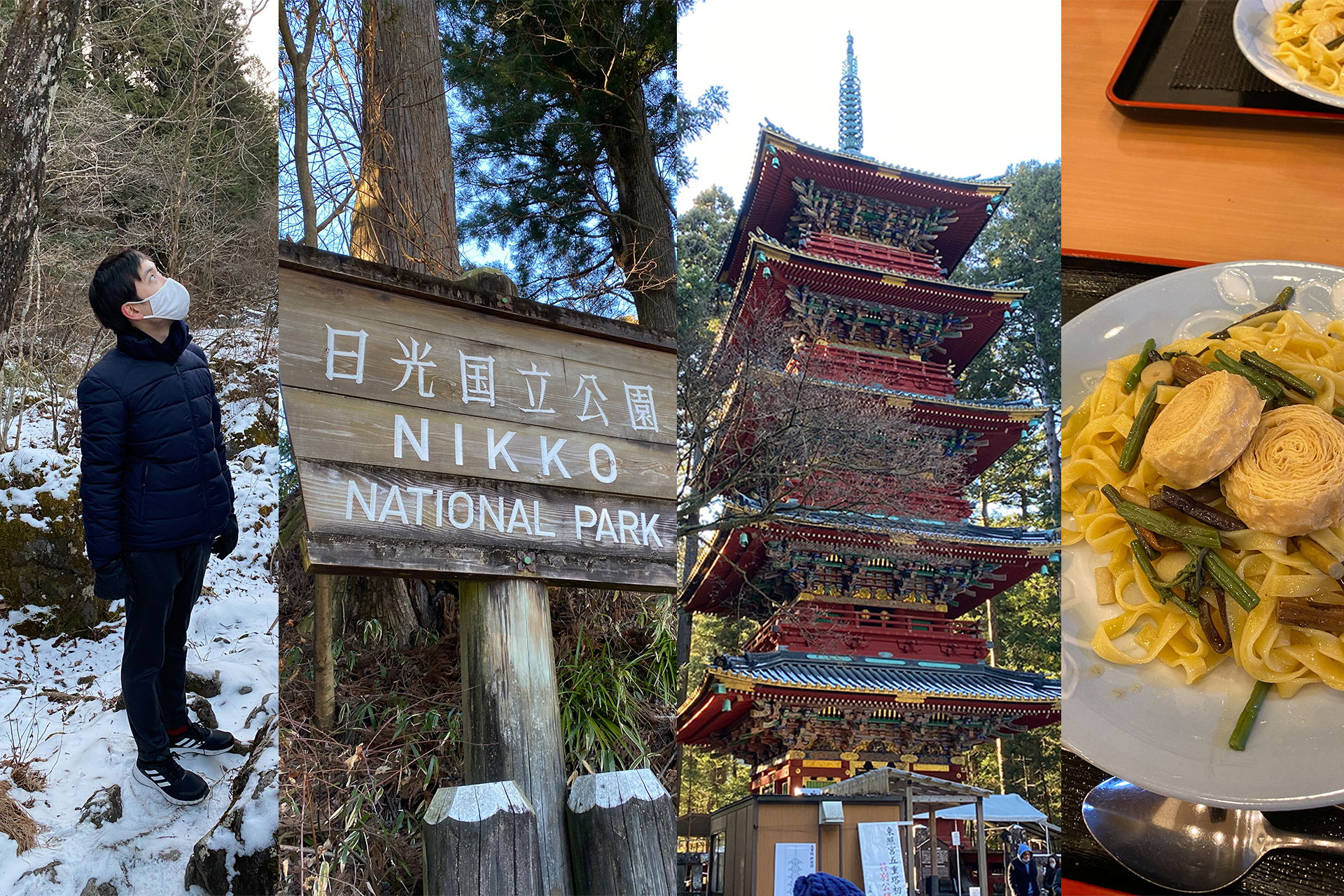
스키어, 스노보더 등 겨울 스포츠 애호가에게 최고의 시즌입니다. 보다 여유롭게 즐기고 싶다면 온천(온센)에서 휴식하거나, 눈 덮인 풍경을 감상해도 좋습니다. 겨울에는 최고의 해산물도 맛볼 수 있습니다.
나의 개인적인 추천 계절
개인적으로는 봄과 가을이 최고라고 생각합니다. 너무 춥지도 덥지도 않으면서, 대체로 맑은 하늘이 이어져 완벽한 조합이니까요! 일본의 여름은 온실, 혹은 동물원의 열대온실과 비슷하다고 할 수 있습니다. 매우 덥고, 습하고, 답답하죠.
참고로, 독일과는 달리 일본은 계절의 전환이 좀 더 자연스럽고 갑작스럽지 않게 느껴졌습니다.
일본의 연휴와 성수기
가능하다면 성수기와 주요 연휴에는 여행을 피하는 것이 좋습니다! 비싼 가격뿐 아니라 엄청난 인파로 인해 인내심이 시험받을 수 있습니다.
벚꽃 시즌
일본 달력의 첫 번째 하이라이트는 바로 벚꽃 시즌입니다. 3월 말에서 4월 초까지, 시민과 관광객 모두가 가장 아름다운 벚나무 명소를 찾기 위해 경쟁을 벌입니다.
골든 위크
4월 말에서 5월 초까지 이어지는 일주일 동안 네 개의 공휴일이 이어지고, 많은 회사가 징검다리 휴일까지 제공합니다. 이때는 거의 모든 인기 있는 여행지가 일본인 관광객으로 가득 찹니다.
오본(Obon)
오본 연휴(8월 13일 경)에는 많은 일본인들이 고향 가족을 찾아가거나 여행을 떠납니다. 홋카이도와 오키나와가 인기가 압도적으로 많습니다.
가을 단풍 시즌
벚꽃만큼이나 인기가 많은 것이 가을 단풍 시즌입니다. 교토, 히로시마, 도쿄 등 인기 명소는 11월 말이면 여행객들로 붐빕니다. 가능하다면 주중에 관광지를 방문하고, 주말은 피하는 것이 좋습니다.
연말연시
오본처럼 신년 연휴 기간에도 많은 일본인들이 가족과 시간을 보내기 위해 고향을 찾습니다. 독일의 크리스마스와 비슷합니다. 이 시기에 관광도 활발하게 이뤄집니다.
팁: 신년 직후에는 연말 세일에서 알뜰한 쇼핑도 할 수 있습니다.
태풍 시즌
매년 6월부터 9월까지 이어지는 태풍 시즌에는 고온과 많은 비가 찾아옵니다. 대부분의 태풍은 본토에는 직접 상륙하지 않으며, 특히 도쿄 지역은 영향을 덜 받습니다. 남부 지역은 그에 비해 훨씬 더 많이 영향을 받습니다. 강력한 태풍은 드물지만, 만약을 대비해 사전 대비책을 꼭 점검해야 하며, 이 시기에는 뉴스와 일기예보를 매일 체크하는 것이 좋습니다.
결론
결국, 일본 여행 시기를 결정하기가 쉽지는 않습니다. 일본은 항상 여행할 가치가 있는 나라입니다. 각 지역, 각 계절마다 특별한 매력과 볼거리가 있으니, 본인의 관심사에 따라 여행 시기를 고르는 것이 가장 좋습니다.
댓글
처음에는 일단 방향을 잡기 위해 글을 남깁니다. 저희는 이미 한 번 5월에 일본에 가서 도쿄, 교토, 히로시마 지역을 여행한 적이 있어요. 정말 멋진 여행이었습니다. 이번에는 남쪽 지역을 한 번 방문해볼까 해요. 안부 인사 전해요, 도린
안녕하세요 도린, 즐거운 시간을 보냈다고 하니 저도 기쁩니다. 일본 남부도 정말 아름다워요. 그곳에서도 많은 즐거운 추억 만드시길 바랍니다! 따뜻한 인사와 함께, 류세이