
Il rapporto dettagliato dell'esperienza di RyuKoch
Indice dei contenuti:
Bibimcup a colpo d'occhio
Il ristorante Bibimcup è stato ampliato dai proprietari e ora offre più posti a sedere e una più ampia scelta di cibo coreano. Non abbiamo ancora visitato il locale ristrutturato!
Orari di apertura
- Lun - Mer: 11:30 - 21:30
- Gio - Sab: 11:30 - 22:00
- Dom: Chiuso
Valutazione
- Ryusei: 4,5/5
- Matthias: 4,6/5
Prezzo
- 10€ per un menu piccolo
- 11€ per un menu grande
Conclusione riassuntiva
Bibimcup è un piccolo ristorante che offre il piatto nazionale coreano Bibimbap in diverse varianti. Bibimcup è molto conveniente e offre un menu tra 9,50 e 11 euro con una ciotola di Bibimbap con contorno, un contorno e una bevanda. In termini di gusto, Bibimcup rientra nella categoria Delizioso.
Se stai cercando un piatto economico, gustoso e sano a Düsseldorf, ti consigliamo di visitare questo piccolo ristorante.
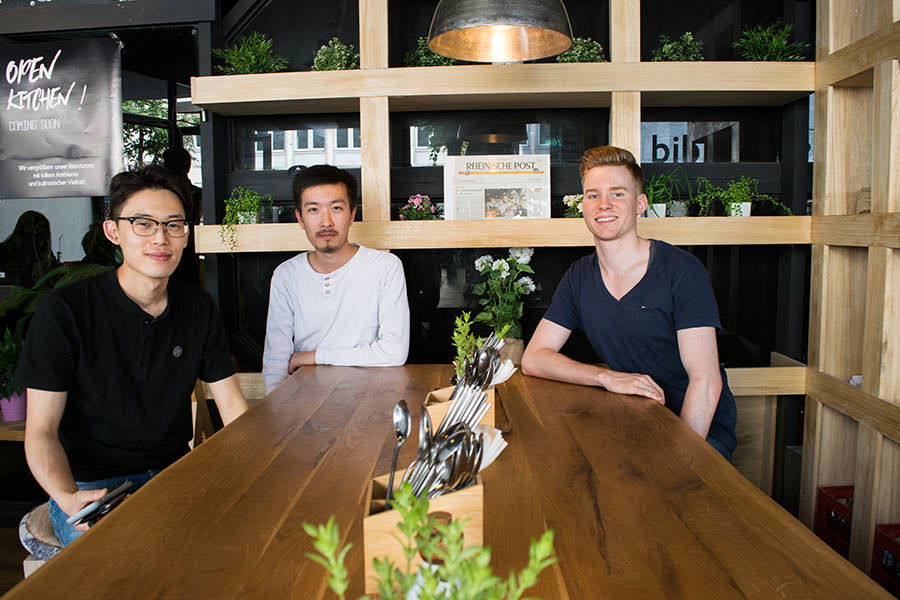
Three young men sit side by side at a long communal wooden table inside Bibimcup, a Korean bibimbap restaurant in Düsseldorf, all three smiling toward the camera. The man on the left wears glasses and a black polo shirt and holds a phone in his lap. In the middle is a man with a mustache in a white henley shirt, arms resting on the table edge. The man on the right has reddish blond hair, wears a navy v-neck t-shirt, and leans forward on his forearms. The room behind them has a light wood shelf wall dotted with small green plants and white flowers, topped by a large metal dome pendant lamp. A copy of the Rheinische Post newspaper stands upright on one of the shelves, and to the left a black poster reads "OPEN KITCHEN! COMING SOON." On the table in the foreground, a wooden caddy holds spoons and forks wrapped in napkins, with a few sprigs of fresh herbs beside it. The overall feel is bright, modern, and welcoming, like a portrait of the team in their newly opened restaurant.
Three young men sit side by side at a long communal wooden table inside Bibimcup, a Korean bibimbap restaurant in Düsseldorf, all three smiling toward the camera. The man on the left wears glasses and a black polo shirt and holds a phone in his lap. In the middle is a man with a mustache in a white henley shirt, arms resting on the table edge. The man on the right has reddish blond hair, wears a navy v-neck t-shirt, and leans forward on his forearms.
The room behind them has a light wood shelf wall dotted with small green plants and white flowers, topped by a large metal dome pendant lamp. A copy of the Rheinische Post newspaper stands upright on one of the shelves, and to the left a black poster reads "OPEN KITCHEN! COMING SOON." On the table in the foreground, a wooden caddy holds spoons and forks wrapped in napkins, with a few sprigs of fresh herbs beside it. The overall feel is bright, modern, and welcoming, like a portrait of the team in their newly opened restaurant.
Testo visibile nell'immagine
OPEN
KITCHEN !
COMING SOON
RHEINISCHE POST
bil
Bibimbap - Il piatto nazionale della Corea del Sud
Bibimbap è un piatto di riso coreano in cui il gusto può essere personalizzato con diversi ingredienti. Ogni combinazione immaginabile di carne, verdura e salsa è possibile. Se vuoi saperne di più sul Bibimbap o vuoi provare a cucinare la ricetta base, dai un'occhiata alla nostra ricetta adatta >> Ciotola di riso Bibimbap con deliziosi condimenti Prima di poter mangiare il tuo Bibimbap, dovresti mescolarlo molto bene con un cucchiaio mescolare . È solo mescolando che gli ingredienti si combinano tra loro e sviluppano un gusto diverso e meraviglioso ogni volta.
Questo è quello che abbiamo ordinato
Durante la nostra visita, abbiamo ordinato 2 Bibimbaps con 2 diversi contorni. I contorni (Kimbap e Mandu) sono fatti a mano e preparati freschi. Oltre al riso, tra gli ingredienti principali ci sono insalata di germogli di fagiolini mung, champignon in salsa, insalata di carote, pezzi di zucchine, insalata iceberg e cipolle verdi. Puoi poi arricchire il tuo Bibimbap con la salsa coreana Ssamchang, che aggiunge un po' di piccantezza al piatto. Abbiamo poi scelto 2 diversi condimenti.

A generous serving of beef bibimbap fills a wide speckled ceramic bowl with a brown band around its base, set on a light wooden table. The rice is buried under crumbled bulgogi-style beef dusted with sesame seeds and topped with a scatter of chopped scallions, with slices of zucchini and shredded carrot visible around the edge. Behind the bowl, a small plate holds pieces of gimbap, the seaweed rolls showing rice, greens and egg in the cross-section. Further back on a wooden tray sit a white ceramic sauce bottle, a dark lidded pot with a spoon resting on top, and a little glass jar sprouting fresh greens. The warm, casual table setting reads as a Korean restaurant meal, photographed at Bibimcup in Düsseldorf.
A generous serving of beef bibimbap fills a wide speckled ceramic bowl with a brown band around its base, set on a light wooden table. The rice is buried under crumbled bulgogi-style beef dusted with sesame seeds and topped with a scatter of chopped scallions, with slices of zucchini and shredded carrot visible around the edge. Behind the bowl, a small plate holds pieces of gimbap, the seaweed rolls showing rice, greens and egg in the cross-section. Further back on a wooden tray sit a white ceramic sauce bottle, a dark lidded pot with a spoon resting on top, and a little glass jar sprouting fresh greens. The warm, casual table setting reads as a Korean restaurant meal, photographed at Bibimcup in Düsseldorf.
Testo visibile nell'immagine
No clearly readable text is present in the image.

A large grey ceramic bowl of spicy squid bibimbap sits front and center on a wooden restaurant table, photographed from just above the rim. The rice bowl is topped with sesame seeds, chopped green onions, bean sprouts, shredded lettuce, and chunks of squid coated in red chili sauce. Around it, the rest of the meal is arranged: two pan-fried dumplings on a rectangular plate behind the bowl, a row of maki sushi rolls to the left, and a blue-and-white patterned cup of tea on the right. The setting reads as a casual Korean restaurant table, with the bibimbap as the clear centerpiece.
A large grey ceramic bowl of spicy squid bibimbap sits front and center on a wooden restaurant table, photographed from just above the rim. The rice bowl is topped with sesame seeds, chopped green onions, bean sprouts, shredded lettuce, and chunks of squid coated in red chili sauce. Around it, the rest of the meal is arranged: two pan-fried dumplings on a rectangular plate behind the bowl, a row of maki sushi rolls to the left, and a blue-and-white patterned cup of tea on the right. The setting reads as a casual Korean restaurant table, with the bibimbap as the clear centerpiece.
Testo visibile nell'immagine
No clearly readable text is present in the image.
Il rapporto qualità-prezzo
Il menu di Bibimcup è appeso in grande dietro il bancone. In alternativa, guarda le piccole tessere. In termini di prezzo, Bibimcup è molto buono e offre un menu equo per soli 10-11 euro. Abbiamo pagato solo 22 € per i nostri due menu. A Düsseldorf è difficile trovare un menu così gustoso e sano a prezzi così convenienti.

A handwritten chalkboard menu from Bibimcup, a Korean bibimbap restaurant in Düsseldorf, photographed straight on. The header, "Choose your bibimcup," is picked out in green chalk while everything else is white. The menu walks through a two-step ordering system: Step 1 is the classic bibimcup, rice with six vegetable variations and a sauce of chili paste or soy, priced at 6 euros for a small and 7 for a large. Step 2 lists toppings: tofu (dubu), glass noodles (jap-chae), and spicy pork (jae-yuk) at 1.50 euros each, with beef bulgogi and spicy squid (o-jinger) at 2.00 euros. A boxed "Vegan (topping)" section on the right highlights the bibimcup, jap-chae, and dubu as the plant-based picks, each add-on 1.50 euros. Below that, cold drinks run 2.20 euros for cola, Fanta, Sprite, apple spritzer, and orange juice, with water at 2.00, all in 0.33-liter bottles with a 10-cent deposit. Hot drinks finish the board: coffee 2.00, cappuccino 2.30, espresso 1.80, and Korean tea at 2.20 in green, quince, ginger, or yuja lemon.
A handwritten chalkboard menu from Bibimcup, a Korean bibimbap restaurant in Düsseldorf, photographed straight on. The header, "Choose your bibimcup," is picked out in green chalk while everything else is white. The menu walks through a two-step ordering system: Step 1 is the classic bibimcup, rice with six vegetable variations and a sauce of chili paste or soy, priced at 6 euros for a small and 7 for a large. Step 2 lists toppings: tofu (dubu), glass noodles (jap-chae), and spicy pork (jae-yuk) at 1.50 euros each, with beef bulgogi and spicy squid (o-jinger) at 2.00 euros.
A boxed "Vegan (topping)" section on the right highlights the bibimcup, jap-chae, and dubu as the plant-based picks, each add-on 1.50 euros. Below that, cold drinks run 2.20 euros for cola, Fanta, Sprite, apple spritzer, and orange juice, with water at 2.00, all in 0.33-liter bottles with a 10-cent deposit. Hot drinks finish the board: coffee 2.00, cappuccino 2.30, espresso 1.80, and Korean tea at 2.20 in green, quince, ginger, or yuja lemon.
Testo visibile nell'immagine
# CHOOSE YOUR bibimcup
\* **Step 1** (classic)
**BIBIMCUP** Klein Grob
6 € 7 €
Reis mit 6 verschiedenen
Gemüsevariationen
(inkl. scharfe Chilipaste/Soja)
\* **Step 2** (TOPPING)
+ 1,50€
- DUBU (Tofu)
- JAP-CHAE (Glasnudeln)
- JAE-YUK scharf (Schweinefleisch)
+ 2,00€
- BULGOGI (Rindfleisch)
- O-JINGER scharf (Tintenfisch)
**VEGAN** (TOPPING)
- BIBIMCUP
- DUBU +1.50 (Tofu)
- JAP-CHAE +1.50€ (Glasnudeln)
**Getränke** (0,33l, 0,2l, Pfand 10 cent)
- Cola 2.20
- Fanta 2.20
- Sprite 2.20
- Apfelschorle 2.20
- Orangensaft 2.20
- Wasser 2.00
**heipe Getränke**
Kaffee 2.00 Tee (koreanisch) 2.20
Cappuccino 2.30 Grün/Quitten/Ingwer
Espresso 1.80 Yuja (zitronen)
Sung-Ryul Choi ci ha detto che Bibimcup si espanderà nei prossimi mesi. Il ristorante ancora piccolo sarà ampliato con una stanza aggiuntiva e offrirà quindi una gamma più ampia di piatti coreani. Siamo curiosi e torneremo a visitare Bibimcup e non vediamo l'ora dell'espansione del ristorante.
La nostra conclusione
Ci siamo sentiti a nostro agio al Bibimcup. Sia per l'atmosfera, il cibo che il servizio. Il prezzo conveniente di un pasto completo è perfetto. Naturalmente, il prezzo è giustificato dalla composizione degli ingredienti come champignon e insalata iceberg, ma il Bibimbap è delizioso in termini di gusto.
Commenti
Mamma mia... frasi vuote, affermazioni inutili senza contenuto, troppo poco critico. Un esempio: "...rientra nella categoria gustoso..." oppure "...prezzo molto giusto...". Ma che categoria sarebbe questa, cosa significa gustoso e chi decide cosa sia un prezzo giusto? Perché non viene argomentato o paragonato con altro? E poi una foto con il proprietario del ristorante – niente di più lontano dall'oggettività. Non avete davvero idea di cosa significhi una vera critica gastronomica... si capisce anche leggendo la recensione per il BB4U... ("...la salsa presumibilmente fatta in casa..."). Cosa significa presumibilmente, o lo sapete oppure evitate una frase che non serve a nessuno. Tra l'altro manca il nome della salsa. Dovrei ordinarla così? "Vorrei la salsa presumibilmente fatta in casa senza nome"? Meglio meno recensioni, ma fatte bene.
Ciao Matthias, grazie per il tuo commento, sì, in effetti, non siamo critici gastronomici né recensori professionisti, condividiamo in gran parte solo le nostre esperienze :) Ma proprio perché non vogliamo farlo a metà, abbiamo deciso di non fare più le recensioni di ristoranti, proprio per i motivi che hai menzionato :) Tanti saluti Matthias
Il commento non è ancora stato verificato.