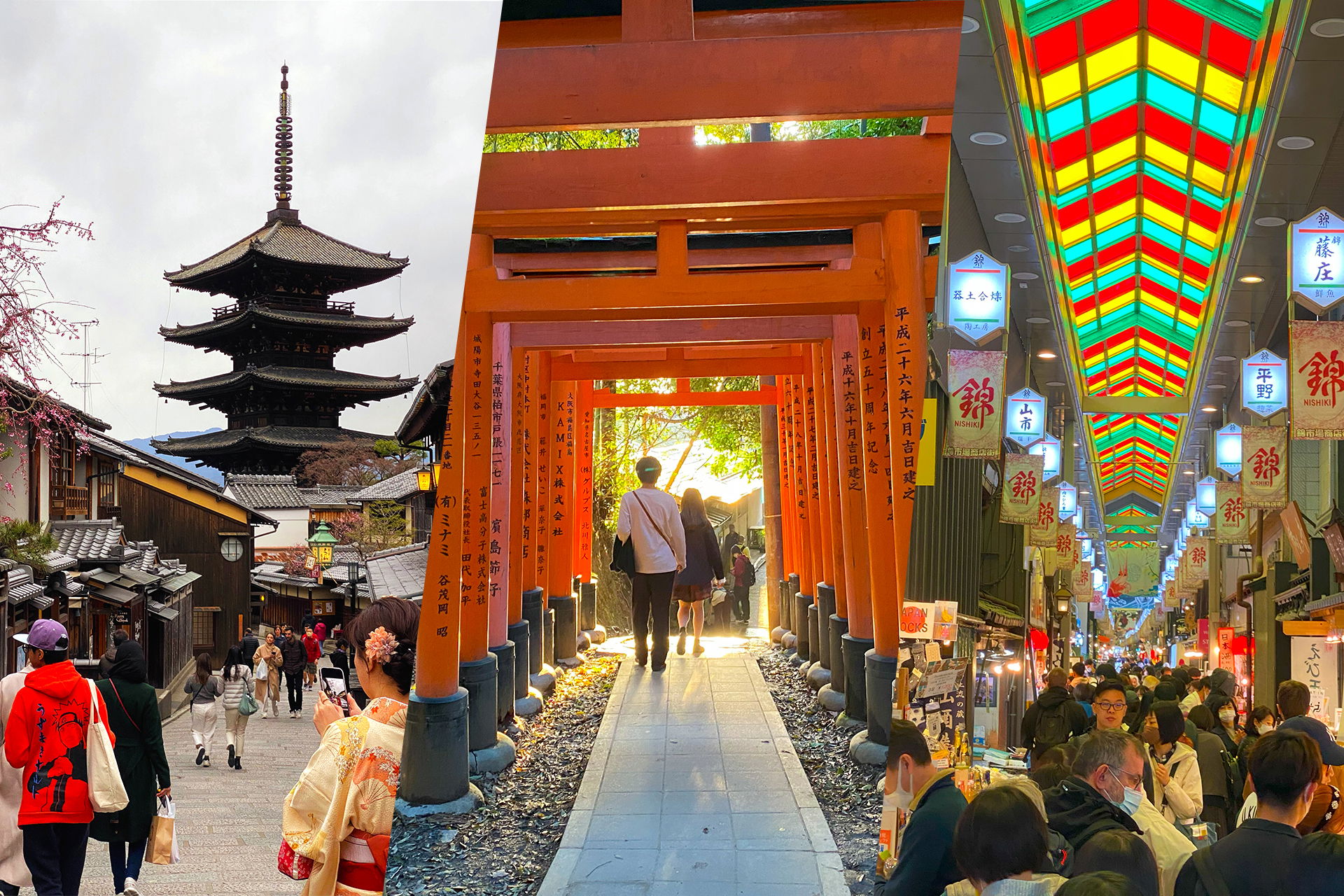
Indice dei contenuti:
TL;DR
Kyōto Trip è una guida di viaggio che descrive l'esperienza di un viaggio in auto da Tokyo a Kyoto, evidenziando la bellezza del paesaggio giapponese e i vantaggi delle soste lungo il percorso, come quella al lago Hamana, famosa per la sua tranquillità e la sua varietà di pesci. Il sito sottolinea il confronto tra i costi del viaggio in auto e quelli in treno, con una raccomandazione per il comodo e veloce Shinkansen, che collega le due città in meno di tre ore. Infine, vengono presentate le cinque principali attrazioni da non perdere a Kyoto, tra cui il suggestivo bosco di bambù di Arashiyama e il vivace mercato Nishiki, ideale per scoprire specialità locali e souvenir.Il nostro viaggio in auto da Tokyo a Kyoto
Oggi siamo partiti per andare da Tokyo a Kyoto in macchina. Anche se il viaggio è durato in totale nove ore, è stato comunque piacevole, perché io e mia madre ci siamo alternate alla guida.
Le autostrade in Giappone sono molto ben sviluppate e ben segnalate. Lungo il percorso ci sono anche molte aree di sosta dove potevamo rinfrescarci.
Durante il viaggio abbiamo potuto goderci il meraviglioso paesaggio. Lungo l’autostrada c’erano sempre valli verdi, laghi e montagne che attraversavamo. Questo ha reso il viaggio molto rilassante e vario.
Tuttavia, devo dire che è un po’ triste che guidare un’auto sia ancora più economico che prendere il treno, soprattutto considerando il cambiamento climatico. Rispetto all’auto, il treno è quasi due o tre volte più caro, il che significa che molte persone preferiscono ancora andare in macchina, anche se esiste un’alternativa più ecologica.
D’altra parte, devo anche ammettere che apprezzo la comodità di un’auto. Potevamo riposarci quando volevamo, fermarci quando avevamo bisogno di una pausa e avevamo sempre con noi le nostre cose. Questo non è necessariamente il caso quando si viaggia in treno.
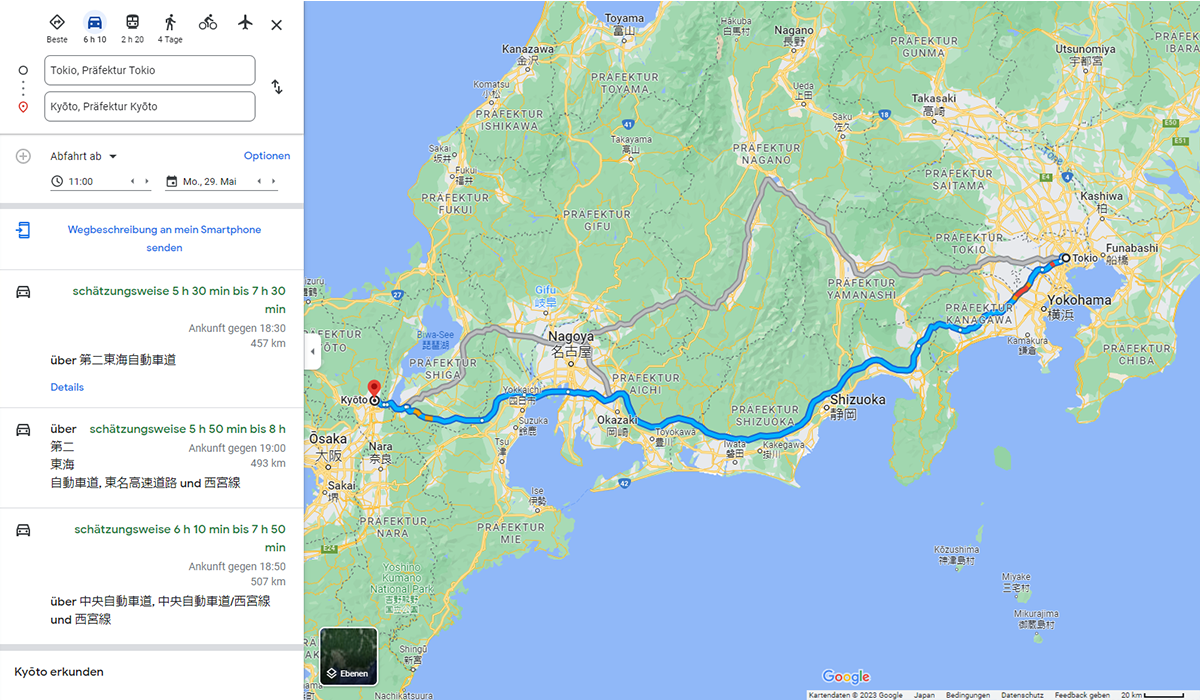
A Google Maps route planning screenshot in German shows the drive from Tokio to Kyōto. The left panel lists three route options with travel times: about 5 h 30 min to 7 h 30 min (457 km), 5 h 50 min to 8 h (493 km), and 6 h 10 min to 7 h 50 min (507 km), all departing Monday, May 29 at 11:00. The driving mode is selected, and each option names the expressways used, such as 第二東海自動車道 and 東名高速道路. The map on the right covers central Japan, with the recommended route drawn as a thick blue line running from Tokio past Yokohama, along the Pacific coast through Shizuoka, then west via Nagoya to a red destination pin at Kyōto, with Osaka and Nara nearby. A gray alternative route swings inland north of the mountains through the Nagano region. City labels like Toyama, Kanazawa, Takasaki and Utsunomiya mark the surrounding prefectures.
A Google Maps route planning screenshot in German shows the drive from Tokio to Kyōto. The left panel lists three route options with travel times: about 5 h 30 min to 7 h 30 min (457 km), 5 h 50 min to 8 h (493 km), and 6 h 10 min to 7 h 50 min (507 km), all departing Monday, May 29 at 11:00. The driving mode is selected, and each option names the expressways used, such as 第二東海自動車道 and 東名高速道路.
The map on the right covers central Japan, with the recommended route drawn as a thick blue line running from Tokio past Yokohama, along the Pacific coast through Shizuoka, then west via Nagoya to a red destination pin at Kyōto, with Osaka and Nara nearby. A gray alternative route swings inland north of the mountains through the Nagano region. City labels like Toyama, Kanazawa, Takasaki and Utsunomiya mark the surrounding prefectures.
Testo visibile nell'immagine
Beste
6 h 10
2 h 20
4 Tage
Tokio, Präfektur Tokio
Kyōto, Präfektur Kyōto
Abfahrt ab
Optionen
11:00
Mo., 29. Mai
Wegbeschreibung an mein Smartphone senden
schätzungsweise 5 h 30 min bis 7 h 30 min
Ankunft gegen 18:30
457 km
über 第二東海自動車道
Details
über 東海
schätzungsweise 5 h 50 min bis 8 h
Ankunft gegen 19:00
493 km
自動車道, 東名高速道路 und 西宮線
schätzungsweise 6 h 10 min bis 7 h 50 min
Ankunft gegen 18:50
507 km
über 中央自動車道, 中央自動車道/西宮線 und 西宮線
Kyōto erkunden
Toyama
Kanazawa
Nagano
Takasaki
Utsunomiya
Kashiwa
Tokio
Funabashi
Yokohama
Nagoya
Kyōto
Shizuoka
Ōsaka
Nara
Sakai
Biwa-See
PRAFEKTUR TOYAMA
PRAFEKTUR ISHIKAWA
PRAFEKTUR FUKUI
PRAFEKTUR GIFU
PRAFEKTUR NAGANO
PRAFEKTUR SAITAMA
PRAFEKTUR YAMANASHI
PRAFEKTUR TOKIO
PRAFEKTUR SHIGA
PRAFEKTUR AICHI
PRAFEKTUR CHIBA
PRAFEKTUR NARA
PRAFEKTUR MIE
Kōzushima
Miyake
Mikurajima
Hachijō-jima
Google
Kartendaten © 2023 Google Japan Bedingungen Datenschutz Feedback geben 20 km
Ebisen
Una sosta a Hamamatsu: relax al Lago Hamana
Se sei in viaggio da Tokyo a Kyoto, vale la pena fare una sosta a Hamamatsu. Abbiamo visitato in particolare il bellissimo Lago Hamana—un luogo di pace e relax.
Ciò che rende particolarmente interessante il lago è il fatto che abbia sia una parte d’acqua dolce che una di acqua salata. Per questo motivo qui vengono allevate anche le anguille, il che lo rende molto popolare tra gli amanti del pesce.
Dopo una passeggiata lungo la riva del lago, siamo andati al vicino ristorante Shibuki. Il ristorante offre anche menù in inglese, il che ha reso più facile ordinare. Mia madre e mio fratello hanno provato la famosa anguilla alla griglia, mentre io ho scelto il piatto con Shirasu (sardine baby).
Quindi se cerchi un posto dove rilassarti e staccare la spina, ti consiglio vivamente una sosta a Hamamatsu e al Lago Hamana. Qui puoi non solo goderti la natura, ma anche scoprire la cucina e la cultura locale.
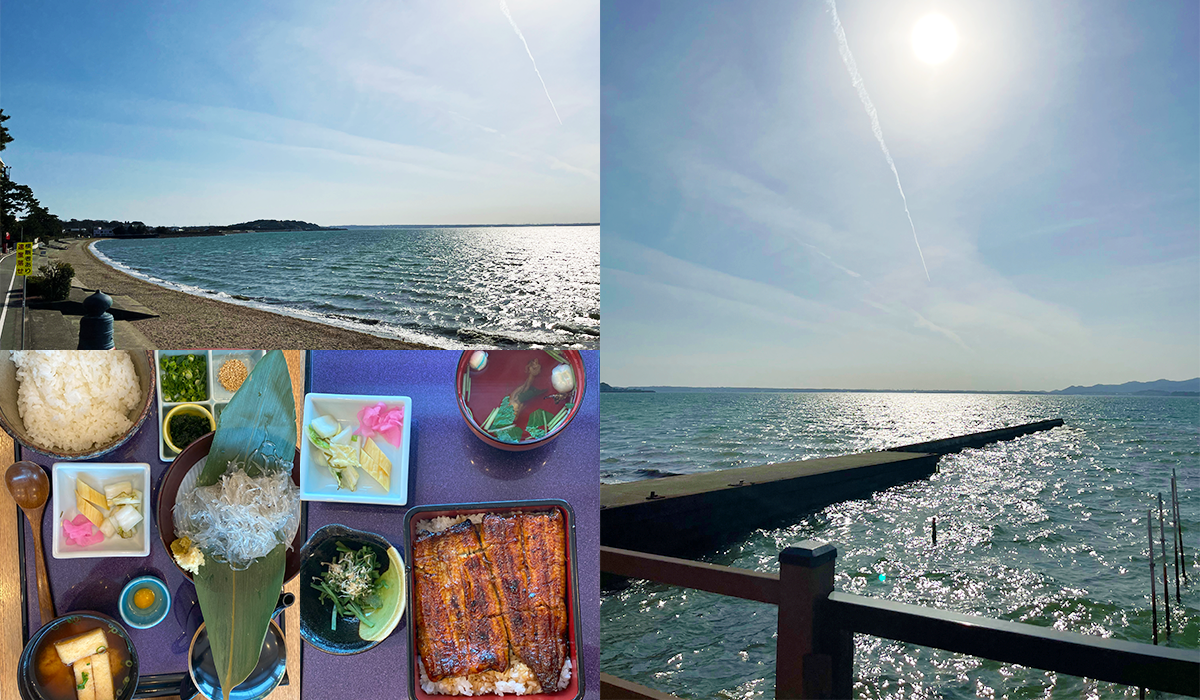
A three-photo collage from a stop in Hamamatsu on the drive from Tokyo to Kyoto. The top left photo shows a sandy beach curving along calm, sun-glittered water, with a quiet road and pine trees at the shore's edge. The large photo on the right looks out from a wooden terrace over a wide, sparkling bay, where a long concrete breakwater juts into the water under a bright sun and a single contrail. The bottom left photo looks straight down at a Japanese meal spread across a table. The centerpiece is unagi: broiled eel glazed a deep caramel brown, served over rice in a red and black lacquered box. Around it are a bowl of white rice, miso soup with tofu, cold soba noodles on a big green leaf, a raw egg yolk in a small cup, and little dishes of pickles and greens.
A three-photo collage from a stop in Hamamatsu on the drive from Tokyo to Kyoto. The top left photo shows a sandy beach curving along calm, sun-glittered water, with a quiet road and pine trees at the shore's edge. The large photo on the right looks out from a wooden terrace over a wide, sparkling bay, where a long concrete breakwater juts into the water under a bright sun and a single contrail.
The bottom left photo looks straight down at a Japanese meal spread across a table. The centerpiece is unagi: broiled eel glazed a deep caramel brown, served over rice in a red and black lacquered box. Around it are a bowl of white rice, miso soup with tofu, cold soba noodles on a big green leaf, a raw egg yolk in a small cup, and little dishes of pickles and greens.
Testo visibile nell'immagine
No clearly readable text.
Prendere lo Shinkansen per Kyoto
Se vuoi andare a Kyoto, dovresti assolutamente prendere lo Shinkansen—il treno superveloce giapponese. Con velocità massime fino a 320 km/h, ti porta a Kyoto in meno di tre ore. Una volta a bordo, noterai subito quanto sono spaziosi e confortevoli i sedili. Con Wi-Fi e prese di corrente a ogni posto, puoi continuare a lavorare o semplicemente rilassarti durante il viaggio.
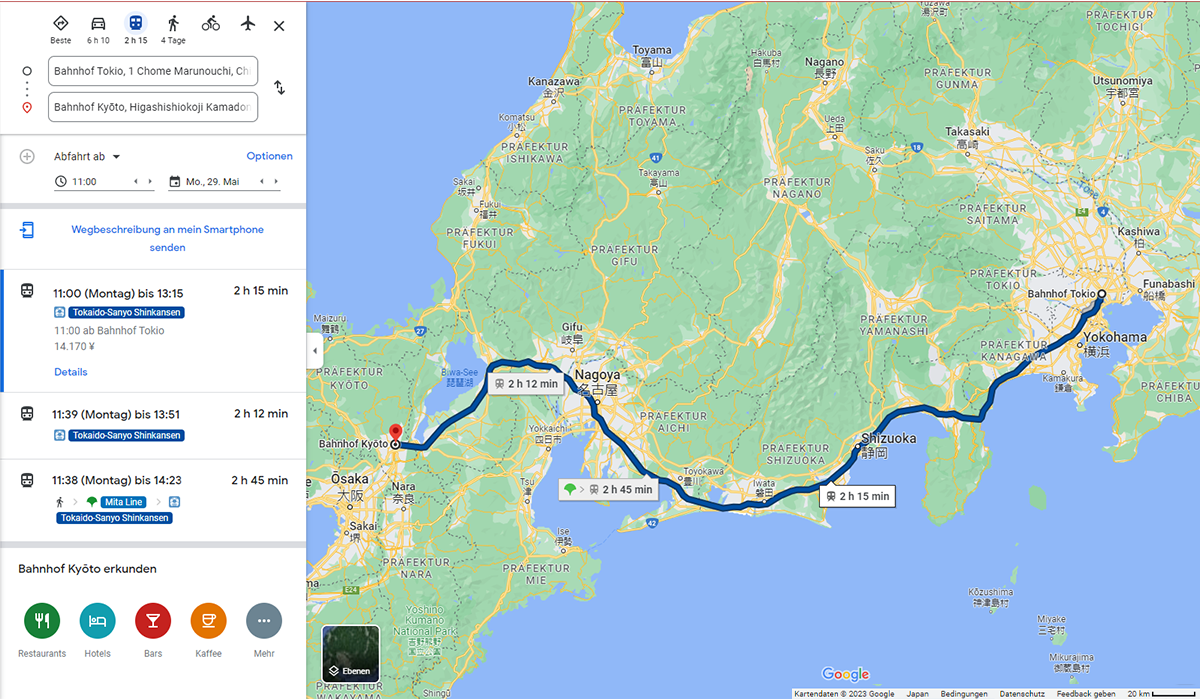
A Google Maps route planning screenshot showing the Shinkansen connection from Tokyo to Kyoto. The map fills most of the frame, covering central Japan from Tokyo Bay to the Osaka area, with prefecture labels such as Präfektur Shizuoka, Präfektur Aichi, and Präfektur Kyōto. A thick dark blue line traces the rail route along the Pacific coast, passing Yokohama, Shizuoka, and Nagoya before ending at a red pin at Kyoto Station. Small white badges along the route mark travel times of 2h 15 min, 2h 12 min, and 2h 45 min for different segments. The sidebar on the left is in German. At the top, mode icons compare options: car at 6h 10, train at 2h 15, walking at 4 days, plus cycling and flights. The start and destination fields read "Bahnhof Tokio, 1 Chome Marunouchi" and "Bahnhof Kyōto, Higashishiojokamado", with departure set to 11:00 on Monday, May 29. Below, three itinerary cards list Tokaido-Sanyo Shinkansen departures, the first running 11:00 to 13:15 for 2h 15 min at a fare of 14,170 ¥. At the bottom, a "Bahnhof Kyōto erkunden" section offers icons for restaurants, hotels, bars, and coffee near the destination.
A Google Maps route planning screenshot showing the Shinkansen connection from Tokyo to Kyoto. The map fills most of the frame, covering central Japan from Tokyo Bay to the Osaka area, with prefecture labels such as Präfektur Shizuoka, Präfektur Aichi, and Präfektur Kyōto. A thick dark blue line traces the rail route along the Pacific coast, passing Yokohama, Shizuoka, and Nagoya before ending at a red pin at Kyoto Station. Small white badges along the route mark travel times of 2h 15 min, 2h 12 min, and 2h 45 min for different segments.
The sidebar on the left is in German. At the top, mode icons compare options: car at 6h 10, train at 2h 15, walking at 4 days, plus cycling and flights. The start and destination fields read "Bahnhof Tokio, 1 Chome Marunouchi" and "Bahnhof Kyōto, Higashishiojokamado", with departure set to 11:00 on Monday, May 29. Below, three itinerary cards list Tokaido-Sanyo Shinkansen departures, the first running 11:00 to 13:15 for 2h 15 min at a fare of 14,170 ¥. At the bottom, a "Bahnhof Kyōto erkunden" section offers icons for restaurants, hotels, bars, and coffee near the destination.
Testo visibile nell'immagine
Beste
6 h 10
2 h 15
4 Tage
Bahnhof Tokio, 1 Chome Marunouchi, Ch
Bahnhof Kyōto, Higashiokioki Kamado
Abfahrt ab
Optionen
11:00
Mo., 29. Mai
Wegbeschreibung an mein Smartphone
senden
11:00 (Montag) bis 13:15
2 h 15 min
Tokaido-Sanyo Shinkansen
11:00 ab Bahnhof Tokio
14.170 ¥
Details
11:39 (Montag) bis 13:51
2 h 12 min
Tokaido-Sanyo Shinkansen
11:38 (Montag) bis 14:23
2 h 45 min
Mifa Line
Tokaido-Sanyo Shinkansen
Bahnhof Kyōto erkunden
Restaurants
Hotels
Bars
Kaffee
Mehr
Toyama
Hakuba
Nagano
Kanazawa
Komatsu
PRAFEKTUR TOYAMA
Utsunomiya
PRAFEKTUR TOCHIGI
PRAFEKTUR GUNMA
PRAFEKTUR ISHIKAWA
Takasaki
PRAFEKTUR FUKUI
Takayama
PRAFEKTUR NAGANO
PRAFEKTUR SAITAMA
Kashiwa
PRAFEKTUR GIFU
PRAFEKTUR YAMANASHI
Bahnhof Tokio
Funabashi
Gifu
Yokohama
PRAFEKTUR KANAGAWA
PRAFEKTUR KYOTO
Biwa-See
2 h 12 min
Nagoya
PRAFEKTUR AICHI
Bahnhof Kyōto
Yokkaichi
Shizuoka
PRAFEKTUR SHIZUOKA
Ōsaka
Nara
2 h 45 min
Toyokawa
2 h 15 min
Iwata
Sakai
PRAFEKTUR NARA
PRAFEKTUR MIE
Yoshino
Kumano Natio
nal Park
Kōzushima
Miyake
Mikurajima
Ebenen
Google
Kartendaten ©2023 Google Japan Bedingungen Datenschutz Feedback geben 20 km
Le migliori attrazioni di Kyoto
Sei finalmente arrivato a Kyoto e ti chiedi quali attrazioni devi assolutamente visitare? Ecco le nostre 5 raccomandazioni top:
Arashiyama: la foresta di bambù
Se desideri natura e tranquillità, Arashiyama è il luogo perfetto per te. Qui trovi una foresta di bambù in cui passeggiare.
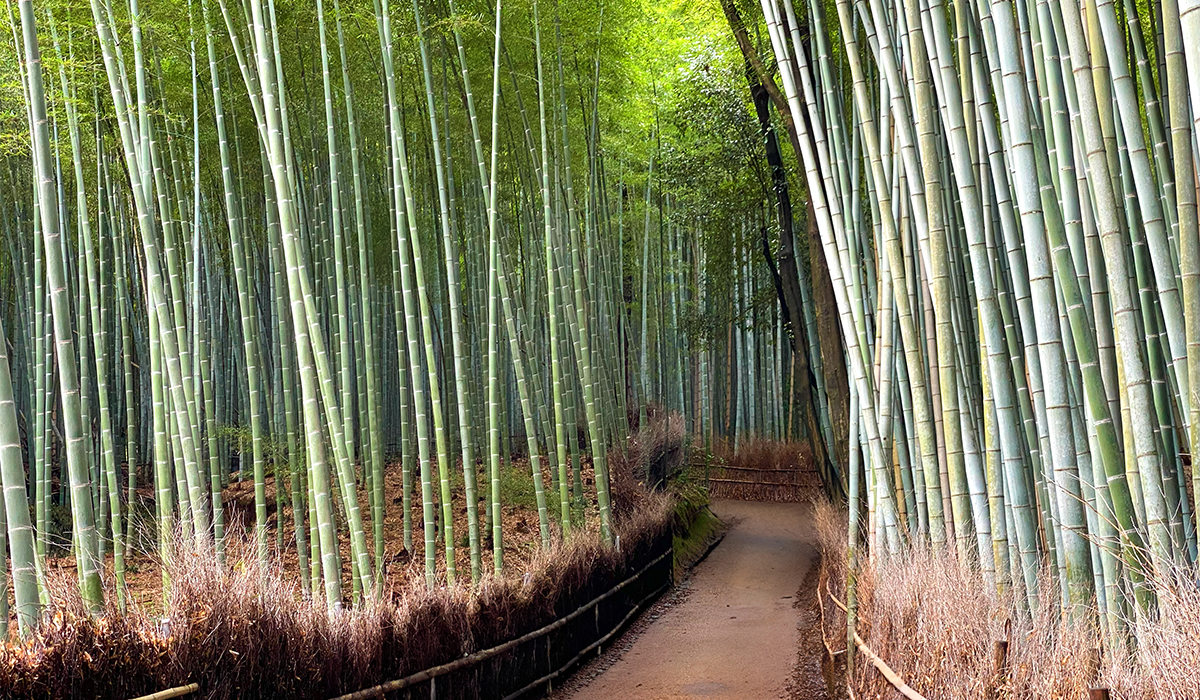
A narrow dirt path curves through the dense bamboo grove of Arashiyama in Kyoto. Tall, pale green bamboo stalks rise on both sides, leaning slightly inward and closing over the walkway so their leaves filter the light into a soft green glow. The path itself is empty and fades into the thicket a short distance ahead, while low fences woven from dried brush and bamboo line its edges.
A narrow dirt path curves through the dense bamboo grove of Arashiyama in Kyoto. Tall, pale green bamboo stalks rise on both sides, leaning slightly inward and closing over the walkway so their leaves filter the light into a soft green glow. The path itself is empty and fades into the thicket a short distance ahead, while low fences woven from dried brush and bamboo line its edges.
Testo visibile nell'immagine
There is no clearly readable text in this image.
Tour a piedi di Arashiyama – Bambù, templi e scimmie
Scopri il quartiere Arashiyama di Kyoto con una visita guidata: passeggia nella famosa foresta di bambù, visita il tempio Tenryu-ji e sali fino al parco delle scimmie con vista sulla città. Ideale per chi ama natura e cultura. (Agoda)
*Link affiliato: se prenoti un’attività tramite il mio widget o il mio link su viator.com, ricevo una piccola commissione. Non ci sono costi aggiuntivi per te e sostieni il mio blog. Te ne sono molto grata e ti auguro buon viaggio (^_^)
Mercato Nishiki: il famoso mercato per cibo e souvenir
Se cerchi un’esperienza autentica, visita il Mercato Nishiki. Qui troverai specialità locali e souvenir da portare a casa.
Speriamo che le nostre 5 raccomandazioni aiutino a rendere indimenticabile il tuo viaggio a Kyoto.
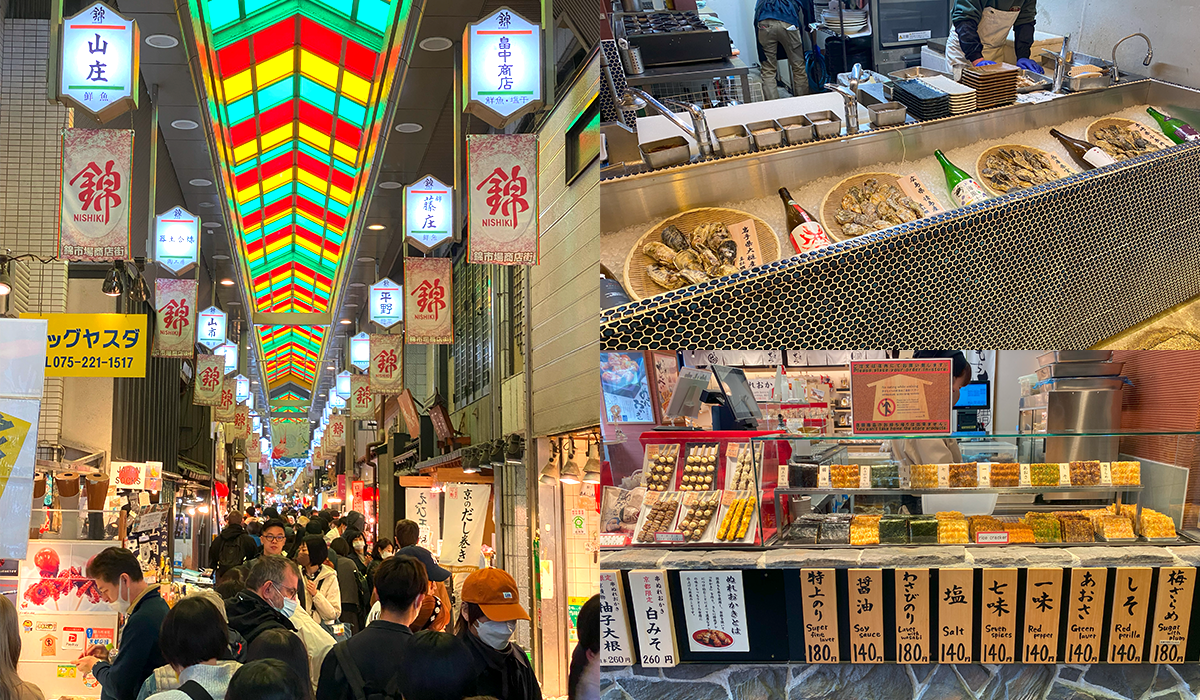
A side-by-side view of Nishiki Market in Kyoto, the covered shopping street known as "Kyoto's kitchen." The left photo looks down the narrow arcade, packed with shoppers in jackets, several wearing face masks. Overhead, the ceiling is lined with striking red, green, and yellow chevron-patterned light panels, and red-and-white fabric banners reading "NISHIKI" with the kanji 錦 hang alongside shop signs and paper lanterns on both sides. The right photo shows one of the market's food stalls up close. An ice-filled counter displays oysters and other shellfish on woven trays next to bottles of sake, with a vendor in an apron working behind it. In front, glass cases hold skewers and neat rows of bite-sized cubes in soy, seaweed, and sesame coatings, and a handwritten price board lists flavors like soy sauce, wasabi, salt, seven spice, and perilla starting at 140 yen.
A side-by-side view of Nishiki Market in Kyoto, the covered shopping street known as "Kyoto's kitchen." The left photo looks down the narrow arcade, packed with shoppers in jackets, several wearing face masks. Overhead, the ceiling is lined with striking red, green, and yellow chevron-patterned light panels, and red-and-white fabric banners reading "NISHIKI" with the kanji 錦 hang alongside shop signs and paper lanterns on both sides.
The right photo shows one of the market's food stalls up close. An ice-filled counter displays oysters and other shellfish on woven trays next to bottles of sake, with a vendor in an apron working behind it. In front, glass cases hold skewers and neat rows of bite-sized cubes in soy, seaweed, and sesame coatings, and a handwritten price board lists flavors like soy sauce, wasabi, salt, seven spice, and perilla starting at 140 yen.
Testo visibile nell'immagine
錦
山庄
鮮魚
錦
NISHIKI
錦市場商店街
昌早商店
鮮魚
グヤスタ
075-221-1517
京だし巻
白みそ 260円
特上 Sweet soy 180円
醬油 Soy sauce 140円
塩 Salt 140円
七味 Seven spices 140円
一味 Red pepper 140円
あさつき Green leek 140円
しそ Red perilla 140円
Sweet perilla 180円
Fiume Kamo 鴨川
Se cerchi un luogo rilassante e affascinante a Kyoto, allora dovresti visitare il fiume Kamo. È una piacevole alternativa a templi, santuari e alla città.
Soprattutto in primavera, lungo il fiume ci sono alcuni punti con bellissimi alberi di Sakura che trasformano il paesaggio in un mare colorato di rosa e bianco.
Anche se a Kyoto ci sono molte attrazioni, il fiume Kamo vale sicuramente una visita. Che tu voglia pedalare lungo il fiume o semplicemente passeggiare, resterai sicuramente colpito dalla bellezza di questo luogo.
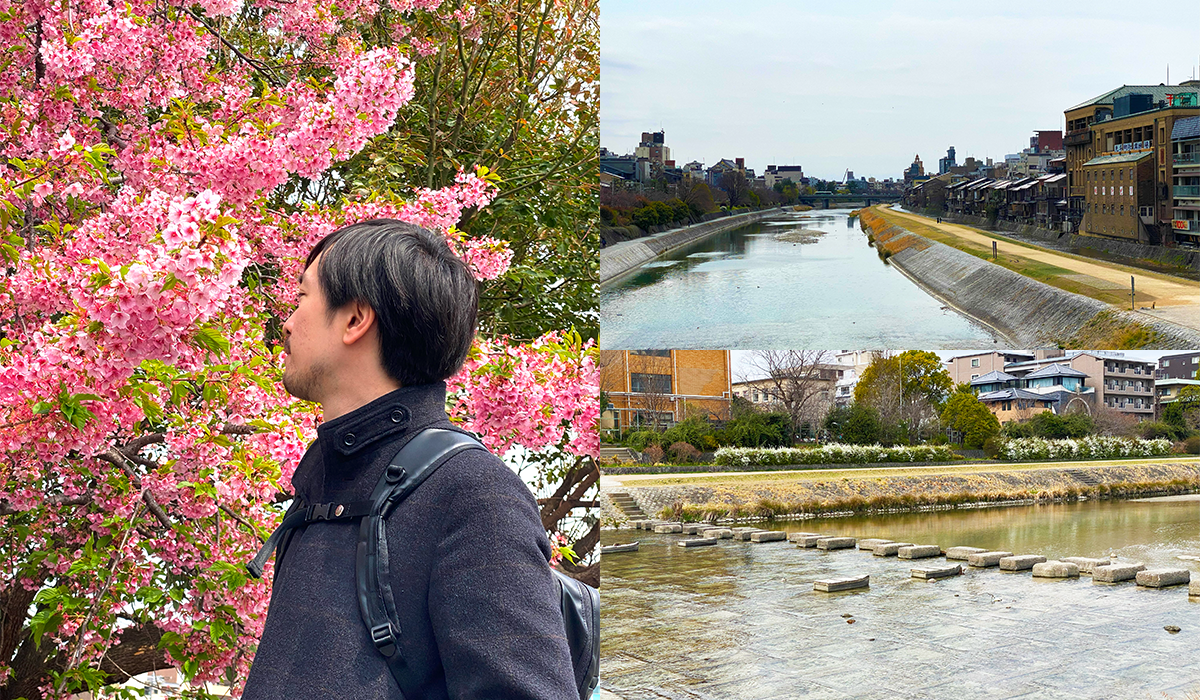
A collage of three photos from the Kamo River in Kyoto. On the left, a man in a dark wool coat with a black backpack stands in profile among dense clusters of pink cherry blossoms, looking up into the flowers. The right side shows the river itself in two views. The upper shot looks along the channelized river toward the city skyline, with sloped concrete embankments, a walking path, and low buildings lining the banks under an overcast sky. The lower shot captures the shallow water near the bank, where rows of square stepping stones cross the river, backed by apartment buildings, bare trees, and a strip of riverside greenery.
A collage of three photos from the Kamo River in Kyoto. On the left, a man in a dark wool coat with a black backpack stands in profile among dense clusters of pink cherry blossoms, looking up into the flowers.
The right side shows the river itself in two views. The upper shot looks along the channelized river toward the city skyline, with sloped concrete embankments, a walking path, and low buildings lining the banks under an overcast sky. The lower shot captures the shallow water near the bank, where rows of square stepping stones cross the river, backed by apartment buildings, bare trees, and a strip of riverside greenery.
Testo visibile nell'immagine
No clearly readable text.
Visita di templi e santuari a Kyoto
Goju-no-to Kyoto
Goju-no-to Kyoto è un edificio impressionante a Kyoto. È una pagoda a cinque piani che fa parte del tempio Tō-ji. La torre è stata costruita nel 1644 ed è una parte importante del patrimonio culturale della città. La torre è nota per le sue dimensioni e la sua bellezza, nonché per le numerose statue buddhiste conservate all’interno. Se sei a Kyoto, dovresti assolutamente visitare la Goju-no-to Kyoto per ammirare questa struttura straordinaria.
Fushimi Inari-Taisha: il celebre santuario con migliaia di Torii
Pronto per un’escursione affascinante? Allora visita Fushimi Inari-Taisha, il famoso santuario con migliaia di Torii. La passeggiata dura circa due ore, ma la vista mozzafiato e l’atmosfera unica la renderanno un’esperienza indimenticabile.
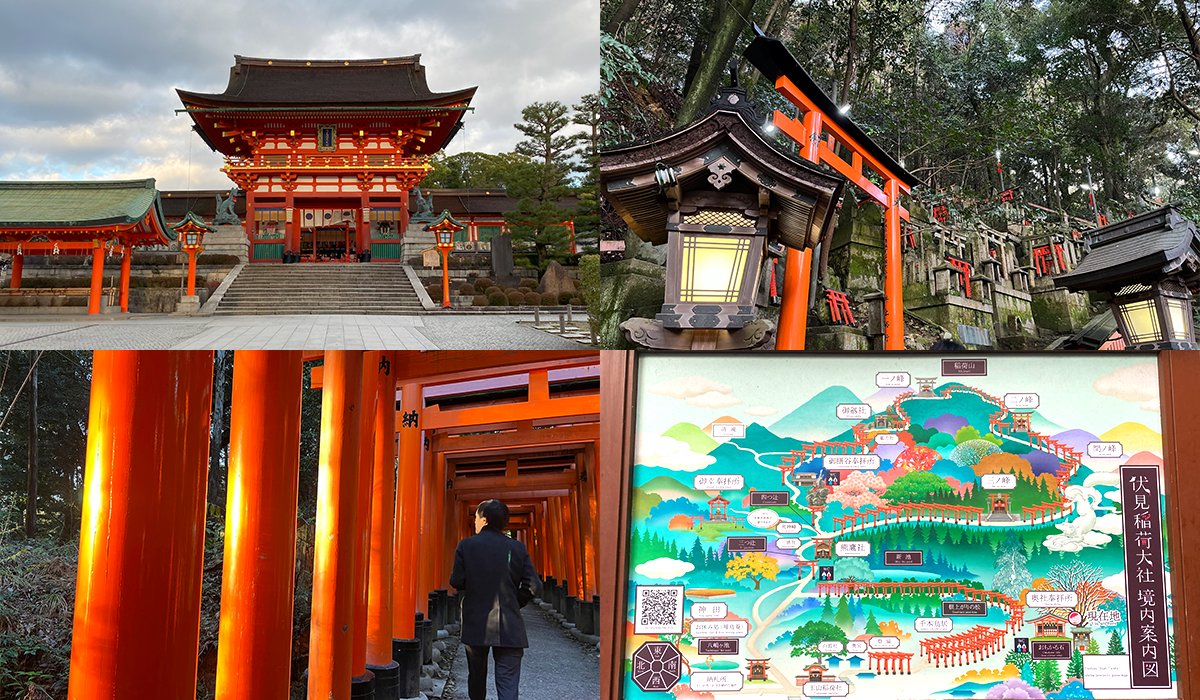
A four-photo collage from Fushimi Inari Taisha, the famous vermilion shrine in Kyoto. The top left photo shows the shrine's grand entrance gate, a two-story red structure with a sweeping dark roof, stone steps leading up to it, and lanterns flanking the approach under a cloudy sky. Top right, a tall torii gate rises from a wooded hillside dotted with small stone shrines and glowing lanterns tucked into the slope. The bottom left photo takes you inside the signature tunnel of closely packed orange torii gates, with a visitor in a dark coat walking away down the gravel path. The bottom right photo is an illustrated grounds map of the shrine complex, drawn in bright greens and reds, showing the hiking trails, sub-shrines, and the three peaks of Mount Inari with labels in Japanese.
A four-photo collage from Fushimi Inari Taisha, the famous vermilion shrine in Kyoto.
The top left photo shows the shrine's grand entrance gate, a two-story red structure with a sweeping dark roof, stone steps leading up to it, and lanterns flanking the approach under a cloudy sky. Top right, a tall torii gate rises from a wooded hillside dotted with small stone shrines and glowing lanterns tucked into the slope. The bottom left photo takes you inside the signature tunnel of closely packed orange torii gates, with a visitor in a dark coat walking away down the gravel path. The bottom right photo is an illustrated grounds map of the shrine complex, drawn in bright greens and reds, showing the hiking trails, sub-shrines, and the three peaks of Mount Inari with labels in Japanese.
Testo visibile nell'immagine
内
納
伏見稲荷大社境内案内図
稲荷山
一ノ峰
二ノ峰
三ノ峰
間ノ峰
四辻
手水舎
Fushimi Inari Taisha – Tour privato di mezza giornata a Kyoto
Vivi il celebre Fushimi Inari Taisha con i suoi infiniti tunnel rossi di Torii in un tour privato di mezza giornata. Una guida locale ti accompagnerà lungo i sentieri storici, ti racconterà le storie delle statue di volpe (Kitsune) e ti porterà in angoli nascosti lontani dalla folla di turisti. Perfetto per chi vuole scoprire il cuore spirituale di Kyoto in modo intenso e personale.
Kinkaku-ji: Il Padiglione d’Oro
Il Padiglione d’Oro, noto anche come Kinkaku-ji, è uno dei simboli più famosi di Kyoto. Il tempio è coperto di foglie d’oro e si riflette nelle tranquille acque dello stagno. È un luogo splendido e tranquillo che non dovresti perdere.
Visite guidate al tempio Kinkaku-ji
Sono disponibili anche visite guidate. Se desideri esplorare il tempio Kinkaku-ji con una guida locale, puoi prenotare direttamente sul posto.
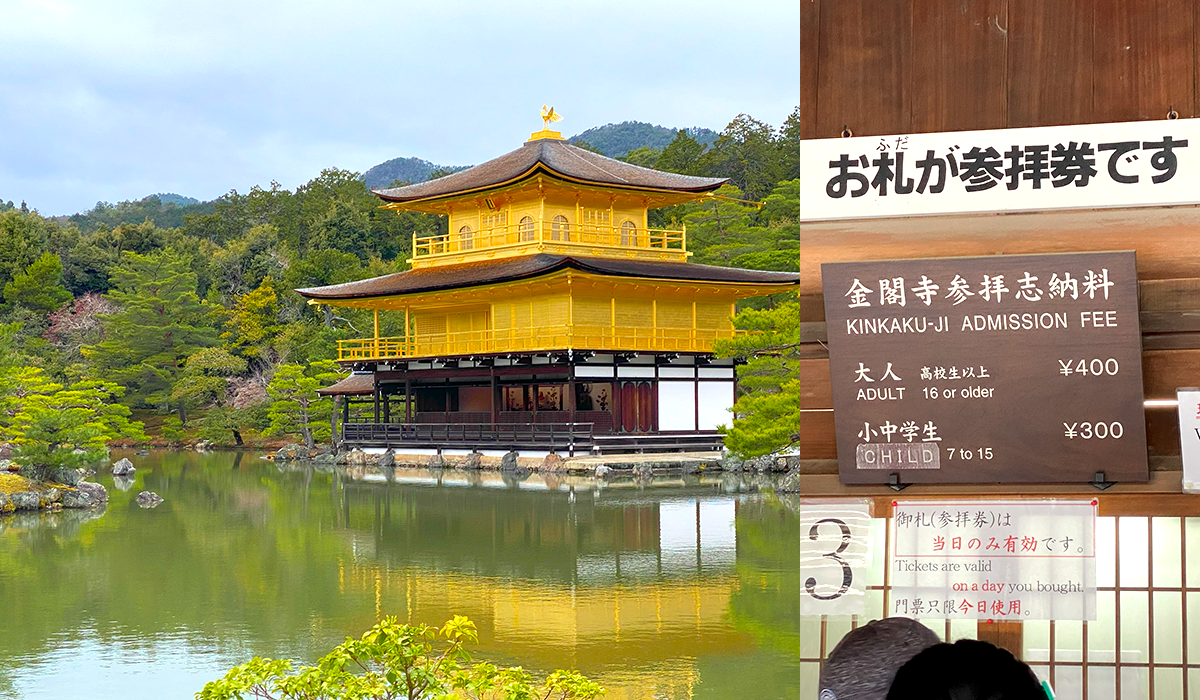
The photo is split into two scenes from a visit to Kinkaku-ji, the Golden Pavilion in Kyoto. On the left, the temple's top two floors gleam in gold leaf above a white-plastered ground level, standing at the edge of a still pond that mirrors the building almost perfectly. Dark tiled roofs stack in tiers, crowned by a small golden phoenix, and forested hills rise behind it under a grey sky. Pines and autumn-touched trees frame the shoreline. The right half shows the ticket counter. A wooden board lists the admission fee in Japanese and English: ¥400 for adults 16 and older, ¥300 for children 7 to 15. Above it, a white banner explains in Japanese that your receipt doubles as the admission ticket, and below, a smaller multilingual notice states tickets are valid only on the day of purchase. The top of a visitor's head is just visible at the bottom edge, waiting at window number 3.
The photo is split into two scenes from a visit to Kinkaku-ji, the Golden Pavilion in Kyoto. On the left, the temple's top two floors gleam in gold leaf above a white-plastered ground level, standing at the edge of a still pond that mirrors the building almost perfectly. Dark tiled roofs stack in tiers, crowned by a small golden phoenix, and forested hills rise behind it under a grey sky. Pines and autumn-touched trees frame the shoreline.
The right half shows the ticket counter. A wooden board lists the admission fee in Japanese and English: ¥400 for adults 16 and older, ¥300 for children 7 to 15. Above it, a white banner explains in Japanese that your receipt doubles as the admission ticket, and below, a smaller multilingual notice states tickets are valid only on the day of purchase. The top of a visitor's head is just visible at the bottom edge, waiting at window number 3.
Testo visibile nell'immagine
ふだ
お札が参拝券です
金閣寺参拝志納料
KINKAKU-JI ADMISSION FEE
大人 高校生以上 ¥400
ADULT 16 or older
小中学生 ¥300
CHILD 7 to 15
3
御札(参拝券)は
当日のみ有効です。
Tickets are valid
on a day you bought.
門票只限今日使用。
Kiyomizu-dera: il tempio su palafitte
Il tempio Kiyomizu-dera è un’altra gemma di Kyoto. Il tempio è stato costruito senza chiodi o viti e si erge su palafitte. Da qui si gode di una vista mozzafiato su Kyoto.
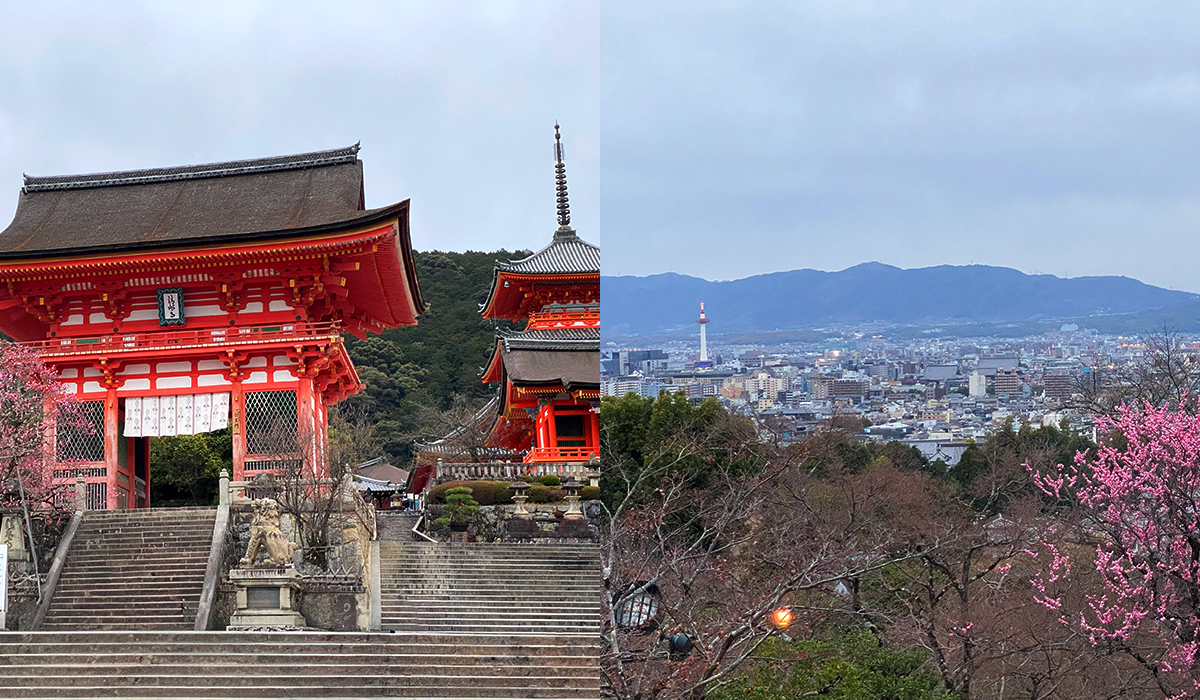
A two-part photo from Kyoto. On the left, the vermilion-red gate of Kiyomizu-dera temple rises above a wide flight of stone stairs. A guardian statue sits in a stone niche beside the steps, white banners hang in the gate's lower level, and the temple's three-storied pagoda stands on the slope behind it under an overcast sky, framed by dark green trees and pink blossoms. The right half shows the view from the hillside looking down over Kyoto: a dense spread of low city buildings stretching toward a band of blue-grey mountains, with the slender white-and-red Kyoto Tower rising near the center. Bare winter branches and bright pink plum blossoms fill the foreground.
A two-part photo from Kyoto. On the left, the vermilion-red gate of Kiyomizu-dera temple rises above a wide flight of stone stairs. A guardian statue sits in a stone niche beside the steps, white banners hang in the gate's lower level, and the temple's three-storied pagoda stands on the slope behind it under an overcast sky, framed by dark green trees and pink blossoms.
The right half shows the view from the hillside looking down over Kyoto: a dense spread of low city buildings stretching toward a band of blue-grey mountains, with the slender white-and-red Kyoto Tower rising near the center. Bare winter branches and bright pink plum blossoms fill the foreground.
Testo visibile nell'immagine
No text is clearly readable in the image.
Esplorare Kyoto in bicicletta
Se vuoi scoprire Kyoto in modo particolare, un giro in bici per la città è proprio ciò che fa per te. Con una bicicletta puoi spostarti velocemente e facilmente da un’attrazione all’altra e ammirare la bellezza della città da una prospettiva diversa. Ti consigliamo di noleggiare una bici e seguire uno dei tanti itinerari ciclabili della città. In questo modo puoi visitare i famosi templi e santuari, pedalare nei vicoli stretti ed entrare a contatto diretto con la cultura giapponese. Un tour in bicicletta a Kyoto è un’esperienza indimenticabile e un ottimo modo per scoprire la città.
Kyoto e la fioritura dei ciliegi: Hanami nell’antica capitale
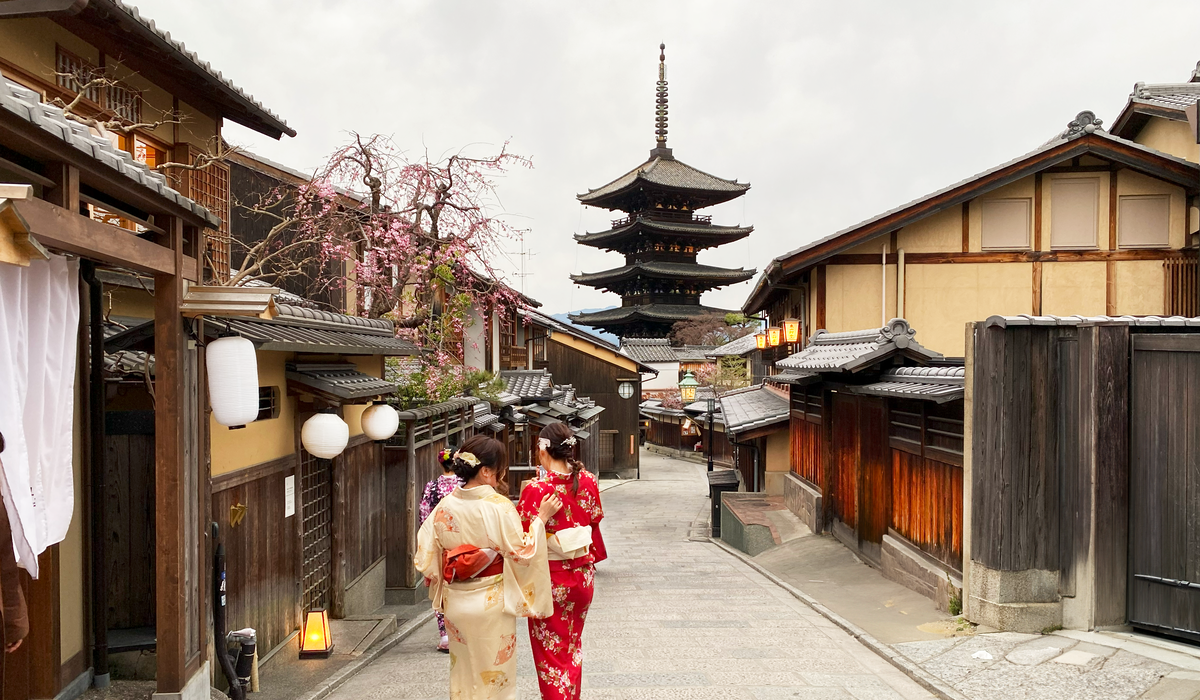
Kyoto è meravigliosa in ogni stagione, ma durante la fioritura dei ciliegi la città si trasforma in una vera terra da fiaba.
A Kyoto ci sono molti luoghi dove puoi ammirare i ciliegi in fiore. Uno dei più noti è il Sentiero del Filosofo, dove puoi passeggiare sotto i ciliegi in fiore e goderti la bellezza della natura. Il sentiero prende il nome dal filosofo Nishida Kitaro, che era solito camminare qui per riflettere e meditare.
Scopri Kyoto con una guida locale – tour privato su misura
Vivi Kyoto come un abitante del posto: questo tour privato è organizzato individualmente secondo i tuoi interessi—che si tratti di templi famosi, vicoli nascosti o specialità culinarie. La tua guida programma l’itinerario insieme a te, così puoi esplorare la città come più ti piace. Perfetto per chi vuole vivere Kyoto in modo autentico e flessibile.
Kyoto Highlights – Tour privato di un giorno
Kyoto Highlights – Tour privato di un giorno: scopri i luoghi più famosi di Kyoto in un giorno con una guida privata—dal Padiglione d’Oro alla foresta di bambù di Arashiyama fino al Fushimi Inari e al quartiere di Gion. Perfetto per conoscere la città in modo compatto e senza stress.
*Link affiliato: se prenoti un’attività tramite il mio widget o il mio link su viator.com, ricevo una piccola commissione. Non ci sono costi aggiuntivi per te e sostieni il mio blog. Te ne sono molto grata e ti auguro buon viaggio (^_^)
*Link affiliato: se prenoti un’attività tramite il mio widget o il mio link su viator.com, ricevo una piccola commissione. Non ci sono costi aggiuntivi per te e sostieni il mio blog. Te ne sono molto grata e ti auguro buon viaggio (^_^)



Commenti