
Indice dei contenuti:
TL;DR
Daikon, conosciuto anche come daikon rettich, rettich giapponese o cinese e rettich invernale, è una varietà di ortaggio radice molto diffusa in Est Asia e fondamentale nella cucina nipponica. La sua stagione principale è l'autunno e viene utilizzato in diverse preparazioni culinarie che esaltano il suo sapore, come il Kiriboshi Daikon, ottenuto mediante essiccazione. Per piatti come il sashimi, il daikon deve essere affettato finemente, poiché strisce più spesse possono risultare eccessivamente piccanti. La dolcezza e la milderzza del daikon tendono a variare con la stagione, essendo più delicato e saporito in inverno. Anche le foglie di daikon sono commestibili e possono essere coltivate riutilizzando una porzione della radice. Negli ultimi tempi, il daikon è diventato sempre più presente nei supermercati tedeschi, dove si consiglia di scegliere esemplari sodi e non gommosi per garantire un buon gusto.| Alta stagione: | Autunno |
|---|---|
| Categoria: | Verdura |
| Altri Nomi: | Daikon-Rettich, ravanello giapponese o cinese, ravanello invernale |
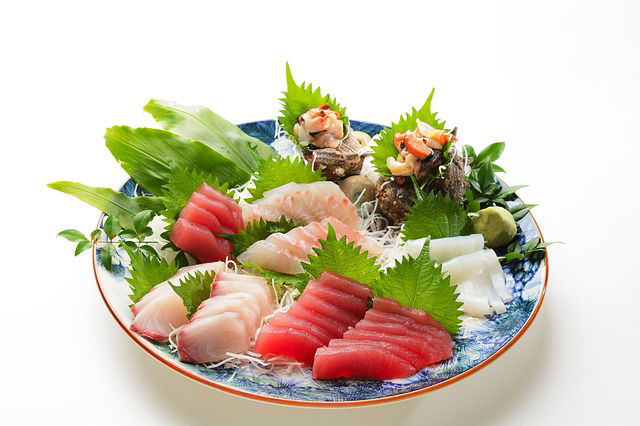
A round plate of assorted sashimi sits on a white surface. The plate is decorated in blue and white patterns with an orange rim, and its base is covered with fine shredded daikon radish. On top are slices of raw fish arranged in small fanned groups: deep red tuna, pale pink and white fish, and translucent squares of squid. Two pieces near the back are topped with a small seafood mixture, and a mound of green wasabi rests at the right edge. Jagged-edged green shiso leaves are tucked between the fish, with a few broader leaves and sprigs filling out the arrangement.
A round plate of assorted sashimi sits on a white surface. The plate is decorated in blue and white patterns with an orange rim, and its base is covered with fine shredded daikon radish. On top are slices of raw fish arranged in small fanned groups: deep red tuna, pale pink and white fish, and translucent squares of squid. Two pieces near the back are topped with a small seafood mixture, and a mound of green wasabi rests at the right edge. Jagged-edged green shiso leaves are tucked between the fish, with a few broader leaves and sprigs filling out the arrangement.
Testo visibile nell'immagine
No text is clearly readable in the image.
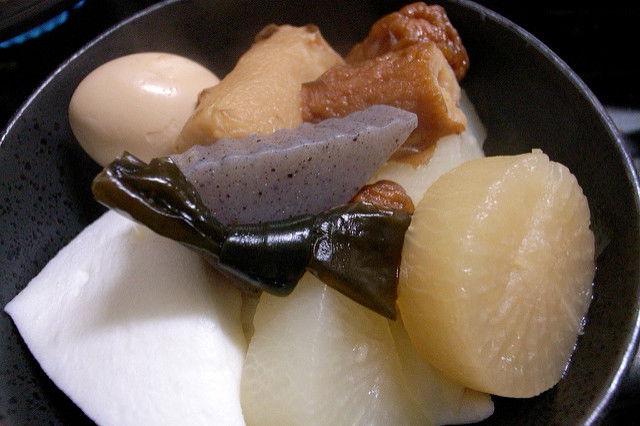
A close-up of a dark bowl filled with oden, the Japanese simmered dish, packed so the pieces nearly fill the frame. A thick round slice of daikon radish sits on the right, cooked to a translucent pale yellow, with a wedge of white daikon at the lower left. Beside them rest a whole boiled egg tinted light brown from the broth, a gray speckled triangle of konjac, a folded piece of dark kombu seaweed tied like a knot, and several browned fish cakes crowded at the top. Everything glistens with simmering broth, giving the dish a soft, stewed look.
A close-up of a dark bowl filled with oden, the Japanese simmered dish, packed so the pieces nearly fill the frame. A thick round slice of daikon radish sits on the right, cooked to a translucent pale yellow, with a wedge of white daikon at the lower left. Beside them rest a whole boiled egg tinted light brown from the broth, a gray speckled triangle of konjac, a folded piece of dark kombu seaweed tied like a knot, and several browned fish cakes crowded at the top. Everything glistens with simmering broth, giving the dish a soft, stewed look.
Testo visibile nell'immagine
No text is clearly readable in this image.
Daikon (giap. だいこん oppure 大根 significa letteralmente "grande radice") è un ravanello diffuso in Asia orientale. È un ingrediente principale della cucina giapponese ed è indispensabile. Per questo motivo, questo ravanello ha molti nomi come: Daikon-Rettich, ravanello giapponese o cinese o anche ravanello invernale. Esistono moltissime modalità di preparazione che esaltano il sapore del Daikon in vari modi. Ad esempio, il Daikon viene tagliato a julienne e successivamente essiccato, chiamato allora Kiriboshi Daikon (切干大根, "Daikon tagliato e essiccato"). In questo processo, il ravanello perde molta acqua, così che gli aromi emergono più intensamente. Come insalata o contorno per sashimi, il Daikon si presta altrettanto bene. È importante che il Daikon venga tagliato a fette molto sottili. Se le fette sono troppo spesse, l'insalata risulta troppo piccante. La piccantezza dipende anche dalla stagione; secondo la mia esperienza, i Daikon invernali sono più delicati e hanno un sapore migliore. Anche le foglie del Daikon possono essere utilizzate. Questo può anche rigenerarsi, a condizione di conservare circa 3 cm della parte superiore e poi lasciarlo in acqua. Nel frattempo, il Daikon si trova anche nei supermercati tedeschi. È importante che sia sodo e non gommoso, altrimenti non avrà più sapore.
Commenti