Daftar isi:
TL;DR
Pulau Hachijō-jima di selatan Tokyo itu ibarat Hawaii-nya Jepang: alam tropis rimbun, pemandangan vulkanik, onsen, dan masih sepi wisatawan. Cara tercepat ke sana adalah penerbangan 45 menit dari Haneda, atau naik feri sekitar 10 jam dari Takeshiba kalau mau lebih santai. Yang paling penting: langsung sewa mobil begitu mendarat, karena busnya jarang dan mobil adalah kunci buat jelajah pulau ini dengan bebas.Hachijō-jima, sebuah pulau vulkanik, terletak sekitar 300 kilometer di selatan Tokyo di Samudra Pasifik dan secara administratif termasuk dalam wilayah ibu kota Jepang. Pulau ini merupakan bagian dari Kepulauan Izu dan Taman Nasional Fuji-Hakone-Izu. Yang membedakan Hachijō-jima dari pulau-pulau lain di rangkaian Izu adalah iklim subtropisnya dan vegetasi yang rimbun, hampir seperti rimba, sebagai hasilnya. Pulau ini menawarkan perpaduan unik antara alam yang masih alami, lanskap vulkanik, onsen yang menenangkan, dan atraksi budaya.
Hachijō-jima memiliki sejarah yang menarik. Temuan arkeologi menunjukkan bahwa pulau ini sudah dihuni sejak periode Jōmon (sekitar 14.000 - 300 SM). Pada periode Edo (1603-1868), pulau ini berfungsi sebagai tempat pengasingan bagi para penjahat dan pembangkang politik. Salah satu orang buangan yang paling terkenal adalah Ukita Hideie, seorang daimyō yang dikalahkan dalam Pertempuran Sekigahara. Keturunannya baru diampuni setelah Restorasi Meiji pada tahun 1869. Sejarah pulau ini sebagai tempat pengasingan telah membentuk budaya dan identitas lokal, memberikan Hachijō-jima suasana yang khas.
Secara pribadi, saya sangat tertarik dengan pulau ini saat musim gugur, ketika Tokyo sudah mengalami suhu yang lebih dingin. Hutan yang rimbun dan lanskap pesisir yang berbatu memancarkan pesona yang unik. Yang membedakan Hachijō-jima dari pulau-pulau lain di rangkaian Izu adalah tingkat pembangunan wisatanya yang rendah. Bangunan-bangunan terbengkalai, seperti bekas Hachijo Royal Hotel, menjadi saksi bisu ledakan pariwisata masa lalu dan memberikan pulau ini sentuhan nostalgia serta petualangan. Justru kontras antara alam yang masih alami dan jejak masa lalu inilah yang membuat Hachijō-jima begitu menarik bagi saya.
Menuju dan Berkeliling di Hachijō-jima
Dengan Pesawat ke Hachijō-jima
Bepergian dengan pesawat adalah pilihan tercepat dan paling nyaman. Penerbangan dari Tokyo (Bandara Haneda) hanya memakan waktu 45 menit dan menawarkan pemandangan menakjubkan Gunung Fuji yang puncaknya bersalju serta pulau-pulau di sekitarnya. Selama penerbangan saya, saya dapat menyaksikan matahari terbenam yang spektakuler di atas lapisan awan dan mengagumi Gunung Fuji yang megah dengan puncaknya yang bersalju. Smartphone modern memungkinkan para pelancong menangkap momen-momen unik ini – seperti matahari terbenam atau pemandangan Fuji – dengan kualitas luar biasa melalui jendela pesawat. Tarif tiket pesawat sekitar 35.000 Yen per orang untuk perjalanan pulang-pergi, cukup wajar untuk pengalaman pulau yang istimewa ini.

Seen from an airplane window, Mount Fuji rises above a thick blanket of clouds at sunset. The volcano's perfectly shaped cone stands in dark silhouette against a sky glowing in soft orange and peach tones, with its lower slopes fading into the hazy cloud layer below. A curved edge of the aircraft's engine is visible in the bottom left corner, confirming the view from the window seat. Wispy clouds catch the warm light overhead, giving the whole scene a calm, golden glow.
Seen from an airplane window, Mount Fuji rises above a thick blanket of clouds at sunset. The volcano's perfectly shaped cone stands in dark silhouette against a sky glowing in soft orange and peach tones, with its lower slopes fading into the hazy cloud layer below. A curved edge of the aircraft's engine is visible in the bottom left corner, confirming the view from the window seat. Wispy clouds catch the warm light overhead, giving the whole scene a calm, golden glow.
Teks yang terlihat pada gambar
No clearly readable text found in the image.
Dengan Feri ke Hachijō-jima
Sebagai alternatif bepergian dengan pesawat, Hachijō-jima juga bisa dicapai dengan feri. Feri beroperasi dari Tokyo (Dermaga Takeshiba) dan pelabuhan-pelabuhan lain di Kepulauan Izu. Penyeberangan memakan waktu sekitar 10 jam dan menawarkan cara yang santai untuk mencapai pulau ini. Informasi tentang jalur feri, jadwal, dan harga dapat ditemukan di situs web Tokai Kisen.
Mobil Sewa - Fleksibilitas dan Kebebasan di Hachijō-jima
Segera setelah mendarat di bandara, kami menyewa mobil K-Car kompak dari ENEOS Rent a Car. Harga 5.000 Yen per hari, termasuk asuransi, cukup wajar menurut standar Jepang. Meskipun mobil sewa kami sudah tidak terbaru lagi (odometer hampir 99.999 kilometer), mobil itu tetap menjalankan fungsinya dengan baik. Untuk masa tinggal empat hari kami, total biayanya, termasuk pengisian bahan bakar, mencapai 22.000 Yen. Tips: Karena perusahaan penyewaan mobil tersebut juga mengoperasikan pom bensin, kami bisa mengembalikan mobil dengan tangki penuh, sehingga tidak perlu repot mengisi bahan bakar sebelum keberangkatan.
Mobil sewa hampir menjadi kebutuhan wajib di Hachijō-jima untuk menjelajahi pulau secara fleksibel. Kelebihan lainnya: Setelah menelepon dari bandara, perusahaan penyewa langsung menjemput kami, sehingga kami terhindar dari biaya taksi.

A small pink kei car, a boxy Japanese mini hatchback, sits parked at night in a rental car lot on Hachijō-jima. The photo is taken from the side at close range, showing its tall windows, roofline rain guards, and simple silver hubcaps with a Nissan logo. A white sign on the wall behind it reads "レンタカー" (rental car) with a phone number, and other sedans in similar reddish shades are parked around it under bright lot lighting. It is exactly the kind of tiny rental you would pick up to loop around the island.
A small pink kei car, a boxy Japanese mini hatchback, sits parked at night in a rental car lot on Hachijō-jima. The photo is taken from the side at close range, showing its tall windows, roofline rain guards, and simple silver hubcaps with a Nissan logo. A white sign on the wall behind it reads "レンタカー" (rental car) with a phone number, and other sedans in similar reddish shades are parked around it under bright lot lighting. It is exactly the kind of tiny rental you would pick up to loop around the island.
Teks yang terlihat pada gambar
レンタカー-あります
TEL 2-2006
Pilihan Transportasi Alternatif
- Bus Umum: Bus-bus di Hachijō-jima tidak beroperasi terlalu sering dan jalurnya terbatas. Ada dua jalur bus: "Community Bus Route" beroperasi di pusat kota (Okago dan Mitsune) dan "Public Bus Route" menghubungkan kelima wilayah pulau (Mitsune, Okago, Kashitate, Nakanogo, Sueyoshi). Jadwal dan informasi rute tersedia di situs web Hachijo Town Bus

A white local bus on Hachijō-jima rolls down a sunny street, its side painted with big, playful illustrations of passion fruit and lemons, plus a few small flowers near the front. Japanese characters and the number 156 are printed beside the doors. Behind it stand a low tiled-roof building and tropical greenery under a blue sky with puffy clouds, giving the island its "Japan's Hawaii" feel.
A white local bus on Hachijō-jima rolls down a sunny street, its side painted with big, playful illustrations of passion fruit and lemons, plus a few small flowers near the front. Japanese characters and the number 156 are printed beside the doors. Behind it stand a low tiled-roof building and tropical greenery under a blue sky with puffy clouds, giving the island its "Japan's Hawaii" feel.
Teks yang terlihat pada gambar
八丈島 156
29-19
- E-Bikes: Di kota dan di sepanjang beberapa ruas pantai, e-bike bisa disewa. Ini sangat cocok untuk jarak pendek dan menjelajahi daerah pesisir yang lebih datar. Kurang disarankan untuk digunakan di bagian pulau yang berbukit.

Three red rental e-bikes stand side by side at a bike-share docking station on a sunny, brick-paved lot. Each bike has a black front basket, a small digital display with a QR code on the handlebars, and a black cover over the rear wheel with stickers and a red reflector. They are the compact, step-through style typical of Japanese city cycles. To the left, a white signboard marks the station: a red bicycle logo, a price of ¥275, the station number 07, and the name of the Kaminato Port parking area in both Japanese and English, identifying the spot as a cycle port on Hachijō-jima. A metal railing and a bit of greenery run behind the bikes.
Three red rental e-bikes stand side by side at a bike-share docking station on a sunny, brick-paved lot. Each bike has a black front basket, a small digital display with a QR code on the handlebars, and a black cover over the rear wheel with stickers and a red reflector. They are the compact, step-through style typical of Japanese city cycles.
To the left, a white signboard marks the station: a red bicycle logo, a price of ¥275, the station number 07, and the name of the Kaminato Port parking area in both Japanese and English, identifying the spot as a cycle port on Hachijō-jima. A metal railing and a bit of greenery run behind the bikes.
Teks yang terlihat pada gambar
八文字島サ
¥275
24
07 神湊港(庁士
駐車場
Kamimato Port (Shokodo) Parking Area
会員登録はアプリから!
バイクシェア アブル
https://docomo-cycle.jp/app_tutorial/
- Taksi: Taksi tersedia di pulau ini, tetapi harganya lebih mahal dibandingkan mobil sewa atau bus.
Akomodasi di Hachijō-jima
Tiny Camp House 月海
Selama masa tinggal kami, kami menginap di Tiny Camp House 月海. Akomodasi ini terletak di area terpencil di tengah lanskap pegunungan di distrik Sueyoshi, sekitar 30 menit berkendara dari pusat kota dan 15 menit dari bandara. Jalan-jalan yang berkelok membuat perjalanan menjadi petualangan kecil setiap harinya. Di dekatnya terdapat onsen terkenal Miharashi-no-Yu, yang sayangnya sedang tutup untuk renovasi selama kunjungan kami. Lokasi Tiny Camp House yang tenang memberikan kami tempat peristirahatan yang sempurna setelah perjalanan sehari kami. Satu kekurangan kecil: Karena lokasinya yang tersembunyi di tengah alam, ada beberapa serangga bahkan di hotel. Lihat di Google Maps

A cozy little cabin bedroom built around one wide bed with beige bedding. Two rolled-up towels or light blankets sit on the bed, and pillows rest against a dark wall with a rough, black stone texture. A tall paper floor lamp glows beside the head of the bed. On the left, the whitewashed plank wall is covered by a yellow and white striped curtain, a second slim paper lamp stands in front of it, and a door painted in soft pastel patches leads out. Rolled towels in pastel colors wait in a laundry basket on the white plank floor. Everything about the room, from the simple wood construction to the warm lamplight, gives it the feel of a small island retreat like a tiny camp house on Hachijō-jima.
A cozy little cabin bedroom built around one wide bed with beige bedding. Two rolled-up towels or light blankets sit on the bed, and pillows rest against a dark wall with a rough, black stone texture. A tall paper floor lamp glows beside the head of the bed. On the left, the whitewashed plank wall is covered by a yellow and white striped curtain, a second slim paper lamp stands in front of it, and a door painted in soft pastel patches leads out. Rolled towels in pastel colors wait in a laundry basket on the white plank floor. Everything about the room, from the simple wood construction to the warm lamplight, gives it the feel of a small island retreat like a tiny camp house on Hachijō-jima.
Teks yang terlihat pada gambar
No clearly readable text is present in the image.
Akomodasi Lainnya di Hachijō-jima
Selain Tiny Camp House, Hachijō-jima menawarkan berbagai pilihan akomodasi sesuai kebutuhan dan anggaran yang berbeda-beda. Pelancong dapat memilih dari hotel, ryokan tradisional Jepang, rumah tamu, dan lokasi perkemahan. Beberapa pilihan populer meliputi:
- Hachijo View Hotel: Sebuah hotel dengan nuansa tradisional Jepang dan pemandangan laut.
- Hachijojima Park Hotel: Sebuah hotel dekat bandara dengan kamar yang nyaman dan restoran.
- Seadive Dormitory: Sebuah hostel dengan harga terjangkau dan suasana yang santai.
Aktivitas dan Atraksi di Hachijō-jima
Hachijō-jima menawarkan berbagai aktivitas dan atraksi bagi pecinta alam, petualang, dan penggemar budaya. Berikut beberapa sorotan yang kami alami selama masa tinggal kami:
Memancing di Sepanjang Pesisir Hachijō-jima
Garis pantai Hachijō-jima adalah surga bagi para pemancing. Di sepanjang bagian berbatu, kami bertemu baik penduduk lokal maupun turis yang mencoba keberuntungan mereka. Varietas spesies ikan di sana melebihi ekspektasi kami. Kami berhasil menangkap beberapa jenis yang belum pernah kami lihat sebelumnya.

The photo pairs two night-fishing shots from a harbor on Hachijō-jima. On the left, two freshly caught squirrelfish lie on dark, speckled concrete: one a vivid red with fine white striping along its body and a spiky dorsal fin, the other smaller and more orange-bronze. Both still have their hooks in, with bright red floats and line trailing beside them, and the tip of a rod juts into the frame at the edge. The right half shows the scene the catch came from. A fishing rod leans against the edge of a concrete pier, propped over calm teal water that glows under the harbor lights. A small white boat sits moored across the water near a low seawall lined with streetlights, their reflections shimmering on the surface under a pitch-black sky. Bollards with ropes and a coiled white line sit on the quay in the foreground.
The photo pairs two night-fishing shots from a harbor on Hachijō-jima. On the left, two freshly caught squirrelfish lie on dark, speckled concrete: one a vivid red with fine white striping along its body and a spiky dorsal fin, the other smaller and more orange-bronze. Both still have their hooks in, with bright red floats and line trailing beside them, and the tip of a rod juts into the frame at the edge.
The right half shows the scene the catch came from. A fishing rod leans against the edge of a concrete pier, propped over calm teal water that glows under the harbor lights. A small white boat sits moored across the water near a low seawall lined with streetlights, their reflections shimmering on the surface under a pitch-black sky. Bollards with ropes and a coiled white line sit on the quay in the foreground.
Teks yang terlihat pada gambar
No clearly readable text is present in the image.

A lone fisherman crouches on a dark, jagged volcanic rock ledge above a choppy, glittering sea. He wears a bright yellow bandana and dark clothing and is bent over an open green and white cooler box at his feet, reaching into it with both hands. A fishing rod lies on the rocks beside him. The rest of the frame is filled with wind-ruffled ocean water, its surface streaked with foam and reflected light. The scene is on the rocky coast of Hachijō-jima, a Pacific island south of Tokyo.
A lone fisherman crouches on a dark, jagged volcanic rock ledge above a choppy, glittering sea. He wears a bright yellow bandana and dark clothing and is bent over an open green and white cooler box at his feet, reaching into it with both hands. A fishing rod lies on the rocks beside him. The rest of the frame is filled with wind-ruffled ocean water, its surface streaked with foam and reflected light. The scene is on the rocky coast of Hachijō-jima, a Pacific island south of Tokyo.
Teks yang terlihat pada gambar
No clearly readable text found.

A sweeping panorama from high on a volcanic peak on Hachijō-jima, looking down on the island's rugged coastline. Steep, densely forested green mountains slope toward the Pacific, their ridgelines softening into a hazy, pale sky. A narrow coastal road winds along the base of the cliffs, crossing a long white viaduct that stands out against the dark slopes. Below, a small town of low white and red-roofed buildings spreads across the green valley floor, and a curved breakwater shelters a harbor at the edge of the calm, silvery sea. The soft, warm light suggests early morning or late afternoon, giving the whole scene a quiet, remote island feel.
A sweeping panorama from high on a volcanic peak on Hachijō-jima, looking down on the island's rugged coastline. Steep, densely forested green mountains slope toward the Pacific, their ridgelines softening into a hazy, pale sky. A narrow coastal road winds along the base of the cliffs, crossing a long white viaduct that stands out against the dark slopes. Below, a small town of low white and red-roofed buildings spreads across the green valley floor, and a curved breakwater shelters a harbor at the edge of the calm, silvery sea. The soft, warm light suggests early morning or late afternoon, giving the whole scene a quiet, remote island feel.
Teks yang terlihat pada gambar
No clearly readable text is present in the image.

Two photos side by side show a volcano climb on Hachijō-jima. In the left one, a hiker in a black jacket with a white hood pulled over their head and a small white shoulder bag walks down a narrow dirt path along a grassy ridge. Tall pale grasses lean across the trail, the ocean spreads out hazy below, and a steep green peak closes off the far end of the ridge under a soft blue sky with scattered clouds. The right photo turns toward the mountain itself. Dense green shrubs and broad leaves fill the foreground, and the low sun catches the rocky crest of the crater rim, lighting the ridgeline in warm orange while the slopes below stay in deep green shadow.
Two photos side by side show a volcano climb on Hachijō-jima. In the left one, a hiker in a black jacket with a white hood pulled over their head and a small white shoulder bag walks down a narrow dirt path along a grassy ridge. Tall pale grasses lean across the trail, the ocean spreads out hazy below, and a steep green peak closes off the far end of the ridge under a soft blue sky with scattered clouds.
The right photo turns toward the mountain itself. Dense green shrubs and broad leaves fill the foreground, and the low sun catches the rocky crest of the crater rim, lighting the ridgeline in warm orange while the slopes below stay in deep green shadow.
Teks yang terlihat pada gambar
No clearly readable text found in the image.
Kebun Raya & Akuarium
Kebun raya di Hachijō-jima adalah tempat yang wajib dikunjungi oleh setiap pengunjung. Masuk gratis, dan fasilitas ini menawarkan koleksi tanaman tropis dan subtropis yang mengesankan. Sorotannya adalah rusa miniatur jinak yang berkeliaran bebas di areal tersebut dan bisa diamati dari dekat. Rusa-rusa ini merupakan spesies langka muncak kerdil. Di akuarium yang bersebelahan, kami dapat mengagumi dunia bawah laut pulau ini yang mempesona. Terutama ikan buntal yang menggemaskan saat bermain-main di dalam tangkinya.

Three photos side by side capture the Hachijō-jima aquarium and botanical garden. On the left, bright magenta bougainvillea blooms spill across a wooden trellis inside a glass-walled greenhouse thick with tropical leaves. The center shot is an underwater close-up of a spotted pufferfish, its huge dark eye and white-dotted body sharp against a blurry seabed of coral rubble and pebbles. The right panel shows the facility's interior: an octagonal hall of warm wooden panels rising to a glass skylight cupola, a raised pool in the middle with two sea turtles resting on a platform, touchscreen display stands in the foreground, framed seascape photos along the walls, and a couple of visitors near a desk at the far end.
Three photos side by side capture the Hachijō-jima aquarium and botanical garden. On the left, bright magenta bougainvillea blooms spill across a wooden trellis inside a glass-walled greenhouse thick with tropical leaves. The center shot is an underwater close-up of a spotted pufferfish, its huge dark eye and white-dotted body sharp against a blurry seabed of coral rubble and pebbles. The right panel shows the facility's interior: an octagonal hall of warm wooden panels rising to a glass skylight cupola, a raised pool in the middle with two sea turtles resting on a platform, touchscreen display stands in the foreground, framed seascape photos along the walls, and a couple of visitors near a desk at the far end.
Teks yang terlihat pada gambar
No clearly readable text found.
Hachijō-Fuji (Mt. Nishi) - Pendakian Gunung Api dengan Pemandangan Panorama
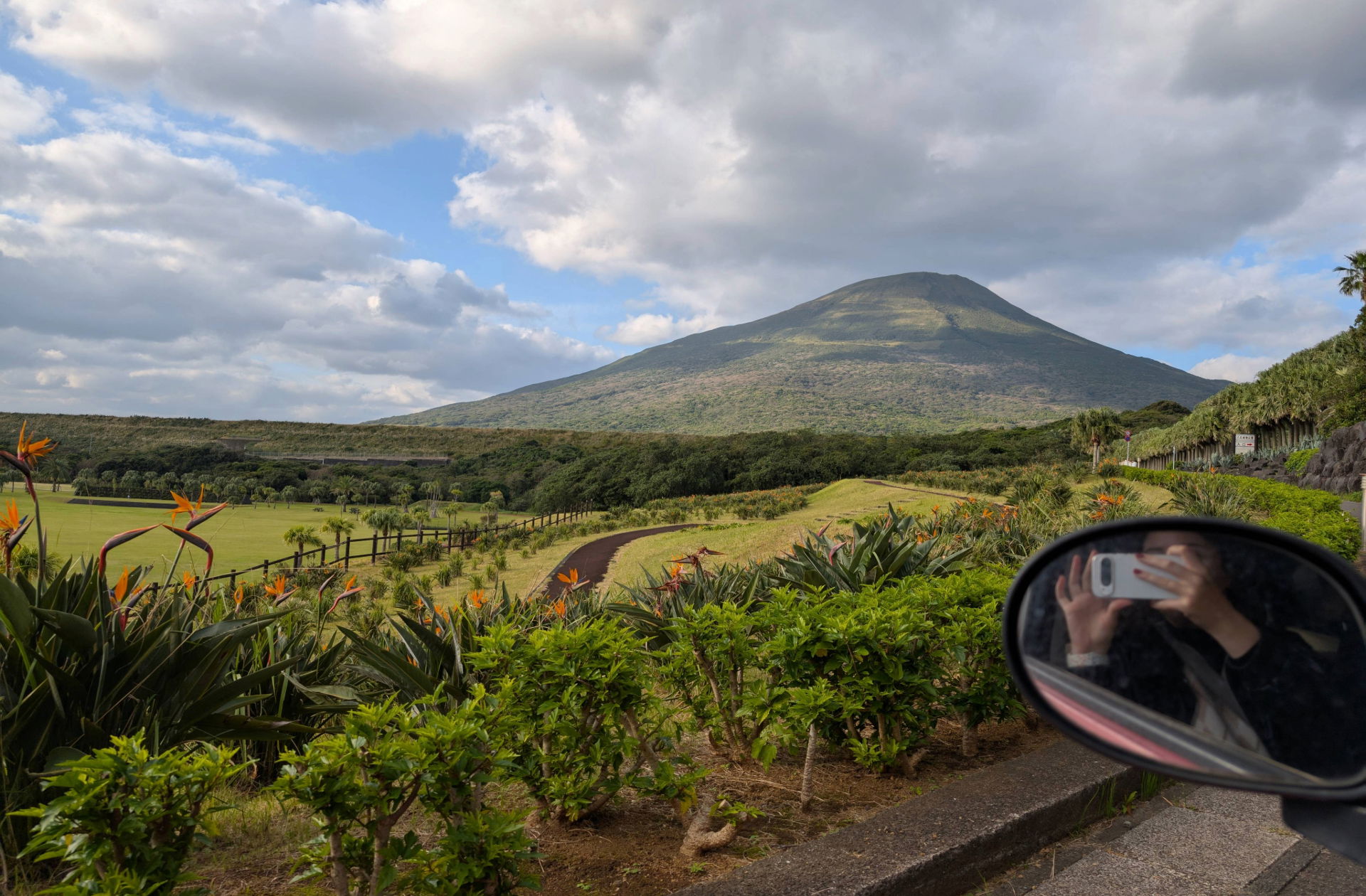
Hachijō-Fuji, juga dikenal sebagai Mt. Nishi, adalah gunung api setinggi 854 meter yang mendominasi lanskap barat laut pulau ini. Pendakiannya melalui 1.280 anak tangga melelahkan, tetapi pemandangan dari puncak mengompensasi segala jerih payah. Kaldera yang masih alami dengan kolam-kolamnya dan Kuil Asama memancarkan suasana mistis. Hachijō-Fuji adalah gunung api aktif dengan sejarah 10.000 tahun. Erupsi terakhir terjadi pada tahun 1605. Aktivitas seismik, seperti gempa berkelompok pada tahun 2002, mengingatkan kita akan sifat vulkanik gunung ini.

A two-part photo from a moss-draped forest shrine on Hachijō-jima, the subtropical island south of Tokyo. On the left, a weathered stone torii gate stands crooked and gray, its surfaces furred with lichen, framed by gnarled trees hung with strands of pale green beard lichen. Ferns crowd the base, and a sliver of red-and-gold brocade peeks out from behind the trunk. The right panel shows the shrine's stone pile: dozens of smooth round rocks stacked beside a path paved with dark river stones, many of them hand-painted white with Japanese wishes. One large stone reads 健康 (health), another 彼女 (girlfriend). Above the pile, a rough torii built from unhewn logs leans among the twisted trunks, giving the whole scene the feel of a forgotten shrine reclaimed by the forest.
A two-part photo from a moss-draped forest shrine on Hachijō-jima, the subtropical island south of Tokyo. On the left, a weathered stone torii gate stands crooked and gray, its surfaces furred with lichen, framed by gnarled trees hung with strands of pale green beard lichen. Ferns crowd the base, and a sliver of red-and-gold brocade peeks out from behind the trunk.
The right panel shows the shrine's stone pile: dozens of smooth round rocks stacked beside a path paved with dark river stones, many of them hand-painted white with Japanese wishes. One large stone reads 健康 (health), another 彼女 (girlfriend). Above the pile, a rough torii built from unhewn logs leans among the twisted trunks, giving the whole scene the feel of a forgotten shrine reclaimed by the forest.
Teks yang terlihat pada gambar
健康
彼女
田村
Tamaishi - Perjalanan Kembali ke Zaman Edo
Tamaishi, tembok batu bundar dari periode Edo (1603-1868), adalah kesaksian yang memikat tentang sejarah pulau ini. Sekitar 2.000 orang buangan membangun struktur-struktur megah ini dari batu-batu yang tergerus laut. Tembok yang telah direstorasi di rumah-rumah pribadi memamerkan kerajinan tradisional dari zaman itu. Setiap batu dipilih dengan cermat dan dipasang secara manual.

Two photos side by side show the characteristic stone walls of Hachijō-jima, built from smooth, rounded boulders stacked in neat rows so they look like giant pebbles. In the left photo, a pair of these walls rises on either side of a mossy, grass-covered path that leads up to a dark traditional wooden building. A vertical wooden sign with Japanese characters stands by the entrance, and a cycad and other subtropical greenery frame the scene under a blue sky with a few clouds. The right photo shows a narrow paved lane curving between taller walls of the same round stones, shaded by a dense canopy of trees, with a reddish wooden house half hidden in the foliage further up the slope.
Two photos side by side show the characteristic stone walls of Hachijō-jima, built from smooth, rounded boulders stacked in neat rows so they look like giant pebbles.
In the left photo, a pair of these walls rises on either side of a mossy, grass-covered path that leads up to a dark traditional wooden building. A vertical wooden sign with Japanese characters stands by the entrance, and a cycad and other subtropical greenery frame the scene under a blue sky with a few clouds. The right photo shows a narrow paved lane curving between taller walls of the same round stones, shaded by a dense canopy of trees, with a reddish wooden house half hidden in the foliage further up the slope.
Teks yang terlihat pada gambar
古民家山茶屋
Hachijo Royal Hotel - Tempat Terbengkalai dengan Sejarah
Hachijo Royal Hotel yang terbengkalai adalah simbol ledakan pariwisata masa lalu pulau ini. Hotel ini dibuka pada tahun 1963 dan saat itu merupakan salah satu hotel terbesar di Jepang. Dengan gaya Barok Prancis-nya, hotel ini menarik tamu dari seluruh negeri. Namun, ledakan pariwisata itu berakhir dan hotel harus ditutup pada tahun 2006. Saat ini, fasilitas yang lapuk tersebut menjadi spot foto populer bagi para penggemar "tempat terbengkalai" dan pengingat akan ketidakkekalan segala sesuatu.

The Hachijō Royal Hotel rises behind palm trees under a bright blue sky, a large tiered concrete building that looks long abandoned. Each level steps back from the one below, edged with white balustrade terraces that are streaked with grime and stains. The windows are dark and empty, and at least one opening is boarded over with an orange panel. At the top sits a small octagonal tower crowned by a weathered dome, giving the whole structure a grand but decayed silhouette. Two tall palm trunks cross the frame in front of the facade, and dense green foliage fills the lower corners, so the derelict resort is seen partly through tropical vegetation.
The Hachijō Royal Hotel rises behind palm trees under a bright blue sky, a large tiered concrete building that looks long abandoned. Each level steps back from the one below, edged with white balustrade terraces that are streaked with grime and stains. The windows are dark and empty, and at least one opening is boarded over with an orange panel. At the top sits a small octagonal tower crowned by a weathered dome, giving the whole structure a grand but decayed silhouette. Two tall palm trunks cross the frame in front of the facade, and dense green foliage fills the lower corners, so the derelict resort is seen partly through tropical vegetation.
Teks yang terlihat pada gambar
No clearly readable text is present in the image.
Nanbara Senjojiki - Pendakian Melintasi Ladang Lava
Nanbara Senjojiki adalah ladang lava sepanjang sekitar 500 meter yang terletak di pantai selatan Hachijō-jima. Terbentuk sekitar 3.700 tahun lalu akibat erupsi gunung api Higashi-yama. Lanskap aneh batuan lava hitam dan laut biru tua adalah tontonan alam yang menakjubkan. Dari Dek Observasi Terowongan Osaka, Anda dapat menikmati pemandangan panorama fantastis atas ladang lava dan pulau tetangga Hachijō-Kojima.
Mendaki, Menyelam, dan Berselancar
Selain aktivitas yang disebutkan di atas, Hachijō-jima menawarkan beragam pilihan bagi para penggemar aktivitas luar ruangan. Pulau ini memiliki banyak jalur pendakian yang berkelok melintasi lanskap vulkanik, hutan rimbun, dan sepanjang garis pantai. Para penyelam dan snorkeler dapat menjelajahi dunia bawah laut pulau ini yang kaya. Perairan hangat di sekitar Hachijō-jima menjadi habitat ikan tropis, karang, dan penyu. Para peselancar akan menemukan kondisi yang baik untuk olahraga mereka di sepanjang pesisir pulau.

A hiker walks along a grassy ridge on Hachijō-jima, heading away from the camera into warm evening light. The person wears a white hood, dark jacket, and light pants, with a small white bag slung across the back, following a narrow path along the crest of the hill. Tall susuki grass fills the foreground, its feathery plumes glowing gold against dark green shrubs that blanket the slope. A forested volcanic ridge rises to the left, a small pointed peak sits in the middle distance, and the sky opens up in soft blue with scattered clouds. On the right the horizon fades into haze, a hint of the Pacific far below.
A hiker walks along a grassy ridge on Hachijō-jima, heading away from the camera into warm evening light. The person wears a white hood, dark jacket, and light pants, with a small white bag slung across the back, following a narrow path along the crest of the hill.
Tall susuki grass fills the foreground, its feathery plumes glowing gold against dark green shrubs that blanket the slope. A forested volcanic ridge rises to the left, a small pointed peak sits in the middle distance, and the sky opens up in soft blue with scattered clouds. On the right the horizon fades into haze, a hint of the Pacific far below.
Teks yang terlihat pada gambar
No clearly readable text is present in the image.

A Shinto purification basin fills the frame: a large rectangular trough of speckled dark granite, its rim glistening with moisture and dotted with algae. Dark, still water sits inside, reflecting the wood laid across it. Resting on the rim are five wooden ladles, each a shallow cylindrical cup on a long straight handle, arranged so the handles fan out in different directions over the water. Visitors would use these to scoop water for ritual hand and mouth rinsing before approaching a shrine. Behind the basin, pale gravel covers the ground, and thick tree trunks rise with bark softened by moss. Glossy green leaves hang into the top of the frame, giving the scene the shaded, quiet feel of a shrine grove. The setting is a shrine on Hachijō-jima, the forested island off Tokyo in the Pacific.
A Shinto purification basin fills the frame: a large rectangular trough of speckled dark granite, its rim glistening with moisture and dotted with algae. Dark, still water sits inside, reflecting the wood laid across it. Resting on the rim are five wooden ladles, each a shallow cylindrical cup on a long straight handle, arranged so the handles fan out in different directions over the water. Visitors would use these to scoop water for ritual hand and mouth rinsing before approaching a shrine.
Behind the basin, pale gravel covers the ground, and thick tree trunks rise with bark softened by moss. Glossy green leaves hang into the top of the frame, giving the scene the shaded, quiet feel of a shrine grove. The setting is a shrine on Hachijō-jima, the forested island off Tokyo in the Pacific.
Teks yang terlihat pada gambar
No clearly readable text is present in the image.

A long volcanic coastline on Hachijō-jima fills the frame, where steep cliffs layered with dark basalt drop straight into a calm blue-gray sea. The clifftops are covered in dense green trees and shrubs, with exposed reddish and black rock bands running along the base of the slope. At the foot of the cliffs, a shoreline of dark boulders and pebbles curves around a small cove, and gentle waves wash in with a smooth, silky blur on the right side of the frame. Above, puffy white clouds drift across a bright blue sky, giving the whole scene the lush, rugged feel of a subtropical Pacific island.
A long volcanic coastline on Hachijō-jima fills the frame, where steep cliffs layered with dark basalt drop straight into a calm blue-gray sea. The clifftops are covered in dense green trees and shrubs, with exposed reddish and black rock bands running along the base of the slope. At the foot of the cliffs, a shoreline of dark boulders and pebbles curves around a small cove, and gentle waves wash in with a smooth, silky blur on the right side of the frame. Above, puffy white clouds drift across a bright blue sky, giving the whole scene the lush, rugged feel of a subtropical Pacific island.
Teks yang terlihat pada gambar
No clearly readable text is present in the image.
Spesialitas Lokal (Meibutsu) - Kuliner
Temuan di Hachijō-jima
Hachijō-jima menawarkan berbagai spesialitas kuliner yang akan memanjakan lidah Anda. Berikut beberapa sorotannya:
| Hidangan | Bahan utama | Metode penyajian | Di mana mendapatkannya? |
|---|---|---|---|
| Sochu | Ubi jalar, beras | Disuling | Penyulingan lokal, restoran |
| Iwanori | Jenis rumput laut | Dipanen, dikeringkan | Restoran sushi, toko spesialitas |
| Shimazushi | Mekajiki (ikan todak), Akahata (kerapu merah), Ishinori (nori batu), daun Ashitaba | Dimarinasi dengan saus kedelai, disajikan di atas nasi | Restoran |
| Kusaya | Ikan kecil (misalnya ikan terbang) | Digarami, dikeringkan, difermentasi | Toko spesialitas, restoran |
| Budo | Rumput laut, kerang, ikan, agar-agar | Dijadikan jelly | Restoran |
| Sasayo (Isuzumi) | Brass ruff | Dipanggang, sashimi | Restoran |
Shochu - Minuman Keras Khas Pulau
Shochu adalah minuman keras tradisional Jepang yang dibuat dari berbagai bahan seperti ubi jalar, beras, atau jelai. Di Hachijō-jima, shochu terutama dibuat dari ubi jalar. Kualitas air pulau yang unik dan metode penyulingan tradisional memberikan shochu Hachijō cita rasa khasnya. Setiap penyulingan di pulau memiliki resep warisan turun-temurunnya sendiri. Shochu dapat dinikmati murni, dengan es, atau dicampur dengan air.

Rows of brown glass bottles of shochu stand on a store shelf, the local spirit of Hachijō Island. Their white neck labels read "junryō shōchū" and call the drink a specialty of Hachijōjima, and the front labels show a stylized volcano in green with pink flowers around the large calligraphy characters Jūchaku (重椿), the name of the brew. Each bottle carries a green sticker marking it as authentic honkaku shōchū with 25 percent alcohol, and the maker is listed as the Hachijōjima Shuzō brewery. To the right sit taller clear bottles with yellow labels, and to the left a plastic package of dried goods, giving the scene the feel of a small island shop or souvenir aisle.
Rows of brown glass bottles of shochu stand on a store shelf, the local spirit of Hachijō Island. Their white neck labels read "junryō shōchū" and call the drink a specialty of Hachijōjima, and the front labels show a stylized volcano in green with pink flowers around the large calligraphy characters Jūchaku (重椿), the name of the brew. Each bottle carries a green sticker marking it as authentic honkaku shōchū with 25 percent alcohol, and the maker is listed as the Hachijōjima Shuzō brewery. To the right sit taller clear bottles with yellow labels, and to the left a plastic package of dried goods, giving the scene the feel of a small island shop or souvenir aisle.
Teks yang terlihat pada gambar
八丈島名産
醇良焼酎
八丈島酒造合名会社製
本格焼酎
アルコール分 25
25度以上 26度未満
秀醇無比
重椿
原材料名 米(国産)
さつま芋(八丈島)
米こうじ
内容量 1.8
製造者 八丈島酒造合名会社
東京都八丈島八丈町大賀郷 1576
TEL 04996-2-2855
品目 本格焼酎
製造者 八丈興発株式会社
八
2094
Iwanori - Rumput Laut dengan Rasa yang Intens
Iwanori adalah jenis rumput laut istimewa yang dipanen langsung dari lepas pantai Hachijō-jima. Rasanya yang intens dan sedikit asin serta teksturnya yang renyah menjadikannya bahan populer untuk sushi dan hidangan lainnya. Rumput laut ini secara tradisional dipetik dengan tangan dan kemudian dikeringkan.

A big black bowl of hot noodle soup sits on a black lacquered tray, heaped with a tangle of dark green iwa nori, the rock seaweed that Hachijō-jima is known for. Under the seaweed are crispy deep-fried ashitaba leaves, a slice of pink-rimmed fish cake, a piece of fried tofu, and bright green vegetable stems in a dark soy-based broth. Next to the bowl the tray holds a small fluted dish of sliced scallions and cucumber, a shaker of brown seasoning powder, and chopsticks still wrapped in paper. A glass of water and a small glass of green tea stand at the edge of the frame, rounding out a simple, hearty lunch at a casual island restaurant.
A big black bowl of hot noodle soup sits on a black lacquered tray, heaped with a tangle of dark green iwa nori, the rock seaweed that Hachijō-jima is known for. Under the seaweed are crispy deep-fried ashitaba leaves, a slice of pink-rimmed fish cake, a piece of fried tofu, and bright green vegetable stems in a dark soy-based broth. Next to the bowl the tray holds a small fluted dish of sliced scallions and cucumber, a shaker of brown seasoning powder, and chopsticks still wrapped in paper. A glass of water and a small glass of green tea stand at the edge of the frame, rounding out a simple, hearty lunch at a casual island restaurant.
Teks yang terlihat pada gambar
No clearly readable text is present in the image.
Shimazushi - Sushi Tradisional dengan Sentuhan Khas Kepulauan
Shimazushi adalah jenis sushi tradisional yang disiapkan dengan tiga spesies ikan khas:
- Mekajiki (ikan todak): Dianggap sebagai hidangan lezat lokal dan memiliki rasa yang lembut dan sedikit manis.
- Akahata (kerapu merah): Dikenal karena dagingnya yang padat dan putih serta rasa yang halus.
- Ishinori (nori batu): Memberikan sentuhan khusus pada sushi dan rasa yang sedikit asin.
Selain itu, Shimazushi disiapkan dengan daun Ashitaba (yang dikenal karena manfaat kesehatannya) dan marinasi saus kedelai khusus. Potongan ikan dimarinasi kemudian disajikan di atas bola nasi. Shimazushi membedakan dirinya dari jenis sushi lain melalui cita rasanya yang lebih intens dan penggunaan bahan-bahan lokal.

A close-up of a black plastic tray of shimazushi, the island-style nigiri from Hachijō-jima. Most pieces are topped with slices of soy-marinated fish, the amber flesh glazed and glistening over rounded mounds of white rice. In the front row, two pieces carry the island's signature topping, a thick black seaweed paste spread across the rice. A small plastic chrysanthemum garnish in yellow and green sits tucked between the pieces. The tray has a gold floral pattern along its edges and rests on a rustic wooden table.
A close-up of a black plastic tray of shimazushi, the island-style nigiri from Hachijō-jima. Most pieces are topped with slices of soy-marinated fish, the amber flesh glazed and glistening over rounded mounds of white rice. In the front row, two pieces carry the island's signature topping, a thick black seaweed paste spread across the rice. A small plastic chrysanthemum garnish in yellow and green sits tucked between the pieces. The tray has a gold floral pattern along its edges and rests on a rustic wooden table.
Teks yang terlihat pada gambar
No clearly readable text is present in the image.
Kusaya - Spesialitas Ikan dengan Aroma yang Intens
Kusaya adalah spesialitas ikan tradisional yang diawetkan dengan pengasinan, pengeringan, dan fermentasi. Ikan-ikan kecil, seperti ikan terbang, digunakan untuk kusaya. Ikannya pertama-tama dibersihkan lalu direndam dalam larutan garam khusus ("Kusaya-jiru"). Larutan garam yang diwariskan turun-temurun ini memberikan kusaya aroma dan cita rasa khasnya yang intens. Setelah direndam, ikannya dijemur di bawah sinar matahari. Kusaya sering dipanggang atau digoreng dan memiliki rasa yang sangat kuat yang perlu dilatih lidah, menyerupai keju.
Budo - Hidangan Rumput Laut dengan Konsistensi Jelly
Budo adalah hidangan lokal yang mengombinasikan berbagai hasil laut dengan rumput laut. Campuran ganggang, kerang, dan ikan diperkaya dengan agar-agar, memberikan hidangan konsistensi jelly yang unik. Budo memiliki rasa yang menyegarkan dan sering disajikan sebagai hidangan pembuka atau lauk pendamping.
Sasayo - Ikan Konsumsi yang Populer
Sasayo, juga dikenal sebagai Isuzumi (brass ruff), adalah ikan konsumsi yang populer di Hachijō-jima. Biasanya dipanggang atau disiapkan sebagai sashimi dan dihargai oleh para nelayan karena cita rasanya yang kaya. Sasayo memiliki daging yang padat dan putih serta rasa yang lembut.
Keberlanjutan di Hachijō-jima
Hachijō-jima berkomitmen pada pariwisata berkelanjutan dan perlindungan lingkungan alam. Penduduk pulau menyadari pentingnya flora dan fauna unik mereka dan terlibat dalam berbagai proyek untuk melindungi lingkungan serta mendorong pariwisata yang bertanggung jawab. Inisiatif-inisiatif tersebut meliputi:
- Perlindungan penyu: Perairan di sekitar Hachijō-jima merupakan tempat berkembang biak yang penting bagi penyu. Ada program-program yang didedikasikan untuk melindungi sarangnya dan mengedukasi masyarakat tentang konservasi penyu.
- Promosi ekowisata: Tur dan aktivitas yang ramah lingkungan serta bertanggung jawab ditawarkan untuk memperkenalkan alam dan budaya pulau kepada pengunjung tanpa membebani lingkungan.
- Pengurangan sampah dan daur ulang: Pulau ini berdedikasi untuk meminimalkan sampah dan mendorong daur ulang.
Kesimpulan - Hachijō-jima: Pengalaman Pulau yang Tak Terlupakan
Hachijō-jima adalah destinasi wisata yang menawan dengan perpaduan unik antara alam yang masih alami, lanskap vulkanik, atraksi budaya, dan spesialitas kuliner. Pulau ini menawarkan pelarian dari rutinitas sehari-hari dan memungkinkan Anda menyelami budaya Jepang. Baik itu memancing, mendaki, bersantai di onsen, atau menjelajahi tempat-tempat terbengkalai - Hachijō-jima punya sesuatu untuk semua orang.
Yang paling mengesankan bagi saya tentang Hachijō-jima adalah kombinasi antara alam yang masih alami dan jejak-jejak masa lalu. Pulau ini tidak sepadat destinasi wisata lainnya di Jepang dan memancarkan ketenangan serta keaslian yang istimewa. Perjumpaan dengan penduduk pulau yang ramah, penjelajahan lanskap vulkanik, dan penemuan kuliner menjadikan perjalanan ini pengalaman yang tak terlupakan.
| Aspek | Deskripsi |
|---|---|
| Lokasi | 300 km di selatan Tokyo, Samudra Pasifik |
| Luas | 63 km² |
| Populasi | 7.522 (per Maret 2018) |
| Iklim | Subtropis, ringan |
| Kedatangan | Pesawat (Bandara Haneda), feri |
| Transportasi | Mobil sewa, e-bike, bus, taksi |
| Akomodasi | Hotel, rumah tamu, sewa liburan |
| Aktivitas | Mendaki, memancing, menyelam, snorkeling, onsen, tempat terbengkalai |
| Atraksi | Hachijō-Fuji, kebun raya, Tamaishi, Hachijo Royal Hotel, Nanbara Senjojiki |
| Spesialitas | Shochu, Iwanori, Shimazushi, Kusaya, Budo, Sasayo |
Informasi Tambahan dan Tips untuk Wisatawan
- Musim Perjalanan: Waktu terbaik untuk mengunjungi Hachijō-jima adalah musim semi atau musim gugur, ketika cuaca ringan dan menyenangkan.
- Bahasa: Bahasa Jepang dituturkan di Hachijō-jima. Kemampuan berbahasa Inggris terbatas, tetapi tersedia di sebagian besar fasilitas wisata. Beberapa penduduk pulau juga menuturkan bahasa Hachijō, sebuah bahasa terancam punah yang berhubungan dengan bahasa-bahasa Ryukyu.
- Mata Uang: Mata uang di Jepang adalah Yen Jepang (JPY).
- Internet: Wi-Fi tersedia di sebagian besar hotel dan beberapa kafe.
- Listrik: Tegangan listrik di Jepang adalah 100 volt. Adaptor diperlukan untuk perangkat Eropa.
- Kesehatan: Ada rumah sakit di pulau ini. Asuransi kesehatan perjalanan disarankan.
- Keamanan: Hachijō-jima adalah pulau yang aman dengan tingkat kejahatan yang rendah.
Komentar