
Table des matières :
TL;DR
Soba est un site dédié aux délicieuses nouilles japonaises faites de sarrasin, offrant un aperçu des différentes variétés de Soba, comme le Ju-wari Soba à 100 % de sarrasin et le Hachiwari Soba à 80 % de sarrasin et 20 % de blé. Le site décrit également les différentes manières de déguster Soba, avec des plats populaires tels que Kake-Soba, servi chaud dans un bouillon, et Zulu-Soba, servi froid avec une sauce. On y explore également des variations comme le Cha-Soba au thé vert et l'Ume-Soba avec une prune fermentée. La tradition du Toshikoshi-Soba, consommé pour le Nouvel An pour attirer la prospérité, est également mise en avant. De plus, le site partage l'expérience d'un cours de fabrication de Soba, où les participants apprennent à pétrir la pâte, à la couper en nouilles et à savourer des mets préparés à base de sarrasin, incluant des douceurs comme le gâteau au sarrasin.Soba – Les nouilles japonaises de sarrasin
Les nouilles soba sont fabriquées à partir de farine de sarrasin, parfois complétée par du blé ordinaire. Le Ju-wari Soba est composé à 100 % de sarrasin et est donc la variante de soba la plus chère, mais aussi la plus aromatique. La version un peu plus courante, Hachiwari-Soba, est composée de 80 % de sarrasin et de 20 % de blé ordinaire et a un goût un peu plus subtil, mais est bien sûr aussi moins chère. Il existe également des variantes qui contiennent une proportion encore plus faible de sarrasin et sont donc encore moins chères. Elles sont principalement utilisées dans les fast-foods, où les soba coûtent entre 2 et 5 euros.
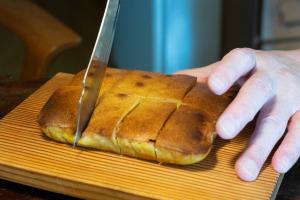
A rectangular buckwheat cake with a golden brown, slightly domed top sits on a wooden cutting board as a large kitchen knife slices down through it. Cuts already made divide the dense cake into even portions, and a hand at the right of the frame steadies it against the board. The dark, blurred background keeps all the attention on the slicing.
A rectangular buckwheat cake with a golden brown, slightly domed top sits on a wooden cutting board as a large kitchen knife slices down through it. Cuts already made divide the dense cake into even portions, and a hand at the right of the frame steadies it against the board. The dark, blurred background keeps all the attention on the slicing.
Texte visible dans l'image
No clearly readable text is present in the image.
Comment manger du soba ?
Le Kake-Soba est le plus souvent servi. Les nouilles sont servies chaudes dans un bouillon appelé « dashi ». Ce bouillon est préparé à partir de flocons de thon, d’algues Kombu, de mirin (vin de riz japonais) et de shoyu (sauce soja japonaise) et est souvent garni d’oignons verts hachés. Le Kake-Soba est souvent consommé en hiver. Il est généralement accompagné de wasabi (souvent sous forme de racine fraîche que vous pouvez râper vous-même) et de gingembre.
Une deuxième variante courante est le Zulu-Soba. Les nouilles soba sont servies sur une grille en bambou. Une coupelle de bouillon froid est servie séparément. Les soba sont prises avec des baguettes, trempées dans le bouillon et mangées directement. Bien sûr, comme toujours au Japon, on les slurpe. On sert souvent des tempura avec les soba.
Au fait : chaque bouchée prise avec des baguettes doit être mangée entière. Les nouilles qui dépassent sont considérées comme extrêmement impoli.
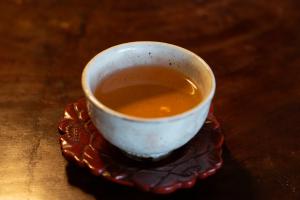
A small white ceramic cup filled with clear amber tea sits on a carved, deep reddish-brown lacquered coaster. The warm light catches the surface of the liquid, suggesting a cup of soba or buckwheat tea, served in the traditional Japanese style. The dark wood table around it falls into shadow, keeping all attention on the cup and its glowing contents.
A small white ceramic cup filled with clear amber tea sits on a carved, deep reddish-brown lacquered coaster. The warm light catches the surface of the liquid, suggesting a cup of soba or buckwheat tea, served in the traditional Japanese style. The dark wood table around it falls into shadow, keeping all attention on the cup and its glowing contents.
Texte visible dans l'image
No clearly readable text is present in the image.
Des variations colorées
Il existe aussi le Cha-Soba, c’est-à-dire le « soba au thé vert ». La saveur du thé vert est très subtile, mais ce soba est vert. Il existe aussi l’Ume-Soba, où l’on utilise une prune Ume rouge fermentée, qui donne au soba une légère teinte rosée. Le sarrasin lui-même est gris avec des points noirs. Une tradition japonaise populaire est de manger du soba avant le début de la nouvelle année. On appelle cela Toshikoshi-Soba et il est censé apporter la chance financière dans la nouvelle année. Dans ma famille aussi, nous avons mangé du soba chaque Nouvel An !
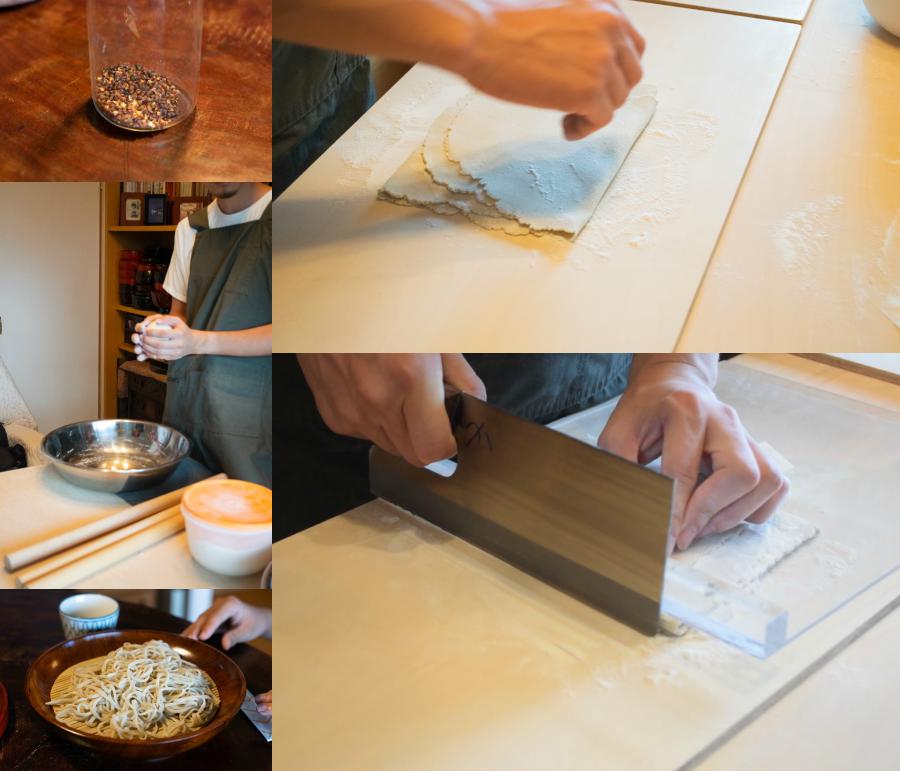
A four-photo collage documents the process of making soba, Japanese buckwheat noodles, by hand at home. The left column runs top to bottom through the stages. A small glass jar holds raw buckwheat groats on a wooden table. Below it, a man in a green apron over a white t-shirt kneads dough with his hands, a stainless steel mixing bowl, a wooden rolling pin, and a container of dusting flour arranged on the counter in front of him. At the bottom, the finished dish: a generous mound of pale grey noodles served on a bamboo draining basket set inside a dark wooden bowl, with a small ceramic cup alongside. The tall right column shows two close-ups of the noodle work: hands handling a folded, flour-dusted sheet of dough on a wooden board, then slicing the dough into thin strands with a long rectangular soba knife, using a wooden guide to keep the cuts even.
A four-photo collage documents the process of making soba, Japanese buckwheat noodles, by hand at home.
The left column runs top to bottom through the stages. A small glass jar holds raw buckwheat groats on a wooden table. Below it, a man in a green apron over a white t-shirt kneads dough with his hands, a stainless steel mixing bowl, a wooden rolling pin, and a container of dusting flour arranged on the counter in front of him. At the bottom, the finished dish: a generous mound of pale grey noodles served on a bamboo draining basket set inside a dark wooden bowl, with a small ceramic cup alongside. The tall right column shows two close-ups of the noodle work: hands handling a folded, flour-dusted sheet of dough on a wooden board, then slicing the dough into thin strands with a long rectangular soba knife, using a wooden guide to keep the cuts even.
Texte visible dans l'image
No clearly readable text found in the image.
Voici comment on fait – Je participe à un cours de soba
C’est un autre cours japonais que ma mère a trouvé pour moi. J’ai d’ailleurs aussi suivi un cours de miso ! Il existe différents portails japonais en ligne sur lesquels des particuliers peuvent proposer des services très divers. Il s’agit par exemple de cours de cuisine, qui sont très appréciés des femmes au foyer et des enfants. Ce cours de soba a été dirigé par un Japonais qui étudiait en Allemagne et parlait donc allemand !
Au début du cours, on nous a servi du soba et on nous a montré comment le préparer. Nous avons bu du thé de soba, préparé à partir de sarrasin grillé. Il y avait aussi un délicieux gâteau de sarrasin que la femme de notre moniteur a fait pour nous.
Ensuite, nous nous sommes attelés à la fabrication du soba : pétrir la pâte, l’étaler et la couper en forme de nouilles. Le soba doit en fait être coupé très finement et uniformément – ce n’est pas si facile ! Les parties plus épaisses de mon soba avaient un goût différent du soba coupé de manière professionnelle – mais le cours a néanmoins été une expérience très intéressante et enrichissante pour moi !
Commentaires