
Table des matières :
TL;DR
Le site Daikon présente ce légume essentiel de la cuisine japonaise, connu sous divers noms tels que Daikon-Rettich, radis japonais ou chinois, et radis d'hiver. Réputé pour sa polyvalence, le Daikon est particulièrement apprécié en automne et peut être préparé de multiples façons : en salade, en accompagnement de sashimi, ou séché pour donner du Kiriboshi Daikon. Sa texture et son goût dépendent de sa coupe, les tranches fines étant recommandées pour éviter une saveur trop piquante, qui varie également selon la saison. Les feuilles du Daikon sont également comestibles, et il est possible de le faire repousser en conservant un morceau de la racine. Ce radis est désormais disponible dans les supermarchés allemands, où il est important de choisir des spécimens fermes.| Haute saison : | Automne |
|---|---|
| Catégorie : | Légumes |
| Autres appellations : | Daikon-Rettich, radis japonais ou chinois, radis d'hiver |
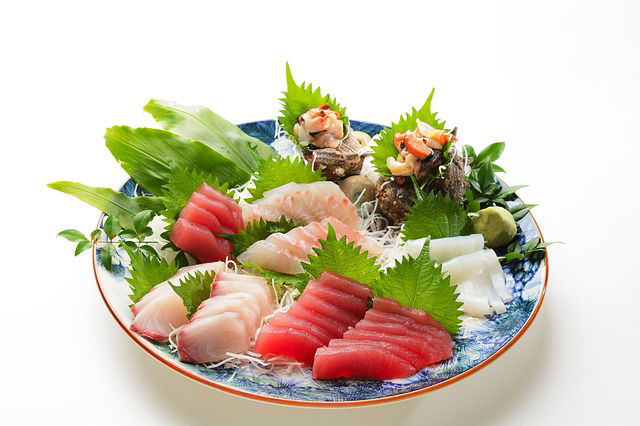
A round plate of assorted sashimi sits on a white surface. The plate is decorated in blue and white patterns with an orange rim, and its base is covered with fine shredded daikon radish. On top are slices of raw fish arranged in small fanned groups: deep red tuna, pale pink and white fish, and translucent squares of squid. Two pieces near the back are topped with a small seafood mixture, and a mound of green wasabi rests at the right edge. Jagged-edged green shiso leaves are tucked between the fish, with a few broader leaves and sprigs filling out the arrangement.
A round plate of assorted sashimi sits on a white surface. The plate is decorated in blue and white patterns with an orange rim, and its base is covered with fine shredded daikon radish. On top are slices of raw fish arranged in small fanned groups: deep red tuna, pale pink and white fish, and translucent squares of squid. Two pieces near the back are topped with a small seafood mixture, and a mound of green wasabi rests at the right edge. Jagged-edged green shiso leaves are tucked between the fish, with a few broader leaves and sprigs filling out the arrangement.
Texte visible dans l'image
No text is clearly readable in the image.
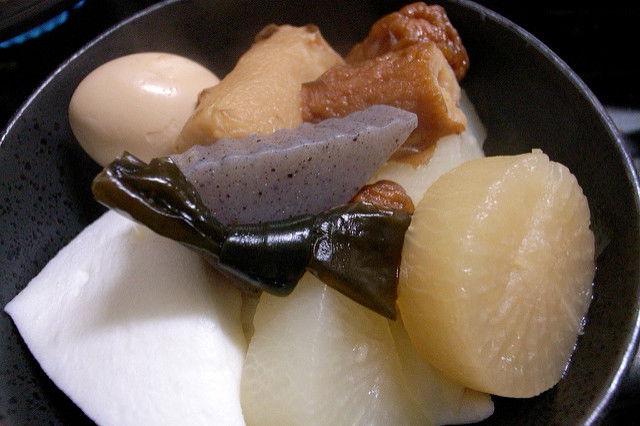
A close-up of a dark bowl filled with oden, the Japanese simmered dish, packed so the pieces nearly fill the frame. A thick round slice of daikon radish sits on the right, cooked to a translucent pale yellow, with a wedge of white daikon at the lower left. Beside them rest a whole boiled egg tinted light brown from the broth, a gray speckled triangle of konjac, a folded piece of dark kombu seaweed tied like a knot, and several browned fish cakes crowded at the top. Everything glistens with simmering broth, giving the dish a soft, stewed look.
A close-up of a dark bowl filled with oden, the Japanese simmered dish, packed so the pieces nearly fill the frame. A thick round slice of daikon radish sits on the right, cooked to a translucent pale yellow, with a wedge of white daikon at the lower left. Beside them rest a whole boiled egg tinted light brown from the broth, a gray speckled triangle of konjac, a folded piece of dark kombu seaweed tied like a knot, and several browned fish cakes crowded at the top. Everything glistens with simmering broth, giving the dish a soft, stewed look.
Texte visible dans l'image
No text is clearly readable in this image.
Daikon (japon. だいこん ou aussi 大根 signifie littéralement « grande racine ») est un radis qui est répandu en Asie de l'Est. Il est un ingrédient principal de la cuisine japonaise et est indispensable. C'est pourquoi ce radis porte également de nombreux noms tels que : Daikon-Rettich, radis japonais ou chinois, ou encore radis d'hiver. Il existe de nombreuses façons de préparer le Daikon qui mettent en valeur son goût de différentes manières. Par exemple, le Daikon est coupé en julienne puis séché, ce qui s'appelle Kiriboshi Daikon (切干大根, « Daikon coupé et séché »). Dans ce processus, le radis perd beaucoup d'eau, ce qui renforce encore les arômes. En tant que salade ou accompagnement pour sashimi, le Daikon est également un excellent choix. Il est important que le Daikon soit coupé en très fines lamelles. Car si les lamelles sont trop épaisses, la salade a un goût très épicé. La piquant est également dépendante des saisons, selon mon expérience, les Daikons en hiver sont plus doux et ont meilleur goût. Les feuilles de Daikon peuvent également être utilisées. Il peut également repousser, à condition de conserver un morceau de la tige d'environ 3 cm et de le placer dans l'eau par la suite. De nos jours, le Daikon est également disponible dans les supermarchés allemands. Il est important qu'il soit ferme et non gélatineux, sinon il ne goûte plus bon.
Commentaires