Table des matières :
TL;DR
Hachijō-jima, une île volcanique située à environ 300 kilomètres au sud de Tokyo, est souvent surnommée le "Hawaï du Japon" en raison de son climat subtropical et de sa végétation luxuriante. Elle fait partie de la chaîne d'îles Izu et se distingue par ses paysages naturels intacts, ses sources chaudes apaisantes et son riche patrimoine culturel, influencé par son passé en tant que lieu d'exil durant la période Edo. Les visiteurs peuvent explorer des vestiges de son histoire, comme l'ancien Hachijo Royal Hotel, tout en profitant de la beauté des forêts et des côtes sauvages, surtout en automne lorsque l'île offre un charme particulier. L'accès à Hachijō-jima se fait facilement par avion, avec un vol de 45 minutes depuis Tokyo, ou par ferry pour une expérience plus relaxante de 10 heures. Sur place, la location d'une voiture s'avère très pratique pour découvrir l'île à son rythme.Hachijō-jima, une île d'origine volcanique, se trouve à environ 300 kilomètres au sud de Tokyo, dans l'océan Pacifique, et fait administrativement partie de la capitale japonaise. L'île fait partie de l'archipel d'Izu ainsi que du parc national Fuji-Hakone-Izu. Ce qui distingue Hachijō-jima des autres îles de la chaîne d'Izu, c'est son climat subtropical et la végétation luxuriante, presque semblable à une jungle, qui en découle. L'île offre un mélange unique de nature intacte, de paysages volcaniques, d'onsen relaxants et de sites culturels.
Hachijō-jima a une histoire fascinante. Des découvertes archéologiques montrent que l'île était déjà habitée durant la période Jōmon (environ 14 000 - 300 av. J.-C.). Pendant l'époque Edo (1603-1868), l'île servit de lieu d'exil pour les criminels et les dissidents politiques. L'un des exilés les plus connus fut Ukita Hideie, un Daimyō vaincu lors de la bataille de Sekigahara. Ses descendants ne furent graciés qu'après la Restauration Meiji en 1869. L'histoire de l'île en tant que lieu d'exil a façonné la culture locale et son identité, conférant à Hachijō-jima une atmosphère particulière.
Personnellement, l'île m'a particulièrement fasciné en automne, alors que Tokyo connaissait déjà des températures plus fraîches. Les forêts luxuriantes et le littoral accidenté dégageaient un charme tout particulier. Ce qui distingue Hachijō-jima des autres îles de la chaîne d'Izu, c'est le faible développement touristique. Des bâtiments abandonnés, comme l'ancien Hachijo Royal Hotel, témoignent d'une époque prospère du tourisme et confèrent à l'île une touche de nostalgie et d'aventure. Ce contraste entre la nature intacte et les traces du passé constitue, pour moi, l'attrait de Hachijō-jima.
Arrivée et déplacements à Hachijō-jima
En avion jusqu'à Hachijō-jima
L'arrivée en avion est l'option la plus rapide et la plus confortable. Le vol depuis Tokyo (aéroport Haneda) ne dure que 45 minutes et offre des vues à couper le souffle sur le Mont Fuji enneigé et les îles environnantes. Pendant mon vol, j'ai pu observer un coucher de soleil spectaculaire à travers un épais nuage, et admirer le majestueux Fuji avec son sommet enneigé. Les smartphones modernes permettent aux voyageurs d'immortaliser ces moments uniques – comme le coucher de soleil ou la vue sur le Fuji – à travers les hublots de l'avion avec une qualité exceptionnelle. Le coût du vol s'élève à environ 35 000 yens par personne pour l'aller-retour, ce qui est tout à fait raisonnable pour cette expérience insulaire particulière.

Seen from an airplane window, Mount Fuji rises above a thick blanket of clouds at sunset. The volcano's perfectly shaped cone stands in dark silhouette against a sky glowing in soft orange and peach tones, with its lower slopes fading into the hazy cloud layer below. A curved edge of the aircraft's engine is visible in the bottom left corner, confirming the view from the window seat. Wispy clouds catch the warm light overhead, giving the whole scene a calm, golden glow.
Seen from an airplane window, Mount Fuji rises above a thick blanket of clouds at sunset. The volcano's perfectly shaped cone stands in dark silhouette against a sky glowing in soft orange and peach tones, with its lower slopes fading into the hazy cloud layer below. A curved edge of the aircraft's engine is visible in the bottom left corner, confirming the view from the window seat. Wispy clouds catch the warm light overhead, giving the whole scene a calm, golden glow.
Texte visible dans l'image
No clearly readable text found in the image.
En ferry jusqu'à Hachijō-jima
En alternative à l'arrivée en avion, Hachijō-jima peut également être atteint en ferry. Les ferries partent de Tokyo (quai Takeshiba) ainsi que d'autres ports de l'archipel d'Izu. La traversée dure environ 10 heures et offre une manière détendue de rejoindre l'île. Les informations concernant les liaisons, les horaires et les tarifs sont disponibles sur le site de Tokai Kisen.
Voiture de location - Flexibilité et liberté à Hachijō-jima
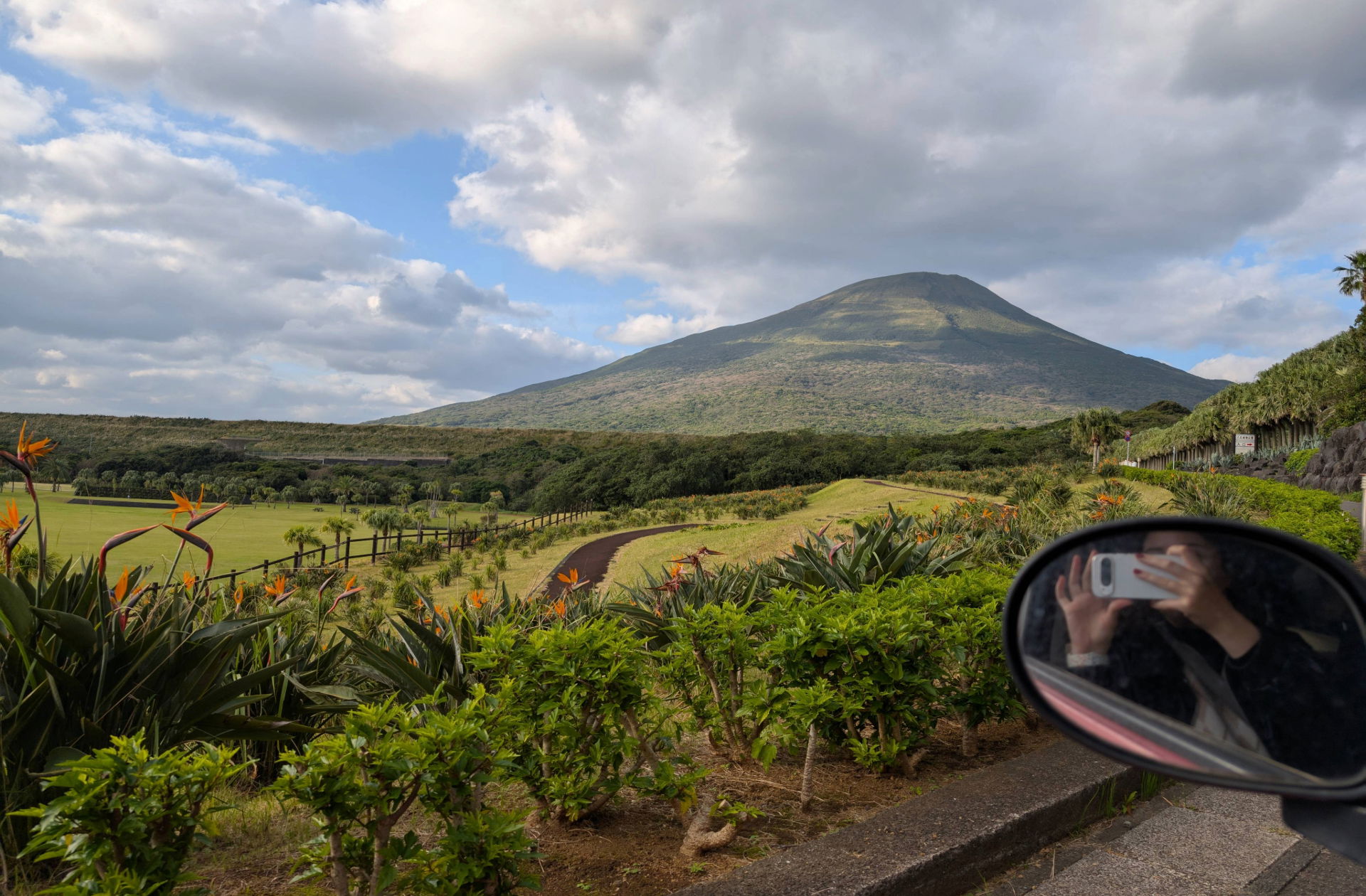
Dès notre atterrissage à l'aéroport, nous avons loué un petit K-Car chez ENEOS Rent a Car. Le prix était de 5 000 yens par jour, assurance incluse, ce qui est raisonnable compte tenu des standards japonais. Certes, notre voiture de location n'était plus le dernier modèle (avec près de 99 999 kilomètres au compteur), mais il remplissait bien sa fonction. Pour notre séjour de quatre jours, le coût total, carburant compris, s'élevait à 22 000 yens. Un conseil : puisque le loueur possède également une station-service, nous avons pu rendre la voiture avec le réservoir plein sans avoir à nous soucier de faire le plein avant notre départ.
Une voiture de location est presque indispensable à Hachijō-jima pour explorer l'île en toute liberté. Un autre avantage : après un appel depuis l'aéroport, le loueur nous a récupérés directement, ce qui nous a permis d'économiser le coût d'une course en taxi.

A small pink kei car, a boxy Japanese mini hatchback, sits parked at night in a rental car lot on Hachijō-jima. The photo is taken from the side at close range, showing its tall windows, roofline rain guards, and simple silver hubcaps with a Nissan logo. A white sign on the wall behind it reads "レンタカー" (rental car) with a phone number, and other sedans in similar reddish shades are parked around it under bright lot lighting. It is exactly the kind of tiny rental you would pick up to loop around the island.
A small pink kei car, a boxy Japanese mini hatchback, sits parked at night in a rental car lot on Hachijō-jima. The photo is taken from the side at close range, showing its tall windows, roofline rain guards, and simple silver hubcaps with a Nissan logo. A white sign on the wall behind it reads "レンタカー" (rental car) with a phone number, and other sedans in similar reddish shades are parked around it under bright lot lighting. It is exactly the kind of tiny rental you would pick up to loop around the island.
Texte visible dans l'image
レンタカー-あります
TEL 2-2006
Autres moyens de transport
- Bus publics: Les bus à Hachijō-jima ne sont pas très fréquents et les itinéraires sont limités. Il existe deux lignes de bus : la « Community Bus Route » qui circule dans le centre-ville (Okago et Mitsune) et la « Public Bus Route » qui relie les cinq zones de l'île (Mitsune, Okago, Kashitate, Nakanogo, Sueyoshi). Les horaires et informations sur les itinéraires sont disponibles sur le site de Hachijo Town Bus.

A white local bus on Hachijō-jima rolls down a sunny street, its side painted with big, playful illustrations of passion fruit and lemons, plus a few small flowers near the front. Japanese characters and the number 156 are printed beside the doors. Behind it stand a low tiled-roof building and tropical greenery under a blue sky with puffy clouds, giving the island its "Japan's Hawaii" feel.
A white local bus on Hachijō-jima rolls down a sunny street, its side painted with big, playful illustrations of passion fruit and lemons, plus a few small flowers near the front. Japanese characters and the number 156 are printed beside the doors. Behind it stand a low tiled-roof building and tropical greenery under a blue sky with puffy clouds, giving the island its "Japan's Hawaii" feel.
Texte visible dans l'image
八丈島 156
29-19
- E-Bikes: Dans la ville et sur certaines portions côtières, il est possible de louer des E-Bikes. Ceux-ci conviennent particulièrement pour des courtes distances et pour explorer les zones côtières plates. Pour les sections montagneuses de l'île, ils sont moins recommandés.

Three red rental e-bikes stand side by side at a bike-share docking station on a sunny, brick-paved lot. Each bike has a black front basket, a small digital display with a QR code on the handlebars, and a black cover over the rear wheel with stickers and a red reflector. They are the compact, step-through style typical of Japanese city cycles. To the left, a white signboard marks the station: a red bicycle logo, a price of ¥275, the station number 07, and the name of the Kaminato Port parking area in both Japanese and English, identifying the spot as a cycle port on Hachijō-jima. A metal railing and a bit of greenery run behind the bikes.
Three red rental e-bikes stand side by side at a bike-share docking station on a sunny, brick-paved lot. Each bike has a black front basket, a small digital display with a QR code on the handlebars, and a black cover over the rear wheel with stickers and a red reflector. They are the compact, step-through style typical of Japanese city cycles.
To the left, a white signboard marks the station: a red bicycle logo, a price of ¥275, the station number 07, and the name of the Kaminato Port parking area in both Japanese and English, identifying the spot as a cycle port on Hachijō-jima. A metal railing and a bit of greenery run behind the bikes.
Texte visible dans l'image
八文字島サ
¥275
24
07 神湊港(庁士
駐車場
Kamimato Port (Shokodo) Parking Area
会員登録はアプリから!
バイクシェア アブル
https://docomo-cycle.jp/app_tutorial/
- Taxi: Des taxis sont disponibles sur l'île, mais ils sont plus coûteux comparés à la voiture de location ou aux bus.
Hébergement à Hachijō-jima
Tiny Camp House 月海
Pendant notre séjour, nous avons séjourné au Tiny Camp House 月海. L'hébergement est situé dans un cadre isolé, au cœur d'un paysage montagneux du district Sueyoshi, à environ 30 minutes en voiture du centre-ville et à 15 minutes de l'aéroport. Le trajet sur des routes sinueuses fut chaque jour une petite aventure. À proximité se trouve l'onsen réputé Miharashi-no-Yu, malheureusement fermé pour rénovations lors de notre visite. Le calme environnant du Tiny Camp House nous offrait un refuge parfait après nos excursions quotidiennes. Ce qui nous a particulièrement marqués, c'est la vue depuis l'établissement sur d'immenses falaises et la mer. Un petit bémol : en raison de son isolement en pleine nature, l'hôtel accueillait également quelques insectes. Ici sur Google Maps

A cozy little cabin bedroom built around one wide bed with beige bedding. Two rolled-up towels or light blankets sit on the bed, and pillows rest against a dark wall with a rough, black stone texture. A tall paper floor lamp glows beside the head of the bed. On the left, the whitewashed plank wall is covered by a yellow and white striped curtain, a second slim paper lamp stands in front of it, and a door painted in soft pastel patches leads out. Rolled towels in pastel colors wait in a laundry basket on the white plank floor. Everything about the room, from the simple wood construction to the warm lamplight, gives it the feel of a small island retreat like a tiny camp house on Hachijō-jima.
A cozy little cabin bedroom built around one wide bed with beige bedding. Two rolled-up towels or light blankets sit on the bed, and pillows rest against a dark wall with a rough, black stone texture. A tall paper floor lamp glows beside the head of the bed. On the left, the whitewashed plank wall is covered by a yellow and white striped curtain, a second slim paper lamp stands in front of it, and a door painted in soft pastel patches leads out. Rolled towels in pastel colors wait in a laundry basket on the white plank floor. Everything about the room, from the simple wood construction to the warm lamplight, gives it the feel of a small island retreat like a tiny camp house on Hachijō-jima.
Texte visible dans l'image
No clearly readable text is present in the image.
Autres hébergements à Hachijō-jima
Outre notre Tiny Camp House, Hachijō-jima offre une multitude d'hébergements pour divers besoins et budgets. Les voyageurs peuvent opter pour des hôtels, des ryokans traditionnels japonais, des pensions ou des campings. Parmi les options populaires figurent :
- Hachijo View Hotel: Un hôtel au cadre traditionnel japonais avec vue sur la mer.
- Hachijojima Park Hotel: Un hôtel proche de l'aéroport avec des chambres confortables et un restaurant.
- Seadive Dormitory: Une auberge à tarifs abordables et à l'atmosphère décontractée.
Activités et sites touristiques à Hachijō-jima
Hachijō-jima offre une multitude d'activités et de sites pour les amoureux de la nature, les aventuriers et les passionnés de culture. Voici quelques points forts que nous avons découverts lors de notre séjour :
Pêche sur la côte de Hachijō-jima
La côte de Hachijō-jima est un véritable paradis pour les pêcheurs. Le long des zones rocheuses, nous avons rencontré des habitants et des touristes tentant leur chance. La diversité des espèces de poissons a largement dépassé nos attentes. Nous avons pu capturer quelques espèces que nous n'avions jamais vues auparavant.

The photo pairs two night-fishing shots from a harbor on Hachijō-jima. On the left, two freshly caught squirrelfish lie on dark, speckled concrete: one a vivid red with fine white striping along its body and a spiky dorsal fin, the other smaller and more orange-bronze. Both still have their hooks in, with bright red floats and line trailing beside them, and the tip of a rod juts into the frame at the edge. The right half shows the scene the catch came from. A fishing rod leans against the edge of a concrete pier, propped over calm teal water that glows under the harbor lights. A small white boat sits moored across the water near a low seawall lined with streetlights, their reflections shimmering on the surface under a pitch-black sky. Bollards with ropes and a coiled white line sit on the quay in the foreground.
The photo pairs two night-fishing shots from a harbor on Hachijō-jima. On the left, two freshly caught squirrelfish lie on dark, speckled concrete: one a vivid red with fine white striping along its body and a spiky dorsal fin, the other smaller and more orange-bronze. Both still have their hooks in, with bright red floats and line trailing beside them, and the tip of a rod juts into the frame at the edge.
The right half shows the scene the catch came from. A fishing rod leans against the edge of a concrete pier, propped over calm teal water that glows under the harbor lights. A small white boat sits moored across the water near a low seawall lined with streetlights, their reflections shimmering on the surface under a pitch-black sky. Bollards with ropes and a coiled white line sit on the quay in the foreground.
Texte visible dans l'image
No clearly readable text is present in the image.

A lone fisherman crouches on a dark, jagged volcanic rock ledge above a choppy, glittering sea. He wears a bright yellow bandana and dark clothing and is bent over an open green and white cooler box at his feet, reaching into it with both hands. A fishing rod lies on the rocks beside him. The rest of the frame is filled with wind-ruffled ocean water, its surface streaked with foam and reflected light. The scene is on the rocky coast of Hachijō-jima, a Pacific island south of Tokyo.
A lone fisherman crouches on a dark, jagged volcanic rock ledge above a choppy, glittering sea. He wears a bright yellow bandana and dark clothing and is bent over an open green and white cooler box at his feet, reaching into it with both hands. A fishing rod lies on the rocks beside him. The rest of the frame is filled with wind-ruffled ocean water, its surface streaked with foam and reflected light. The scene is on the rocky coast of Hachijō-jima, a Pacific island south of Tokyo.
Texte visible dans l'image
No clearly readable text found.

A sweeping panorama from high on a volcanic peak on Hachijō-jima, looking down on the island's rugged coastline. Steep, densely forested green mountains slope toward the Pacific, their ridgelines softening into a hazy, pale sky. A narrow coastal road winds along the base of the cliffs, crossing a long white viaduct that stands out against the dark slopes. Below, a small town of low white and red-roofed buildings spreads across the green valley floor, and a curved breakwater shelters a harbor at the edge of the calm, silvery sea. The soft, warm light suggests early morning or late afternoon, giving the whole scene a quiet, remote island feel.
A sweeping panorama from high on a volcanic peak on Hachijō-jima, looking down on the island's rugged coastline. Steep, densely forested green mountains slope toward the Pacific, their ridgelines softening into a hazy, pale sky. A narrow coastal road winds along the base of the cliffs, crossing a long white viaduct that stands out against the dark slopes. Below, a small town of low white and red-roofed buildings spreads across the green valley floor, and a curved breakwater shelters a harbor at the edge of the calm, silvery sea. The soft, warm light suggests early morning or late afternoon, giving the whole scene a quiet, remote island feel.
Texte visible dans l'image
No clearly readable text is present in the image.

Two photos side by side show a volcano climb on Hachijō-jima. In the left one, a hiker in a black jacket with a white hood pulled over their head and a small white shoulder bag walks down a narrow dirt path along a grassy ridge. Tall pale grasses lean across the trail, the ocean spreads out hazy below, and a steep green peak closes off the far end of the ridge under a soft blue sky with scattered clouds. The right photo turns toward the mountain itself. Dense green shrubs and broad leaves fill the foreground, and the low sun catches the rocky crest of the crater rim, lighting the ridgeline in warm orange while the slopes below stay in deep green shadow.
Two photos side by side show a volcano climb on Hachijō-jima. In the left one, a hiker in a black jacket with a white hood pulled over their head and a small white shoulder bag walks down a narrow dirt path along a grassy ridge. Tall pale grasses lean across the trail, the ocean spreads out hazy below, and a steep green peak closes off the far end of the ridge under a soft blue sky with scattered clouds.
The right photo turns toward the mountain itself. Dense green shrubs and broad leaves fill the foreground, and the low sun catches the rocky crest of the crater rim, lighting the ridgeline in warm orange while the slopes below stay in deep green shadow.
Texte visible dans l'image
No clearly readable text found in the image.
Jardin botanique & Aquarium
Le jardin botanique de Hachijō-jima est un incontournable pour tout visiteur. L'entrée est gratuite et l'installation abrite une impressionnante collection de plantes tropicales et subtropicales. Un des points forts était la présence de petits cerfs apprivoisés, se promenant librement dans l'enceinte et observables de près. Il s'agit d'une espèce rare de muntjak nain. Dans l'aquarium attenant, nous avons pu admirer le fascinant monde sous-marin de l'île. Les poissons-globes, particulièrement charmants, évoluaient gaiement dans leurs bassins.

Three photos side by side capture the Hachijō-jima aquarium and botanical garden. On the left, bright magenta bougainvillea blooms spill across a wooden trellis inside a glass-walled greenhouse thick with tropical leaves. The center shot is an underwater close-up of a spotted pufferfish, its huge dark eye and white-dotted body sharp against a blurry seabed of coral rubble and pebbles. The right panel shows the facility's interior: an octagonal hall of warm wooden panels rising to a glass skylight cupola, a raised pool in the middle with two sea turtles resting on a platform, touchscreen display stands in the foreground, framed seascape photos along the walls, and a couple of visitors near a desk at the far end.
Three photos side by side capture the Hachijō-jima aquarium and botanical garden. On the left, bright magenta bougainvillea blooms spill across a wooden trellis inside a glass-walled greenhouse thick with tropical leaves. The center shot is an underwater close-up of a spotted pufferfish, its huge dark eye and white-dotted body sharp against a blurry seabed of coral rubble and pebbles. The right panel shows the facility's interior: an octagonal hall of warm wooden panels rising to a glass skylight cupola, a raised pool in the middle with two sea turtles resting on a platform, touchscreen display stands in the foreground, framed seascape photos along the walls, and a couple of visitors near a desk at the far end.
Texte visible dans l'image
No clearly readable text found.
Hachijō-Fuji (Mt. Nishi) - Ascension volcanique avec vue panoramique
Le Hachijō-Fuji, également connu sous le nom de Mt. Nishi, est un volcan de 854 mètres qui domine le paysage nord-ouest de l'île. L'ascension, qui comporte 1280 marches, est certes éprouvante, mais la vue depuis le sommet compense tous les efforts. La caldeira intacte, avec ses étangs et le sanctuaire Asama, dégage une atmosphère mystique. Le Hachijō-Fuji est un volcan actif avec une histoire de 10 000 ans. Sa dernière éruption remonte à 1605. Les activités sismiques, telles que les essaims de tremblements de terre en 2002, rappellent la nature volcanique du mont.

A two-part photo from a moss-draped forest shrine on Hachijō-jima, the subtropical island south of Tokyo. On the left, a weathered stone torii gate stands crooked and gray, its surfaces furred with lichen, framed by gnarled trees hung with strands of pale green beard lichen. Ferns crowd the base, and a sliver of red-and-gold brocade peeks out from behind the trunk. The right panel shows the shrine's stone pile: dozens of smooth round rocks stacked beside a path paved with dark river stones, many of them hand-painted white with Japanese wishes. One large stone reads 健康 (health), another 彼女 (girlfriend). Above the pile, a rough torii built from unhewn logs leans among the twisted trunks, giving the whole scene the feel of a forgotten shrine reclaimed by the forest.
A two-part photo from a moss-draped forest shrine on Hachijō-jima, the subtropical island south of Tokyo. On the left, a weathered stone torii gate stands crooked and gray, its surfaces furred with lichen, framed by gnarled trees hung with strands of pale green beard lichen. Ferns crowd the base, and a sliver of red-and-gold brocade peeks out from behind the trunk.
The right panel shows the shrine's stone pile: dozens of smooth round rocks stacked beside a path paved with dark river stones, many of them hand-painted white with Japanese wishes. One large stone reads 健康 (health), another 彼女 (girlfriend). Above the pile, a rough torii built from unhewn logs leans among the twisted trunks, giving the whole scene the feel of a forgotten shrine reclaimed by the forest.
Texte visible dans l'image
健康
彼女
田村
Tamaishi - Voyage dans le temps à l'époque Edo
Les Tamaishi, des murs ronds en pierres datant de l'époque Edo (1603-1868), sont un impressionnant témoignage de l'histoire de l'île. Environ 2 000 exilés ont érigé ces imposantes structures en pierres polies par la mer. Les murs restaurés sur des propriétés privées illustrent l'artisanat traditionnel de l'époque. Chaque pierre avait été soigneusement sélectionnée et posée à la main.

Two photos side by side show the characteristic stone walls of Hachijō-jima, built from smooth, rounded boulders stacked in neat rows so they look like giant pebbles. In the left photo, a pair of these walls rises on either side of a mossy, grass-covered path that leads up to a dark traditional wooden building. A vertical wooden sign with Japanese characters stands by the entrance, and a cycad and other subtropical greenery frame the scene under a blue sky with a few clouds. The right photo shows a narrow paved lane curving between taller walls of the same round stones, shaded by a dense canopy of trees, with a reddish wooden house half hidden in the foliage further up the slope.
Two photos side by side show the characteristic stone walls of Hachijō-jima, built from smooth, rounded boulders stacked in neat rows so they look like giant pebbles.
In the left photo, a pair of these walls rises on either side of a mossy, grass-covered path that leads up to a dark traditional wooden building. A vertical wooden sign with Japanese characters stands by the entrance, and a cycad and other subtropical greenery frame the scene under a blue sky with a few clouds. The right photo shows a narrow paved lane curving between taller walls of the same round stones, shaded by a dense canopy of trees, with a reddish wooden house half hidden in the foliage further up the slope.
Texte visible dans l'image
古民家山茶屋
Hachijo Royal Hotel - Lieu abandonné chargé d'histoire
L'abandonné Hachijo Royal Hotel est le symbole d'une époque florissante du tourisme sur l'île. Inauguré en 1963, il était alors l'un des plus grands hôtels du Japon. Avec son style baroque français, il attirait des clients de tout le pays. Le boom touristique s'étant essoufflé, l'hôtel a dû fermer ses portes en 2006. Aujourd'hui, ce site délabré est un lieu de prédilection pour les passionnés de "Lost Place" et un monument à l'impermanence.

The Hachijō Royal Hotel rises behind palm trees under a bright blue sky, a large tiered concrete building that looks long abandoned. Each level steps back from the one below, edged with white balustrade terraces that are streaked with grime and stains. The windows are dark and empty, and at least one opening is boarded over with an orange panel. At the top sits a small octagonal tower crowned by a weathered dome, giving the whole structure a grand but decayed silhouette. Two tall palm trunks cross the frame in front of the facade, and dense green foliage fills the lower corners, so the derelict resort is seen partly through tropical vegetation.
The Hachijō Royal Hotel rises behind palm trees under a bright blue sky, a large tiered concrete building that looks long abandoned. Each level steps back from the one below, edged with white balustrade terraces that are streaked with grime and stains. The windows are dark and empty, and at least one opening is boarded over with an orange panel. At the top sits a small octagonal tower crowned by a weathered dome, giving the whole structure a grand but decayed silhouette. Two tall palm trunks cross the frame in front of the facade, and dense green foliage fills the lower corners, so the derelict resort is seen partly through tropical vegetation.
Texte visible dans l'image
No clearly readable text is present in the image.
Nanbara Senjojiki - Randonnée à travers un champ de lave
Nanbara Senjojiki est un champ de lave d'environ 500 mètres de long situé sur la côte sud de Hachijō-jima. Il s'est formé il y a environ 3 700 ans lors de l'éruption du volcan Higashi-yama. Le paysage étrange, composé de pierres de lave noires et de la mer d'un bleu profond, offre un spectacle naturel impressionnant. Depuis la plateforme d'observation du Osaka Tunnel, on bénéficie d'une vue panoramique fantastique sur le champ de lave et sur l'île voisine, Hachijō-Kojima.
Randonnée, plongée et surf
Outre les activités déjà mentionnées, Hachijō-jima propose de nombreuses autres possibilités pour les amateurs d'activités de plein air. L'île dispose de multiples sentiers de randonnée traversant des paysages volcaniques, des forêts luxuriantes et longeant la côte. Les plongeurs et snorqueurs peuvent explorer la diversité de la vie sous-marine de l'île. Les eaux chaudes entourant Hachijō-jima abritent des poissons tropicaux, des coraux et des tortues marines. Les surfeurs y trouveront des conditions idéales pour leur sport.

A hiker walks along a grassy ridge on Hachijō-jima, heading away from the camera into warm evening light. The person wears a white hood, dark jacket, and light pants, with a small white bag slung across the back, following a narrow path along the crest of the hill. Tall susuki grass fills the foreground, its feathery plumes glowing gold against dark green shrubs that blanket the slope. A forested volcanic ridge rises to the left, a small pointed peak sits in the middle distance, and the sky opens up in soft blue with scattered clouds. On the right the horizon fades into haze, a hint of the Pacific far below.
A hiker walks along a grassy ridge on Hachijō-jima, heading away from the camera into warm evening light. The person wears a white hood, dark jacket, and light pants, with a small white bag slung across the back, following a narrow path along the crest of the hill.
Tall susuki grass fills the foreground, its feathery plumes glowing gold against dark green shrubs that blanket the slope. A forested volcanic ridge rises to the left, a small pointed peak sits in the middle distance, and the sky opens up in soft blue with scattered clouds. On the right the horizon fades into haze, a hint of the Pacific far below.
Texte visible dans l'image
No clearly readable text is present in the image.

A Shinto purification basin fills the frame: a large rectangular trough of speckled dark granite, its rim glistening with moisture and dotted with algae. Dark, still water sits inside, reflecting the wood laid across it. Resting on the rim are five wooden ladles, each a shallow cylindrical cup on a long straight handle, arranged so the handles fan out in different directions over the water. Visitors would use these to scoop water for ritual hand and mouth rinsing before approaching a shrine. Behind the basin, pale gravel covers the ground, and thick tree trunks rise with bark softened by moss. Glossy green leaves hang into the top of the frame, giving the scene the shaded, quiet feel of a shrine grove. The setting is a shrine on Hachijō-jima, the forested island off Tokyo in the Pacific.
A Shinto purification basin fills the frame: a large rectangular trough of speckled dark granite, its rim glistening with moisture and dotted with algae. Dark, still water sits inside, reflecting the wood laid across it. Resting on the rim are five wooden ladles, each a shallow cylindrical cup on a long straight handle, arranged so the handles fan out in different directions over the water. Visitors would use these to scoop water for ritual hand and mouth rinsing before approaching a shrine.
Behind the basin, pale gravel covers the ground, and thick tree trunks rise with bark softened by moss. Glossy green leaves hang into the top of the frame, giving the scene the shaded, quiet feel of a shrine grove. The setting is a shrine on Hachijō-jima, the forested island off Tokyo in the Pacific.
Texte visible dans l'image
No clearly readable text is present in the image.

A long volcanic coastline on Hachijō-jima fills the frame, where steep cliffs layered with dark basalt drop straight into a calm blue-gray sea. The clifftops are covered in dense green trees and shrubs, with exposed reddish and black rock bands running along the base of the slope. At the foot of the cliffs, a shoreline of dark boulders and pebbles curves around a small cove, and gentle waves wash in with a smooth, silky blur on the right side of the frame. Above, puffy white clouds drift across a bright blue sky, giving the whole scene the lush, rugged feel of a subtropical Pacific island.
A long volcanic coastline on Hachijō-jima fills the frame, where steep cliffs layered with dark basalt drop straight into a calm blue-gray sea. The clifftops are covered in dense green trees and shrubs, with exposed reddish and black rock bands running along the base of the slope. At the foot of the cliffs, a shoreline of dark boulders and pebbles curves around a small cove, and gentle waves wash in with a smooth, silky blur on the right side of the frame. Above, puffy white clouds drift across a bright blue sky, giving the whole scene the lush, rugged feel of a subtropical Pacific island.
Texte visible dans l'image
No clearly readable text is present in the image.
Spécialités locales (Meibutsu) - Culinaire
Découvertes à Hachijō-jima
Hachijō-jima propose une série de spécialités culinaires qui raviront vos papilles. Voici quelques points forts :
| Plat | Ingrédients principaux | Méthode de préparation | Où le trouver ? |
|---|---|---|---|
| Sochu | Patates douces, riz | Distillé | Distilleries locales, restaurants |
| Iwanori | Type d’algue | Récoltée, séchée | Restaurants de sushi, magasins spécialisés |
| Shimazushi | Mekajiki (poisson-sabre), Akahata (vivaneau rouge), Ishinori (algue de roche), feuilles d'Ashitaba | Mariné dans de la sauce soja, servi sur du riz | Restaurants |
| Kusaya | Petit poisson (ex. poisson volant) | Salé, séché, fermenté | Magasins spécialisés, restaurants |
| Budo | Algues, moules, poisson, agar-agar | Gélifié | Restaurants |
| Sasayo (Isuzumi) | Messing-Ruderfisch | Grillé, Sashimi | Restaurants |
Shochu - L'alcool de l'île
Shochu est un alcool traditionnel japonais fabriqué à partir de divers ingrédients tels que les patates douces, le riz ou l'orge. Sur Hachijō-jima, le shochu est principalement élaboré à partir de patates douces. La qualité unique de l'eau de l'île et les méthodes de distillation traditionnelles confèrent au shochu de Hachijō son goût particulier. Chaque distillerie sur l'île a sa propre recette transmise de génération en génération. Le shochu peut être dégusté pur, sur glace ou dilué avec de l'eau.

Rows of brown glass bottles of shochu stand on a store shelf, the local spirit of Hachijō Island. Their white neck labels read "junryō shōchū" and call the drink a specialty of Hachijōjima, and the front labels show a stylized volcano in green with pink flowers around the large calligraphy characters Jūchaku (重椿), the name of the brew. Each bottle carries a green sticker marking it as authentic honkaku shōchū with 25 percent alcohol, and the maker is listed as the Hachijōjima Shuzō brewery. To the right sit taller clear bottles with yellow labels, and to the left a plastic package of dried goods, giving the scene the feel of a small island shop or souvenir aisle.
Rows of brown glass bottles of shochu stand on a store shelf, the local spirit of Hachijō Island. Their white neck labels read "junryō shōchū" and call the drink a specialty of Hachijōjima, and the front labels show a stylized volcano in green with pink flowers around the large calligraphy characters Jūchaku (重椿), the name of the brew. Each bottle carries a green sticker marking it as authentic honkaku shōchū with 25 percent alcohol, and the maker is listed as the Hachijōjima Shuzō brewery. To the right sit taller clear bottles with yellow labels, and to the left a plastic package of dried goods, giving the scene the feel of a small island shop or souvenir aisle.
Texte visible dans l'image
八丈島名産
醇良焼酎
八丈島酒造合名会社製
本格焼酎
アルコール分 25
25度以上 26度未満
秀醇無比
重椿
原材料名 米(国産)
さつま芋(八丈島)
米こうじ
内容量 1.8
製造者 八丈島酒造合名会社
東京都八丈島八丈町大賀郷 1576
TEL 04996-2-2855
品目 本格焼酎
製造者 八丈興発株式会社
八
2094
Iwanori - L'algue au goût intense
Iwanori est un type particulier d'algue, récoltée directement au large des côtes de Hachijō-jima. Son goût intense, légèrement salé, et sa texture croquante en font un ingrédient apprécié pour le sushi et autres plats. Les algues sont traditionnellement cueillies à la main puis séchées.

A big black bowl of hot noodle soup sits on a black lacquered tray, heaped with a tangle of dark green iwa nori, the rock seaweed that Hachijō-jima is known for. Under the seaweed are crispy deep-fried ashitaba leaves, a slice of pink-rimmed fish cake, a piece of fried tofu, and bright green vegetable stems in a dark soy-based broth. Next to the bowl the tray holds a small fluted dish of sliced scallions and cucumber, a shaker of brown seasoning powder, and chopsticks still wrapped in paper. A glass of water and a small glass of green tea stand at the edge of the frame, rounding out a simple, hearty lunch at a casual island restaurant.
A big black bowl of hot noodle soup sits on a black lacquered tray, heaped with a tangle of dark green iwa nori, the rock seaweed that Hachijō-jima is known for. Under the seaweed are crispy deep-fried ashitaba leaves, a slice of pink-rimmed fish cake, a piece of fried tofu, and bright green vegetable stems in a dark soy-based broth. Next to the bowl the tray holds a small fluted dish of sliced scallions and cucumber, a shaker of brown seasoning powder, and chopsticks still wrapped in paper. A glass of water and a small glass of green tea stand at the edge of the frame, rounding out a simple, hearty lunch at a casual island restaurant.
Texte visible dans l'image
No clearly readable text is present in the image.
Shimazushi - Sushi traditionnel avec une touche insulaire
Shimazushi est une variante traditionnelle de sushi préparée avec trois espèces de poisson caractéristiques :
- Mekajiki (poisson-sabre): Considéré comme une délicatesse locale, il possède une saveur douce et légèrement sucrée.
- Akahata (vivaneau rouge): Se distinguant par sa chair ferme et blanche et son goût délicat.
- Ishinori (algue de roche): Apporte au sushi une note particulière et une légère salinité.
De plus, le Shimazushi est préparé avec des feuilles d'Ashitaba (connues pour leurs vertus bénéfiques) et une marinade spéciale à base de sauce soja. Les morceaux de poisson y sont marinés avant d'être servis sur des boulettes de riz. Le Shimazushi se distingue des autres variantes de sushi par son goût plus prononcé et l'utilisation d'ingrédients locaux.

A close-up of a black plastic tray of shimazushi, the island-style nigiri from Hachijō-jima. Most pieces are topped with slices of soy-marinated fish, the amber flesh glazed and glistening over rounded mounds of white rice. In the front row, two pieces carry the island's signature topping, a thick black seaweed paste spread across the rice. A small plastic chrysanthemum garnish in yellow and green sits tucked between the pieces. The tray has a gold floral pattern along its edges and rests on a rustic wooden table.
A close-up of a black plastic tray of shimazushi, the island-style nigiri from Hachijō-jima. Most pieces are topped with slices of soy-marinated fish, the amber flesh glazed and glistening over rounded mounds of white rice. In the front row, two pieces carry the island's signature topping, a thick black seaweed paste spread across the rice. A small plastic chrysanthemum garnish in yellow and green sits tucked between the pieces. The tray has a gold floral pattern along its edges and rests on a rustic wooden table.
Texte visible dans l'image
No clearly readable text is present in the image.
Kusaya - La spécialité de poisson au parfum intense
Kusaya est une spécialité de poisson traditionnelle conservée par salage, séchage et fermentation. De petits poissons, comme par exemple le poisson volant, sont utilisés pour le kusaya. Les poissons sont d'abord nettoyés, puis immergés dans une saumure spéciale (« Kusaya-jiru »). Cette saumure transmise de génération en génération confère au kusaya son arôme et son goût caractéristiques. Après l'immersion, les poissons sont séchés au soleil. Le kusaya est souvent grillé ou frit et possède une saveur très prononcée qui peut rappeler celle du fromage.
Budo - Plat d'algues à la consistance gélifiée
Budo est un plat local qui combine divers fruits de mer avec des algues. Le mélange d'algues, de moules et de poisson est rehaussé avec de l'agar-agar, ce qui confère au plat une texture gélifiée unique. Le budo offre une saveur rafraîchissante et est souvent servi en entrée ou en accompagnement.
Sasayo - Le poisson de prédilection
Sasayo, également appelé Isuzumi, est un poisson prisé dans la cuisine de Hachijō-jima. Généralement grillé ou préparé en sashimi, il est apprécié par les pêcheurs pour sa saveur riche. Le Sasayo se caractérise par sa chair ferme et blanche ainsi que par son goût doux.
Durabilité à Hachijō-jima
Hachijō-jima s'engage pour un tourisme durable et la protection de son environnement naturel. Les habitants de l'île sont conscients de l'importance de leur flore et de leur faune uniques et participent à divers projets visant à préserver l'environnement et à promouvoir un tourisme responsable. Parmi les initiatives, on peut citer :
- Protection des tortues de mer: Les eaux entourant Hachijō-jima constituent un site de nidification important pour les tortues marines. Des programmes existent pour protéger les nids et sensibiliser la population à la conservation des tortues.
- Promotion de l'éco-tourisme: Des excursions et activités écologiques sont proposées afin de permettre aux visiteurs de découvrir la nature et la culture de l'île sans la dégrader.
- Réduction des déchets et recyclage: L'île s'engage dans la diminution des déchets et la promotion du recyclage.
Conclusion - Hachijō-jima : Une expérience insulaire inoubliable
Hachijō-jima est une destination fascinante qui séduit par son mélange unique de nature intacte, de paysages volcaniques, de sites culturels et de spécialités culinaires. L'île offre une échappée belle du quotidien et permet de plonger dans la culture japonaise. Que ce soit pour la pêche, la randonnée, se détendre dans un onsen ou explorer des lieux abandonnés, Hachijō-jima a de quoi satisfaire tous les goûts.
Ce qui m'a particulièrement impressionné à Hachijō-jima, c'est la combinaison de la nature intacte et des traces du passé. L'île n'est pas aussi surpeuplée que d'autres destinations touristiques du Japon et dégage une sérénité et une authenticité particulières. Les rencontres avec les habitants sympathiques, l'exploration des paysages volcaniques et les découvertes culinaires ont rendu ce voyage inoubliable.
| Aspect | Description |
|---|---|
| Lage | 300 km au sud de Tokyo, océan Pacifique |
| Größe | 63 km² |
| Bevölkerung | 7.522 (Stand März 2018) |
| Klima | Subtropical, doux |
| Anreise | Avion (aéroport Haneda), ferry |
| Transport | Voiture de location, E-Bikes, bus, taxi |
| Unterkunft | Hôtels, pensions, locations de vacances |
| Aktivitäten | Randonnée, pêche, plongée, snorkeling, onsen, lieux abandonnés |
| Sehenswürdigkeiten | Hachijō-Fuji, Jardin botanique, Tamaishi, Hachijo Royal Hotel, Nanbara Senjojiki |
| Spezialitäten | Shochu, Iwanori, Shimazushi, Kusaya, Budo, Sasayo |
Informations supplémentaires et conseils pour les voyageurs
- Meilleure période pour visiter: Le printemps ou l'automne, lorsque le climat est doux et agréable.
- Langue: Le japonais est parlé sur Hachijō-jima. Les connaissances en anglais sont limitées, bien que présentes dans la plupart des structures touristiques. Certains habitants parlent également le Hachijō, une langue en danger apparentée aux langues Ryukyu.
- Monnaie: La monnaie au Japon est le yen japonais (JPY).
- Internet: Le Wi-Fi est disponible dans la plupart des hôtels et certains cafés.
- Électricité: La tension au Japon est de 100 volts. Des adaptateurs sont nécessaires pour les appareils européens.
- Santé: Il y a un hôpital sur l'île. Il est recommandé de souscrire une assurance voyage.
- Sécurité: Hachijō-jima est une île sûre avec un faible taux de criminalité.
Commentaires