
El informe detallado de la experiencia de RyuKoch
Tabla de contenidos:
Bibimcup de un vistazo
El restaurante Bibimcup ha sido ampliado por los propietarios y ahora ofrece más asientos y una mayor variedad de comida coreana. ¡Aún no hemos visitado el local renovado!
Horario de apertura
- Lun - Mié: 11:30 - 21:30
- Jue - Sáb: 11:30 - 22:00
- Dom: Día de descanso
Calificación
- Ryusei: 4,5/5
- Matthias: 4,6/5
Precio
- 10€ para un menú pequeño
- 11€ para un menú grande
Conclusión resumida
Bibimcup es un pequeño restaurante que ofrece el plato nacional coreano Bibimbap en diferentes variantes. En términos de precio, Bibimcup es muy justo y ofrece un menú por entre 9,50 € y 11 € con un tazón de Bibimbap, incluido el topping, un acompañamiento y una bebida. En cuanto al sabor, Bibimcup se clasifica en la categoría de delicioso.
Si quieres comer un plato barato, delicioso y saludable en Düsseldorf, te recomendamos que visites este pequeño restaurante.
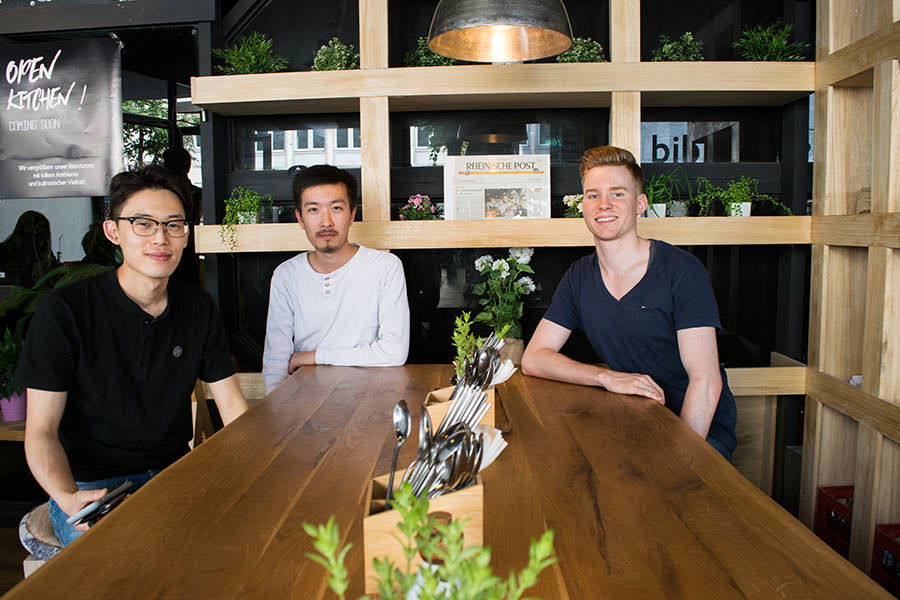
Three young men sit side by side at a long communal wooden table inside Bibimcup, a Korean bibimbap restaurant in Düsseldorf, all three smiling toward the camera. The man on the left wears glasses and a black polo shirt and holds a phone in his lap. In the middle is a man with a mustache in a white henley shirt, arms resting on the table edge. The man on the right has reddish blond hair, wears a navy v-neck t-shirt, and leans forward on his forearms. The room behind them has a light wood shelf wall dotted with small green plants and white flowers, topped by a large metal dome pendant lamp. A copy of the Rheinische Post newspaper stands upright on one of the shelves, and to the left a black poster reads "OPEN KITCHEN! COMING SOON." On the table in the foreground, a wooden caddy holds spoons and forks wrapped in napkins, with a few sprigs of fresh herbs beside it. The overall feel is bright, modern, and welcoming, like a portrait of the team in their newly opened restaurant.
Three young men sit side by side at a long communal wooden table inside Bibimcup, a Korean bibimbap restaurant in Düsseldorf, all three smiling toward the camera. The man on the left wears glasses and a black polo shirt and holds a phone in his lap. In the middle is a man with a mustache in a white henley shirt, arms resting on the table edge. The man on the right has reddish blond hair, wears a navy v-neck t-shirt, and leans forward on his forearms.
The room behind them has a light wood shelf wall dotted with small green plants and white flowers, topped by a large metal dome pendant lamp. A copy of the Rheinische Post newspaper stands upright on one of the shelves, and to the left a black poster reads "OPEN KITCHEN! COMING SOON." On the table in the foreground, a wooden caddy holds spoons and forks wrapped in napkins, with a few sprigs of fresh herbs beside it. The overall feel is bright, modern, and welcoming, like a portrait of the team in their newly opened restaurant.
Texto visible en la imagen
OPEN
KITCHEN !
COMING SOON
RHEINISCHE POST
bil
Bibimbap - El plato nacional de Corea del Sur
Bibimbap es un plato de arroz coreano en el que el sabor se puede determinar individualmente mediante diferentes ingredientes. Cualquier combinación imaginable de carne, verduras y salsa es posible. Si quieres saber más sobre Bibimbap o quieres cocinar la receta básica tú mismo, consulta nuestra receta correspondiente >> Bibimbap Reisschale mit traumhaften Toppings Antes de poder comer tu Bibimbap, debes mezclarlo muy bien con una cuchara mezclar . Solo al mezclar se combinan los ingredientes y desarrollan cada vez un sabor diferente y maravilloso.
Esto es lo que pedimos
En nuestra visita, pedimos 2 Bibimbaps con 2 guarniciones diferentes. Los acompañamientos (Kimbap y Mandu) son hechos a mano y se preparan frescos. Los ingredientes principales, además del arroz, son una ensalada de brotes de judía mungo, champiñones en salsa, ensalada de zanahoria, trozos de calabacín, lechuga y cebolla verde. Puedes refinar tu Bibimbap con la salsa coreana Ssamchang, que le da un toque picante al plato. Elegimos 2 toppings diferentes.

A generous serving of beef bibimbap fills a wide speckled ceramic bowl with a brown band around its base, set on a light wooden table. The rice is buried under crumbled bulgogi-style beef dusted with sesame seeds and topped with a scatter of chopped scallions, with slices of zucchini and shredded carrot visible around the edge. Behind the bowl, a small plate holds pieces of gimbap, the seaweed rolls showing rice, greens and egg in the cross-section. Further back on a wooden tray sit a white ceramic sauce bottle, a dark lidded pot with a spoon resting on top, and a little glass jar sprouting fresh greens. The warm, casual table setting reads as a Korean restaurant meal, photographed at Bibimcup in Düsseldorf.
A generous serving of beef bibimbap fills a wide speckled ceramic bowl with a brown band around its base, set on a light wooden table. The rice is buried under crumbled bulgogi-style beef dusted with sesame seeds and topped with a scatter of chopped scallions, with slices of zucchini and shredded carrot visible around the edge. Behind the bowl, a small plate holds pieces of gimbap, the seaweed rolls showing rice, greens and egg in the cross-section. Further back on a wooden tray sit a white ceramic sauce bottle, a dark lidded pot with a spoon resting on top, and a little glass jar sprouting fresh greens. The warm, casual table setting reads as a Korean restaurant meal, photographed at Bibimcup in Düsseldorf.
Texto visible en la imagen
No clearly readable text is present in the image.

A large grey ceramic bowl of spicy squid bibimbap sits front and center on a wooden restaurant table, photographed from just above the rim. The rice bowl is topped with sesame seeds, chopped green onions, bean sprouts, shredded lettuce, and chunks of squid coated in red chili sauce. Around it, the rest of the meal is arranged: two pan-fried dumplings on a rectangular plate behind the bowl, a row of maki sushi rolls to the left, and a blue-and-white patterned cup of tea on the right. The setting reads as a casual Korean restaurant table, with the bibimbap as the clear centerpiece.
A large grey ceramic bowl of spicy squid bibimbap sits front and center on a wooden restaurant table, photographed from just above the rim. The rice bowl is topped with sesame seeds, chopped green onions, bean sprouts, shredded lettuce, and chunks of squid coated in red chili sauce. Around it, the rest of the meal is arranged: two pan-fried dumplings on a rectangular plate behind the bowl, a row of maki sushi rolls to the left, and a blue-and-white patterned cup of tea on the right. The setting reads as a casual Korean restaurant table, with the bibimbap as the clear centerpiece.
Texto visible en la imagen
No clearly readable text is present in the image.
La relación calidad-precio
La carta de Bibimcup está colgada en la parte posterior del mostrador. Alternativamente, puedes consultar las pequeñas tarjetas de mano. En términos de precio, Bibimcup es muy bueno y ofrece un menú justo por solo 10-11 €. Pagamos 22 € por nuestros dos menús. En Düsseldorf es difícil encontrar un menú tan delicioso y saludable a precios tan bajos.

A handwritten chalkboard menu from Bibimcup, a Korean bibimbap restaurant in Düsseldorf, photographed straight on. The header, "Choose your bibimcup," is picked out in green chalk while everything else is white. The menu walks through a two-step ordering system: Step 1 is the classic bibimcup, rice with six vegetable variations and a sauce of chili paste or soy, priced at 6 euros for a small and 7 for a large. Step 2 lists toppings: tofu (dubu), glass noodles (jap-chae), and spicy pork (jae-yuk) at 1.50 euros each, with beef bulgogi and spicy squid (o-jinger) at 2.00 euros. A boxed "Vegan (topping)" section on the right highlights the bibimcup, jap-chae, and dubu as the plant-based picks, each add-on 1.50 euros. Below that, cold drinks run 2.20 euros for cola, Fanta, Sprite, apple spritzer, and orange juice, with water at 2.00, all in 0.33-liter bottles with a 10-cent deposit. Hot drinks finish the board: coffee 2.00, cappuccino 2.30, espresso 1.80, and Korean tea at 2.20 in green, quince, ginger, or yuja lemon.
A handwritten chalkboard menu from Bibimcup, a Korean bibimbap restaurant in Düsseldorf, photographed straight on. The header, "Choose your bibimcup," is picked out in green chalk while everything else is white. The menu walks through a two-step ordering system: Step 1 is the classic bibimcup, rice with six vegetable variations and a sauce of chili paste or soy, priced at 6 euros for a small and 7 for a large. Step 2 lists toppings: tofu (dubu), glass noodles (jap-chae), and spicy pork (jae-yuk) at 1.50 euros each, with beef bulgogi and spicy squid (o-jinger) at 2.00 euros.
A boxed "Vegan (topping)" section on the right highlights the bibimcup, jap-chae, and dubu as the plant-based picks, each add-on 1.50 euros. Below that, cold drinks run 2.20 euros for cola, Fanta, Sprite, apple spritzer, and orange juice, with water at 2.00, all in 0.33-liter bottles with a 10-cent deposit. Hot drinks finish the board: coffee 2.00, cappuccino 2.30, espresso 1.80, and Korean tea at 2.20 in green, quince, ginger, or yuja lemon.
Texto visible en la imagen
# CHOOSE YOUR bibimcup
\* **Step 1** (classic)
**BIBIMCUP** Klein Grob
6 € 7 €
Reis mit 6 verschiedenen
Gemüsevariationen
(inkl. scharfe Chilipaste/Soja)
\* **Step 2** (TOPPING)
+ 1,50€
- DUBU (Tofu)
- JAP-CHAE (Glasnudeln)
- JAE-YUK scharf (Schweinefleisch)
+ 2,00€
- BULGOGI (Rindfleisch)
- O-JINGER scharf (Tintenfisch)
**VEGAN** (TOPPING)
- BIBIMCUP
- DUBU +1.50 (Tofu)
- JAP-CHAE +1.50€ (Glasnudeln)
**Getränke** (0,33l, 0,2l, Pfand 10 cent)
- Cola 2.20
- Fanta 2.20
- Sprite 2.20
- Apfelschorle 2.20
- Orangensaft 2.20
- Wasser 2.00
**heipe Getränke**
Kaffee 2.00 Tee (koreanisch) 2.20
Cappuccino 2.30 Grün/Quitten/Ingwer
Espresso 1.80 Yuja (zitronen)
Sung-Ryul Choi nos ha informado de que Bibimcup se ampliará en breve. El restaurante, todavía pequeño, se ampliará con una sala adicional y ofrecerá entonces una mayor variedad de platos coreanos. Estamos deseando volver a visitar Bibimcup y esperamos con interés la ampliación del restaurante.
Nuestra conclusión
Nos sentimos cómodos en Bibimcup. Tanto por el ambiente, la comida como el servicio. El precio bajo de un plato completo es perfecto. Por supuesto, el precio se basa en la composición de los ingredientes, como los champiñones y la lechuga, pero el Bibimbap sabe genial.
Comentarios
Meine Güte... frases vacías, oraciones innecesarias sin contenido, demasiado poco crítica. Un ejemplo: "...se clasifica en la categoría de delicioso..." o "...muy justo en cuanto al precio...". ¿Qué es esa categoría, qué significa delicioso y quién decide qué es justo en precio? ¿Por qué no se justifica ni se compara? Y además una foto con el dueño del restaurante: cero objetividad. No tenéis ni idea de cómo hacer una crítica de restaurante de verdad... se nota también cuando uno lee la reseña de BB4U... ("...la salsa probablemente casera..."). ¿Qué significa probablemente, o lo sabéis o mejor os ahorráis esa frase que no ayuda a nadie. Además, falta el nombre de la salsa. ¿Se supone que debo pedirla así? “¿Me da la salsa probablemente casera sin nombre?”. Mejor menos críticas, pero bien hechas.
Hola Matthias, gracias por tu comentario, sí, en efecto, no somos críticos de restaurantes ni reseñadores profesionales, en su mayoría solo compartimos nuestras experiencias :) Pero como tampoco queremos hacerlo a medias, ya no hacemos más reseñas de restaurantes, precisamente por las razones que mencionaste :) Muchos saludos Matthias
El comentario aún no ha sido verificado.