
Tabla de contenidos:
TL;DR
Daikon, conocido como el "rábano japonés" o "rábano de invierno", es un ingrediente fundamental en la cocina japonesa, disponible principalmente en otoño. Este versátil vegetal, que puede ser preparado de múltiples formas, se destaca no solo por su sabor, que varía según la temporada, sino también por su utilización en platos como sashimi y ensaladas, donde es esencial cortarlo en rodajas muy finas para evitar un sabor demasiado picante. Además del rábano, las hojas del Daikon son también comestibles y pueden ser cultivadas nuevamente si se conserva una parte del tallo. Hoy en día, el Daikon se puede encontrar en supermercados alemanes, siendo importante elegir ejemplares firmes en lugar de gomosos.| Temporada alta: | Otoño |
|---|---|
| Categoría: | Verdura |
| Otros nombres: | Daikon-Rettich, rábano japonés o chino, rábano de invierno |
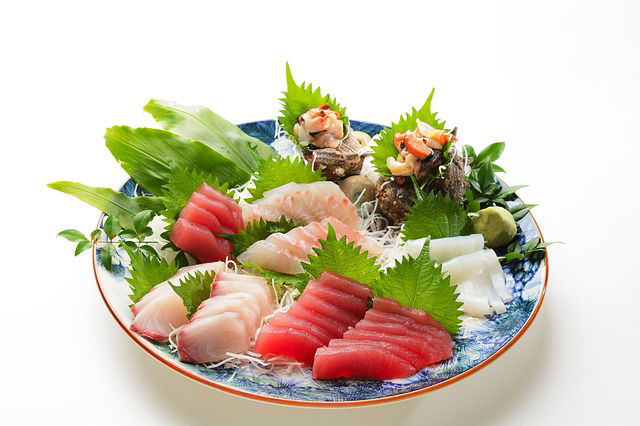
A round plate of assorted sashimi sits on a white surface. The plate is decorated in blue and white patterns with an orange rim, and its base is covered with fine shredded daikon radish. On top are slices of raw fish arranged in small fanned groups: deep red tuna, pale pink and white fish, and translucent squares of squid. Two pieces near the back are topped with a small seafood mixture, and a mound of green wasabi rests at the right edge. Jagged-edged green shiso leaves are tucked between the fish, with a few broader leaves and sprigs filling out the arrangement.
A round plate of assorted sashimi sits on a white surface. The plate is decorated in blue and white patterns with an orange rim, and its base is covered with fine shredded daikon radish. On top are slices of raw fish arranged in small fanned groups: deep red tuna, pale pink and white fish, and translucent squares of squid. Two pieces near the back are topped with a small seafood mixture, and a mound of green wasabi rests at the right edge. Jagged-edged green shiso leaves are tucked between the fish, with a few broader leaves and sprigs filling out the arrangement.
Texto visible en la imagen
No text is clearly readable in the image.
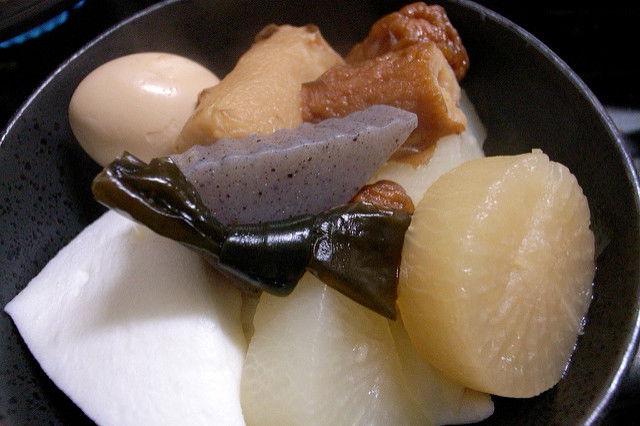
A close-up of a dark bowl filled with oden, the Japanese simmered dish, packed so the pieces nearly fill the frame. A thick round slice of daikon radish sits on the right, cooked to a translucent pale yellow, with a wedge of white daikon at the lower left. Beside them rest a whole boiled egg tinted light brown from the broth, a gray speckled triangle of konjac, a folded piece of dark kombu seaweed tied like a knot, and several browned fish cakes crowded at the top. Everything glistens with simmering broth, giving the dish a soft, stewed look.
A close-up of a dark bowl filled with oden, the Japanese simmered dish, packed so the pieces nearly fill the frame. A thick round slice of daikon radish sits on the right, cooked to a translucent pale yellow, with a wedge of white daikon at the lower left. Beside them rest a whole boiled egg tinted light brown from the broth, a gray speckled triangle of konjac, a folded piece of dark kombu seaweed tied like a knot, and several browned fish cakes crowded at the top. Everything glistens with simmering broth, giving the dish a soft, stewed look.
Texto visible en la imagen
No text is clearly readable in this image.
Daikon (jap. だいこん o también 大根 significa literalmente "rábano grande") es un rábano que se distribuye en Asia Oriental. Es un ingrediente principal de la cocina japonesa y es indispensable. Por eso, este rábano también tiene muchos nombres como: Daikon-Rettich, rábano japonés o chino, o rábano de invierno. Existe una gran variedad de métodos de preparación que resalta el sabor del daikon de diversas maneras. Por ejemplo, el daikon se corta finamente y luego se seca, lo que se conoce como Kiriboshi Daikon (切干大根, "daikon cortado y seco"). De este modo, el rábano pierde mucha agua, haciendo que los aromas sean aún más intensos. Como ensalada o acompañamiento para sashimi, el daikon también es ideal. Es importante que el daikon se corte en tiras muy finas. Porque si las tiras son demasiado gruesas, la ensalada sabe muy picante. La picantez también depende de la temporada; según mi experiencia, los daikons en invierno son más suaves y saben mejor. Las hojas del daikon también pueden ser utilizadas. Puede regenerarse si se conserva un trozo de la base de aproximadamente 3 cm y luego se mantiene en agua. Actualmente, el daikon también se encuentra en supermercados alemanes. Es importante que esté firme y no gomoso, de lo contrario, ya no sabe bien.
Comentarios