
Tabla de contenidos:
TL;DR
En este viaje a Hokkaido, específicamente a Sapporo, se comparten valiosos consejos y experiencias de una travesía que destaca lo mejor de la isla más septentrional de Japón. Se recomienda el vuelo desde Tokio, con un coste de aproximadamente 37.000 yenes por persona y una duración de 1,5 horas, frente a otras opciones como el viaje en coche o en tren, que son significativamente más largos. Al llegar a Sapporo, la conveniencia de alquilar un coche se resalta, dado que el transporte público no es tan eficiente como en Tokio; se menciona una experiencia satisfactoria al alquilar un híbrido con Toyota Rent a Car, donde el personal hablaba inglés, lo que facilita la comunicación. Además, el artículo promete ofrecer detalles sobre la gastronomía local y las impresionantes vistas que ofrece esta región, todo enmarcado en un clima único y paisajes cautivadores.En este relato de viaje te muestro todo sobre mi viaje de varios días a la isla más septentrional de Japón: ¡Hokkaido! Comparto mis consejos y experiencias contigo: cómo llegar a Sapporo y qué especialidades culinarias locales puedes esperar aquí. Hokkaido ofrece un paisaje único, un clima frío y magníficos lugares de interés que hacen que esta prefectura sea especial.
De Tokio a Sapporo
En avión
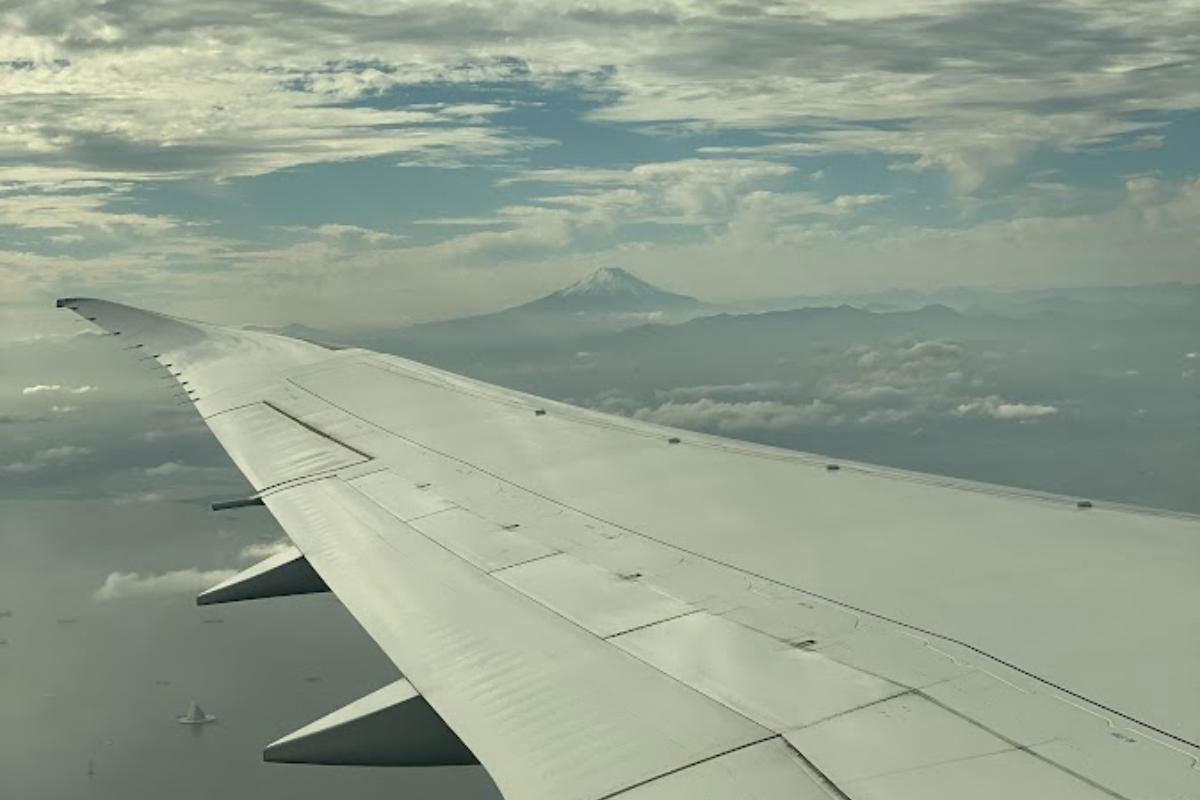
Sapporo se encuentra en Hokkaido, que es la isla más al norte de Japón. Para nuestro viaje a Hokkaido volamos desde Haneda a Sapporo. El costo del vuelo de ida y vuelta fue de 37.000 yenes (aproximadamente 228 euros) por persona. El vuelo duró unas 1,5 horas y recomiendo estar en el aeropuerto entre 1 y 2 horas antes de la salida. El control de seguridad fue rápido por tratarse de un vuelo nacional y las puertas de embarque eran fácilmente accesibles. Sin embargo, la comida en la puerta de embarque no fue recomendable. Antes del control de seguridad en el Aeropuerto Internacional de Haneda hay buena oferta de restaurantes, pero ya que nuestro vuelo era nacional, salía de otra terminal y esta vez no pudimos comer allí.
View from an airplane window, with the aircraft's long white wing sweeping across the lower half of the frame from the left edge toward the bottom right. Beyond the wing, the unmistakable snow-capped cone of Mount Fuji rises above a thick layer of haze and scattered clouds, its summit the only point breaking the horizon. Patches of blue sky show through broken clouds overhead, while the ground and water far below are softened by the cloudy veil. A quiet moment on a flight over Japan, the kind of view travelers catch on the way north to Hokkaido.
View from an airplane window, with the aircraft's long white wing sweeping across the lower half of the frame from the left edge toward the bottom right. Beyond the wing, the unmistakable snow-capped cone of Mount Fuji rises above a thick layer of haze and scattered clouds, its summit the only point breaking the horizon. Patches of blue sky show through broken clouds overhead, while the ground and water far below are softened by the cloudy veil. A quiet moment on a flight over Japan, the kind of view travelers catch on the way north to Hokkaido.
Texto visible en la imagen
No clearly readable text.
En automóvil
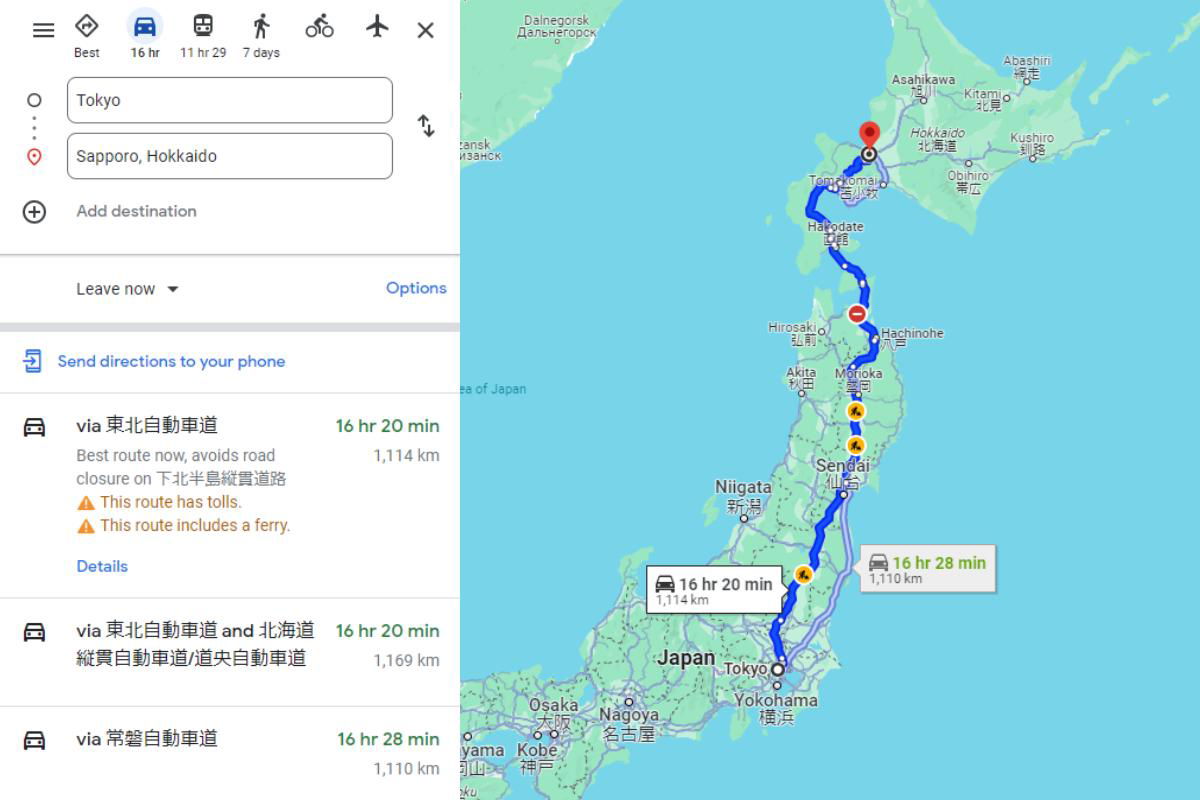
En general, también es posible viajar en automóvil desde Tokio a Hokkaido. Sin embargo, es un trayecto muy largo: unas 17 horas según Google Maps. En el camino hay varios peajes y hay que tomar un ferry, lo que supone costes adicionales. Por ello, recomiendo tomar el avión y alquilar un coche en el lugar de destino.
A Google Maps screenshot showing driving directions from Tokyo to Sapporo, Hokkaido. The left panel lists route options, the fastest being 16 hr 20 min over 1,114 km via the Tohoku Expressway, with warnings that the route has tolls and includes a ferry. Two alternative routes are listed below, each around 16 hr 20 to 28 min. The map on the right shows Japan with a blue route line running from Tokyo northward through Sendai, Aomori, and Hakodate up to Sapporo on Hokkaido, where a red pin marks the destination.
A Google Maps screenshot showing driving directions from Tokyo to Sapporo, Hokkaido. The left panel lists route options, the fastest being 16 hr 20 min over 1,114 km via the Tohoku Expressway, with warnings that the route has tolls and includes a ferry. Two alternative routes are listed below, each around 16 hr 20 to 28 min.
The map on the right shows Japan with a blue route line running from Tokyo northward through Sendai, Aomori, and Hakodate up to Sapporo on Hokkaido, where a red pin marks the destination.
Texto visible en la imagen
Best
16 hr
11 hr 29
7 days
Tokyo
Sapporo, Hokkaido
Add destination
Leave now
Options
Send directions to your phone
via 東北自動車道
16 hr 20 min
Best route now, avoids road
closure on 下北半島縦貫道路
1,114 km
This route has tolls.
This route includes a ferry.
Details
via 東北自動車道 and 北海
縦貫自動車道/道央自動車道
16 hr 20 min
1,169 km
via 常磐自動車道
16 hr 28 min
1,110 km
Dalnegorsk
Дальнегорск
Abashiri
網走
Asahikawa
旭川
Kitami
北見
Hakodate
北海道
Kushiro
釧路
Tomakomai
苫小牧
Obihiro
帯広
Hakodate
函館
Hachinohe
八戸
Hirosaki
弘前
Akita
秋田
Morioka
盛岡
Sendai
仙台
Niigata
新潟
Japan
Tokyo
Yokohama
横浜
Osaka
大阪
Nagoya
名古屋
yama
Kobe
神戸
16 hr 28 min
1,110 km
16 hr 20 min
1,114 km
ea of Japan
En tren
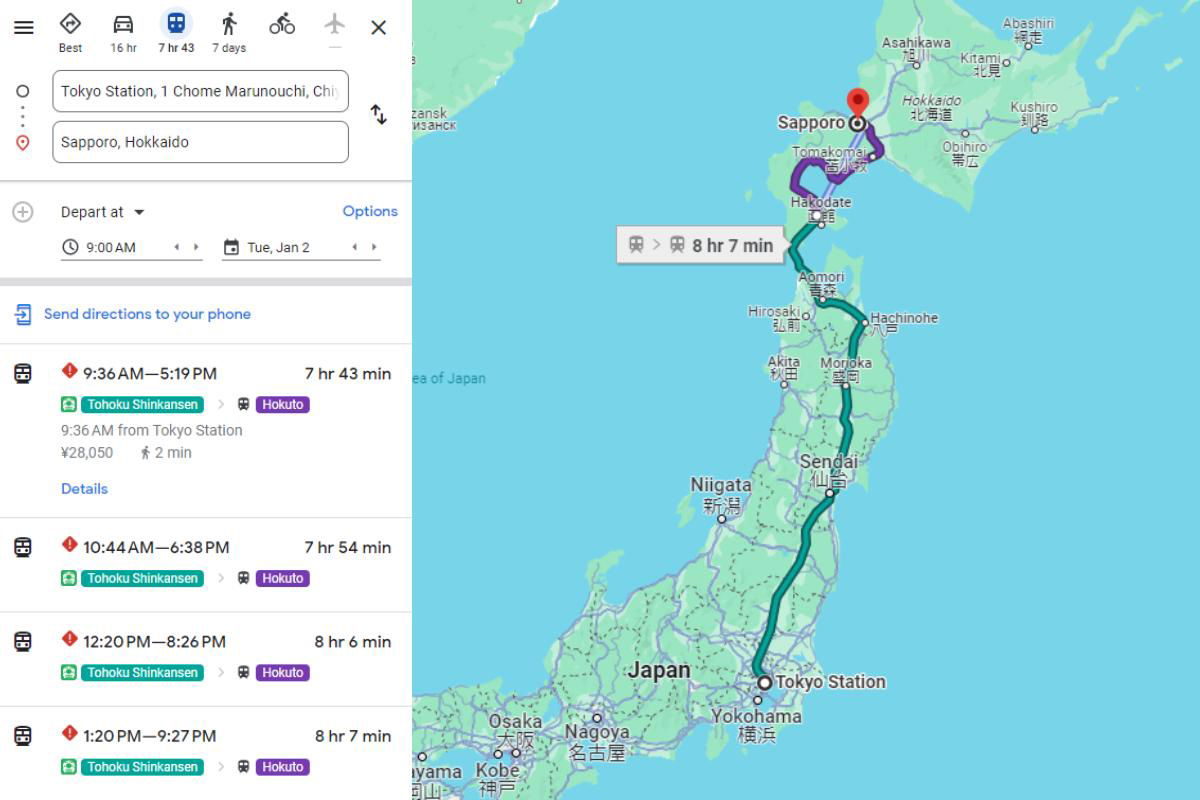
También existe la opción de ir en Shinkansen hasta Hokkaido, pero el trayecto desde la estación de Tokio dura unas 8 horas. Además, el Shinkansen solo llega hasta la estación Shin-Hakodate-Hokuto; después hay que hacer un transbordo a un tren local hasta Sapporo. De todas las opciones, definitivamente recomiendo invertir el dinero y viajar en avión para ahorrar tiempo.
This is a screenshot of a Google Maps route search for a train trip from Tokyo Station to Sapporo, Hokkaido. The left panel lists four departure options on Tuesday, January 2, each combining the Tohoku Shinkansen and the Hokuto limited express, with journey times ranging from about 7 hr 43 min to 8 hr 7 min and a fare of ¥28,050. The map on the right shows the route as a line running north from Tokyo through Sendai, Morioka, and Aomori, crossing to Hokkaido via Hakodate and Tomakomai before ending with a red pin in Sapporo.
This is a screenshot of a Google Maps route search for a train trip from Tokyo Station to Sapporo, Hokkaido. The left panel lists four departure options on Tuesday, January 2, each combining the Tohoku Shinkansen and the Hokuto limited express, with journey times ranging from about 7 hr 43 min to 8 hr 7 min and a fare of ¥28,050. The map on the right shows the route as a line running north from Tokyo through Sendai, Morioka, and Aomori, crossing to Hokkaido via Hakodate and Tomakomai before ending with a red pin in Sapporo.
Texto visible en la imagen
Best 16 hr 7 hr 43 7 days
Tokyo Station, 1 Chome Marunouchi, Chi
Sapporo, Hokkaido
Depart at
Options
9:00 AM Tue, Jan 2
Send directions to your phone
9:36 AM—5:19 PM 7 hr 43 min
Tohoku Shinkansen > Hokuto
9:36 AM from Tokyo Station
¥28,050 2 min
Details
10:44 AM—6:38 PM 7 hr 54 min
Tohoku Shinkansen > Hokuto
12:20 PM—8:26 PM 8 hr 6 min
Tohoku Shinkansen > Hokuto
1:20 PM—9:27 PM 8 hr 7 min
Tohoku Shinkansen > Hokuto
8 hr 7 min
Abashiri
綾走
Asahikawa
旭川
Kitami
北見
Kushiro
釧路
Hokkaido
北海道
Sapporo
札幌
Tomakomai
苫小牧
Obihiro
帯広
Hakodate
函館
Aomori
青森
Hirosaki
弘前
Hachinohe
八戸
Akita
秋田
Morioka
盛岡
Sea of Japan
Sendai
仙台
Niigata
新潟
Japan
Tokyo Station
Yokohama
横浜
Osaka
大阪
Nagoya
名古屋
yama Kobe
神戸
岡山
Cómo alquilar un coche
Al llegar a Sapporo, decidimos alquilar un coche . Así tienes flexibilidad y no dependes del transporte público local, que en Hokkaido no está tan desarrollado como en Tokio, por ejemplo.
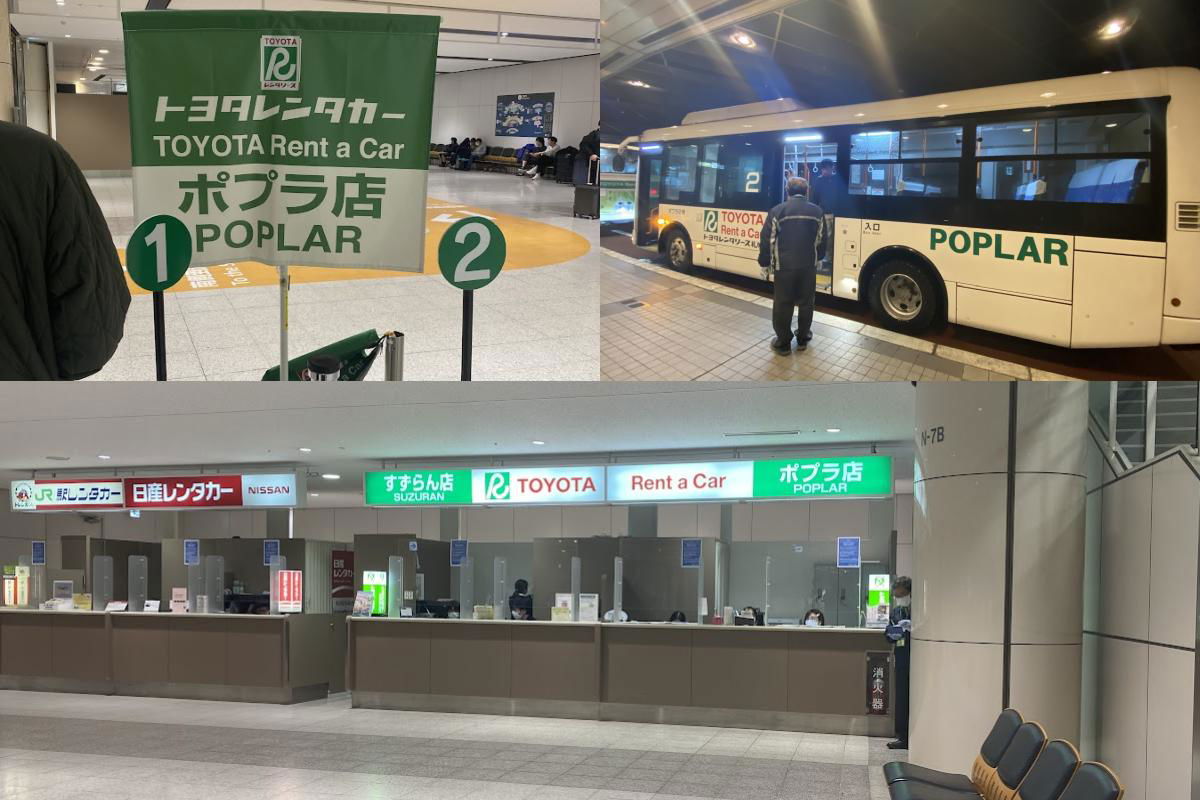
Para nuestras excursiones por Hokkaido alquilamos un coche de Toyota Rent a Car . En el aeropuerto fuimos directamente al mostrador y nos dieron un número. Luego nos llevaron con un bus especial hasta el mostrador, donde pagamos y nos mostraron el coche. Al haber alquilado un coche híbrido, durante todo el viaje solo gastamos 4.000 yenes adicionales en gasolina/transporte, ¡aunque no usamos transporte público! Un gran punto a favor para quienes no hablan japonés: los empleados del mostrador de Toyota Rent a Car en Sapporo también hablaban inglés.
Sitio web oficial (inglés): https://rent.toyota.co.jp/eng/
A three-part collage documenting a car rental pickup in Hokkaido, Japan. In the top left photo, a green Toyota Rent a Car banner hangs in an airport arrivals hall, reading "TOYOTA Rent a Car" in English and Japanese with "POPLAR" underneath, the branch name. Two numbered posts marked 1 and 2 stand beside it, marking the shuttle stop. Travelers with luggage sit on benches in the background. The top right photo shows the shuttle itself at night: a white bus with "POPLAR" and Toyota Rent a Car branding along its side, its door open as a uniformed staff member steps aboard at a lit curbside platform. The bottom photo stretches across the airport's rental car counter row. Illuminated signs sit above a long service counter: JR, Nippon with Nissan, and a large green Toyota Rent a Car sign flanked by its Suzuran and Poplar branches in both Japanese and English. The counters are quiet, with a couple of staff visible behind protective screens and empty seating in the foreground.
A three-part collage documenting a car rental pickup in Hokkaido, Japan.
In the top left photo, a green Toyota Rent a Car banner hangs in an airport arrivals hall, reading "TOYOTA Rent a Car" in English and Japanese with "POPLAR" underneath, the branch name. Two numbered posts marked 1 and 2 stand beside it, marking the shuttle stop. Travelers with luggage sit on benches in the background. The top right photo shows the shuttle itself at night: a white bus with "POPLAR" and Toyota Rent a Car branding along its side, its door open as a uniformed staff member steps aboard at a lit curbside platform.
The bottom photo stretches across the airport's rental car counter row. Illuminated signs sit above a long service counter: JR, Nippon with Nissan, and a large green Toyota Rent a Car sign flanked by its Suzuran and Poplar branches in both Japanese and English. The counters are quiet, with a couple of staff visible behind protective screens and empty seating in the foreground.
Texto visible en la imagen
トヨタレンタカー
TOYOTA Rent a Car
ポプラ店
POPLAR
1
2
TOYOTA Rent a Car
入口
POPLAR
JR 駅レンタカー 日産レンタカー NISSAN
すずらん店
SUZURAN
TOYOTA
Rent a Car
ポプラ店
POPLAR
Nuestro alojamiento - el Hotel "Sapporo Granbell"
Durante nuestra estancia en Sapporo nos alojamos en el hotel "Sapporo Granbell" *. Reservamos una habitación un poco más grande, y el hotel nos ofreció una experiencia muy especial: un Onsen, disponible gratuitamente para los huéspedes en la azotea del hotel. Especialmente en invierno es una experiencia maravillosa.
El hotel también dispone de un garaje en el que un robot estaciona el coche. Puedes aparcar y sacar el coche tantas veces como quieras durante tu estancia. El costo del garaje es de 2.000 yenes por día, lo que resulta más barato que los aparcamientos locales. Ten en cuenta que al hacer el check-out a las 11:00 horas, el coche debe ser recogido directamente, ya que si no se cobra 200 yenes por cada hora extra. Pudimos guardar nuestro equipaje gratuitamente en el hotel el último día, lo que nos permitió disfrutar la última jornada sin cargas.
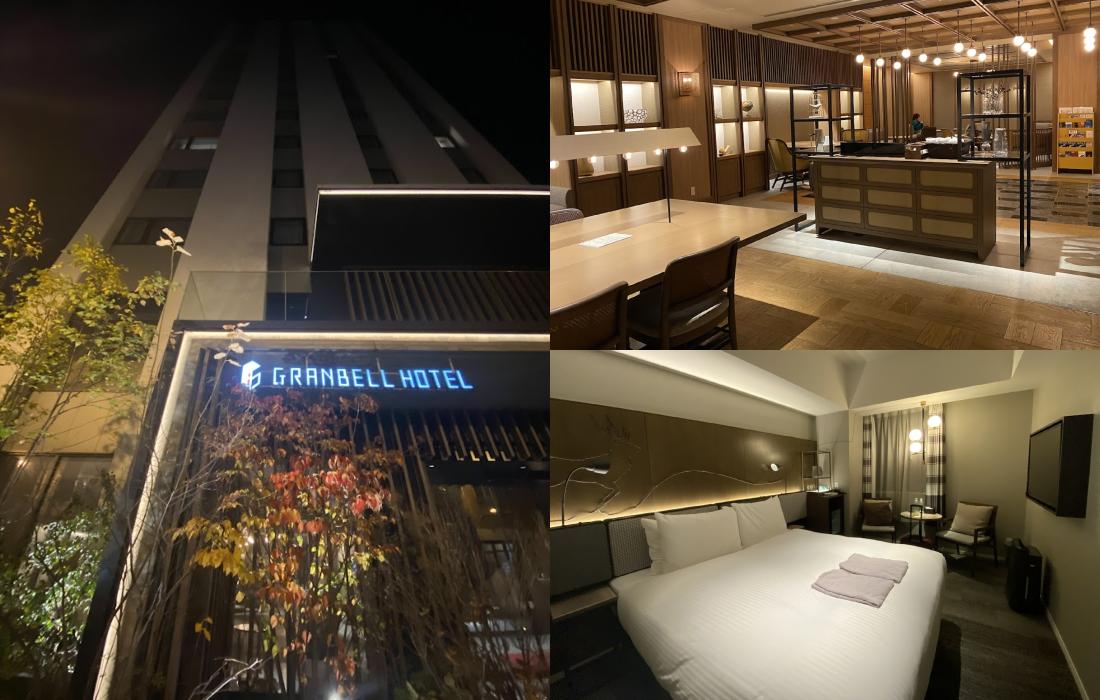
A three-part collage showing the Granbell Hotel in Sapporo. On the left, a nighttime view looking up the tower's dark facade, with a glowing blue "GRANBELL HOTEL" sign above the entrance and autumn-colored branches in the foreground. The right side shows two interior shots. The top one is a warmly lit lounge with wood-panelled walls, hanging pendant bulbs, a long communal table, and a bar counter with a staff member behind it. The bottom one is a guest room with a wide bed dressed in white linens, folded towels laid across it, a wall-mounted TV, and a pair of armchairs beside a curtained window.
A three-part collage showing the Granbell Hotel in Sapporo. On the left, a nighttime view looking up the tower's dark facade, with a glowing blue "GRANBELL HOTEL" sign above the entrance and autumn-colored branches in the foreground.
The right side shows two interior shots. The top one is a warmly lit lounge with wood-panelled walls, hanging pendant bulbs, a long communal table, and a bar counter with a staff member behind it. The bottom one is a guest room with a wide bed dressed in white linens, folded towels laid across it, a wall-mounted TV, and a pair of armchairs beside a curtained window.
Texto visible en la imagen
GRANBELL HOTEL
*Enlace de Afiliado
Enlace de Afiliado: Si realizas una reserva de hotel en Booking.com a través de mi widget o enlace, recibo una pequeña comisión. Para ti no hay ningún coste adicional y apoyas mi blog. Te lo agradezco mucho y te deseo un buen viaje (^_^)Más hoteles en Sapporo
Aquí puedes reservar el hotel*
Google Maps: https://maps.app.goo.gl/giPB9PZK1MJAVZ579
Comida en Hokkaido
Nuestro viaje de varios días a Hokkaido fue una buena ocasión para probar tantas especialidades culinarias locales como fuera posible. Qué platos probamos, lo descubrirás en los siguientes apartados.
Sushi con vieiras
La isla de Hokkaido es conocida por su variedad de mariscos y, sobre todo, por su sushi súper fresco. Personalmente recomiendo especialmente las vieiras, que aquí son muy grandes. El sushi con vieiras también es muy popular en Hokkaido. Por supuesto, probamos diferentes tipos de sushi para degustar todo.
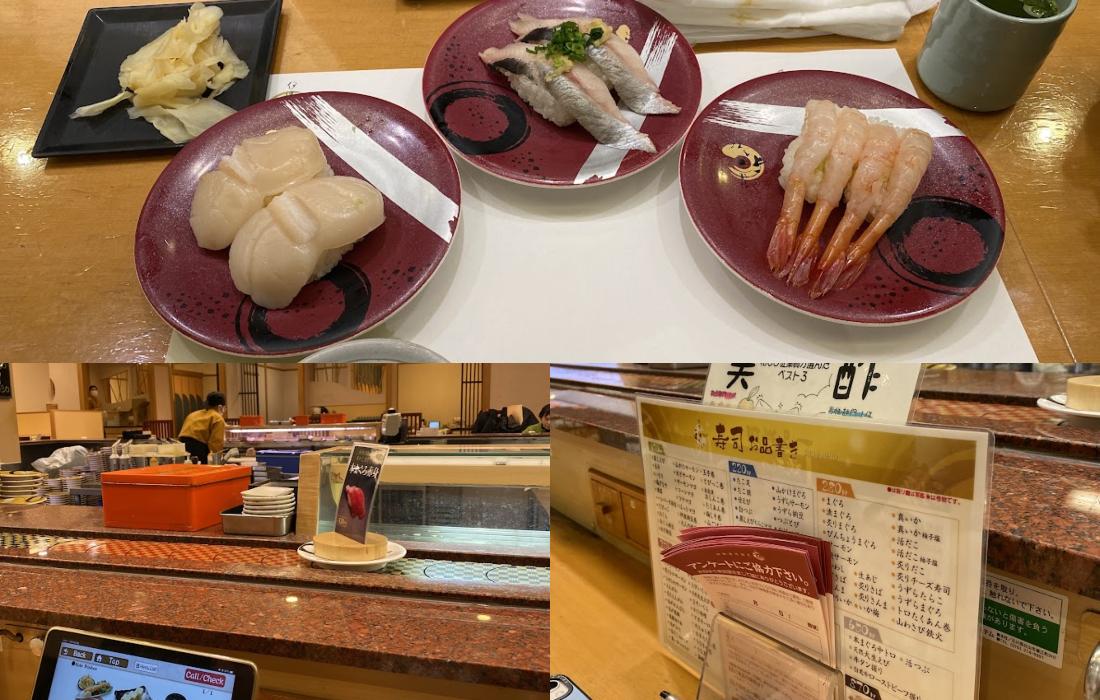
A collage of three photos from a conveyor-belt sushi restaurant in Sapporo, Hokkaido. The top photo is the star: three small red plates with black brushstroke designs, each holding two pieces of nigiri. One plate has thick, pearly scallops draped over rice, another white fish topped with chopped green onion, and the third shrimp with their tails curled up over the rice. A black dish of pickled ginger and a cup of green tea sit at the edges of the wooden table. The bottom two photos show the restaurant itself. On the left, the counter runs alongside a glass-fronted refrigerated case and a conveyor belt, with a staff member in a yellow top working behind it and a tablet ordering screen at the seat showing a "Call / Check" button. On the right, a laminated Japanese menu stand at the counter lists the different sushi items and prices, with a rotation of plates sliding past behind it.
A collage of three photos from a conveyor-belt sushi restaurant in Sapporo, Hokkaido. The top photo is the star: three small red plates with black brushstroke designs, each holding two pieces of nigiri. One plate has thick, pearly scallops draped over rice, another white fish topped with chopped green onion, and the third shrimp with their tails curled up over the rice. A black dish of pickled ginger and a cup of green tea sit at the edges of the wooden table.
The bottom two photos show the restaurant itself. On the left, the counter runs alongside a glass-fronted refrigerated case and a conveyor belt, with a staff member in a yellow top working behind it and a tablet ordering screen at the seat showing a "Call / Check" button. On the right, a laminated Japanese menu stand at the counter lists the different sushi items and prices, with a rotation of plates sliding past behind it.
Texto visible en la imagen
Goto
Call / Check
Cangrejo de Hokkaido
Si te gusta el cangrejo, tienes que probar el cangrejo de Hokkaido sí o sí. Recomiendo la dirección Kaniya Sapporo Crab House (sucursal principal). El precio por persona varía según el menú y va de 6.000 a 20.000 yenes. Es algo caro, pero ¡vale la pena la visita! Además de la calidad de la comida, el ambiente del restaurante también es muy especial.
Kaniya Sapporo Crab House (Sucursal principal): https://maps.app.goo.gl/89WZdyCgMknxE7PG8
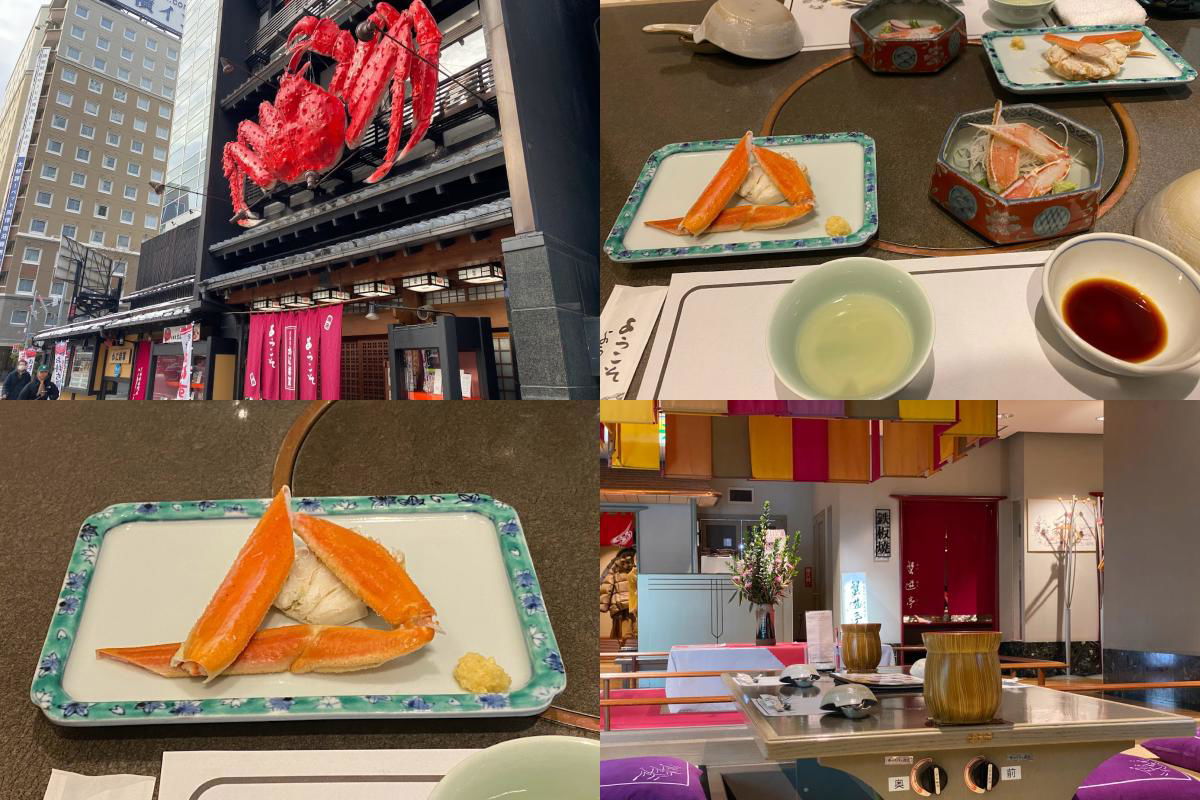
A four-photo collage from a crab feast in Sapporo, Hokkaido. In the top left, a huge bright red king crab is mounted on the dark wooden facade of a restaurant, its legs spread wide above the entrance where red curtains hang. A tall pale hotel tower rises right beside it, showing the restaurant sits on a downtown street. The other three photos move inside to the meal itself. The top right shows a low table set with king crab legs fanned across a rectangular plate with a green floral border, a red lacquered box holding more crab over noodles or vegetables, green tea, and a small dish of soy sauce. The bottom left zooms in on that plate: orange crab legs arranged over a mound of meat or rice with a small dab of roe beside them. The bottom right captures the dining room, with bright fabric panels in pink, orange, and yellow hanging from the ceiling, a glossy red door, flowers on the counter, and wooden tea canisters on the table in front of purple floor cushions.
A four-photo collage from a crab feast in Sapporo, Hokkaido.
In the top left, a huge bright red king crab is mounted on the dark wooden facade of a restaurant, its legs spread wide above the entrance where red curtains hang. A tall pale hotel tower rises right beside it, showing the restaurant sits on a downtown street. The other three photos move inside to the meal itself. The top right shows a low table set with king crab legs fanned across a rectangular plate with a green floral border, a red lacquered box holding more crab over noodles or vegetables, green tea, and a small dish of soy sauce. The bottom left zooms in on that plate: orange crab legs arranged over a mound of meat or rice with a small dab of roe beside them. The bottom right captures the dining room, with bright fabric panels in pink, orange, and yellow hanging from the ceiling, a glossy red door, flowers on the counter, and wooden tea canisters on the table in front of purple floor cushions.
Texto visible en la imagen
HOTEL
よしもと
Jingisukan Yakiniku
Otra especialidad local que hay que probar en Hokkaido es el Jingisukan Yakiniku (ジンギスカン, Yakiniku "Gengis Khan"). Se trata de un plato de carne de cordero asada que se prepara en una plancha de metal convexa o en una parrilla. El plato a menudo se asa con brotes de soja, setas, cebolla y pimientos, y se sirve con una salsa de soja o sake. Es sabroso, pero por la carne de cordero resulta bastante contundente y para mi gusto fue un poco graso. Aun así, recomiendo probarlo cuando estés en Hokkaido.
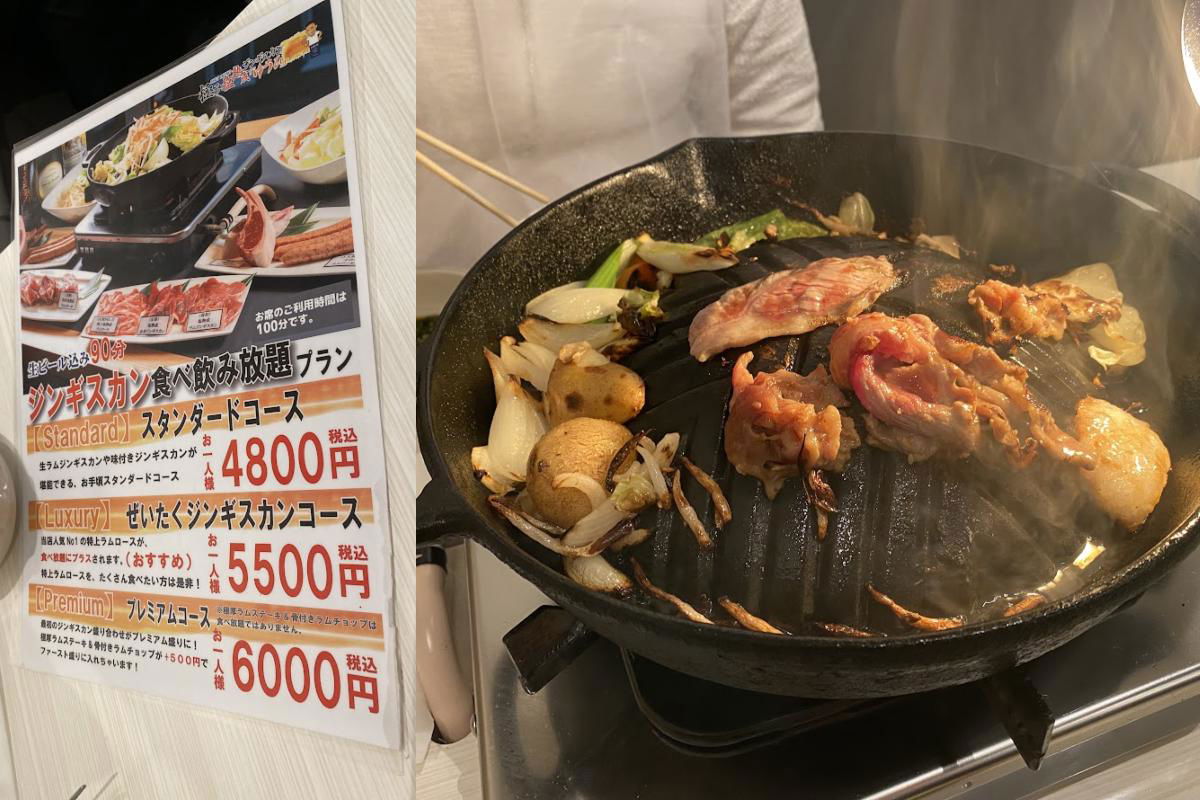
A two-part photo from a Sapporo restaurant showing jingisukan, Hokkaido's grilled mutton dish. On the right, a dome-shaped cast iron griddle steams over a portable burner, with thin slices of lamb browning among softening onions, cabbage, and green pepper. A pair of chopsticks reaches in from above, and a diner in a white shirt sits just behind the rising steam. On the left, the menu board lists all-you-can-eat plans in Japanese: a Standard course at 4800 yen, a Luxury lamb-loin course at 5500 yen, and a Premium course at 6000 yen per person, tax included, with a 100-minute time limit. Small photos on the board show the same dome pan piled with raw lamb and vegetables, matching the meal being cooked in the picture.
A two-part photo from a Sapporo restaurant showing jingisukan, Hokkaido's grilled mutton dish. On the right, a dome-shaped cast iron griddle steams over a portable burner, with thin slices of lamb browning among softening onions, cabbage, and green pepper. A pair of chopsticks reaches in from above, and a diner in a white shirt sits just behind the rising steam.
On the left, the menu board lists all-you-can-eat plans in Japanese: a Standard course at 4800 yen, a Luxury lamb-loin course at 5500 yen, and a Premium course at 6000 yen per person, tax included, with a 100-minute time limit. Small photos on the board show the same dome pan piled with raw lamb and vegetables, matching the meal being cooked in the picture.
Texto visible en la imagen
お席のご利用時間は100分です。
生ビール込 90分
ジンギスカン食べ飲み放題プラン
【Standard】スタンダードコース
お一人様 4800円 税込
【Luxury】ぜいたくジンギスカンコース
おすすめ
お一人様 5500円 税込
【Premium】プレミアムコース
お一人様 6000円 税込
プラス500円で
Miso-Ramen
Cuando afuera hace frío e incomoda, el ramen (sopa de fideos) es especialmente reconfortante. Durante nuestro viaje probamos un restaurante (らーめん吉山商店 狸小路店) que, en mi opinión, servía uno de los mejores ramen que he comido hasta ahora. La sopa no estaba demasiado salada, que a menudo es un problema en mi opinión. La base de la sopa era muy ahumada y la carne extremadamente tierna. Los brotes de bambú eran también más frescos que en otros restaurantes de ramen estándar. El precio por esta calidad fue, sin embargo, bastante asequible; como casi siempre en Japón. Solo hay que conocer los lugares correctos.
Google Maps: https://maps.app.goo.gl/Tr2o8ZGV2MhBZSoz9?g_st=ic
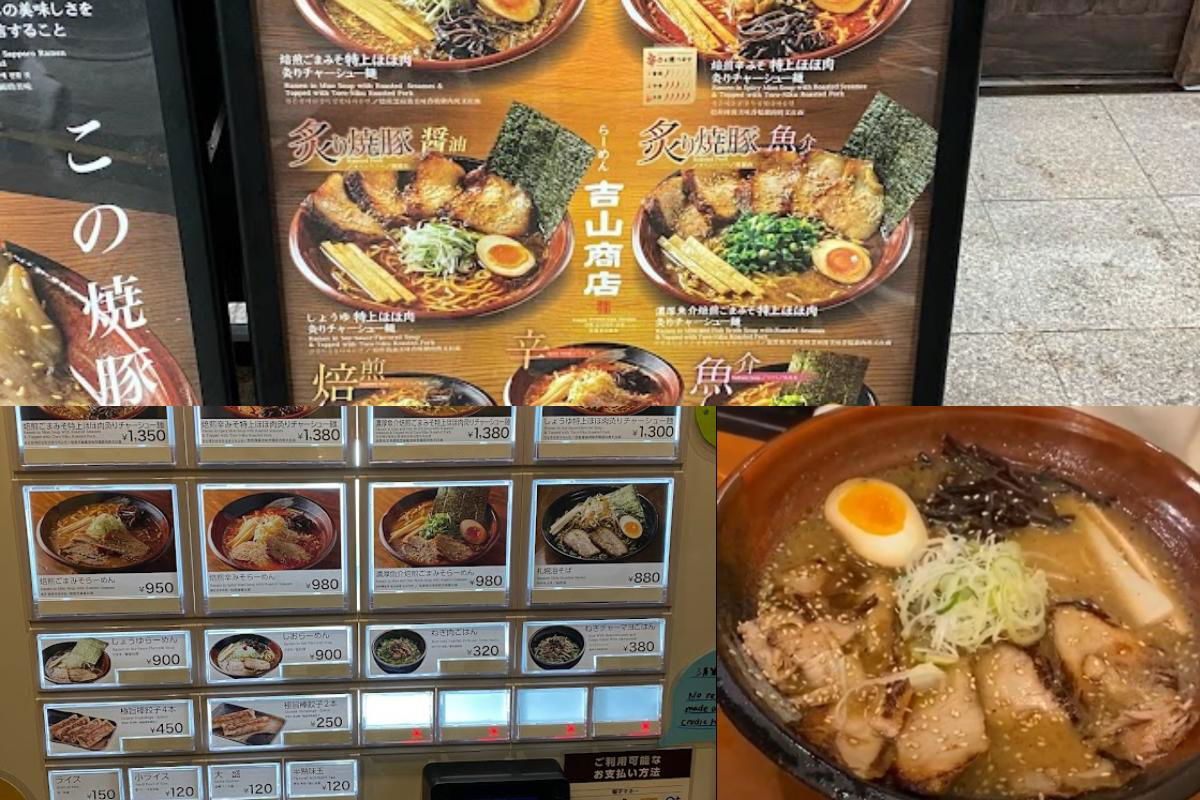
This collage captures a visit to a Sapporo ramen shop, from ordering to the finished bowl. The top shows a large backlit menu board for Yoshiyama Shoten, covered with appetizing photos of steaming ramen bowls: spicy miso ramen topped with seared chashu pork, a soy sauce version, and a fish broth variety, each piled with egg, greens, and sheets of nori. Below it sits the shop's ticket vending machine, its rows of backlit buttons displaying photos and prices for the different bowls and toppings, ranging from about ¥120 for extras up to ¥1,380 for the signature dishes. The bottom right photo shows the reward: a close-up of miso ramen in a brown ceramic bowl. A halved soft-boiled egg with a jammy orange yolk sits on top beside tender slices of chashu, a mound of shredded leek, sesame seeds, and wavy noodles in a rich, opaque broth. Together the three images tell the classic Sapporo ramen ritual: browse the picture menu, buy a ticket from the machine, then dig in.
This collage captures a visit to a Sapporo ramen shop, from ordering to the finished bowl. The top shows a large backlit menu board for Yoshiyama Shoten, covered with appetizing photos of steaming ramen bowls: spicy miso ramen topped with seared chashu pork, a soy sauce version, and a fish broth variety, each piled with egg, greens, and sheets of nori. Below it sits the shop's ticket vending machine, its rows of backlit buttons displaying photos and prices for the different bowls and toppings, ranging from about ¥120 for extras up to ¥1,380 for the signature dishes.
The bottom right photo shows the reward: a close-up of miso ramen in a brown ceramic bowl. A halved soft-boiled egg with a jammy orange yolk sits on top beside tender slices of chashu, a mound of shredded leek, sesame seeds, and wavy noodles in a rich, opaque broth. Together the three images tell the classic Sapporo ramen ritual: browse the picture menu, buy a ticket from the machine, then dig in.
Texto visible en la imagen
の美味しさを
めること
こ
の
焼
豚
進化系つけ麺特上はん肉
Spicy Sesame Dipping Noodles with Roasted Pork & Seasoned Egg
炙り焼豚 醤油
全サイズ一律
らーめん
吉山商店
炙り焼豚 魚介
全サイズ一律
炙りチャーシュー麺
Braised Pork Shoulder Sirloin Roasting in a Sweet Soy-based Sauce
Spicy Sesame Dipping Noodle Soup with Seasoned Pork
Spicy Sesame Dipping Soup with Seasoned Pork
辛
焙煎
魚介
¥1,350
¥1,380
¥1,380
¥1,300
¥950
¥980
炙り特製ちゃーしゅーめん ¥980
¥880
ちゃーしゅーごはん ¥900
しおそば ¥900
お好み焼そば ¥320
¥380
¥450
極炙餃子2ケ ¥250
ライス ¥150
スープライス ¥120
大盛 ¥120
¥120
ご利用可能券をお買い求め
お釣り
Comiendo en la izakaya "rukku & uohei"
Si buscas una muy buena izakaya en Sapporo, te recomiendo la izakaya "rukku & uohei" . Este restaurante, del típico estilo "izakaya", está en pleno Sapporo y comimos allí verdaderamente bien. Más sobre los platos que pedimos te cuento en los siguientes apartados.
Kaisendon
Otro gran punto culinario de Hokkaido fue el Kaisendon - un sashimi donburi con pescado fresco sobre arroz suave y esponjoso. Nuestro Kaisendon consistía en distintas variedades de pescado local, camarones y huevas de salmón, todo crudo por supuesto. El pescado sabe especialmente fresco en la isla y Hokkaido es famosa por su increíble calidad. Así que no debes perder la oportunidad de probar un plato de pescado aquí. Sobre todo creo que los platos de sashimi son muy recomendables.
Google Maps: https://maps.app.goo.gl/RnBqN2iEyVPUnSXf9
.jpg?width=1200)
This split image shows a small izakaya in Sapporo and the kind of meal it serves. On the left is the restaurant entrance, framed by a dark blue noren curtain with white Japanese lettering. A woman in a cream coat and black tights steps through the doorway, and outside stands a menu board advertising a lunch set for 750 yen along with other dishes priced around 580 to 780 yen. The right half is a close-up of a kaisendon, a seafood rice bowl, on a worn wooden table. The rice is nearly buried under sashimi: two whole sweet shrimp with long antennae, glistening orange salmon roe, slices of tuna, squid, and white fish, with a dollop of wasabi and a shiso leaf at the center. A glass of beer sits just behind the bowl.
This split image shows a small izakaya in Sapporo and the kind of meal it serves. On the left is the restaurant entrance, framed by a dark blue noren curtain with white Japanese lettering. A woman in a cream coat and black tights steps through the doorway, and outside stands a menu board advertising a lunch set for 750 yen along with other dishes priced around 580 to 780 yen.
The right half is a close-up of a kaisendon, a seafood rice bowl, on a worn wooden table. The rice is nearly buried under sashimi: two whole sweet shrimp with long antennae, glistening orange salmon roe, slices of tuna, squid, and white fish, with a dollop of wasabi and a shiso leaf at the center. A glass of beer sits just behind the bowl.
Texto visible en la imagen
磯ちらし&魚平
クラシック
特
飲み
本日おすすめランチ(税込)
750円
メバルあずき丼 580円
ランチタイムメニ
のど黒定食 780円
(税込価格)
カレーライス 600円
日替わり定食 750円
ミニランチ 750円
うにいくら丼 650円
いくら丼 330円
330円
330円
280円
Lachs Nabe
Otro plato que comimos en la izakaya "rukku & uohei" fue Lachs Nabe . Es un guiso ideal para los días fríos y servido con salmón y verduras. El pescado en el guiso se cocina ante tus ojos en un pequeño hornillo. ¡Es la comida perfecta para el invierno y un verdadero placer culinario!
Google Maps: https://maps.app.goo.gl/RnBqN2iEyVPUnSXf9
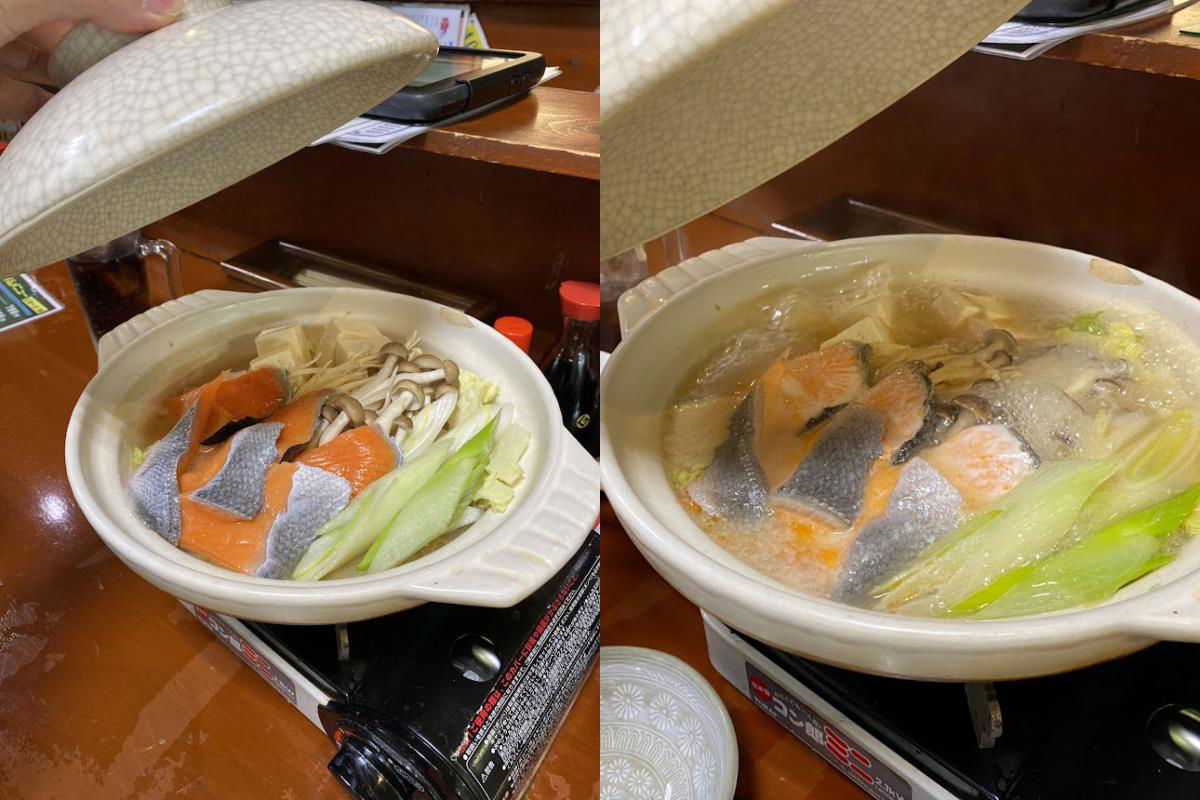
A two-photo spread of a salmon hot pot, Lachs Nabe, served in a round clay pot on a portable gas stove at a wooden restaurant counter. In the left photo, a hand lifts the speckled ceramic lid to reveal the pot's raw contents: orange salmon fillets with silvery skin laid across the center, surrounded by blocks of tofu, enoki mushrooms, napa cabbage, and leeks nestled in clear broth. The right photo shows the same pot after cooking, the salmon now paler and flaking, the vegetables wilted, everything bubbling in a cloudy, steaming broth. Soy sauce and other condiment bottles sit on the counter beside the stove, giving the scene the feel of a casual Japanese restaurant meal.
A two-photo spread of a salmon hot pot, Lachs Nabe, served in a round clay pot on a portable gas stove at a wooden restaurant counter. In the left photo, a hand lifts the speckled ceramic lid to reveal the pot's raw contents: orange salmon fillets with silvery skin laid across the center, surrounded by blocks of tofu, enoki mushrooms, napa cabbage, and leeks nestled in clear broth. The right photo shows the same pot after cooking, the salmon now paler and flaking, the vegetables wilted, everything bubbling in a cloudy, steaming broth. Soy sauce and other condiment bottles sit on the counter beside the stove, giving the scene the feel of a casual Japanese restaurant meal.
Texto visible en la imagen
GB
うちのジン
Ikura Don
Para los amantes de las huevas recomiendo el Ikura Don. Es un donburi de huevas de salmón sobre arroz suave y caliente. Además el plato fue servido con un show: el personal de servicio llena una gran cantidad de huevas usando una cuchara de madera sobre tu bowl de arroz hasta que casi rebosa de huevas. Definitivamente fue una experiencia única y sobre todo, con el show, resulta inolvidable.
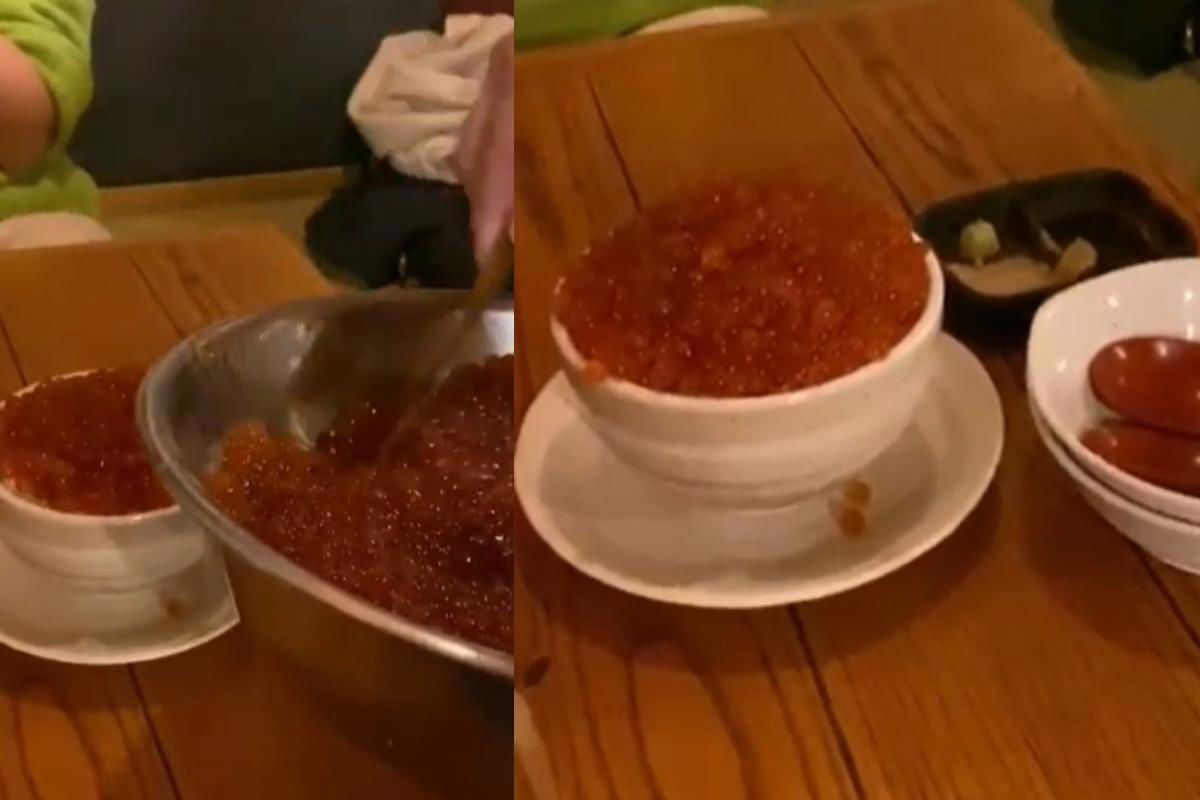
A two-part photo of an ikura don being served at a wooden restaurant table in Sapporo. On the right, a white bowl on a saucer is piled so high with glistening orange salmon roe that it domes well above the rim, with a few loose pearls on the plate. A small black dish of pickles and a stack of white bowls with red spoons sit beside it. The left half shows the serving step: a large metal bowl filled with salmon roe, a hand scooping more roe with a spoon, and an already topped rice bowl waiting nearby.
A two-part photo of an ikura don being served at a wooden restaurant table in Sapporo. On the right, a white bowl on a saucer is piled so high with glistening orange salmon roe that it domes well above the rim, with a few loose pearls on the plate. A small black dish of pickles and a stack of white bowls with red spoons sit beside it. The left half shows the serving step: a large metal bowl filled with salmon roe, a hand scooping more roe with a spoon, and an already topped rice bowl waiting nearby.
Texto visible en la imagen
No clearly readable text is present in the image.
Lugares de interés en la prefectura de Hokkaido
Jigokudani (Hell Valley) 登別地獄谷
Durante nuestro viaje a Hokkaido visitamos diferentes lugares y zonas. Uno de ellos es Jigokudani (Hell Valley), un paisaje fascinante con lagunas y ríos termales burbujeantes como de otro mundo. Debido a bacterias en el entorno surgen varios colores como blanco, verde y azul, lo que da al paisaje un aspecto único.
Cuando nieva es especialmente impresionante, pero incluso sin nieve ¡vale la pena la visita! Se puede llegar en coche en 1,5-2 horas, o en bus en unas 2-3 horas.
Google Maps: https://maps.app.goo.gl/29CTGfqYStRdip8Y8?g_st=ic
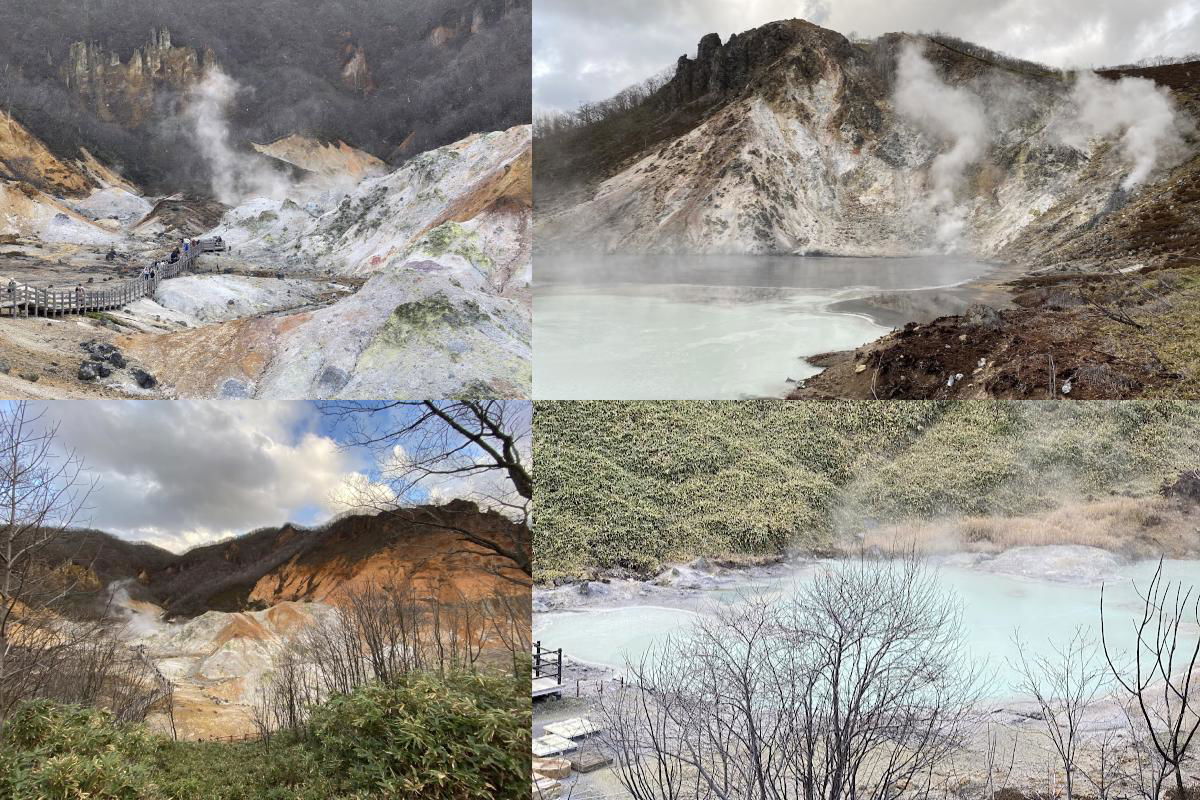
A four-photo collage of a steaming volcanic valley in Hokkaido, at Hell Valley (Jigokudani) near Noboribetsu. In every shot the hillsides are stripped of vegetation and stained pale gray, white, and rust orange by sulfur deposits, with thick plumes of steam rising from the ground. The four views cover different corners of the valley. The top left follows a wooden boardwalk where tiny figures of visitors wind between the mineral slopes, jagged dark rock spires looming above. The top right looks across a milky gray pond gathered at the base of a steep, eroded mountainside, steam drifting low over the water. The bottom two show an orange-stained hillside framed by bare branches under a partly cloudy sky, and a pale blue hot spring pool edged with dried grasses and leafless shrubs, a small wooden platform at its shore.
A four-photo collage of a steaming volcanic valley in Hokkaido, at Hell Valley (Jigokudani) near Noboribetsu. In every shot the hillsides are stripped of vegetation and stained pale gray, white, and rust orange by sulfur deposits, with thick plumes of steam rising from the ground.
The four views cover different corners of the valley. The top left follows a wooden boardwalk where tiny figures of visitors wind between the mineral slopes, jagged dark rock spires looming above. The top right looks across a milky gray pond gathered at the base of a steep, eroded mountainside, steam drifting low over the water. The bottom two show an orange-stained hillside framed by bare branches under a partly cloudy sky, and a pale blue hot spring pool edged with dried grasses and leafless shrubs, a small wooden platform at its shore.
Texto visible en la imagen
No clearly readable text is present in the image.
Región de Yubari
Durante nuestro viaje también visitamos la región de Yubari, conocida por sus deliciosos melones. Estos melones son considerados una delicia y son muy populares en todo Japón. Destacan por su sabor dulce. Muchos agricultores en la región de Yubari se dedican al cultivo de esta variedad especial de melón. Lamentablemente, tuvimos mala suerte con el clima y empezó a nevar mucho. Por eso no pudimos visitar el puente turístico local ni la cascada Chidorigataki. Aun así, fue interesante explorar la región con el coche de alquiler.
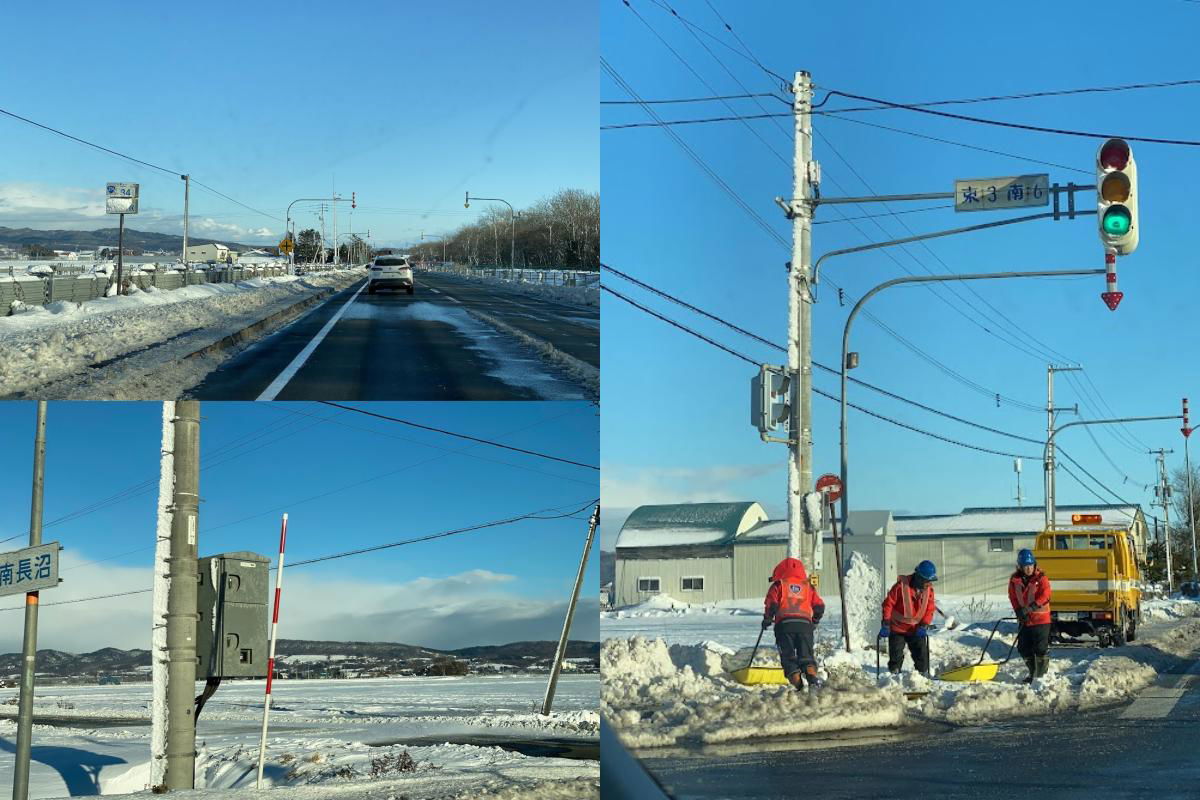
A three-photo collage of winter road scenes around Yubari in Hokkaido, all under a clear blue sky. The largest photo, on the right, shows three snow-clearing workers in bright orange and red winter jackets and helmets shoveling deep, dirty snow at a roadside intersection. They work with yellow shovels next to a small yellow utility truck, with a metal barn-like building and a traffic light on green above them. The top left photo looks down a long, wet two-lane highway cleared of snow, with high snowbanks on both shoulders, a white car driving ahead, and low mountains on the horizon. The bottom left photo shows a snowy field stretching toward distant hills, with a utility pole and a gray utility cabinet in the foreground and a street sign with Japanese characters at the edge of the frame. Together the photos capture the feel of a Hokkaido winter day: bright sun, deep snow, and crews keeping the roads open.
A three-photo collage of winter road scenes around Yubari in Hokkaido, all under a clear blue sky.
The largest photo, on the right, shows three snow-clearing workers in bright orange and red winter jackets and helmets shoveling deep, dirty snow at a roadside intersection. They work with yellow shovels next to a small yellow utility truck, with a metal barn-like building and a traffic light on green above them. The top left photo looks down a long, wet two-lane highway cleared of snow, with high snowbanks on both shoulders, a white car driving ahead, and low mountains on the horizon. The bottom left photo shows a snowy field stretching toward distant hills, with a utility pole and a gray utility cabinet in the foreground and a street sign with Japanese characters at the edge of the frame. Together the photos capture the feel of a Hokkaido winter day: bright sun, deep snow, and crews keeping the roads open.
Texto visible en la imagen
3d
東3南6
南長沼
Monte Moiwa
Un atractivo con una vista impresionante de los alrededores es la plataforma de observación del Monte Moiwa. Se llega en dos teleféricos. Un ticket para el teleférico y la plataforma cuesta 1.400 yenes por persona. Hay descuentos para niños, estudiantes y mayores. Según la temporada, la plataforma abre de 11:00 a 22:00. En verano abre incluso media hora antes, para que los visitantes tengan más tiempo para disfrutar de la vista. El último teleférico sube a las 21:30 horas. Tanto de día como de noche se obtiene una espléndida vista de los alrededores. Nosotros fuimos por la noche y tuvimos una preciosa vista de las luces de la ciudad.
Sitio web oficial: https://mt-moiwa.jp/en/guide/
Google Maps: https://maps.app.goo.gl/igbe7sKEdtBnmeqc9
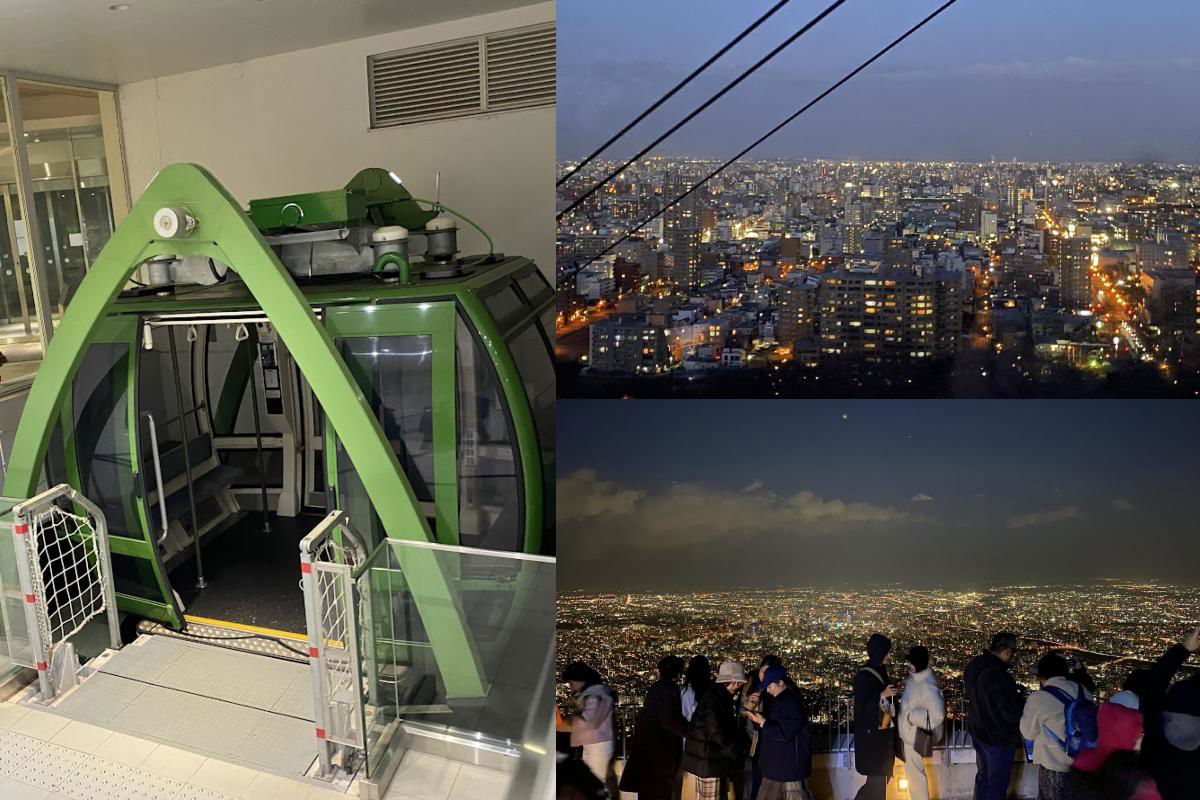
A three-photo collage from a visit to Mount Moiwa in Sapporo. On the left, a green ropeway cabin sits at its station with its doors open, showing the benches and hanging straps inside. The rounded green frame of the gondola dominates the shot, with a boarding platform and safety netting in front. The right side shows two night views from the mountain. The top photo looks straight down at Sapporo glowing after dark, office towers and apartment blocks lit up in orange and white, with the thick cables of the ropeway crossing the frame overhead. The bottom photo shows the observation deck itself: a crowd of visitors in winter jackets stands along the railing, silhouetted against an ocean of city lights spreading to the horizon under a dark, hazy sky.
A three-photo collage from a visit to Mount Moiwa in Sapporo. On the left, a green ropeway cabin sits at its station with its doors open, showing the benches and hanging straps inside. The rounded green frame of the gondola dominates the shot, with a boarding platform and safety netting in front.
The right side shows two night views from the mountain. The top photo looks straight down at Sapporo glowing after dark, office towers and apartment blocks lit up in orange and white, with the thick cables of the ropeway crossing the frame overhead. The bottom photo shows the observation deck itself: a crowd of visitors in winter jackets stands along the railing, silhouetted against an ocean of city lights spreading to the horizon under a dark, hazy sky.
Texto visible en la imagen
No clearly readable text found.
La torre de TV: Sapporo TV Tower
Un lugar conocido en el centro de Sapporo es la torre de televisión. No solo es bonita por fuera, sino que también muestra la hora. De forma recuerda un poco a la Torre Eiffel. Se puede ver desde abajo, pero también hay una plataforma de observación en la torre desde la que se tiene una vista de Sapporo. El precio de 1.000 yenes por persona nos pareció un poco caro, por lo cual no subimos al mirador.
Sitio web oficial: https://www.tv-tower.co.jp/en/
Google Maps: https://maps.app.goo.gl/Lcevdjm3Ri9DS4Ug9
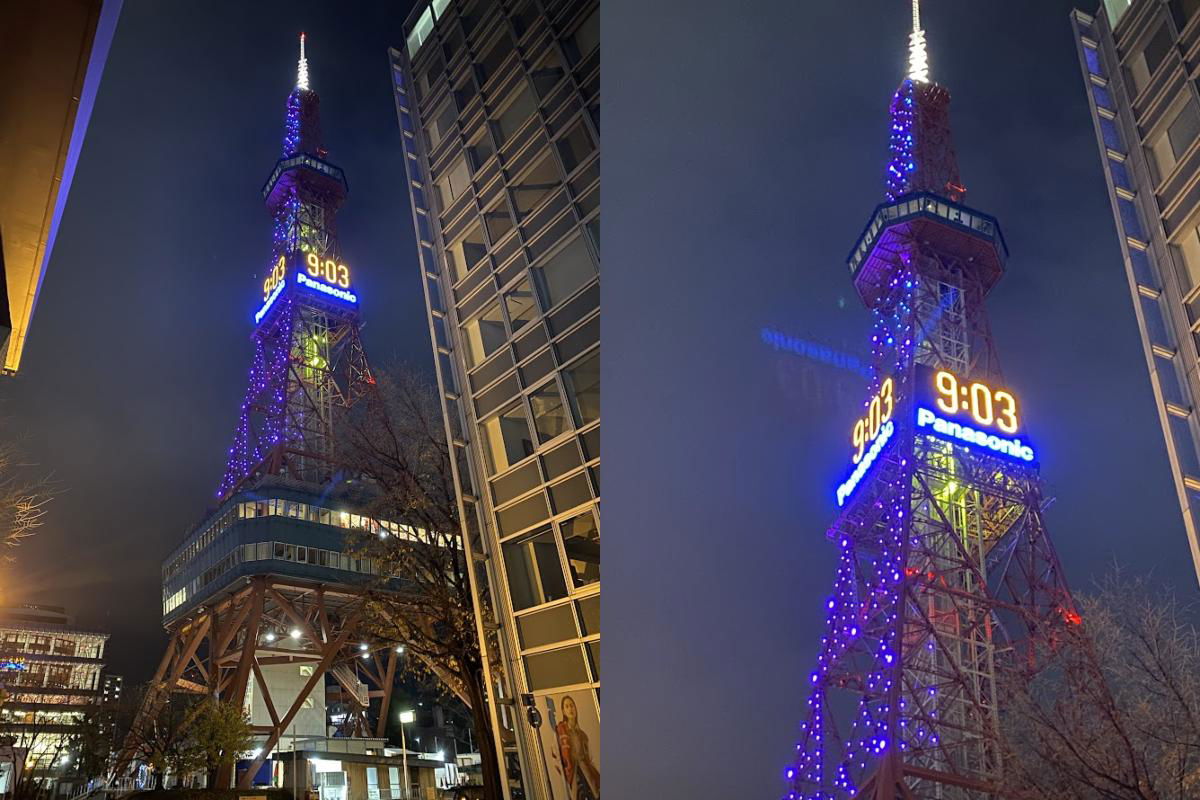
Two nighttime photos of the Sapporo TV Tower sit side by side. The tower is a red steel lattice structure modeled on the Eiffel Tower, and both shots show it glowing with strings of purple and blue lights against a dark sky. Its digital clock faces read 9:03 in bright orange, with "Panasonic" written below in blue. The left photo takes in the whole tower from street level, framed by a modern glass office building and the lit windows of its mid-level observation deck. The right photo zooms in on the upper half, where the clock, the enclosed top deck, and the antenna spire stand out more clearly. Bare tree branches at the edges suggest a cold season in this downtown Sapporo scene.
Two nighttime photos of the Sapporo TV Tower sit side by side. The tower is a red steel lattice structure modeled on the Eiffel Tower, and both shots show it glowing with strings of purple and blue lights against a dark sky. Its digital clock faces read 9:03 in bright orange, with "Panasonic" written below in blue. The left photo takes in the whole tower from street level, framed by a modern glass office building and the lit windows of its mid-level observation deck. The right photo zooms in on the upper half, where the clock, the enclosed top deck, and the antenna spire stand out more clearly. Bare tree branches at the edges suggest a cold season in this downtown Sapporo scene.
Texto visible en la imagen
9:03
Panasonic
9:03
Panasonic
Mercado navideño en la Sapporo TV Tower
Para mi sorpresa, había un pequeño mercado navideño justo al pie de la torre de TV de Sapporo. En estas fechas prenavideñas creaba un ambiente muy bonito y acogedor. Incluso había sidra alemana, almendras garrapiñadas, vino y cerveza alemanes, codillo y muchas otras especialidades y productos alemanes. Por supuesto, era bastante caro en comparación con el original en Alemania. Pero con la vista de la torre iluminada, todo parecía muy festivo y navideño.
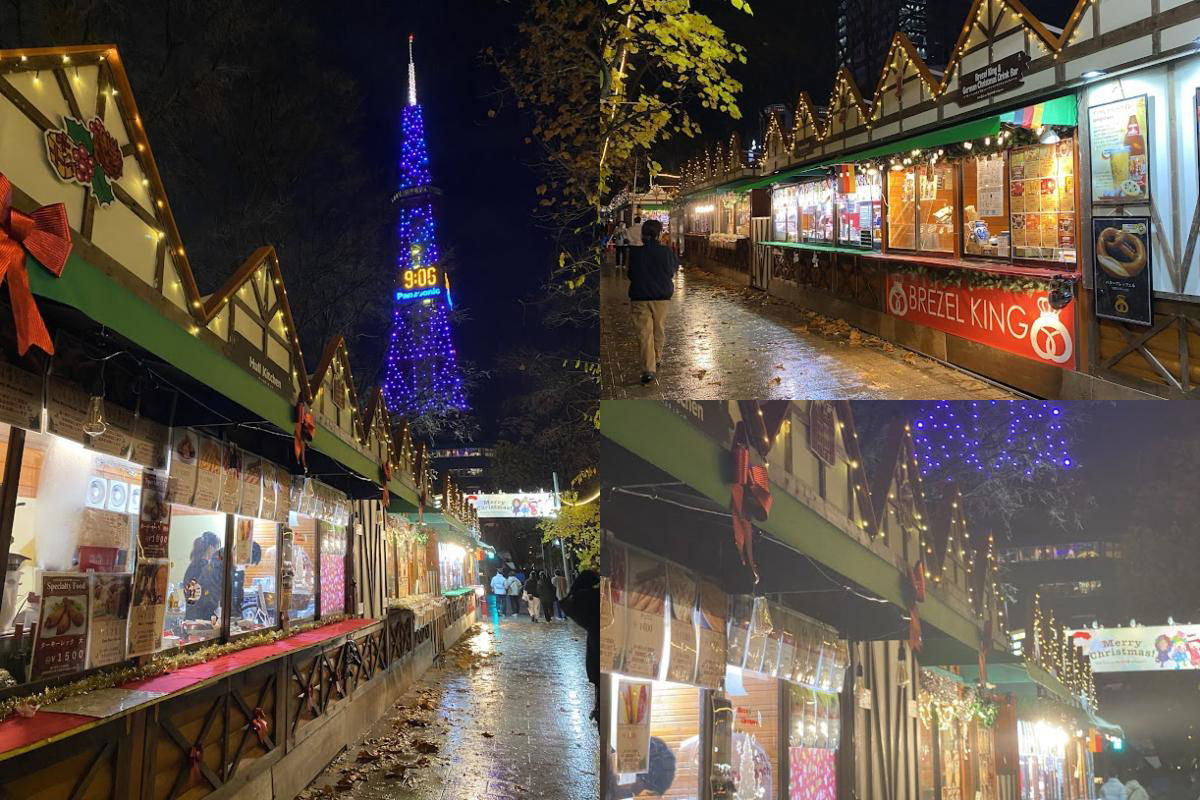
A four-photo collage shows a German-style Christmas market in Sapporo after dark. Wooden stalls built like half-timbered chalets line a rain-slicked walkway scattered with yellow leaves, their peaked roofs edged with warm fairy lights and big red ribbon bows. In one shot the Sapporo TV Tower rises behind the rooftops, wrapped in blue and white lights with a bright sign on its shaft. The other views move along the stalls themselves. A red Brezel King banner hangs across one counter, a sign advertises a German Christmas market bar, and menu boards crowd the lit service windows where vendors work. Visitors in winter jackets wander the path, and in the last frame a tree glows blue overhead next to a Merry Christmas sign decorated with Santa and a snowman.
A four-photo collage shows a German-style Christmas market in Sapporo after dark. Wooden stalls built like half-timbered chalets line a rain-slicked walkway scattered with yellow leaves, their peaked roofs edged with warm fairy lights and big red ribbon bows. In one shot the Sapporo TV Tower rises behind the rooftops, wrapped in blue and white lights with a bright sign on its shaft.
The other views move along the stalls themselves. A red Brezel King banner hangs across one counter, a sign advertises a German Christmas market bar, and menu boards crowd the lit service windows where vendors work. Visitors in winter jackets wander the path, and in the last frame a tree glows blue overhead next to a Merry Christmas sign decorated with Santa and a snowman.
Texto visible en la imagen
9:05
PARCO
Brezel King
German Original Brezel Bar
BREZEL KING
Spätzle Toast
¥1,500
Merry Christmas!
La ciudad portuaria de Otaru
Otaru es una ciudad portuaria en Hokkaido, al noroeste de Sapporo y situada en la bahía de Ishikari. La ciudad es famosa por la producción de vidrio y destilerías. Por desgracia, ese día no me encontraba bien y mi amiga salió a explorar Otaru sola. Lo más llamativo es el canal, bordeado de antiguos almacenes reconvertidos en cafés y tiendas. En el canal puedes hacer un paseo en barco para ver los alrededores. Especialmente por la noche se disfruta de una hermosa vista del canal iluminado.
Los billetes de día cuestan 1.800 yenes (unos 11 euros) y por la noche 2.000 yenes (unos 13 euros) por adulto.
Google Maps: https://maps.app.goo.gl/6BwTE8P75c3Kj6Pp9
Otaru Canal Cruise (sitio oficial): https://otaru.cc/en/
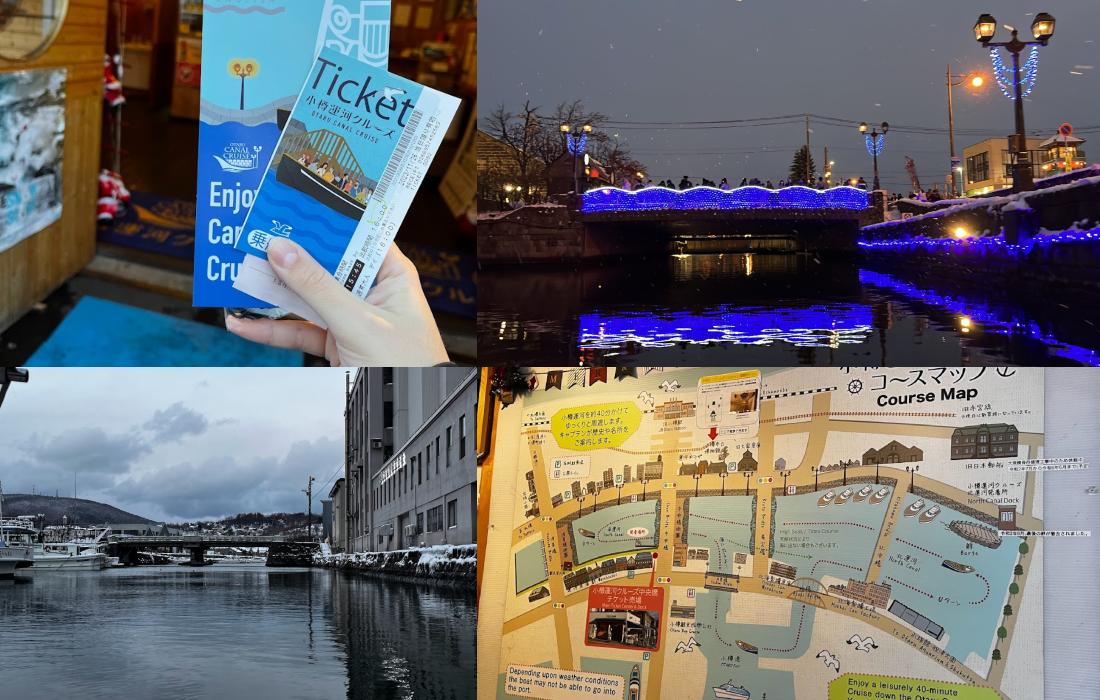
A four-photo collage captures a canal cruise experience in Otaru, Hokkaido. In the top left, a hand holds two blue-and-white tickets for the Otaru Canal Cruise, printed with a small illustration of a boat carrying passengers. The top right photo shows the canal at night: a bridge strung with vivid blue lights glows over the dark water, with snow piled on the stone banks and blue-lit street lamps lining the promenade. The bottom left photo shows the same canal by day under a gray winter sky, with stone warehouses along the water, snow at the edges, and small boats moored near a bridge. The bottom right photo is a colorful illustrated course map for the cruise, tracing boat routes along the canal with labeled stops and English notes, including one promising a leisurely 40-minute cruise.
A four-photo collage captures a canal cruise experience in Otaru, Hokkaido. In the top left, a hand holds two blue-and-white tickets for the Otaru Canal Cruise, printed with a small illustration of a boat carrying passengers. The top right photo shows the canal at night: a bridge strung with vivid blue lights glows over the dark water, with snow piled on the stone banks and blue-lit street lamps lining the promenade.
The bottom left photo shows the same canal by day under a gray winter sky, with stone warehouses along the water, snow at the edges, and small boats moored near a bridge. The bottom right photo is a colorful illustrated course map for the cruise, tracing boat routes along the canal with labeled stops and English notes, including one promising a leisurely 40-minute cruise.
Texto visible en la imagen
Ticket
小樽運河クルーズ
OTARU CANAL CRUISE
CANAL CRUISE
Enjo
Can
Cru
コースマップ
Course Map
旧日本郵船
小樽運河クルーズ乗り場
Depending upon weather conditions
the boat may not be able to go into
the port
Enjoy a leisurely 40-minute
Cruise down the
Un consejo para cualquier viaje por Japón: Kuroneko Yamato
Un auténtico consejo para cualquier viaje a Japón es el servicio de reparto Kuroneko Yamato. Con él puedes enviar tu equipaje pesado y voluminoso de un hotel a otro dentro de Japón, ¡incluso si está en otra prefectura! Normalmente hay formularios en los hoteles de Japón y puedes preguntar allí por este servicio. Los precios varían dependiendo del peso y tamaño del equipaje.
Sitio web oficial: https://www.global-yamato.com/en/hands-free-travel/
Conclusión
La prefectura de Hokkaido y la ciudad de Sapporo tienen mucho que ofrecer. La prefectura más al norte de Japón convence con lugares y paisajes únicos, así como especialidades culinarias. Como está en el norte, debes estar preparado para mucho frío y frecuentes nevadas. Especialmente el invierno empieza aquí antes que en el resto del país. Asegúrate de llevar buen calzado, ya que muchas calles no están ni saladas ni limpiadas, pudiendo estar extremadamente resbaladizas. Tampoco se esparce sal. Me sorprendió que aquí no parezca haber normas especiales por nevadas y que la ciudad tampoco haga mucho al respecto. Así que prepárate lo mejor posible para poder disfrutar tu viaje a Hokkaido.
Descubre Sapporo de la mano de un local: tú eliges qué quieres ver: los monumentos más conocidos o rincones escondidos, totalmente según tus gustos.
*Enlace de afiliado: Si reservas una actividad en viator.com a través de mi widget o enlace, recibo una pequeña comisión. Para ti no hay ningún coste adicional y apoyas mi blog. Te agradezco mucho y te deseo un buen viaje (^_^)


Comentarios