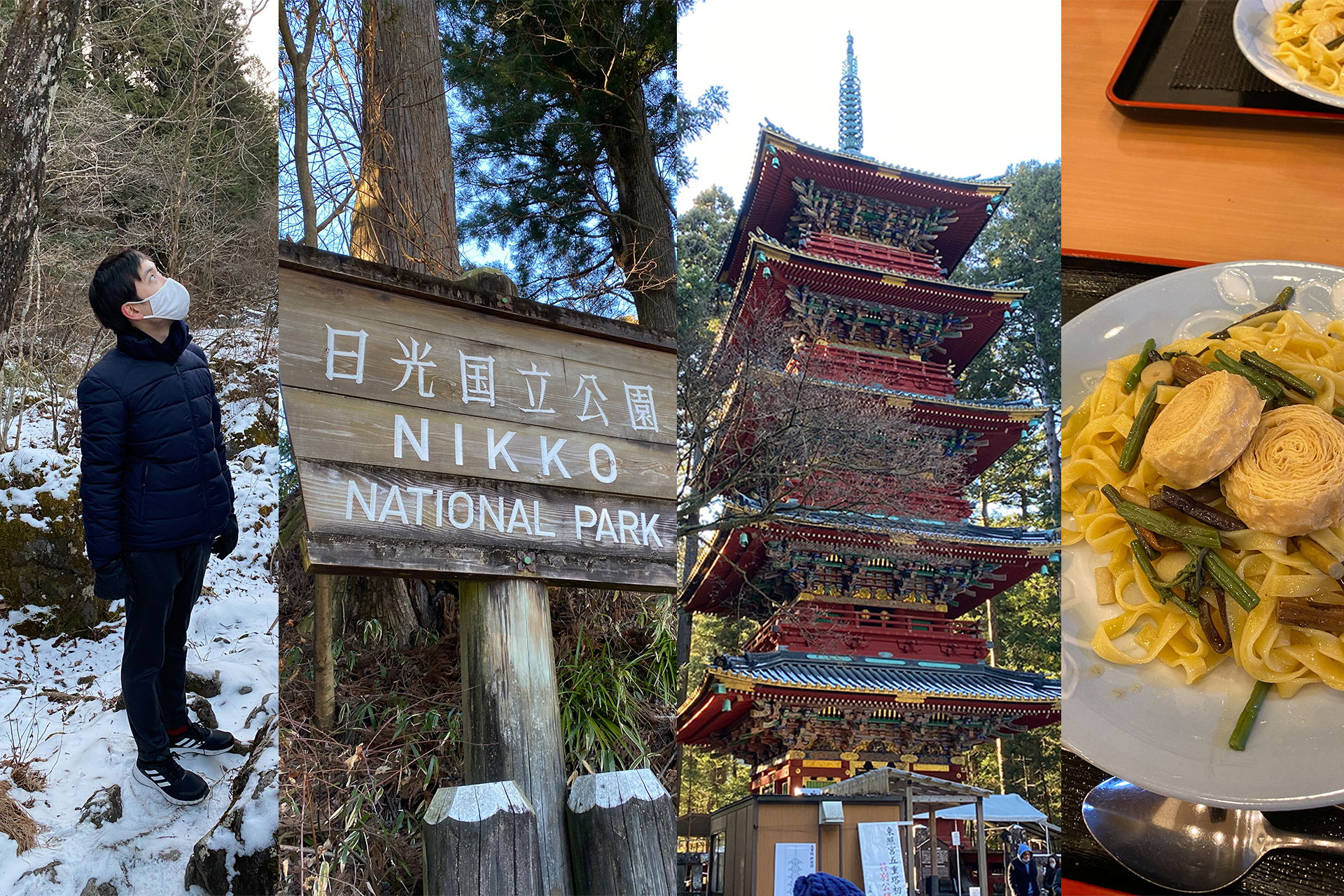
Tabla de contenidos:
TL;DR
Nikko es la escapada perfecta de 1 a 2 días desde Tokio para desconectar de la ciudad. Lo mejor es comprar el pase de autobús extendido (3500 yenes) porque te lleva hasta Yumoto Onsen y te ahorras mucho frente al billete suelto. El Toshogu y el puente Shinkyo son lo más famoso, pero el lago y el aire fresco son el verdadero atractivo.Nikko / Nikkō o en japonés (jap. 日光市) es una ciudad famosa de Japón. Está ubicada en la prefectura de Tochigi-Ken y se puede llegar en tren desde Tokio en unas 2 horas.
Para la mayoría de los turistas, el Templo Nikkō Tōshō-gū (reconocido como Patrimonio de la Humanidad por la UNESCO) es la primera parada, conocido por los Tres Monos Sabios que no ven (el mal), no oyen ni hablan el mal. Pero Nikko tiene mucho más que ofrecer. Hay sobre todo muchos edificios históricos, además de mucha naturaleza y aire fresco—algo que a veces no puedes experimentar en Tokio.
Visité Nikko tanto en 2022 como en 2023 y en este artículo te mostraré todo lo que viví en ambos viajes.

This is a cute, hand-drawn infographic titled "Nikko Travel Guide: Nature & Heritage Escape." The centerpiece is an ornate, gold-accented illustration of Toshogu Shrine framed by a pink cherry tree on one side and a fiery red maple on the other. Three cartoon monkeys in the classic "see no evil, hear no evil, speak no evil" poses sit on a branch in the upper left, and cherry blossoms drift across the pastel sky. Along the bottom, five round vignettes preview the top sights: Shinkyo Bridge (a red bridge over a river), Kegon Waterfalls with a rainbow at its base, Lake Chuzenji backed by a mountain, Yumoto Onsen with smiling bathers in a steaming hot spring, and Edo Wonderland with two figures in samurai-era dress. The right column is split into three themed sections. Under Transport, a small red train and a yellow bus note that the ride from Tokyo takes about two hours and that a pass covers travel around Nikko and Lake Chuzenji. The Food section shows bowls of yuba (tofu skin) and soba with edamame and tea. Travel tips suggest packing a snowskate, a puffer jacket, and a coin purse, each drawn as a simple icon.
This is a cute, hand-drawn infographic titled "Nikko Travel Guide: Nature & Heritage Escape." The centerpiece is an ornate, gold-accented illustration of Toshogu Shrine framed by a pink cherry tree on one side and a fiery red maple on the other. Three cartoon monkeys in the classic "see no evil, hear no evil, speak no evil" poses sit on a branch in the upper left, and cherry blossoms drift across the pastel sky.
Along the bottom, five round vignettes preview the top sights: Shinkyo Bridge (a red bridge over a river), Kegon Waterfalls with a rainbow at its base, Lake Chuzenji backed by a mountain, Yumoto Onsen with smiling bathers in a steaming hot spring, and Edo Wonderland with two figures in samurai-era dress. The right column is split into three themed sections. Under Transport, a small red train and a yellow bus note that the ride from Tokyo takes about two hours and that a pass covers travel around Nikko and Lake Chuzenji. The Food section shows bowls of yuba (tofu skin) and soba with edamame and tea. Travel tips suggest packing a snowskate, a puffer jacket, and a coin purse, each drawn as a simple icon.
Texto visible en la imagen
NIKKO TRAVEL GUIDE:
Nature & Heritage Escape
Transport
Cute train
(approx. 2 hours
from Tokyo)
Bus
(Pass covers travel around
Nikko & to Lake Chuzenji)
Food
Yuba
(Tofu Skin)
Soba
Travel tips
Snowskate
Puffer Jacket
Coin purse
Toshogu Shrine
Cute
Shinkyo Bridge
Kegon
Kegan Waterfalls
Lake
Lake Chuzenji
Yumoto
Yumoto Onsen
Edo
Edo Wonderland
De Tokio a Nikko
En coche
Si quieres conducir a Nikko en coche, ten en cuenta que el viaje dura unas 2 horas (puede ser más largo dependiendo del tráfico). Hay estaciones de peaje en la ruta, así que revísalas con anticipación para presupuestar los costos.
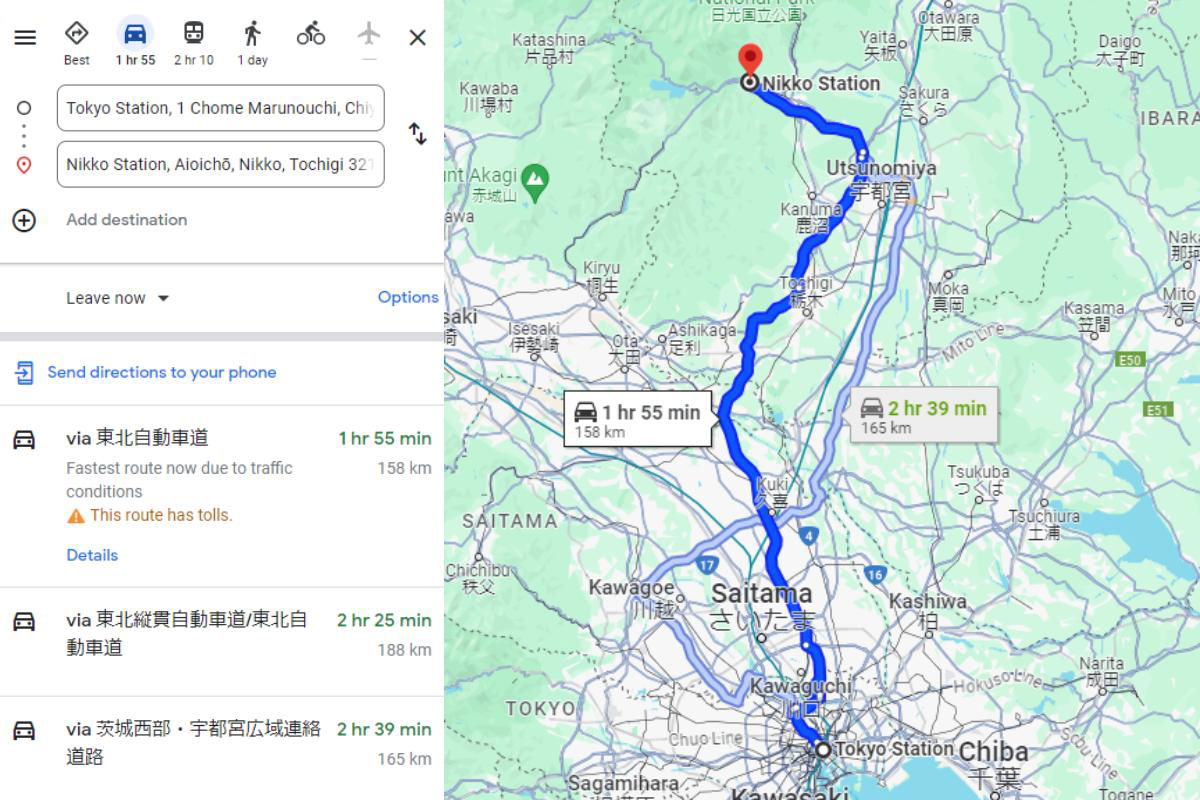
A Google Maps screenshot of driving directions from Tokyo Station to Nikko Station in Tochigi Prefecture. The left panel lists the two endpoints and three route options. The top pick, via the Tohoku Expressway (東北自動車道), takes 1 hr 55 min over 158 km and is marked as the fastest route under current traffic, with a yellow warning that it has tolls. The other two options take 2 hr 25 min over 188 km and 2 hr 39 min over 165 km. A row of travel-mode icons at the top shows the car selected, with transit at 2 hr 10 and walking at 1 day as comparisons. The map fills the rest of the frame. A thick blue line runs north out of Tokyo Station, past Saitama, Kuki, and Tochigi, through Utsunomiya, and ends at a red pin on Nikko Station. Two gray badges along the way show the competing travel times of 1 hr 55 min / 158 km and 2 hr 39 min / 165 km. Labels for Tokyo, Saitama, Kawagoe, Utsunomiya, and Ibaraki make clear this is the route north across the Kanto region.
A Google Maps screenshot of driving directions from Tokyo Station to Nikko Station in Tochigi Prefecture. The left panel lists the two endpoints and three route options. The top pick, via the Tohoku Expressway (東北自動車道), takes 1 hr 55 min over 158 km and is marked as the fastest route under current traffic, with a yellow warning that it has tolls. The other two options take 2 hr 25 min over 188 km and 2 hr 39 min over 165 km. A row of travel-mode icons at the top shows the car selected, with transit at 2 hr 10 and walking at 1 day as comparisons.
The map fills the rest of the frame. A thick blue line runs north out of Tokyo Station, past Saitama, Kuki, and Tochigi, through Utsunomiya, and ends at a red pin on Nikko Station. Two gray badges along the way show the competing travel times of 1 hr 55 min / 158 km and 2 hr 39 min / 165 km. Labels for Tokyo, Saitama, Kawagoe, Utsunomiya, and Ibaraki make clear this is the route north across the Kanto region.
Texto visible en la imagen
**Directions panel**
Best
1 hr 55
2 hr 10
1 day
Tokyo Station, 1 Chome Marunouchi, Chi
Nikko Station, Aioichō, Nikko, Tochigi 32
Add destination
Leave now
Options
Send directions to your phone
via 東北自動車道 — 1 hr 55 min
Fastest route now due to traffic conditions — 158 km
⚠ This route has tolls.
Details
via 東北縦貫自動車道/東北自動車道 — 2 hr 25 min
188 km
via 茨城西部・宇都宮広域連絡道路 — 2 hr 39 min
165 km
**Map**
Katashina 片品村
Kawaba 川場村
Ōtawara 大田原
Yaita 矢板
Daigo 大子町
IBARA
Nikko Station
Sakura さくら
Akagi 赤城山
Utsunomiya 宇都宮
Kanuma 鹿沼
Kiryu 桐生
那珂
Moka 真岡
Tochigi 栃木
Kasama 笠間
Mito 水戸
伊勢崎
Ōta 大田
Ashikaga 足利
E50
Mito Line
E51
1 hr 55 min — 158 km
2 hr 39 min — 165 km
Kuki 久喜
Tsukuba つくば
Tsuchiura 土浦
SAITAMA
Chichibu 秩父
4
17
16
Kawagoe 川越
Saitama さいたま
Kashiwa 柏
TOKYO
Kawaguchi 川口
Narita 成田
Hokuso Line
Tokyo Station
Chiba 千葉
Chuo Line
Sagamihara
Kawasaki
Tone
En tren
Para el "Limited Express" además de la tarjeta IC (por ejemplo, Passmo o Suica) necesitas ¡un billete Limited Express! Pero solo se debe escanear la tarjeta IC.
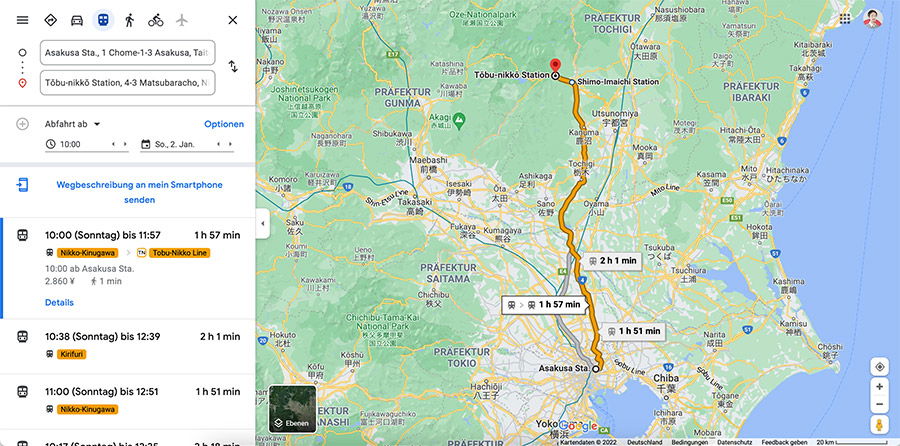
A Google Maps route screenshot showing directions from Asakusa Sta. in Tokyo to Tōbu-nikkō Station in Nikkō, north of the city. The left panel, set to German, lists train options for Sunday, January 2nd, starting at 10:00. The top result takes 1 hour 57 minutes on the Tōbu Nikkō Line, with later alternatives at 2 hours 1 minute and 1 hour 51 minutes. The map itself shows the orange route line running north from Asakusa through Saitama and Tochigi prefectures to Tobu-nikkō Station, marked with a red pin near Shimo-imaichi Station. Travel time labels appear along the route, and the surrounding prefectures of Gunma, Ibaraki, and Chiba are visible across the frame.
A Google Maps route screenshot showing directions from Asakusa Sta. in Tokyo to Tōbu-nikkō Station in Nikkō, north of the city. The left panel, set to German, lists train options for Sunday, January 2nd, starting at 10:00. The top result takes 1 hour 57 minutes on the Tōbu Nikkō Line, with later alternatives at 2 hours 1 minute and 1 hour 51 minutes.
The map itself shows the orange route line running north from Asakusa through Saitama and Tochigi prefectures to Tobu-nikkō Station, marked with a red pin near Shimo-imaichi Station. Travel time labels appear along the route, and the surrounding prefectures of Gunma, Ibaraki, and Chiba are visible across the frame.
Texto visible en la imagen
Asakusa Sta., 1 Chome-1-3 Asakusa, Tai
Tōbu-nikkō Station, 43 Matsubaracho, N
Abfahrt um
Optionen
10:00
So., 2. Jan.
Wegbeschreibung an mein Smartphone senden
10:00 (Sonntag) bis 11:57 — 1 h 57 min
10:00 Nikkō Kinugawa
Tōbu-Nikko Line
10.00 ab Asakusa Sta.
2.860 ¥ — 1 min
Details
10:38 (Sonntag) bis 12:39 — 2 h 1 min
Kintō
11:00 (Sonntag) bis 12:51 — 1 h 51 min
Nikko Kinugawa
Tobu-nikkō Station
Shimo-imaichi Station
2 h 1 min
1 h 57 min
1 h 51 min
Asakusa Sta.
PRAFEKTUR TOCHIGI
PRAFEKTUR GUNMA
PRAFEKTUR IBARAKI
PRAFEKTUR SAITAMA
PRAFEKTUR TOKIO
Chiba
Yokohama
Ebene
Google
Kartendaten ©2025 — Deutschland — Nutzungsbedingungen — Datenschutz — Feedback geben — 20 km
En mi opinión, la forma más fácil de ir de Tokio a Nikko es en tren. Solo necesitas una conexión y no tienes que hacer transbordos, lo cual es muy cómodo. Este tren local va desde Asakusa (Tokio) hasta Nikko (Tobu Skytree Line), y tarda aproximadamente 2 horas.
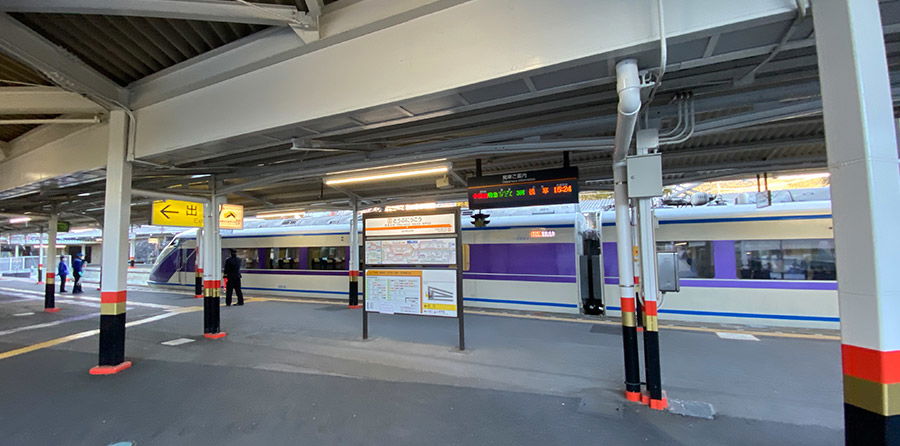
A covered train station platform with a Revaty limited express stopped alongside. The train has a white body wrapped in a wide purple stripe with blue trim, and a long, curved aerodynamic nose. The platform's columns are painted black with red and gold bands, a nod to nearby Nikko's shrine colors. An LED departure board hangs overhead showing a departure time in red, next to a yellow exit sign and a standing timetable board framed in orange. A station attendant in dark uniform walks the platform, with a few passengers farther down near the train's front car. The whole scene sits under a large white steel roof, the kind of departure moment on the Tokyo to Nikko rail route.
A covered train station platform with a Revaty limited express stopped alongside. The train has a white body wrapped in a wide purple stripe with blue trim, and a long, curved aerodynamic nose. The platform's columns are painted black with red and gold bands, a nod to nearby Nikko's shrine colors. An LED departure board hangs overhead showing a departure time in red, next to a yellow exit sign and a standing timetable board framed in orange. A station attendant in dark uniform walks the platform, with a few passengers farther down near the train's front car. The whole scene sits under a large white steel roof, the kind of departure moment on the Tokyo to Nikko rail route.
Texto visible en la imagen
← 出
16:24
Moviéndose por Nikko
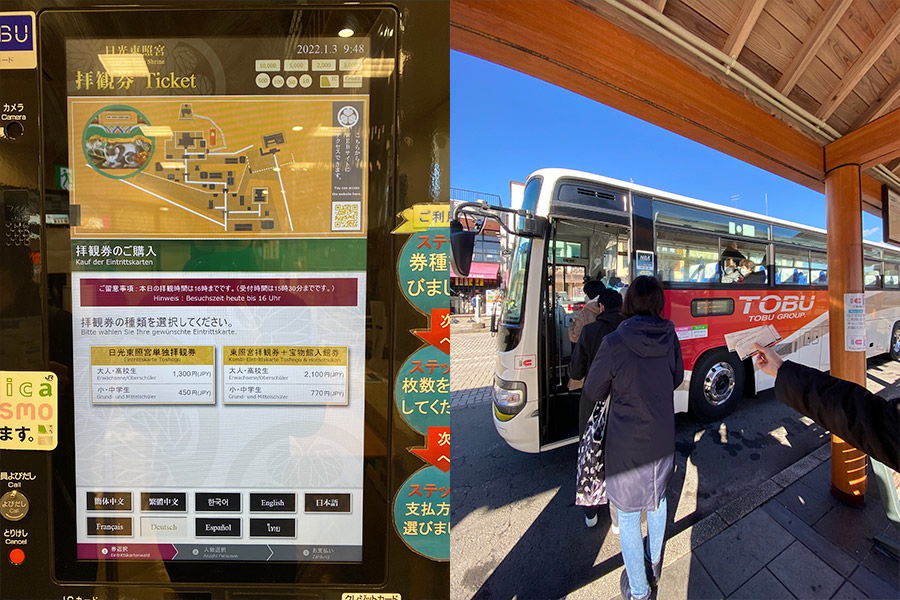
A side-by-side photo showing two steps of visiting Nikko: buying a shrine ticket and catching the bus. The left panel is a close-up of a multilingual ticket machine screen for Nikkō Tōshōgū Shrine. It displays a color map of the shrine grounds, a notice in Japanese, German, and English that same-day tickets are sold until 16:00, and a price list. The shrine-only ticket costs 1,300 yen for adults and high school students and 450 yen for junior high and elementary school children. A combined shrine and Treasure Museum ticket runs 2,100 yen for adults and 770 yen for children. Language buttons at the bottom offer English, Japanese, Chinese, Korean, French, German, Spanish, and Italian. The right panel shows a white and red Tobu bus pulled up under a wooden covered bus stop on a clear, sunny day. Several passengers are boarding through the open front door, and in the foreground a gloved hand holds up a paper ticket toward the driver. Blue sky and storefronts sit behind the bus, giving the feel of a small tourist town transit stop.
A side-by-side photo showing two steps of visiting Nikko: buying a shrine ticket and catching the bus.
The left panel is a close-up of a multilingual ticket machine screen for Nikkō Tōshōgū Shrine. It displays a color map of the shrine grounds, a notice in Japanese, German, and English that same-day tickets are sold until 16:00, and a price list. The shrine-only ticket costs 1,300 yen for adults and high school students and 450 yen for junior high and elementary school children. A combined shrine and Treasure Museum ticket runs 2,100 yen for adults and 770 yen for children. Language buttons at the bottom offer English, Japanese, Chinese, Korean, French, German, Spanish, and Italian.
The right panel shows a white and red Tobu bus pulled up under a wooden covered bus stop on a clear, sunny day. Several passengers are boarding through the open front door, and in the foreground a gloved hand holds up a paper ticket toward the driver. Blue sky and storefronts sit behind the bus, giving the feel of a small tourist town transit stop.
Texto visible en la imagen
BU
ト
カメラ
Camera
ica
smo
ます。
戻る
もどる
Cancel
日光東照宮
Nikko Toshogu
2022.1.3 9:48
拝観券 Ticket
拝観券のご購入
Kauf der Eintrittskarten
ご注意事項
*本日の拝観時間は16時30分まで、受付終了は15時50分です。
Hinweis: Besucherzeit heute bis 16 Uhr
拝観券の種類を選択してください。
Bitte wählen Sie die Eintrittskarte aus.
日光東照宮単独拝観券
Einzel-Eintrittskarte
大人・高校生
Erwachsene und Oberschüler
1,300 [円/Yen]
小人・中学生
Grund- und Mittelschüler
450 [円/Yen]
東照宮拝観券+宝物館入館券
Kombikarte
大人・高校生
Erwachsene und Oberschüler
2,100 [円/Yen]
小人・中学生
Grund- und Mittelschüler
770 [円/Yen]
簡体中文 繁體中文 한국어 English 日本語
Français Deutsch Español Ita
言語選択
入口選択
TOBU
TOBU GROUP
En Nikko, además de conducir, también puedes tomar el autobús. En nuestro viaje de 2022 compramos un boleto por 2.200 yenes que nos llevó al Lago Chuzenji y de regreso. Este boleto es válido para todas las paradas en toda la ruta entre la estación Nikko y el lago.
En nuestro viaje más reciente de 2023 compramos un boleto extendido por 3.500 yenes, que incluso nos llevó hasta Yumoto Onsen. El ticket especial tiene una excelente relación calidad-precio, pues un trayecto sencillo normalmente costaría 1.950 yenes. Además, es práctico porque no necesitas una tarjeta IC aparte. El boleto es válido por 2 días, así que deberías considerar cuándo comprarlo. Nota que es válido desde la fecha de compra, así que lo mejor es comprarlo el primer día de tu viaje. Lo compramos directamente en la primera mañana en Nikko después de pasar la noche allí.
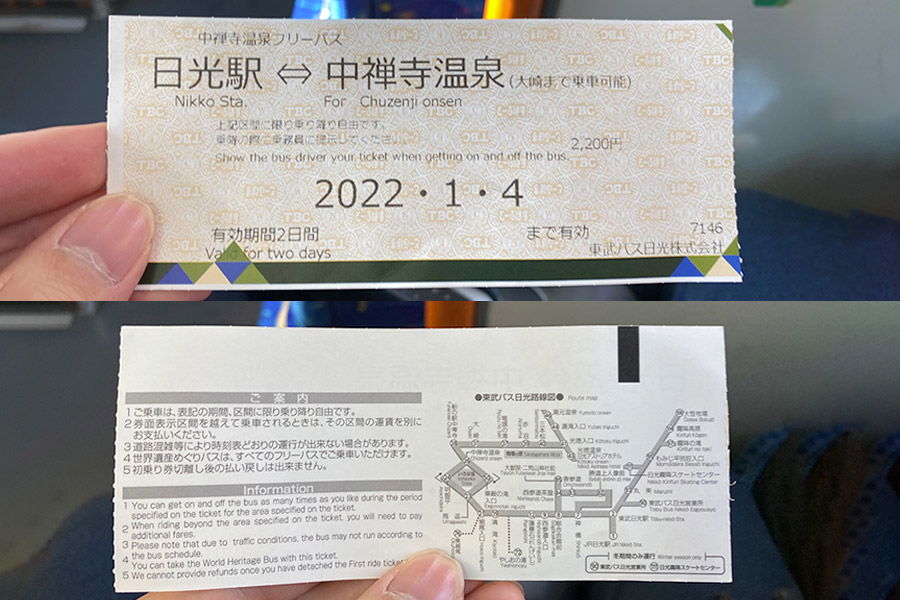
The image shows a hand holding a Nikko free bus pass, photographed from both sides in two stacked frames. The top frame is the front of the ticket, a wide cream-colored slip with a repeating gold pattern. Large text reads 日光駅 ⇔ 中禅寺温泉 (Nikko Sta. ⇔ For Chuzenji onsen), showing that the pass covers the bus route between Nikko Station and Chuzenji Onsen, with a note that buses with racks can carry snowboards. A printed date of 2022·1·4 sits in the middle, alongside the price 2,200円 and the phrase "Valid for two days" (有効期間2日間). Small English text instructs riders to show the ticket to the driver when getting on and off. The bottom frame is the back of the same ticket. The left half has an Information section in Japanese and English, with numbered rules explaining that the holder can get on and off the bus freely within the specified area, that rides outside the area cost extra, and that the ticket also covers some World Heritage sightseeing buses. The right half features a small route map showing the bus line from Tobu-Nikko and JR Nikko stations up through the World Heritage area, Nikko Onsen, and onward to Chuzenji Onsen, Yumoto Onsen, and other stops, with a winter-season note at the bottom. The photo was taken inside a bus or train, with a hand gripping the ticket against a blurred window background.
The image shows a hand holding a Nikko free bus pass, photographed from both sides in two stacked frames.
The top frame is the front of the ticket, a wide cream-colored slip with a repeating gold pattern. Large text reads 日光駅 ⇔ 中禅寺温泉 (Nikko Sta. ⇔ For Chuzenji onsen), showing that the pass covers the bus route between Nikko Station and Chuzenji Onsen, with a note that buses with racks can carry snowboards. A printed date of 2022·1·4 sits in the middle, alongside the price 2,200円 and the phrase "Valid for two days" (有効期間2日間). Small English text instructs riders to show the ticket to the driver when getting on and off.
The bottom frame is the back of the same ticket. The left half has an Information section in Japanese and English, with numbered rules explaining that the holder can get on and off the bus freely within the specified area, that rides outside the area cost extra, and that the ticket also covers some World Heritage sightseeing buses. The right half features a small route map showing the bus line from Tobu-Nikko and JR Nikko stations up through the World Heritage area, Nikko Onsen, and onward to Chuzenji Onsen, Yumoto Onsen, and other stops, with a winter-season note at the bottom.
The photo was taken inside a bus or train, with a hand gripping the ticket against a blurred window background.
Texto visible en la imagen
The user wants me to extract readable text from an image of a Japanese bus ticket. Let me carefully read the visible text.
Top ticket (front):
- 中禅寺温泉フリーパス
- 日光駅 ⇔ 中禅寺温泉 (大晦日まで乗車可能)
- Nikko Sta. For Chuzenj onsen
- Some small text about rules - 上下車区間で乗り越したり自由にする - hard to read
- 乗降・降車(ご乗車区間以上にご利用ください) - partially readable
- Show the bus driver your ticket when getting on and off the bus.
- 2,200円
- 2022・1・4
- 有効期間2日間
- まで有効
- 7146
- Valid for two days
- 東武バス日光株式会社
Bottom ticket (back):
- ご案内
- 1.ご乗車は、表記の順順に、区間に限りご乗車の自由です - hmm, let me read carefully: "1.ご乗車は、表記の順順に、区間に限りご乗車の自由です" - actually likely "1.ご乗車は、表記の順順に、区間に関りご乗車の自由です" — I need to be careful, only include what I can read with confidence. The small print is hard. Let me try: "1.ご乗車は、表記の順順に、区間に限りご乗車の自由です。" It's blurry. Maybe "1.ご乗車は、表記の順序に、区間に限りご乗車の自由です" - I should be cautious.
Actually the visible text appears to be:
1.ご乗車は、表記の順順に、区間に限りご乗車の自由です。 - uncertain
2.券面表示区間を越えて乗車されますときは、その区間の運賃を別にお支払いください。
3.途中下車いたします場合は、4.世界遺産めぐりバス(または、スワスワございます) - uncertain
4.世界遺産のめぐりバスは、本線でのシリーズ イスでご乗車いただけます。 - uncertain
5.切り取りの列は残りますが、切り離しは出来ません。 - uncertain
Information section:
1. You can get on and off the bus as many times as you like during the period specified on the ticket for the area specified on the ticket
2. When riding beyond the area specified on the ticket, you will need to pay additional fare
3. Please note that due to traffic conditions, the bus may not run according to the bus schedule.
4. You can take the World Heritage Bus with this ticket.
5. We cannot provide refunds once you have detached the First ride ticket
Route map labels:
- 東武バス日光株式会社 (top right of map)
- Route map
- 中禅寺温泉
- 塩原入口(湯元温泉) - maybe "湯元入口"? Hard to read. Let me think: labels like 湯元温泉, 中禅寺温泉, 片品温泉...
- 大鳥温泉
- 華厳の滝
- 中禅寺温泉駅
- 西参道(二荒山神社) - uncertain
- 世界遺産めぐりバス - uncertain
- 東武日光駅
- 日光東照宮
- 勝道上神社 - uncertain
- 神橋
- JR日光駅
- 明智平
- 霧降の滝
- etc.
Many of these are too small/blurry to read with high confidence. The rules say to only include text readable with high confidence and not to guess.
Let me be careful and only extract high-confidence text.
Front of ticket (clear):
中禅寺温泉フリーパス
日光駅 ⇔ 中禅寺温泉 (大晦日まで乗車可能)
Nikko Sta. For Chuzenj onsen
Show the bus driver your ticket when getting on and off the bus.
2,200円
2022・1・4
有効期間2日間
まで有効
7146
Valid for two days
東武バス日光株式会社
The Japanese lines between the English are partially readable:
- 上下車区間... something like "上下車は、区間での乗り降り自由にする" - too uncertain
- 乗降・降車(ご乗車区間以上にご利用ください) - uncertain
Actually let me look at typical text: "上下車は、区間での乗り降り自由にできます" Hmm. The line reads "上下車は、区間での乗り降り自由にする" - I can't be sure. I'll skip uncertain lines.
Wait, the second Japanese line: "乗降・降車(ご乗車区間以上にご利用ください)" Hmm, that doesn't quite make sense either. Actually it might be "乗降・降車のご乗車区間以上にご利用ください" - uncertain. Skip.
Actually, maybe it's "乗降・降車にご乗車区間以上にご利用ください" - I can't be confident. Skip.
Back of ticket:
ご案内
Information
Clear English (Information):
1. You can get on and off the bus as many times as you like during the period specified on the ticket for the area specified on the ticket
2. When riding beyond the area specified on the ticket, you will need to pay additional fare
3. Please note that due to traffic conditions, the bus may not run according to the bus schedule.
4. You can take the World Heritage Bus with this ticket.
5. We cannot provide refunds once you have detached the First ride ticket
Japanese ご案内 lines - small print, partially readable:
1.ご乗車は、表記の順順に、区間に限りご乗車の自由です。 - uncertain wording
2.券面表示区間を越えて乗車されますときは、その区間の運賃を別にお支払いください。 - this seems readable
3.途中下車いたします場合は、... - uncertain
4.世界遺産のめぐりバスは、... - uncertain
5.切り取りの列は残りますが、切り離しは出来ません。 - uncertain
Given uncertainty, I might include only the ones I can read confidently. Let me consider:
Line 2: "券面表示区間を越えて乗車されますときは、その区間の運賃を別にお支払いください。" This matches standard ticket wording and appears consistent with the image. I can include it with reasonable confidence.
Line 3: "途中下車いたします場合は、..." then continues "その区間の運賃は..." hmm. Standard: "途中下車された場合は、前途は無効となります" - uncertain. Skip or partially? Rules say omit if not certain. I'll skip line 3's uncertain parts... Actually maybe I should include what's clearly readable per-line. But partial inclusion within a line could produce garbled text. Better to omit uncertain lines entirely.
Line 4: "世界遺産めぐりバスは、スパイスでご乗車いただけます" - uncertain. Hmm, could be "世界遺産めぐりバスは、主要スペースでご乗車いただけます" - no. Skip.
Line 5: "切り取りの..." uncertain. Skip.
Line 1: "1.ご乗車は、表記の順順に、区間に限りご乗車の自由です。" Hmm. Actually the standard wording for this ticket: "ご乗車は、表記の順序に限りご乗車の自由です" or "区間に限り乗降の自由です". The image shows "1.ご乗車は、表記の順順に、区間に限りご乗車の自由です。" I'm not confident. Skip? The instruction says include only high confidence. I'll skip line 1 too, or include? Let me think about what's most defensible.
Actually, looking again at the image description: "1.ご乗車は、表記の順順に、区間に限りご乗車の自由です" — I can't verify. I'll omit the ご案内 numbered lines except line 2 which I'm fairly confident about? Hmm, even line 2... "券面表示区間を越えて乗車されますときは、その区間の運賃を別にお支払いください。" That's standard phrasing. The image shows "2.券面表示区間を越えて乗車されますときは、その区間の運賃を別にお支払いください。" I'll include it.
Route map labels - many are tiny. Clear ones:
- 東武バス日光株式会社 (top right)
- Route map
- 中禅寺温泉 (appears twice possibly)
- 大鳥温泉? "大輪温泉"? uncertain
- 華厳の滝 - appears
- 世界遺産めぐりバス - appears in a banner maybe
- 東武日光駅
- 日光東照宮
- 神橋
- JR日光駅
- 明智平
- 東照宮バス停場? uncertain
- たむろ戸・中宮祠? uncertain
Given the resolution, most map labels are too small. I'll include only clearly readable ones. Honestly, given the small size, I might include: Route map, 中禅寺温泉, 華厳の滝, 明智平, 東武日光駅, JR日光駅, 日光東照宮, 神橋, 東武バス日光株式会社. But confidence is moderate. The bottom of the back has:
"有効期間中の2日間 有効期限2日間" - hmm, bottom text: "有効期間中の2日間" uncertain. There's a green box with text "有効期間...2日間" - uncertain.
Bottom right: "東武バス日光株式会社 東武日光大旅行センター"? Actually it says "東武バス日光株式会社 東武日光旅行センター" - uncertain. There's a line "問合せ・発売所" maybe. Hard.
Given the strict rules, I should be conservative. Let me produce the extraction with high-confidence text only.
Front:
中禅寺温泉フリーパス
日光駅 ⇔ 中禅寺温泉 (大晦日まで乗車可能)
Nikko Sta. For Chuzenj onsen
Show the bus driver your ticket when getting on and off the bus.
2,200円
2022・1・4
有効期間2日間
まで有効
7146
Valid for two days
東武バス日光株式会社
Wait "Chuzenj onsen" - the ticket shows "For Chuzenj onsen" (missing 'i' — actually it likely reads "Chuzenji onsen"). The image shows "For Chuzenj onsen"? The instruction says don't correct spelling. In the image it appears "For Chuzenj onsen" — actually it looks like "Chuzenji onsen". Let me think: the visible text: "Nikko Sta. For Chuzenji onsen". Given typical printing, it would be "Chuzenji". The image provided shows "Chuzenj onsen"? I can't be 100% sure. The prompt image text I see: "For Chuzenj onsen". Hmm. In the original rendering of this task, it looked like "Chuzenj onsen". I'll go with what appears: "For Chuzenj onsen". Actually, real tickets say "Chuzenji Onsen". But I must preserve exactly. The image seems to show "Chuzenj onsen". I'll keep "Chuzenj onsen"? Risky either way. I'll write "Chuzenji onsen" — hmm.
Looking at the OCR-like view: "For Chuzenj onsen". The letters: C-h-u-z-e-n-j-i would have 8 chars. The image shows "Chuzenj" possibly missing i. I'll go with "Chuzenji onsen"? No — rules say preserve exactly and don't guess. Given ambiguity, choose the more likely reading from the image. The image caption I was given shows "For Chuzenj onsen". I'll use that.
Also "(大晦日まで乗車可能)" — the parenthetical after 中禅寺温泉. It reads "(大晦日まで乗車可能)"? That seems odd for a ticket. Actually real tickets: "(土日祝日は乗車不可)"? Hmm. Let me think. The image shows "(大晦日まで乗車可能)". Actually reading the pixels: "(大晦日まで乗車可能)". Hmm, could be "(大晦日まで乗車可能)" meaning "can ride until New Year's Eve"? That seems plausible for a limited pass. Or "(土曜休日も乗車可能)"? The visible characters: 大, 晦(?)... The OCR text I perceive: "(大晦日まで乗車可能)". I'll go with that.
Hmm, actually it might be "(大晦日まで乗車可能)" — okay.
Japanese small lines on front (between English lines):
Line: "上下車区間で乗り降り自由にする" - uncertain. Skip.
Line: "乗降・降車(ご乗車区間以上にご利用ください)" - uncertain. Skip.
Actually wait, maybe those two lines are: "上下車は、区間での乗り降り自由にします" and "乗降・降車にご乗車区間以上にご利用ください" — no confidence. Skip both. But the "2,200円" is clear.
Hmm, but the rule says reconstruct natural reading order. I'll present front then back.
Back:
ご案内
2.券面表示区間を越えて乗車されますときは、その区間の運賃を別にお支払いください。
Hmm, if I include only line 2 of the numbered list, that's odd but follows rules. Actually maybe I can read more:
Line 1: "1.ご乗車は、表記の順順に、区間に限りご乗車の自由です。" — I perceive "1.ご乗車は、表記の順順に、区間に限りご乗車の自由です" Hmm. Real wording for this Tobu free pass: "1.ご乗車は、表記の順序に関係なくご乗車の自由です"? Not sure. Skip.
Line 3: "3.途中下車いたします場合は、..." skip.
Line 4: "4.世界遺産のめぐりバスは、..." skip.
Line 5: "5.切り取りの..." skip.
Hmm wait, maybe the lines are:
1.ご乗車は、表記の順に限りご乗車の自由です。
2.券面表示区間を越えて乗車されますときは、その区間の運賃を別にお支払いください。
3.途中下車いたします場合は、その都度区間の運賃をお支払いください。
4.世界遺産のめぐりバスは、スルッとKANSAIでご乗車いただけます。
5.切り取りの列は無効になりますが、切り離しは出来ません。
I can't confirm. I'll include only line 2? Or should I include the ご案内 heading and the lines I can partially read? The rule: "If a word or character cannot be read with certainty, omit it." This applies at word/character level. For lines where most characters are readable, I could include. But I risk inventing.
I think the safest and most useful output: include headings ご案内 and Information, the full English Information list (clearly readable), the Japanese line 2 if confident, and the route map labels that are clear.
Map labels: The map is small. Labels visible: 中禅寺温泉, 華厳の滝, 明智平, 東武日光駅, 日光東照宮, 神橋, JR日光駅, Route map, 東武バス日光株式会社. Also "大鳥温泉"? "湯元温泉"? "片品温泉"? Too small.
Bottom right green box: "有効期間中の2日間 有効期限2日間"? Actually it says "有効期間中の2日間" hmm. There's "冬季閉鎖区間" maybe. The bottom text: "※冬季は運休区間あり" uncertain. Skip.
Bottom-left of map: "東武バス日光株式会社" appears at top of map area. And bottom right: "東武日光駅バス案内所"? The text "東武バス日光株式会社" is at top right of back. Bottom right small: "東武バス日光株式会社 東武日光大宮営業所"? unclear. Skip.
There's "PQR04 中禅寺温泉" maybe. Skip.
Final decision: conservative extraction.
Front:
中禅寺温泉フリーパス
日光駅 ⇔ 中禅寺温泉 (大晦日まで乗車可能)
Nikko Sta. For Chuzenj onsen
Show the bus driver your ticket when getting on and off the bus.
2,200円
2022・1・4
有効期間2日間
まで有効
7146
Valid for two days
東武バス日光株式会社
Back:
ご案内
Information
2.券面表示区間を越えて乗車されますときは、その区間の運賃を別にお支払いください。
1. You can get on and off the bus as many times as you like during the period specified on the ticket for the area specified on the ticket
2. When riding beyond the area specified on the ticket, you will need to pay additional fare
3. Please note that due to traffic conditions, the bus may not run according to the bus schedule.
4. You can take the World Heritage Bus with this ticket.
5. We cannot provide refunds once you have detached the First ride ticket
Route map
東武バス日光株式会社
Should I include the map station names? Given tiny text, I'll include a few clearly readable: 中禅寺温泉, 華厳の滝, 明智平, 東武日光駅, 日光東照宮, 神橋, JR日光駅. Hmm, risk. The map shows "中禅寺温泉" at top left with a bus icon; "華厳の滝" left side; "明智平" middle right; "東武日光駅" bottom; "JR日光駅" bottom left; "日光東照宮" bottom right; "神橋" bottom. Also "世界遺産の道" maybe. Also "大鳥温泉" top right? "湯元温泉"? I'd rather include only ones I'm confident about. Given the resolution described, I'll include the confident ones.
Actually, wait. Let me reconsider the parenthetical: "(大晦日まで乗車可能)". Looking at the image text more carefully: it reads "(大晦日まで乗車可能)" — the characters: 大晦日? Could be "大晦日". Hmm, actually it might be "(土日祝日も乗車可能)"? The first char looks like 大. The OCR: "(大晦日まで乗車可能)". I'll go with 大晦日まで乗車可能.
Hmm, but actually a real "中禅寺温泉フリーパス" from Tobu Bus Nikko says "(大晦日まで乗車可能)"? Not sure. There's a note "冬季閉鎖" for Oku-Nikko... The pass valid two days from 2022.1.4. The parenthetical might be "(大晦日まで乗車可能)" meaning usable until Dec 31? Odd. Alternatively "(大雪時は運行不可能)"? Hmm. I'll trust my reading: 大晦日まで乗車可能.
Wait, actually maybe it's "(大晦日まで乗車可能)" — the third char 日, then まで, 乗車可能. Yes I'll go with it.
Also the second small line on front: "乗降・降車(ご乗車区間以上にご利用ください)" — hmm, actually maybe it's "乗降・降車にご乗車区間以上にご利用ください". Skip.
First small line: "上下車区間で乗り降り自由にする" hmm. Could be "上下車は、区間での乗り降り自由にする". Skip both — safer.
Number "7146" clear. "2022・1・4" clear (using ・ middle dots). "2,200円" clear.
Front top title: "中禅寺温泉フリーパス" clear.
Main route: "日光駅 ⇔ 中禅寺温泉" clear.
Back headings: "ご案内" and "Information" clear.
Japanese list lines: I'll include line 2 only? Actually, let me reconsider line 1: "1.ご乗車は、表記の順順に、区間に限りご乗車の自由です。" Hmm "順順" is weird. Could be "順序". I'd write "1.ご乗車は、表記の順に限りご乗車の自由です。"? No. Skip line 1.
Line 3: "3.途中下車いたします場合は、その区間の運賃をお支払いください。" Hmm the image: "3.途中下車いたします場合は、その都度区間の運賃を..." uncertain. Skip.
Line 4: "4.世界遺産のめぐりバスは、..." skip.
Line 5: "5.切り取りの..." skip.
Actually hold on — maybe I should include the whole ご案内 list since most words are standard. But the rules are strict about not guessing. The rendered text I can "see":
"1.ご乗車は、表記の順順に、区間に限りご乗車の自由です。
2.券面表示区間を越えて乗車されますときは、その区間の運賃を別にお支払いください。
3.途中下車いたします場合は、スはスイトでお支払いきます。
4.世界遺産のめぐりバスは、スパイスでご乗車いただけます。
5.切り取りの列は残りますが、切り離しは出来ません。"
These middle lines are too garbled at this resolution. I'll include only line 2, which I can read clearly, and maybe line 1 if "表記の順に" ... no.
Hmm, but including only line 2 looks odd. Alternatively include lines 1, 2, 4, 5 partially? No. Rules: omit uncertain. Fine.
Actually, let me reconsider: maybe I can read them better. The image at 900px width, the ご案内 text is quite small but the rendering suggests:
1.ご乗車は、表記の順番に、区間に限りご乗車の自由です — hmm.
I'll go with conservative: include heading ご案内 and line 2 only. Hmm, actually maybe I shouldn't even include line 2 if not fully confident. I am fairly confident about line 2's wording as it's standard and matches: "券面表示区間を越えて乗車されますときは、その区間の運賃を別にお支払いください。" Yes include.
English Information lines — check wording:
1. "You can get on and off the bus as many times as you like during the period specified on the ticket for the area specified on the ticket" — yes.
2. "When riding beyond the area specified on the ticket, you will need to pay additional fare" — yes.
3. "Please note that due to traffic conditions, the bus may not run according to the bus schedule." — yes.
4. "You can take the World Heritage Bus with this ticket." — yes.
5. "We cannot provide refunds once you have detached the First ride ticket" — yes.
Route map: "Route map" label clear. "東武バス日光株式会社" top right of map — clear.
Map station names: I'll include the ones clearly readable:
- 中禅寺温泉 (top)
- 華厳の滝 (left)
- 明智平
- 東武日光駅
- 日光東照宮
- JR日光駅
- 神橋
Hmm, "JR日光駅" — the map shows "JR日光駅" bottom left. Also "東武日光駅" bottom. "日光東照宮" bottom right. "神橋" near center bottom. Also "西参道"? "月ヶ瀬"? Too small.
Also on map: "湯元温泉"? top area "湯元温泉" maybe; "大鳥温泉"? uncertain. Skip.
Bottom right corner of back: green box "有効期間中の2日間"? Actually I see "有効期間中の2日間" hmm no. There's text near bottom right: "有効期間中は2日間" uncertain. And "冬季閉鎖区間あり"? Skip.
Bottom: "東武バス日光株式会社" repeated? The bottom right shows "東武バス日光株式会社 東武日光駅前案内所"? uncertain. Skip.
There's also "PQR04" near a bus icon? uncertain. Skip.
Also bottom-left circle "JR" logo? visual, skip.
Final output structure: Since there are two tickets, separate with a divider or blank line. Use natural order.
Let me also double check "まで有効" position: "まで有効" appears right of center, with 7146 far right. And "有効期間2日間 / Valid for two days" bottom left. Order: after date, "まで有効", "7146", then "有効期間2日間", "Valid for two days", "東武バス日光株式会社". Actually "東武バス日光株式会社" is on the right side at bottom of front. Reading order: left column then right. I'll list: 有効期間2日間, まで有効, 7146, Valid for two days, 東武バス日光株式会社. Hmm. Layout: "有効期間2日間" bottom-left, "まで有効" center-right at same-ish height as 7146? "まで有効" is to the left of 7146. And "有効期間2日間 / Valid for two days" is below-left. "東武バス日光株式会社" bottom right.
Order: 2022・1・4 / まで有効 7146 / 有効期間2日間 / Valid for two days / 東武バス日光株式会社. I'll do that.
Also front: "上... 区間..." lines — skip.
Wait, also there's small text at top of front: "中禅寺温泉フリーパス" at very top center. Yes.
Output:
中禅寺温泉フリーパス
日光駅 ⇔ 中禅寺温泉 (大晦日まで乗車可能)
Nikko Sta. For Chuzenj onsen
Show the bus driver your ticket when getting on and off the bus.
2,200円
2022・1・4
まで有効
7146
有効期間2日間
Valid for two days
東武バス日光株式会社
---
ご案内
2.券面表示区間を越えて乗車されますときは、その区間の運賃を別にお支払いください。
Information
1. You can get on and off the bus as many times as you like during the period specified on the ticket for the area specified on the ticket
2. When riding beyond the area specified on the ticket, you will need to pay additional fare
3. Please note that due to traffic conditions, the bus may not run according to the bus schedule.
4. You can take the World Heritage Bus with this ticket.
5. We cannot provide refunds once you have detached the First ride ticket
Route map
東武バス日光株式会社
中禅寺温泉
華厳の滝
明智平
東武日光駅
JR日光駅
日光東照宮
神橋
Hmm, should I include the map names? They're quite small. "中禅寺温泉" on map is readable (appears at top with 中禅寺温泉 label). "華厳の滝" appears left. "明智平" appears middle. "東武日光駅" bottom. "JR日光駅" bottom left. "日光東照宮" bottom right area. "神橋" — hmm, is there 神橋? The map likely has 神橋 between stations. There's also "月ヶ瀬" etc. I'll include 神橋? I see "神橋" possibly. Given uncertainty, maybe skip 神橋. Also "西参道"? skip.
Also "大鳥温泉"? Top right of map shows "大鳥温泉"? I think I see "大輪"? skip.
Also "湯元温泉"? skip.
Also "世界遺産めぐりバス" banner? skip.
Also bottom-right small print: "東武バス日光株式会社 東武日光駅前..." skip.
I think including the few station names is okay but risky. Let me decide: include 中禅寺温泉, 華厳の滝, 明智平, 東武日光駅, JR日光駅, 日光東照宮. Skip 神橋 (less sure). Actually the map does show 神橋 near the bottom center-right... I recall seeing "神橋" in such maps. In this image at that resolution, I can't be sure. Skip.
Hmm, also "明智平" — visible near center right with a lift? I see "明智平". Include.
Also on the back there might be "月中禅寺温泉" no. There's "P40 中禅寺温泉"? skip.
Also near bottom right: "冬季閉鎖区間" with dashed line legend "有効期間中の2日間"? skip.
One more consideration: the front small Japanese lines. Let me try once more:
Line A: "上下車は、区間での乗り降り自由にする" — I perceive "上下車区間で乗り降り自由にする"? Not confident. Skip.
Line B: "乗降・降車(ご乗車区間以上にご利用ください)" — perceived as "乗降・降車にご乗車区間以上にご利用ください"? Not confident. Skip.
Hmm, but these lines exist and are somewhat readable... Standard text on this ticket: "上下車は、区間中自由に乗り降りできます" and "乗降・降車は、ご乗車区間以上にご利用ください"? I don't know. Skip both — safer.
Actually, wait. Looking at the pixelated rendering: "上下車は、区間での乗り降り自由にする" vs "上下車区間で乗り降り自由にする". Either way I can't be certain. Skip.
Similarly the ご案内 items 1,3,4,5 skip.
Hmm, item 5: "5.切り取りの列は無効になりますが、切り離しは出来ません。" The rendering suggests "5.切り取りの..." I can't confirm the rest. Skip.
Actually, hold on, maybe item 4: "4.世界遺産めぐりバスは、スルットでご乗車いただけます" no. Skip.
Item 1: "1.ご乗車は、表記の順番に限りご乗車の自由です。" The rendering: "1.ご乗車は、表記の順順に、区間に限りご乗車の自由です" — the phrase "区間に限り" seems off. Hmm, actually it might be "1.ご乗車は、表記の順序に、区間に限りご乗車の自由です" which is ungrammatical; real text likely "1.ご乗車は、表記の順序にかかわらずご乗車の自由です". Since I can't resolve, skip.
OK final answer as planned. Also include the arrow "⇔". Include parentheses.
Also should I include "Nikko Sta." and "For Chuzenj onsen" on one line as printed: "Nikko Sta. For Chuzenj onsen". I'll write "Nikko Sta. For Chuzenj onsen".
Regarding "Chuzenj" vs "Chuzenji": I'll go with what's shown. Given the low confidence, choose... The image shows "Chuzenji"? Honestly in the provided image text it looks like "Chuzenj onsen". I'll write "Chuzenj onsen" since that's what I perceive. Hmm, but if it's actually "Chuzenji", omitting the "i" would be an error. The rule says don't guess; pick best read. My best read: "Chuzenj onsen". Actually let me think about the pixel pattern: "Chuzenji" would show a small i after j. The rendering "Chuzenj" suggests the i may be cut or absent. Many such tickets print "Chuzenji Onsen". I'll go with "Chuzenj onsen" as perceived...
Ugh. Decision: "For Chuzenj onsen". Done.
Also "2,200円" — yes.
"2022・1・4" — the separators look like middle dots "・". Yes.
Also date "まで有効" preceded by the date. Fine.
Let me also reconsider the back map: there's a legend "冬季閉鎖区間" possibly with a snowflake icon at bottom right, and "有効期間中の2日間" green box bottom right. I see bottom right text: "有効期間中の2日間"? Hmm, could be "冬季は運休になります". Skip.
Also there's "JR" round logo and "東武" marks — logos, skip.
Final output. I'll separate front and back with a blank line (maybe a "---" divider). Rules don't forbid dividers. I'll use a blank line only, or a divider for clarity. I'll use a simple blank line between the two tickets. Actually a divider helps show they're separate areas. I'll use "---".中禅寺温泉フリーパス
日光駅 ⇔ 中禅寺温泉 (大晦日まで乗車可能)
Nikko Sta. For Chuzenj onsen
Show the bus driver your ticket when getting on and off the bus.
2,200円
2022・1・4
まで有効
7146
有効期間2日間
Valid for two days
東武バス日光株式会社
---
ご案内
2.券面表示区間を越えて乗車されますときは、その区間の運賃を別にお支払いください。
Information
1. You can get on and off the bus as many times as you like during the period specified on the ticket for the area specified on the ticket
2. When riding beyond the area specified on the ticket, you will need to pay additional fare
3. Please note that due to traffic conditions, the bus may not run according to the bus schedule.
4. You can take the World Heritage Bus with this ticket.
5. We cannot provide refunds once you have detached the First ride ticket
Route map
東武バス日光株式会社
中禅寺温泉
華厳の滝
明智平
東武日光駅
JR日光駅
日光東照宮
Atracciones en Nikko
Hay muchas atracciones en Nikko y sus alrededores que realmente valen la pena. Ya visitamos algunas de ellas en 2022 y nuevamente en nuestro último viaje en 2023.
Puente Shinkyo
En general, la zona alrededor de Nikko es muy accesible en transporte público. Así que puedes llegar fácilmente a todos los puntos turísticos locales en autobús.
Uno de los puntos de referencia más famosos de Nikko es el Puente Shinkyo—un puente arqueado de color rojo que ofrece una hermosa vista y está ubicado en la entrada del Templo Nikkō Tōshō-gū. Esto lo convierte en el lugar perfecto para tu primera parada turística. Si lo deseas, también puedes pagar una pequeña tarifa para caminar sobre el puente y tomarte una foto (que te saquen una foto allí).
Google Maps: https://goo.gl/maps/ZFtXYWTJJGwvDnVj8
Santuario Toshogu de Nikko
Nikko es famosa por sus impresionantes santuarios y templos. Durante nuestra visita exploramos el Santuario Toshogu, bien conocido por su magnífica arquitectura y los tres monos que no ven, no oyen y no hablan el mal. Por cierto, seguro que conoces a estos monos en el teclado de tu smartphone—¡son los emojis de los Tres Monos Sabios que se usan mucho!
Cuando estuvimos allí en 2022, fue el 2 de enero, lo que significó que estaba extremadamente lleno ya que tradicionalmente los japoneses visitan los santuarios en Año Nuevo. En ese entonces, el COVID todavía era muy común, así que no quisimos quedarnos en la multitud y lamentablemente no vimos a los monos en esa ocasión. ¡Nos lo recompensamos en nuestro viaje de 2023!
Para visitar los distintos santuarios y templos de forma asequible, puedes comprar dos boletos: uno combinado por 900 yenes por persona y otro por 1.300 yenes. Estos boletos te dan acceso a varias atracciones—incluyendo el famoso Santuario Toshogu.
Google Maps: https://maps.app.goo.gl/2rp42L7obG7VkX84A
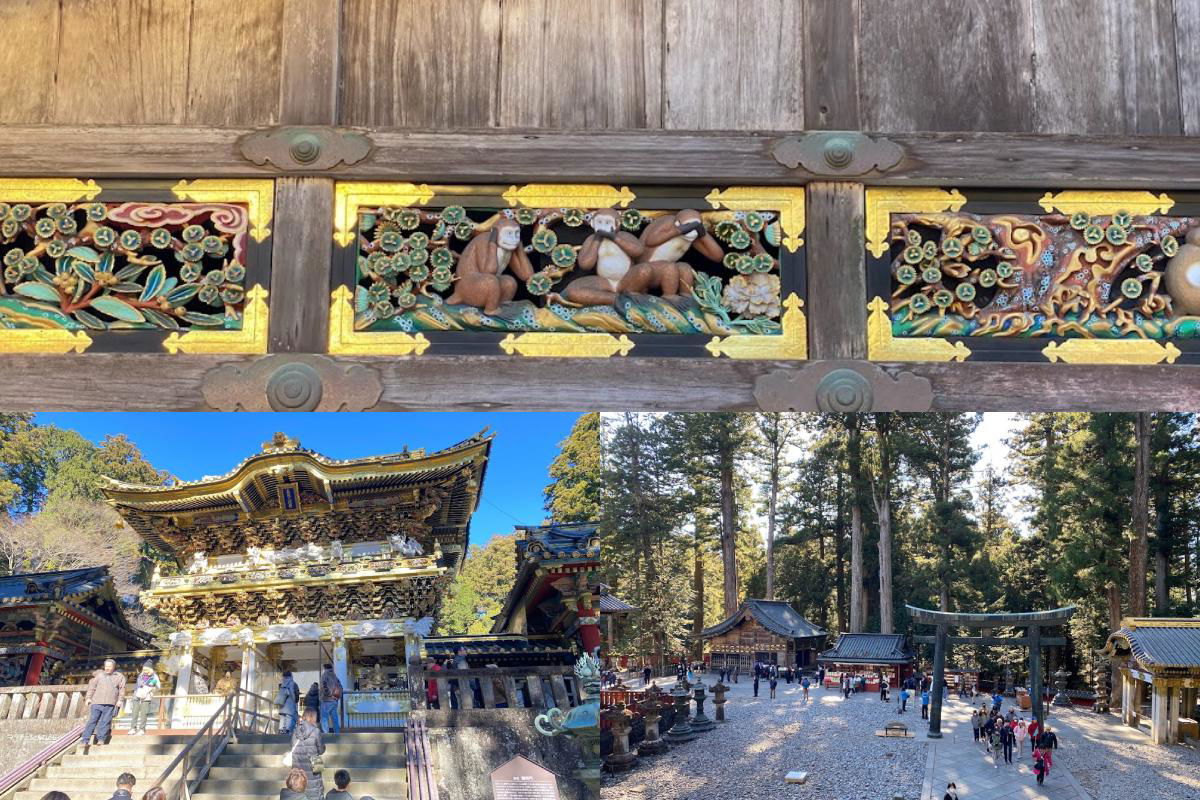
A three-photo collage from Toshogu Shrine in Nikko, Japan. The wide top photo shows a row of elaborately carved wooden panels set into a weathered timber wall. The center panel features the famous three monkeys: one covering its eyes, one its ears, one its mouth, surrounded by painted green leaves and gold framing. Below are two ground-level views of the shrine grounds. The left photo looks up an ornate gate covered in gold, white, and black detailing, with stone stairs and visitors walking up and down under a bright blue sky. The right photo shows an open gravel courtyard framed by tall cedar trees, with a large stone torii gate, dark wooden buildings, rows of stone lanterns, and crowds of visitors wandering through the complex.
A three-photo collage from Toshogu Shrine in Nikko, Japan. The wide top photo shows a row of elaborately carved wooden panels set into a weathered timber wall. The center panel features the famous three monkeys: one covering its eyes, one its ears, one its mouth, surrounded by painted green leaves and gold framing.
Below are two ground-level views of the shrine grounds. The left photo looks up an ornate gate covered in gold, white, and black detailing, with stone stairs and visitors walking up and down under a bright blue sky. The right photo shows an open gravel courtyard framed by tall cedar trees, with a large stone torii gate, dark wooden buildings, rows of stone lanterns, and crowds of visitors wandering through the complex.
Texto visible en la imagen
No clearly readable text.
Parque Conmemorativo de la Villa Imperial Tamozawa
Uno de los edificios de madera más grandes está aquí en el "Parque Conmemorativo de la Villa Imperial Tamozawa". Lamentablemente ya estaba cerrado cuando llegamos. Se encuentra entre el "Templo Nikkō Tōshō-gū" y el Abyss.
Google Maps: https://maps.app.goo.gl/fCEhqVSFT5BzwoBZ7
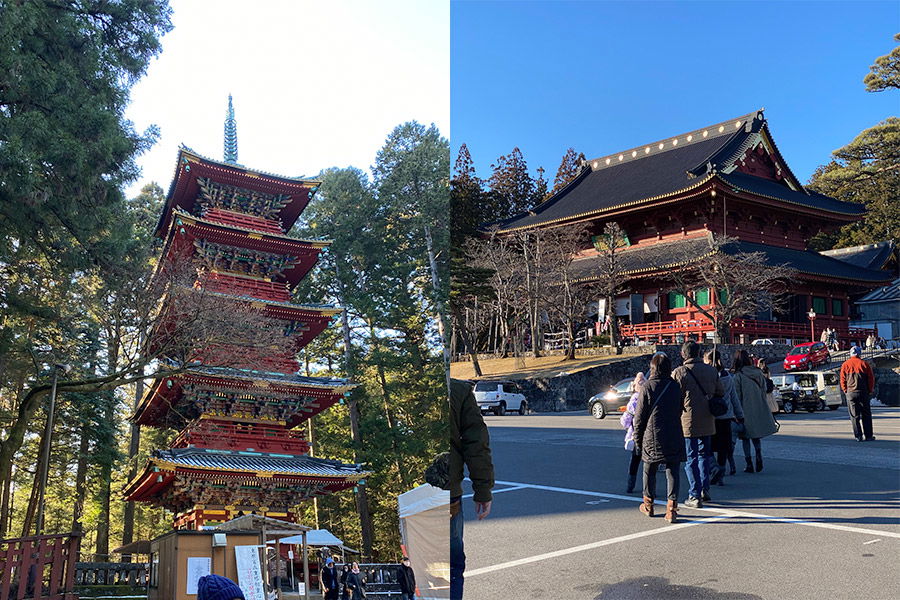
A two-part photo from Nikko Toshogu, the famous shrine complex in Nikko, Japan. On the left, a five-story pagoda rises above tall cedars, its tiers painted deep red with green and gold trim under intricately decorated eaves, topped by a slender bronze spire against a clear blue sky. Small stalls and a few visitors sit at its base. The right half shows the approach to the main hall, a grand red wooden building with a dark tiled roof and gold roof ornaments, set on a stone terrace. A group of visitors in winter coats walks across the open paved space toward it, with parked cars off to the side and bare trees in front of the structure. Bright sun and streaky white clouds give both shots a crisp winter-day feel.
A two-part photo from Nikko Toshogu, the famous shrine complex in Nikko, Japan. On the left, a five-story pagoda rises above tall cedars, its tiers painted deep red with green and gold trim under intricately decorated eaves, topped by a slender bronze spire against a clear blue sky. Small stalls and a few visitors sit at its base.
The right half shows the approach to the main hall, a grand red wooden building with a dark tiled roof and gold roof ornaments, set on a stone terrace. A group of visitors in winter coats walks across the open paved space toward it, with parked cars off to the side and bare trees in front of the structure. Bright sun and streaky white clouds give both shots a crisp winter-day feel.
Texto visible en la imagen
(Retourneer niets – er is geen tekst in de afbeelding die duidelijk leesbaar is.)
No clearly readable text is visible in the provided image.
Abyss Kanmangafuchi
Si quieres terminar el día con una caminata tras explorar el impresionante templo, te recomiendo las estatuas Jizo en Kanmangafuchi Abyss. Las estatuas son fácilmente reconocibles por sus característicos gorros y baberos rojos. Se dice que nunca puedes contarlas; ¡cada vez obtendrás un número diferente!
Google Maps: https://maps.app.goo.gl/nyXQ5mcbT7f8vE4R8
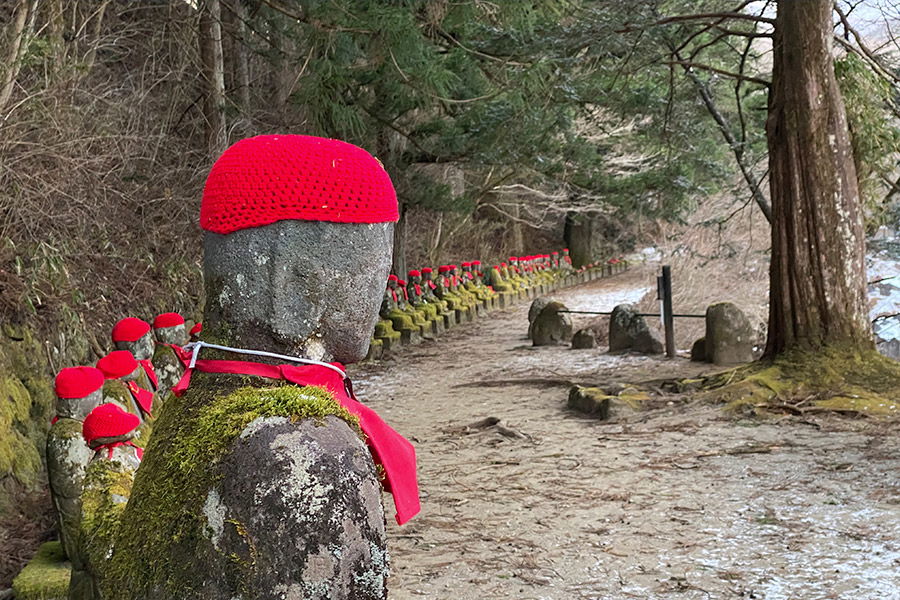
A mossy stone Jizo statue fills the left foreground, seen from behind and wearing a bright red knitted cap and a red bib tied around its neck. Behind it, a long line of similar statues in red hats stretches down a gravel path through a wooded gorge, each one small and weathered with green moss. The ground has patches of frost and scattered leaves, tall cedars rise on both sides, and a large tree trunk anchors the right edge. This is the row of Jizo statues along the Kanmangafuchi Abyss in Nikko, a quiet riverside trail lined with dozens of these guardian figures.
A mossy stone Jizo statue fills the left foreground, seen from behind and wearing a bright red knitted cap and a red bib tied around its neck. Behind it, a long line of similar statues in red hats stretches down a gravel path through a wooded gorge, each one small and weathered with green moss. The ground has patches of frost and scattered leaves, tall cedars rise on both sides, and a large tree trunk anchors the right edge. This is the row of Jizo statues along the Kanmangafuchi Abyss in Nikko, a quiet riverside trail lined with dozens of these guardian figures.
Texto visible en la imagen
No clearly readable text.
Lago Chuzenji
El Lago Chuzenji es muy conocido en la región de Nikko, pero ten cuidado: en invierno hace muchísimo frío y viento allí porque está en una montaña (unos 1.200 metros sobre el nivel del mar). También nieva más seguido, o la nieve permanece más tiempo, y hace mucho más frío que en la estación (unos 500 metros sobre el nivel del mar).
Después de maravillarnos con el lago y de envidiar a los huéspedes del hotel The Ritz-Carlton (alrededor de 1.000 € por noche), fuimos a una cafetería con vistas al lago. Era necesario, porque el viento nos caló a pesar de llevar cuatro capas, guantes y bufanda. En esta época del año no puedes pasear en barco, así que tengo ganas de ver cómo será en verano.
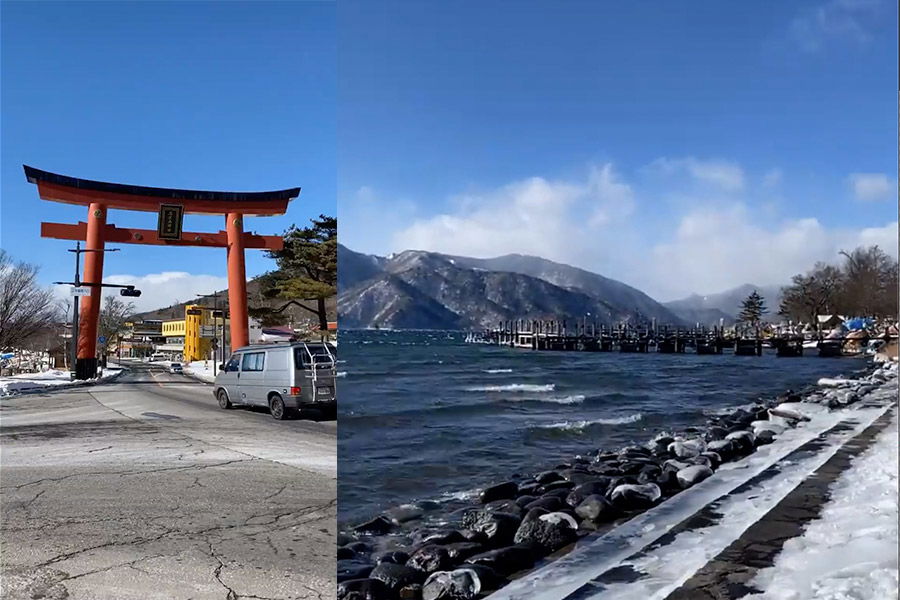
A split photo from Nikkō showing two winter scenes at Lake Chūzenji. On the left, a large red torii gate with a dark wooden plaque stretches across a small town road, a gray van passing beneath it, with snow piled along the roadside and buildings and bare trees behind. On the right, the lake itself: choppy deep-blue water, a rocky shore of dark stones dusted with snow, a long pier reaching out into the lake, and forested mountains with lingering snow rising under a partly cloudy sky.
A split photo from Nikkō showing two winter scenes at Lake Chūzenji. On the left, a large red torii gate with a dark wooden plaque stretches across a small town road, a gray van passing beneath it, with snow piled along the roadside and buildings and bare trees behind. On the right, the lake itself: choppy deep-blue water, a rocky shore of dark stones dusted with snow, a long pier reaching out into the lake, and forested mountains with lingering snow rising under a partly cloudy sky.
Texto visible en la imagen
No text is clearly readable in the image.
En nuestro viaje de 2023 volvimos aquí y, para nuestra sorpresa, esta vez incluso vimos monos salvajes. Viven en Japón, pero en realidad no es común verlos en estado salvaje. Fue una experiencia única que no olvidaré.
Google Maps: https://maps.app.goo.gl/evWiAVvwqkDd1mLDA
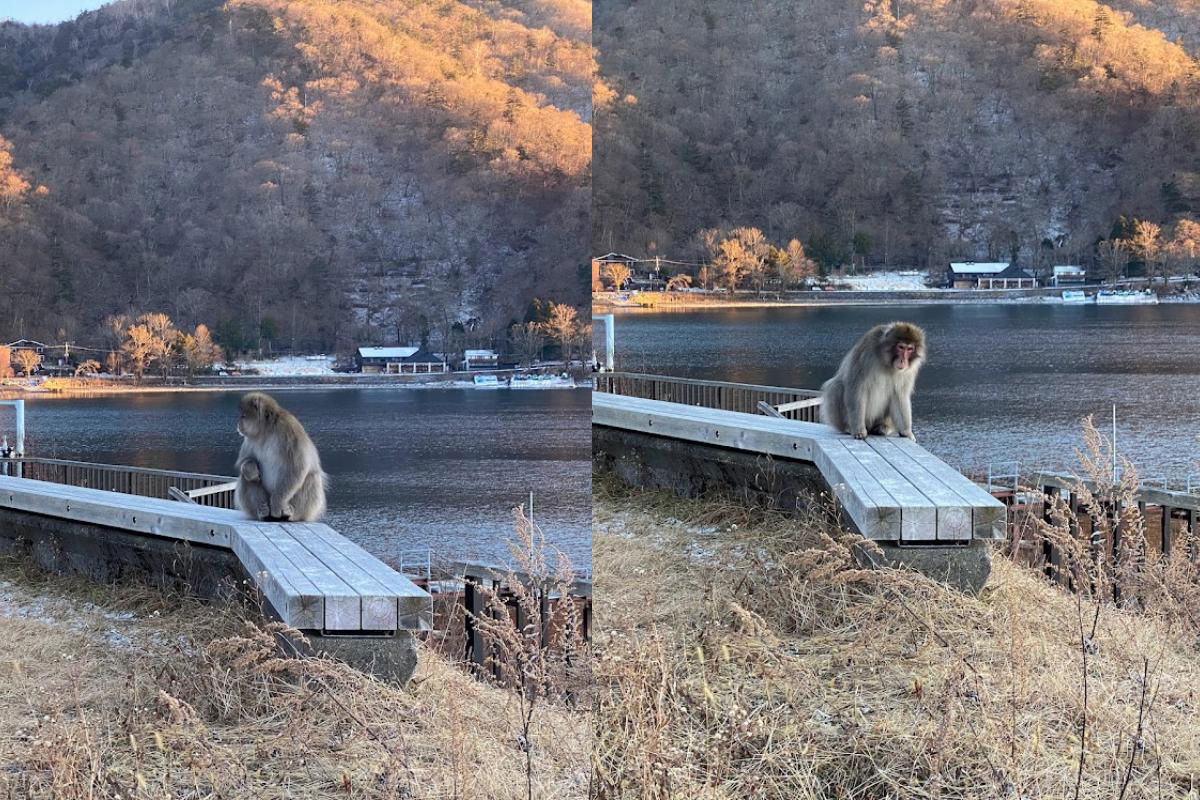
Two nearly identical photos sit side by side, each showing a Japanese macaque on a long wooden bench at Lake Chuzenji in Nikko. In the left frame the monkey hunches forward, head down, grooming or resting; in the right frame it sits upright and looks straight at the camera. It has gray-brown fur and the pink face typical of the species. Dry, bleached grass fills the foreground, and behind the bench the lake stretches flat and dark. Across the water, forested mountains rise steeply, their bare trees catching warm low sun, with a few houses and a road visible along the far shore. The bare hills and dormant grass give the scene a clear late-autumn or early-winter feel.
Two nearly identical photos sit side by side, each showing a Japanese macaque on a long wooden bench at Lake Chuzenji in Nikko. In the left frame the monkey hunches forward, head down, grooming or resting; in the right frame it sits upright and looks straight at the camera. It has gray-brown fur and the pink face typical of the species.
Dry, bleached grass fills the foreground, and behind the bench the lake stretches flat and dark. Across the water, forested mountains rise steeply, their bare trees catching warm low sun, with a few houses and a road visible along the far shore. The bare hills and dormant grass give the scene a clear late-autumn or early-winter feel.
Texto visible en la imagen
No clearly readable text.
Las cataratas Kengon
Nikko y sus alrededores son conocidos por tres cascadas. Logramos ver dos de ellas. Es especialmente espectacular en invierno, ya que el agua cerca y debajo de la cascada se congela. Con 97 metros de altura, también es la más alta e impresionante.
Junto con las cataratas Nachi y Fukuroda en otras prefecturas, las cataratas Kengon son consideradas de las más bellas de Japón.
Si quieres una buena perspectiva de la cascada, hay un ascensor: no puedes usar escaleras. Lamentablemente, el ascensor cuesta unos 600 yenes. Pero tu tarifa también paga al personal y a la plataforma de observación.
Google Maps: https://maps.app.goo.gl/vDZMF7xcDBKd7aY28
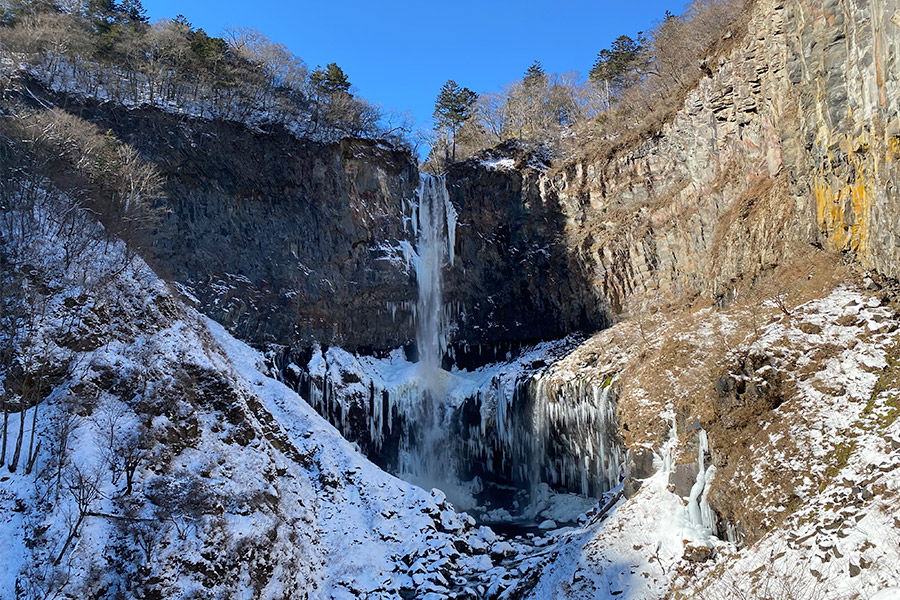
A tall waterfall drops straight down a dark rock cliff into a snow-covered gorge under a clear blue sky. This is Kegon Falls in Nikko, Japan, photographed in the cold season: ice curtains and icicles cling to the rocks where the water hits, and the plunge pool at the bottom is ringed by snow-dusted boulders. The steep slopes on both sides are bare and wintry, with leafless trees on the left and patches of evergreens along the cliff tops. The falls pour from a narrow notch in the rock face, fanning slightly as they fall, while sunlight hits the right side of the canyon and leaves the base in shadow.
A tall waterfall drops straight down a dark rock cliff into a snow-covered gorge under a clear blue sky. This is Kegon Falls in Nikko, Japan, photographed in the cold season: ice curtains and icicles cling to the rocks where the water hits, and the plunge pool at the bottom is ringed by snow-dusted boulders. The steep slopes on both sides are bare and wintry, with leafless trees on the left and patches of evergreens along the cliff tops. The falls pour from a narrow notch in the rock face, fanning slightly as they fall, while sunlight hits the right side of the canyon and leaves the base in shadow.
Texto visible en la imagen
No text is clearly readable in the image.
Si te gusta el pescado, asegúrate de probar pescado en palito en el camino. La mayoría de las veces es trucha, que puedes comer con espinas y entrañas. Son saladas y muy contundentes. Especialmente en clima frío, un pequeño tentempié ayuda a calentar el estómago. Como se asan al carbón, quedan realmente crujientes. Solo escribir esto ya me está dando ganas otra vez, jajaja.
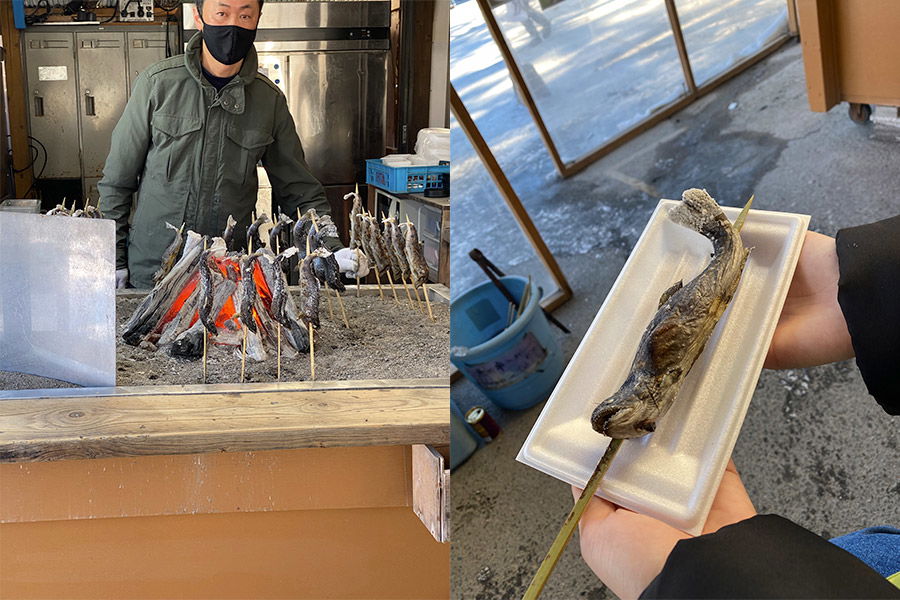
A two-photo split showing riverside fish skewers in Nikkō. On the left, a vendor in a green jacket and black face mask stands behind a sand-filled grill bed where dozens of skewered whole fish fan out over glowing embers like a campfire. On the right, a hand holds one of the finished skewers, a charred whole fish on a green bamboo stick resting on a white styrofoam tray, with snowy ground and wet stone flooring outside a shop entrance behind it.
A two-photo split showing riverside fish skewers in Nikkō. On the left, a vendor in a green jacket and black face mask stands behind a sand-filled grill bed where dozens of skewered whole fish fan out over glowing embers like a campfire. On the right, a hand holds one of the finished skewers, a charred whole fish on a green bamboo stick resting on a white styrofoam tray, with snowy ground and wet stone flooring outside a shop entrance behind it.
Texto visible en la imagen
No clearly readable text.
Las cataratas Ryūzu
Un poco más alejadas están las mucho más pequeñas cataratas Ryūzu. A estas puedes acercarte mucho. Si te da hambre, también hay un restaurante allí—con la especialidad local Yuba, por supuesto.
Google Maps: https://maps.app.goo.gl/pnsSFsc8kP4AX5t87
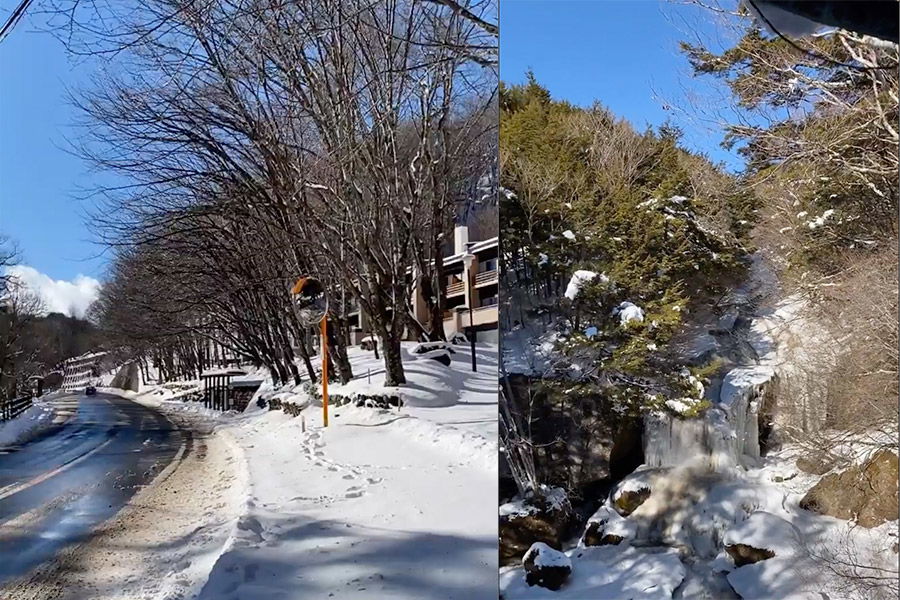
A two-part winter scene from Nikko, shown side by side. On the left, a quiet mountain road curves through deep snow, lined with tall bare trees whose branches fill most of the frame. A rounded traffic mirror on an orange post stands at the roadside, and footprints cross the snow toward a building half-hidden behind the trees under a clear blue sky. On the right, Ryuzu Falls pours over dark rocks in a narrow forested gorge, its lower sections frozen into sheets of ice. Snow dusts the surrounding evergreens, and patches of white cling to the boulders in the stream below.
A two-part winter scene from Nikko, shown side by side. On the left, a quiet mountain road curves through deep snow, lined with tall bare trees whose branches fill most of the frame. A rounded traffic mirror on an orange post stands at the roadside, and footprints cross the snow toward a building half-hidden behind the trees under a clear blue sky. On the right, Ryuzu Falls pours over dark rocks in a narrow forested gorge, its lower sections frozen into sheets of ice. Snow dusts the surrounding evergreens, and patches of white cling to the boulders in the stream below.
Texto visible en la imagen
No clearly readable text is present in the image.
Edo Wonderland Nikko Edomura
Edo Wonderland es un museo al aire libre donde puedes sumergirte en el mundo del periodo Edo. Aquí encontrarás edificios de época con interiores y otros artefactos interesantes de esa era. El precio de entrada de 5.800 yenes (unos 37 euros) por persona es bastante caro, pero podrías estar fácilmente 2-3 horas aquí—¡con niños incluso más tiempo!
Mi consejo: Si compras tu entrada en la estación Nikko Tobu, sólo cuesta 5.500 yenes, así puedes ahorrar algo. También hay un autobús lanzadera gratuito que te lleva desde la estación JR Nikko a Edo Wonderland (¡ojo: NO es la estación Tobu Nikko donde llega el Limited Express!).
Google Maps: https://maps.app.goo.gl/Y2wb12kipxUrKcb36
Sitio web oficial (inglés): https://edowonderland.net/en/
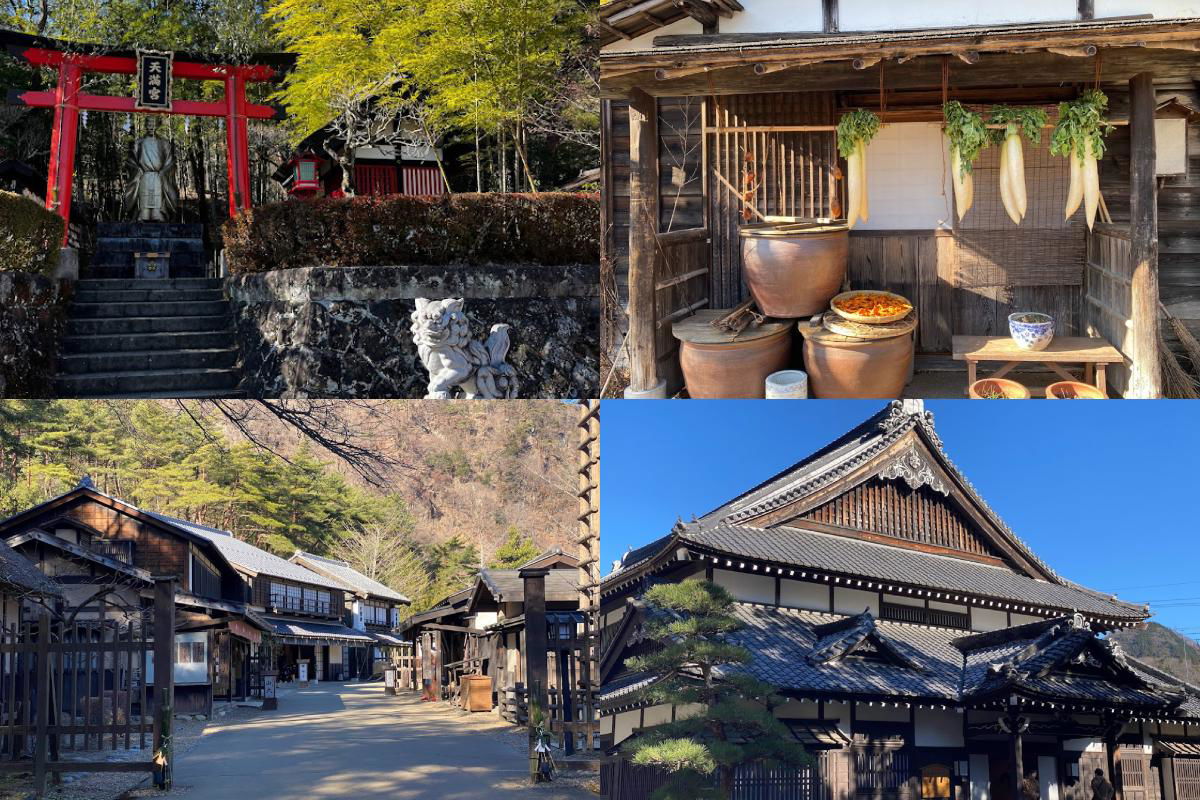
A four-photo collage from a trip to Nikko, Japan, centered on Edo Wonderland, a theme park that recreates a feudal-era town. In the top left photo, a bright red torii gate marks a shrine entrance, with a carved stone statue of a robed figure standing beyond it and a stone guardian lion-dog sitting near the mossy steps below. The top right photo shows the wooden porch of a traditional building where several giant white daikon radishes hang upside down by their leafy greens, above big earthenware pickle pots and trays of orange dried persimmons. The bottom left photo looks down a wide dirt street lined with dark wooden Edo-period houses under bare hills and pine trees. The bottom right photo shows a large traditional building with sweeping dark tiled roofs, carved wooden gables, and white plaster walls set against a clear blue sky, with pruned pines in front.
A four-photo collage from a trip to Nikko, Japan, centered on Edo Wonderland, a theme park that recreates a feudal-era town.
In the top left photo, a bright red torii gate marks a shrine entrance, with a carved stone statue of a robed figure standing beyond it and a stone guardian lion-dog sitting near the mossy steps below. The top right photo shows the wooden porch of a traditional building where several giant white daikon radishes hang upside down by their leafy greens, above big earthenware pickle pots and trays of orange dried persimmons. The bottom left photo looks down a wide dirt street lined with dark wooden Edo-period houses under bare hills and pine trees. The bottom right photo shows a large traditional building with sweeping dark tiled roofs, carved wooden gables, and white plaster walls set against a clear blue sky, with pruned pines in front.
Texto visible en la imagen
天満宮
Con hambre tras explorar el museo al aire libre, decidimos comer en el restaurante del recinto. Había Soba para mojar en Miso Edo—por 1.000 yenes por plato, me pareció caro para solo un poco de soba con wasabi y cebolla verde.
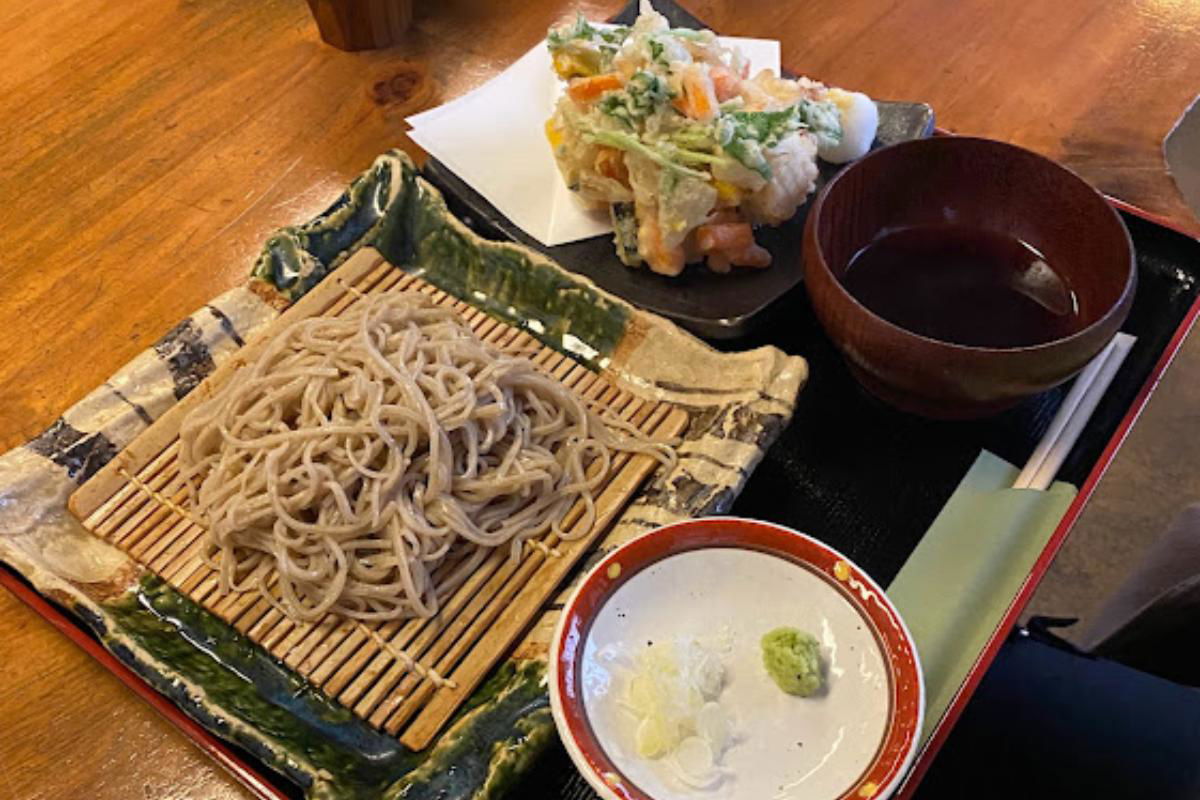
A cold soba set lunch on a dark lacquered tray at a wooden restaurant table in Nikko. A loose tangle of grey-brown buckwheat noodles rests on a square bamboo draining rack, set on a boldly glazed plate in green and cream. Beside it sits a deep brown bowl of dipping sauce, and a small white dish with a red rim holds a mound of wasabi and grated condiments for stirring in. At the top of the tray, a golden vegetable tempura, crisp and flecked with carrot and greens, is served on a black square plate. Chopsticks wait on a green paper sleeve at the edge, ready for a traditional Japanese meal.
A cold soba set lunch on a dark lacquered tray at a wooden restaurant table in Nikko. A loose tangle of grey-brown buckwheat noodles rests on a square bamboo draining rack, set on a boldly glazed plate in green and cream. Beside it sits a deep brown bowl of dipping sauce, and a small white dish with a red rim holds a mound of wasabi and grated condiments for stirring in. At the top of the tray, a golden vegetable tempura, crisp and flecked with carrot and greens, is served on a black square plate. Chopsticks wait on a green paper sleeve at the edge, ready for a traditional Japanese meal.
Texto visible en la imagen
No clearly readable text.
Aguas termales Yumoto Onsen
Otra atracción que visitamos son las aguas termales Yumoto Onsen. Las aguas termales naturales burbujean aquí en un hermoso paisaje entre bosques y montañas. La nieve caída lo hizo aún más especial. Sin embargo, ¡el olor a azufre (huele a huevo podrido) es muy fuerte! La entrada aquí es gratuita.
Como la fuente Yumoto Onsen está en un entorno muy rural, puedes tener suerte y ver animales salvajes como monos o ciervos. ¡Durante nuestra visita, vimos un ciervo en los arbustos!
Google Maps: https://maps.app.goo.gl/t8F1qUZCv8NkYff89
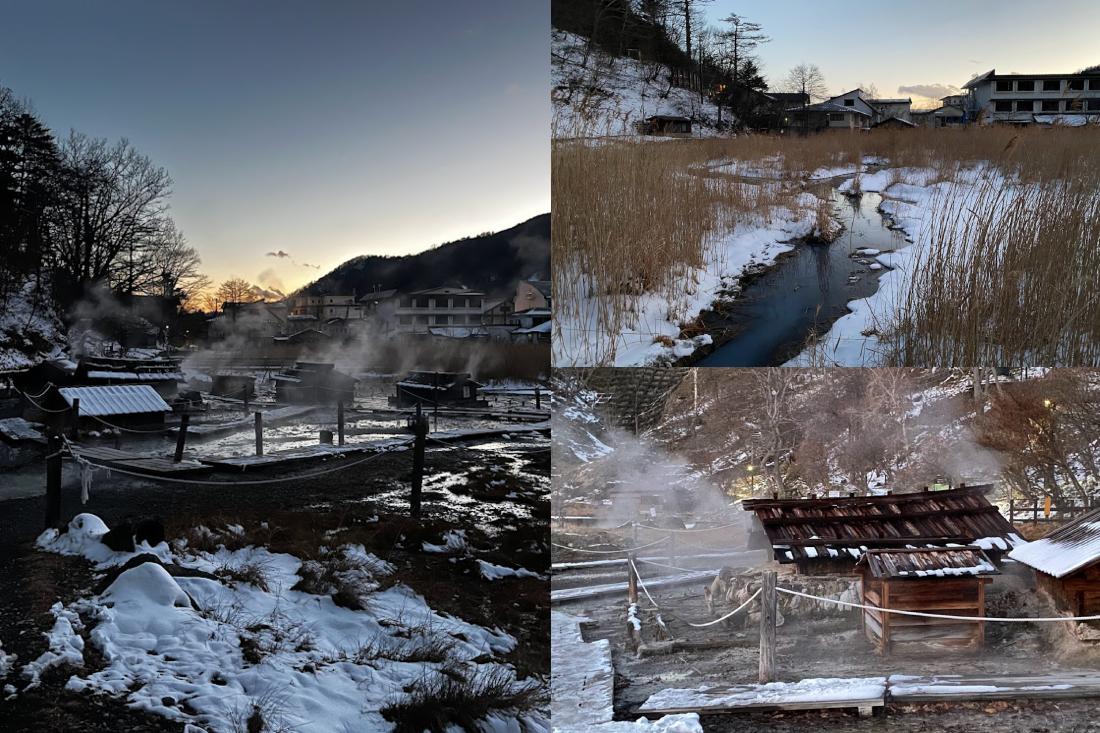
A three-photo collage of Yumoto Onsen in Nikko on a snowy winter evening, with steam rising everywhere from the hot spring sources. The left photo shows the main steaming field at dusk: dark wooden huts and fenced-off spring pools vent thick plumes of vapor, snow piles along the foreground, and low buildings sit at the base of a mountain under an orange fading sky. The top right photo looks down a clear stream winding through snow, flanked by tall dried reeds, with village houses on the slope behind. The bottom right photo gives a closer view of a rustic hot spring hut with a weathered corrugated roof, snow on top, steam pouring from the ground around it, and a simple rope fence marking the path.
A three-photo collage of Yumoto Onsen in Nikko on a snowy winter evening, with steam rising everywhere from the hot spring sources.
The left photo shows the main steaming field at dusk: dark wooden huts and fenced-off spring pools vent thick plumes of vapor, snow piles along the foreground, and low buildings sit at the base of a mountain under an orange fading sky. The top right photo looks down a clear stream winding through snow, flanked by tall dried reeds, with village houses on the slope behind. The bottom right photo gives a closer view of a rustic hot spring hut with a weathered corrugated roof, snow on top, steam pouring from the ground around it, and a simple rope fence marking the path.
Texto visible en la imagen
No clearly readable text is present in the image.
El baño de pies あんよの湯 (anyo no yu)
Cerca del manantial Yumoto Onsen, también hay un baño de pies (あんよの湯 anyo no yu) que puedes visitar. El acceso al baño de pies suele ser gratis, pero ya estaba cerrado cuando llegamos a las 16:00, así que lamentablemente no pudimos probarlo.
Google Maps: https://maps.app.goo.gl/Yv9ELj45z2Ey4qvm8
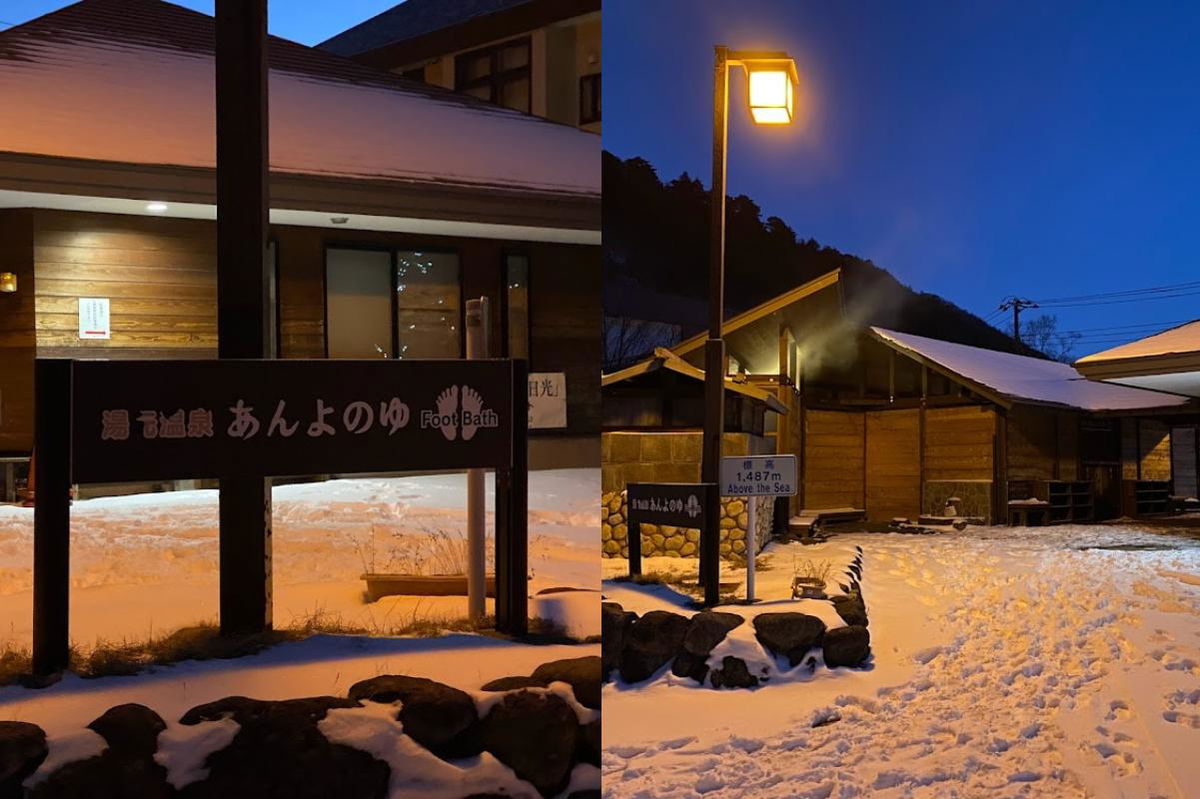
Two photos side by side show a foot bath onsen in Nikko on a snowy winter evening, under a deep blue dusk sky. In the left photo, a dark wooden sign stands in the foreground reading あんよのゆ with "Foot Bath" in English and small footprint icons, set in front of a low wooden building dusted with snow and lit by a warm porch light. The right photo pulls back to a wider view of the same facility: a long timber shelter with a snow-covered roof, steam drifting up from the hot spring water, and a glowing lantern-style lamp post rising above a snow-packed path marked with footprints. A small sign next to the path gives the elevation as 1,487 meters above sea level, matching the high mountain onsen setting.
Two photos side by side show a foot bath onsen in Nikko on a snowy winter evening, under a deep blue dusk sky.
In the left photo, a dark wooden sign stands in the foreground reading あんよのゆ with "Foot Bath" in English and small footprint icons, set in front of a low wooden building dusted with snow and lit by a warm porch light. The right photo pulls back to a wider view of the same facility: a long timber shelter with a snow-covered roof, steam drifting up from the hot spring water, and a glowing lantern-style lamp post rising above a snow-packed path marked with footprints. A small sign next to the path gives the elevation as 1,487 meters above sea level, matching the high mountain onsen setting.
Texto visible en la imagen
湯て温泉 あんよのゆ FootBath
日光」
標高 1,487m
Above the Sea.
湯て温泉 あんよのゆ
Hoteles en Nikko
Nikko Park Lodge Tobu Station (Viaje 2022)
Para nuestro viaje en 2022 elegimos un hotel económico porque queríamos gastar el dinero ahorrado principalmente en comida. El hotel se llama "Nikko Park Lodge Tobu Station" .* Si quieres gastar 200 - 300 € en un hotel, tendrás una selección mucho mejor y más amplia. Por supuesto, esto también depende de la temporada.
- Google Maps: https://maps.app.goo.gl/SK2xoYkAhspGuHgb6
- Booking.com: "Nikko Park Lodge Tobu Station"
Características positivas:
- A 2 minutos de la estación principal
- El personal (cuando llegamos, hablaban muy bien inglés)
- Muy barato (~8,000¥ / 60€)
- Reservable vía Booking.com o Airbnb (Booking.com era más barato en nuestra fecha de reserva)
- No encontramos moho
- Microondas y nevera en las instalaciones del baño compartido (el supermercado está a 2 minutos – la tienda de conveniencia Family Mart tienda de conveniencia está a 5 minutos)
Características negativas:
- Las paredes son muy delgadas (un niño gritó al menos media hora a las 7:30 am)
- A veces el olor no era agradable, pero la habitación estaba bien
- Baños y aseos compartidos (dos habitaciones compartían esto con nosotros)
- Alfombra en la habitación muy manchada, algunos muebles también sucios
- La sábana tenía un pequeño agujero (2 cm), pero estaba limpia para un hotel de dos estrellas
- Sin extras (es solo un hotel de dos estrellas)
Shinkyo Inn Hotel (Viaje 2023)
Para nuestro viaje en 2023 elegimos el Shinkyo Inn Hotel ". Este hotel tiene una ubicación ideal, a solo un minuto del famoso Puente Shinkyo. Hay muchos restaurantes cerca y las principales atracciones como santuarios y templos están solo a 2-3 minutos a pie.
Un punto destacado especial del hotel es que tienes una vista idílica del río cercano tanto desde el baño como desde el resto de la habitación. El dueño es extranjero (creo que era británico) y por lo tanto hablaba perfecto inglés. Eso significa que no hay barreras de idioma, por lo que es altamente recomendable para huéspedes internacionales.
Pudimos dejar nuestro equipaje en el hotel hasta las 14:00. Los dueños estaban fuera ese día, así que no pudimos dejar las maletas más tiempo. El hotel es más parecido a una pensión con solo dos habitaciones, pero ambas son muy espaciosas.
- Google Maps: https://maps.app.goo.gl/4X39RfLKhJZswZoY6
- Booking.com: https://www.booking.com/hotel/jp/shinkyo-inn.de.html
Características positivas:
- Ubicación perfecta, a pocos minutos a pie de las principales atracciones
- El dueño hablaba inglés perfecto (él era británico)
- Muchos restaurantes cerca de la propiedad
- Solo dos habitaciones, así que ambas son muy amplias
- Vista al río, muy idílica
Características negativas:
- El día de la salida solo pudimos dejar el equipaje hasta las 14:00
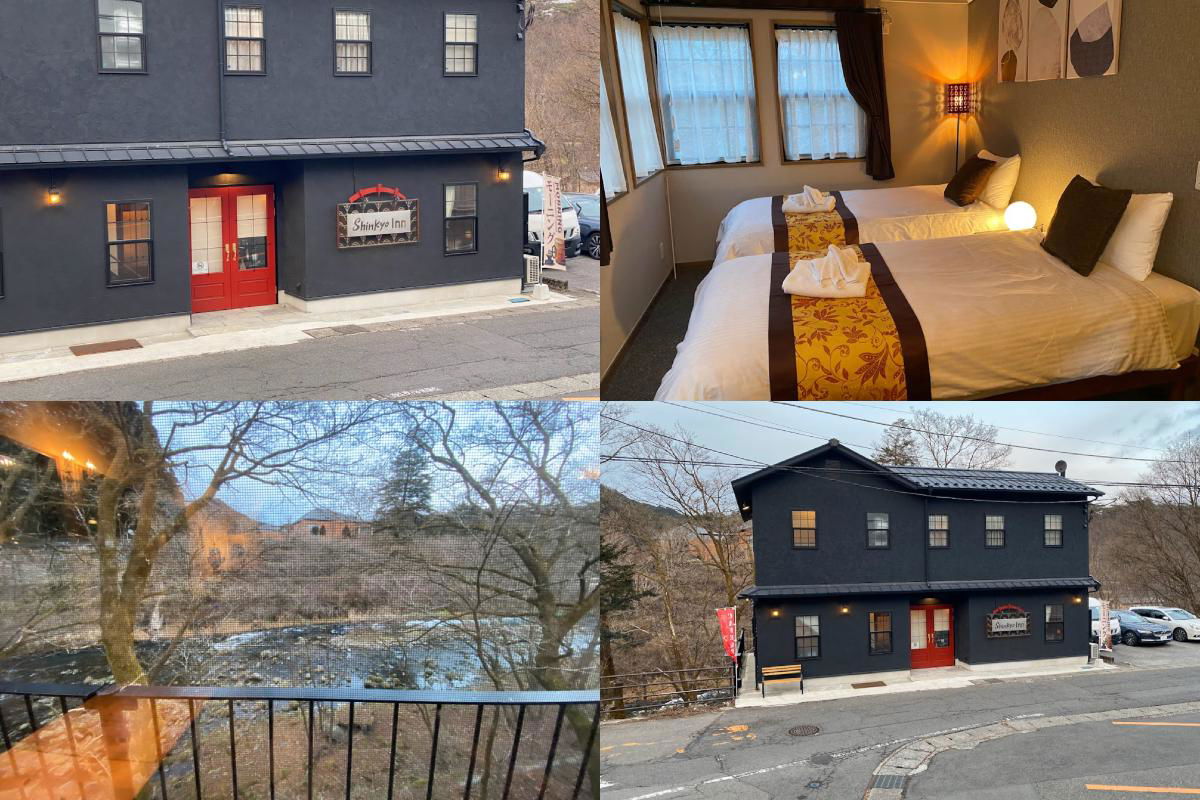
A four-photo collage shows Shinkyo Inn, a small guesthouse in Nikko, Japan. Two of the shots capture its exterior: a two-story building painted dark charcoal with a striking red double-door entrance and a white signboard decorated with a little red bridge illustration. One exterior photo is taken from the street in daylight, the other from across the road at dusk, with warm lamps glowing by the door and a few cars parked alongside. The other two photos show the guesthouse experience. A twin bedroom has two neatly made beds with white linens, gold-and-brown runners, folded towel decorations, and a softly glowing spherical lamp by the pillows. The fourth shot is the view from a window at twilight, looking out over a river lined with bare winter trees, framed by the dark railing of a balcony just outside the glass.
A four-photo collage shows Shinkyo Inn, a small guesthouse in Nikko, Japan. Two of the shots capture its exterior: a two-story building painted dark charcoal with a striking red double-door entrance and a white signboard decorated with a little red bridge illustration. One exterior photo is taken from the street in daylight, the other from across the road at dusk, with warm lamps glowing by the door and a few cars parked alongside.
The other two photos show the guesthouse experience. A twin bedroom has two neatly made beds with white linens, gold-and-brown runners, folded towel decorations, and a softly glowing spherical lamp by the pillows. The fourth shot is the view from a window at twilight, looking out over a river lined with bare winter trees, framed by the dark railing of a balcony just outside the glass.
Texto visible en la imagen
Shinkyo Inn
Costos del viaje
Opción económica 2022: 2 días una persona (el hotel se puede compartir entre dos)
- Ida y vuelta en tren (~¥7,000 / ~55 €)
- Hotel una noche (~¥8,000 / ~60 €)
- Free Bus Ticket 2 días (~¥2,200 / ~17 €)
- Comidas y snacks / comida callejera (~¥5,000 / ~40 €)
- Entradas (~¥2,000 / ~15 €)
- Total = (~¥25,000 / ~190 - 200 €)
Opción un poco más cara 2023 (no lujo): 2 días una persona (hotel y coche se pueden compartir entre dos)
- Tren (~¥7,000 / ~55 €)
- Hotel dos noches (~¥63,000 / ~400 €)
- Coche dos días (~¥20,000 con gasolina / ~150 €)
- Comidas y snacks / comida callejera (~¥10,000 / ~75 €)
- Entradas (~¥12,000 / ~80 €)
- Total = (~¥112,000 / ~720 €)
Comida en Nikko – Platos de Yuba como especialidad local
Yuba & Soba

Yuba ゆば es una delicia local en Nikko y sus alrededores. Aquí en Tokio nunca la he visto ni comido. Pero como casi todos los restaurantes la sirven en sopas, como topping en spaghetti o frita, por supuesto que la probé.
¿Qué es Yuba ゆば?
Yuba se produce a partir de leche de soya. La leche se calienta a 80-90 °C. Luego la película que se forma en la parte superior se retira cuidadosamente con palillos.
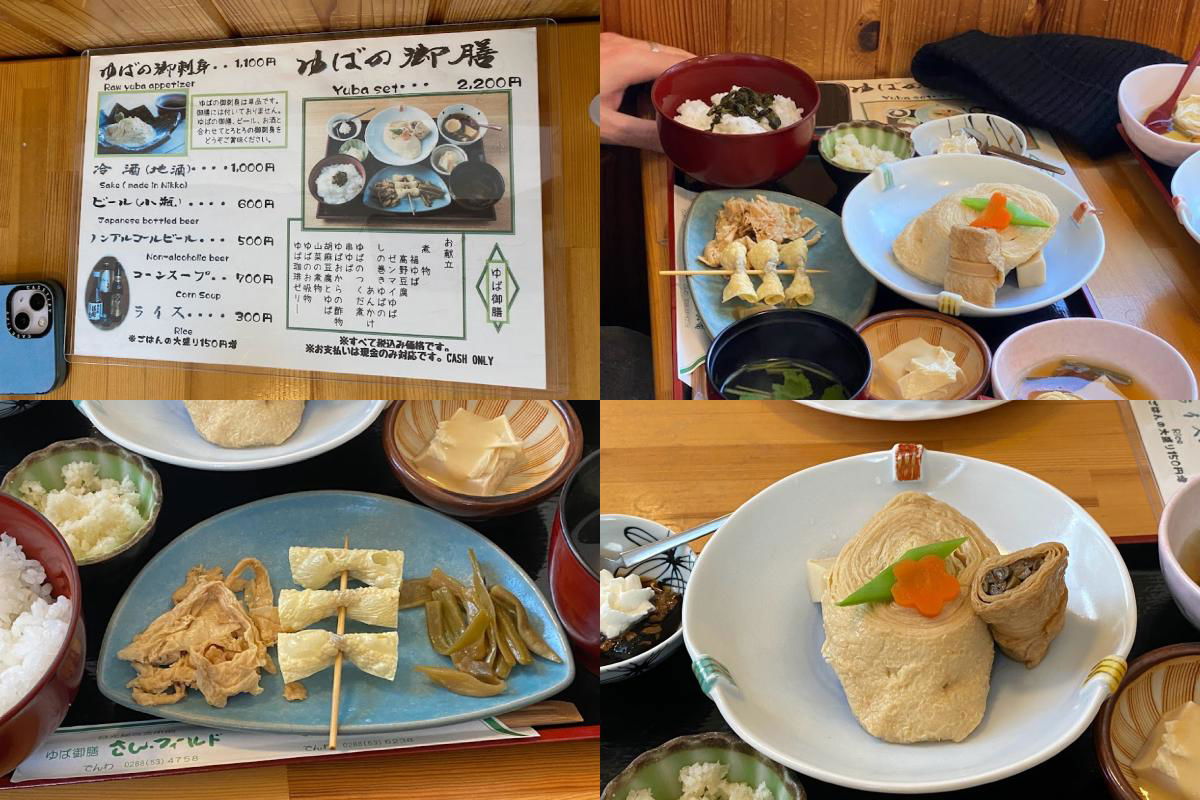
A four-photo collage of a yuba (tofu skin) set meal, a specialty of Nikko, Japan. The top left panel shows the restaurant's menu board, handwritten in Japanese with English labels, listing a raw yuba appetizer for 1,100 yen, a yuba set for 2,200 yen, sake made in Nikko, beer, corn soup, and rice, with a note that the shop is cash only. The other three panels show the meal itself. One captures the full spread on a wooden table: red lacquered bowls of rice topped with something dark and leafy, miso soup, small side dishes, and a plate holding fresh yuba draped over a block of tofu and garnished with a carrot cut into a flower. A close-up shows pale, wrinkled sheets of fried yuba beside skewers of knotted yuba and pickled vegetables on a blue oval plate. The last panel zooms in on a rolled piece of yuba stuffed with a dark filling, served on a white plate with rice and pickles alongside.
A four-photo collage of a yuba (tofu skin) set meal, a specialty of Nikko, Japan. The top left panel shows the restaurant's menu board, handwritten in Japanese with English labels, listing a raw yuba appetizer for 1,100 yen, a yuba set for 2,200 yen, sake made in Nikko, beer, corn soup, and rice, with a note that the shop is cash only.
The other three panels show the meal itself. One captures the full spread on a wooden table: red lacquered bowls of rice topped with something dark and leafy, miso soup, small side dishes, and a plate holding fresh yuba draped over a block of tofu and garnished with a carrot cut into a flower. A close-up shows pale, wrinkled sheets of fried yuba beside skewers of knotted yuba and pickled vegetables on a blue oval plate. The last panel zooms in on a rolled piece of yuba stuffed with a dark filling, served on a white plate with rice and pickles alongside.
Texto visible en la imagen
ゆばの御刺身・・・1,100円
Raw yuba appetizer
ゆばの御膳
Yuba set・・・2,200円
冷酒(地酒)・・・1,000円
Sake (made in Nikko)
ビール(小瓶)・・・600円
Japanese bottled beer
ノンアルコールビール・・・500円
Non-alcoholic beer
コーンスープ・・・700円
Corn Soup
ライス・・・300円
Rice
※ごはん大盛りは50円増
※お支払いは現金のみ対応です。CASH ONLY
ゆば御膳
0288(53)4758
¿A qué sabe Yuba ゆば?
Es difícil de describir. Al principio pensé que tendría una textura parecida a la Tamagoyaki porque más o menos se ve así, pero es mucho más firme y esponjosa. También absorbe mucho líquido. Como es casi insípida, se sirve a menudo en sopas (de fideos) o frita. También puedes comerlo como sashimi.
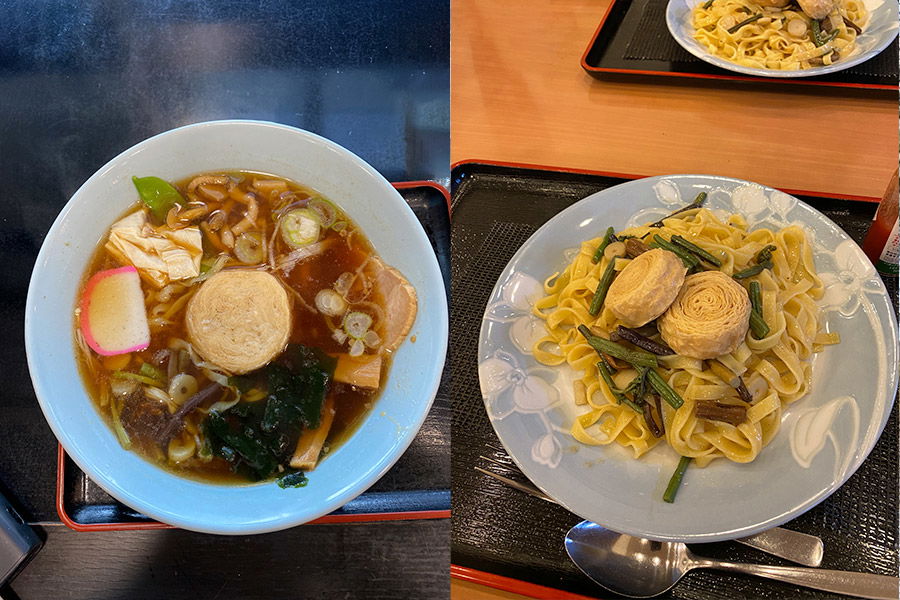
Two yuba dishes from Nikko sit side by side. On the left, a bowl of noodle soup in dark broth, topped with a round of rolled yuba (tofu skin), a pink-and-white naruto fish cake slice, greens, scallions, and mushrooms. On the right, a plate of thick flat noodles tossed with vegetables and mushrooms and crowned with two coiled pieces of fried yuba, served on a black tray with a spoon beside it.
Two yuba dishes from Nikko sit side by side. On the left, a bowl of noodle soup in dark broth, topped with a round of rolled yuba (tofu skin), a pink-and-white naruto fish cake slice, greens, scallions, and mushrooms. On the right, a plate of thick flat noodles tossed with vegetables and mushrooms and crowned with two coiled pieces of fried yuba, served on a black tray with a spoon beside it.
Texto visible en la imagen
No text is clearly readable in the image.
Conclusión:
Especialmente recomiendo Nikko en invierno. En Tokio no hubo nieve en 2021–2022. Pero si vas a Nikko verás mucha nieve. Solo asegúrate de abrigarte muy bien, ya que puede hacer mucho frío en invierno (–3 °C no es raro, y con viento fuerte es aún más incómodo).
Los hoteles son relativamente caros ya que es un destino turístico muy popular. La comida es sabrosa y puedes disfrutar de mucha naturaleza. Si quieres escapar de la ciudad y estás en Tokio, te recomiendo pasar 1 o 2 días en Nikko. Viajar allí tampoco es demasiado caro en general. Una cosa que noté: Cuando volví en diciembre de 2023, casi todo cerraba temprano, incluso los restaurantes a veces solo estaban abiertos hasta las 14:30–15:00.


Comentarios