Tabla de contenidos:
TL;DR
En este artículo sobre la prefectura de Toyama, encontrarás una guía completa para tu viaje desde Tokio, incluyendo recomendaciones sobre cómo llegar, opciones de alojamiento y actividades emocionantes. La mejor manera de llegar a Toyama es en coche, lo que te permite disfrutar de paisajes impresionantes y hacer paradas en el camino. Alternativamente, puedes optar por el tren bala Shinkansen, que te llevará a la ciudad en aproximadamente 2,5 horas, aunque necesitarás un coche para explorar la prefectura, ya que el transporte público es limitado. Se sugiere alojarse en el APA Hotel Takaoka Ekimae, un hotel de tres estrellas convenientemente ubicado cerca de la estación de tren, con tarifas asequibles. Además, el pintoresco pueblo de Gokayama, conocido por su belleza natural y su patrimonio histórico, es una visita imprescindible en la región.En esta entrada sobre la prefectura de Toyama, te mostraré numerosos consejos e información sobre cómo llegar, dónde alojarse y actividades interesantes en el lugar. Toyama es un destino turístico incomparable con impresionantes paisajes, playas de piedras únicas, pueblos históricos y una naturaleza maravillosa en todas las estaciones del año.
De Tokio a Toyama
En coche
Hay varias maneras de llegar a Toyama. La mejor opción es sin duda en coche. Puedes alquilar un coche en una de las muchas empresas de alquiler de coches en Tokio. También hay otras opciones como el tren de alta velocidad ( Shinkansen[/link] ), pero no es tan recomendable como el coche, ya que te hace menos flexible en el lugar. Si te decides por el coche, el trayecto dura unas 5 horas y media. Durante el viaje, puedes disfrutar del precioso paisaje y hacer paradas en diferentes áreas de descanso para tomar un respiro. Durante el viaje se pagan peajes, pero puedes informarte sobre el coste de antemano. Por ejemplo, puedes utilizar Google Maps para calcular el coste de los peajes.
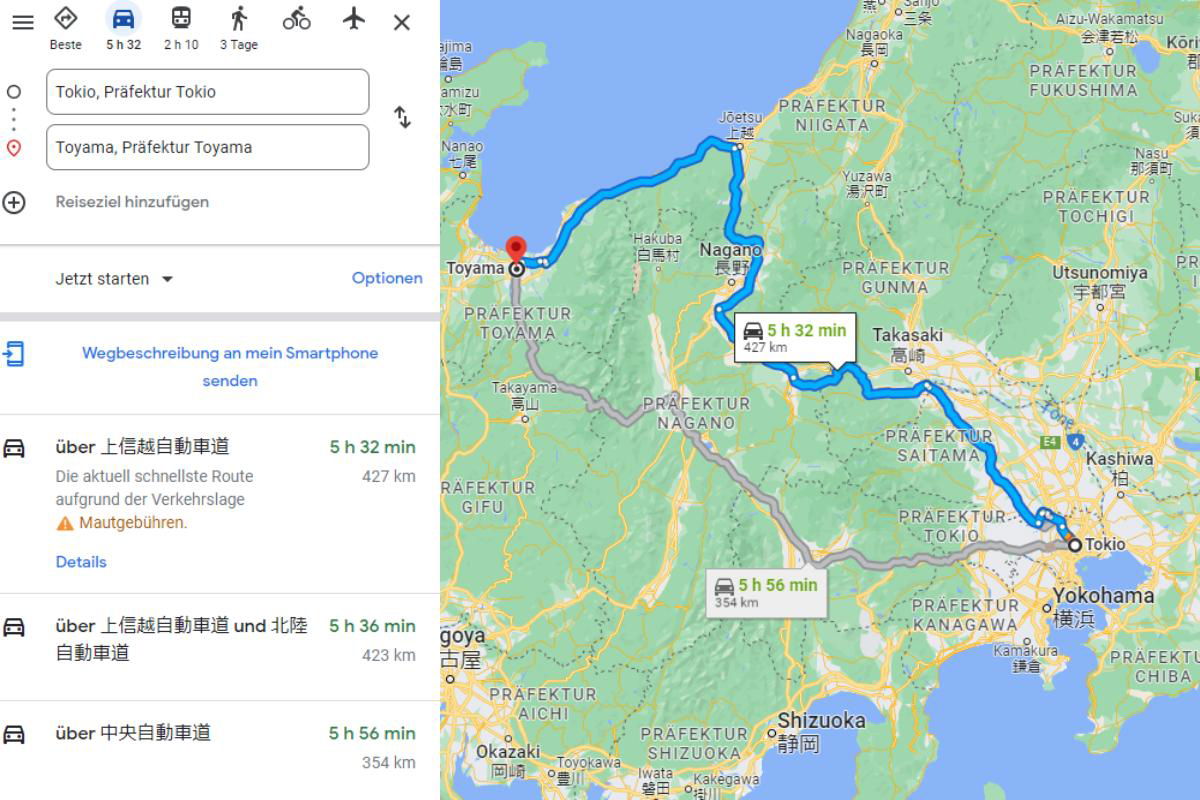
A Google Maps route screenshot in German shows a driving route from Tokio to Toyama. The left panel lists the starting point and destination input fields, plus three route options with travel times and distances: the fastest route via the Jōshin-etsu Expressway takes 5 hours 32 minutes and covers 427 km, with a note about toll charges. Two alternatives come in at 5 h 36 min and 5 h 56 min. The map itself covers central Japan, with the highlighted blue route winding north from Tokio through Gunma and Nagano before reaching Toyama on the coast. A second, shorter route (354 km, 5 h 56 min) is shown in gray along a more southern path. Prefecture labels like Nagano, Gunma, and Niigata are visible, and mode-of-travel icons at the top show the car option selected alongside train, walking, cycling, and flight.
A Google Maps route screenshot in German shows a driving route from Tokio to Toyama. The left panel lists the starting point and destination input fields, plus three route options with travel times and distances: the fastest route via the Jōshin-etsu Expressway takes 5 hours 32 minutes and covers 427 km, with a note about toll charges. Two alternatives come in at 5 h 36 min and 5 h 56 min.
The map itself covers central Japan, with the highlighted blue route winding north from Tokio through Gunma and Nagano before reaching Toyama on the coast. A second, shorter route (354 km, 5 h 56 min) is shown in gray along a more southern path. Prefecture labels like Nagano, Gunma, and Niigata are visible, and mode-of-travel icons at the top show the car option selected alongside train, walking, cycling, and flight.
Texto visible en la imagen
Beste
5 h 32
2 h 10
3 Tage
Tokio, Präfektur Tokio
Toyama, Präfektur Toyama
Reiseziel hinzufügen
Jetzt starten
Optionen
Wegbeschreibung an mein Smartphone senden
über 上信越自動車道
5 h 32 min
427 km
Die aktuell schnellste Route aufgrund der Verkehrslage
Mautgebühren.
Details
über 上信越自動車道 und 北陸自動車道
5 h 36 min
423 km
über 中央自動車道
5 h 56 min
354 km
Aizu-Wakamatsu
会津若松
Kōr
PRAFEKTUR FUKUSHIMA
Nagaoka
長岡
Sanj
PRAFEKTUR NIIGATA
Jōetsu
上越
Nanao
七尾
Yuzawa
湯沢町
Nasu
PRAFEKTUR TOCHIGI
Hakuba
白馬村
Nagano
長野
Toyama
PRAFEKTUR TOYAMA
Utsunomiya
宇都宮
PRAFEKTUR GUNMA
Takasaki
高崎
5 h 32 min
427 km
Takayama
高山
PRAFEKTUR NAGANO
PRAFEKTUR SAITAMA
Kashiwa
柏
PRAFEKTUR TOKIO
Tokio
RAFEKTUR GIFU
5 h 56 min
354 km
goya
古屋
Yokohama
横浜
PRAFEKTUR KANAGAWA
Kamakura
鎌倉
PRAFEKTU
CHIBA
Shizuoka
静岡
PRAFEKTUR AICHI
Okazaki
岡崎
Toyokawa
豊川
PRAFEKTUR SHIZUOKA
Iwata
磐田
Kakegawa
掛川
En tren
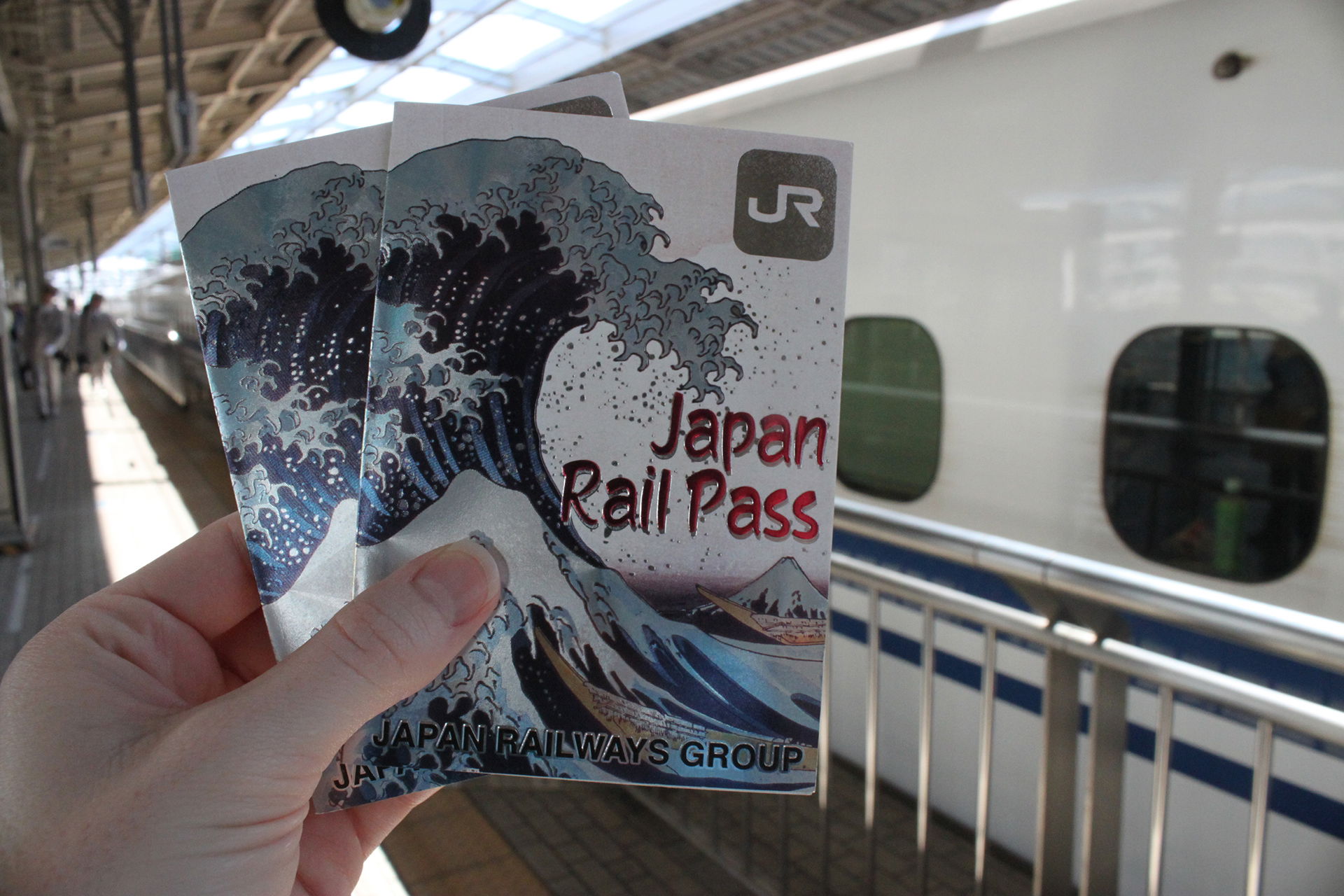
En principio, existe la posibilidad de viajar en tren de alta velocidad, el Shinkansen[/link] , a Toyama. El viaje dura aproximadamente 2 horas y media, lo que es mucho más corto que en coche. Según Google Maps, el coste es de unos 12.750 yenes por viaje. Como alternativa, como turista puedes utilizar el Japan Rail Pass . Sin embargo, el Shinkansen sólo va directamente a la ciudad de Toyama. Si quieres explorar toda la prefectura de Toyama, necesitarás un coche en el lugar, ya que apenas hay transporte público. Un coche no sólo te ofrece más flexibilidad, sino que también te permite explorar completamente la prefectura y disfrutar de los pintorescos paisajes de la región.
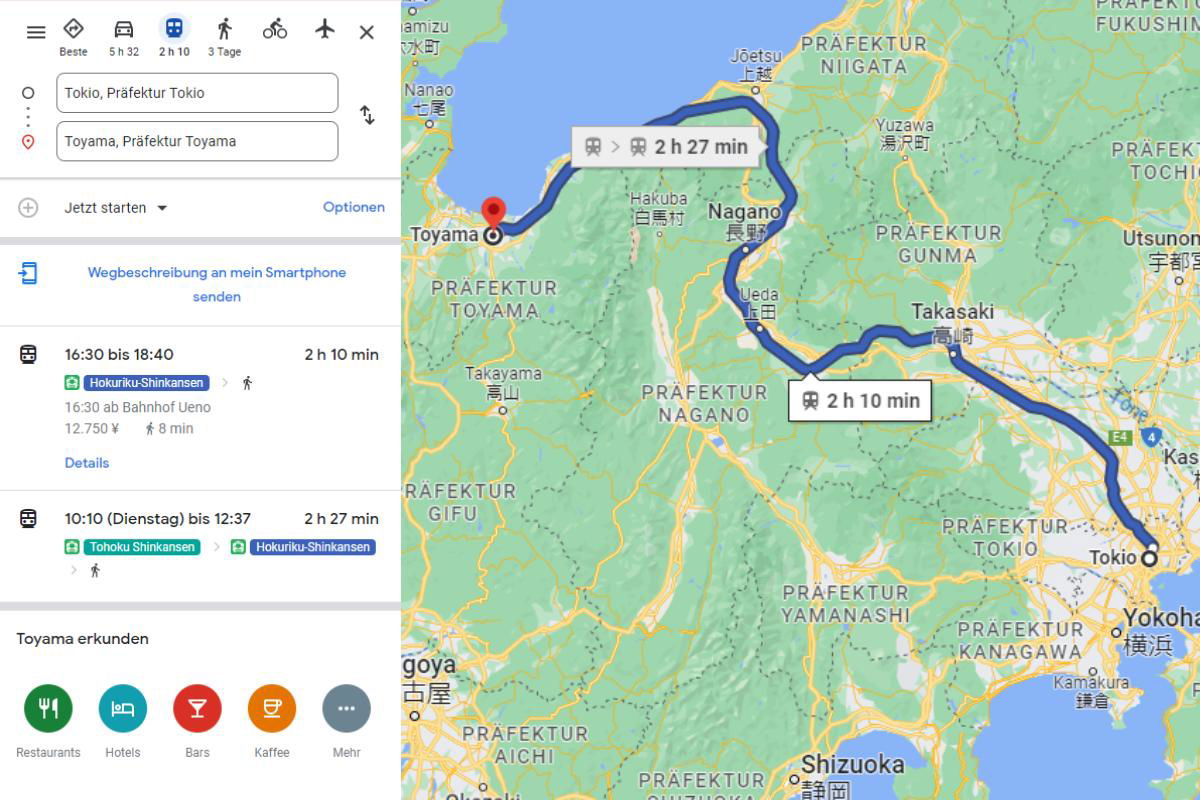
This is a Google Maps screenshot, set to German, showing train directions from Tokio to Toyama. A blue route line traces the path across central Japan, running from Tokyo northwest through Takasaki and Ueda to Nagano, then north past Jōetsu before ending at a red pin in Toyama on the coast. White badges on the map mark travel times of 2 h 27 min and 2 h 10 min, and prefecture labels such as Präfektur Nagano, Präfektur Toyama, and Präfektur Gunma cover the green terrain. The left sidebar lists the two route options. The faster one runs from 16:30 to 18:40, takes 2 h 10 min on the Hokuriku-Shinkansen departing from Bahnhof Ueno, costs 12.750 ¥, and includes an 8-minute walk. The second leaves at 10:10 on Tuesday and arrives at 12:37, taking 2 h 27 min with a transfer from the Tohoku-Shinkansen to the Hokuriku-Shinkansen. Above the routes are mode selectors with driving at 5 h 32 and transit at 2 h 10, the address fields for origin and destination, and a link to send the directions to a smartphone. At the bottom, a "Toyama erkunden" section offers category buttons for Restaurants, Hotels, Bars, Kaffee, and Mehr.
This is a Google Maps screenshot, set to German, showing train directions from Tokio to Toyama. A blue route line traces the path across central Japan, running from Tokyo northwest through Takasaki and Ueda to Nagano, then north past Jōetsu before ending at a red pin in Toyama on the coast. White badges on the map mark travel times of 2 h 27 min and 2 h 10 min, and prefecture labels such as Präfektur Nagano, Präfektur Toyama, and Präfektur Gunma cover the green terrain.
The left sidebar lists the two route options. The faster one runs from 16:30 to 18:40, takes 2 h 10 min on the Hokuriku-Shinkansen departing from Bahnhof Ueno, costs 12.750 ¥, and includes an 8-minute walk. The second leaves at 10:10 on Tuesday and arrives at 12:37, taking 2 h 27 min with a transfer from the Tohoku-Shinkansen to the Hokuriku-Shinkansen. Above the routes are mode selectors with driving at 5 h 32 and transit at 2 h 10, the address fields for origin and destination, and a link to send the directions to a smartphone. At the bottom, a "Toyama erkunden" section offers category buttons for Restaurants, Hotels, Bars, Kaffee, and Mehr.
Texto visible en la imagen
Beste
5 h 32
2 h 10
3 Tage
Tokio, Präfektur Tokio
Toyama, Präfektur Toyama
Jetzt starten
Optionen
Wegbeschreibung an mein Smartphone
senden
16:30 bis 18:40 2 h 10 min
Hokuriku-Shinkansen
16:30 ab Bahnhof Ueno
12.750 ¥ 8 min
Details
10:10 (Dienstag) bis 12:37 2 h 27 min
Tohoku Shinkansen
Hokuriku-Shinkansen
Toyama erkunden
Restaurants
Hotels
Bars
Kaffee
Mehr
PRÄFEKTUR FUKUSHIM
水町
PRÄFEKTUR NIIGATA
Jōetsu
上越
Nanao
七尾
Yuzawa
湯沢町
2 h 27 min
PRÄFEKT
TOCHI
Hakuba
白馬村
Nagano
長野
Toyama
Utsunom
宇都
PRÄFEKTUR TOYAMA
PRÄFEKTUR GUNMA
Ueda
上田
Takasaki
高崎
2 h 10 min
E4
4
Kas
Takayama
高山
PRÄFEKTUR NAGANO
RÄFEKTUR
GIFU
PRÄFEKTUR TOKIO
Tokio
PRÄFEKTUR YAMANASHI
goya
古屋
PRÄFEKTUR AICHI
Oki
PRÄFEKTUR KANAGAWA
Yokoha
横浜
Kamakura
鎌倉
Shizuoka
静岡
PRÄFEKTUR
SHIZUOKA
Nuestro alojamiento: APA Hotel Takaoka Ekimae
Nos alojamos en Takaoka porque la ubicación era práctica y el coste de la estancia era relativamente barato. Aquí nos alojamos en el APA Hotel Takaoka Ekimae * y pagamos unos 7.000 yenes por noche para dos personas (coste a través de Google Maps). Es un hotel de 3 estrellas situado justo en la estación de Takaoka. La cadena hotelera ofrece un estándar constante en todo momento y podemos recomendarla a cualquiera que busque un alojamiento cómodo y económico.
Google Maps: https://goo.gl/maps/pPg5kNtkN3yHaM7M9
Booking.com: Takaoka Eki APA Hotel
*Enlace de afiliado
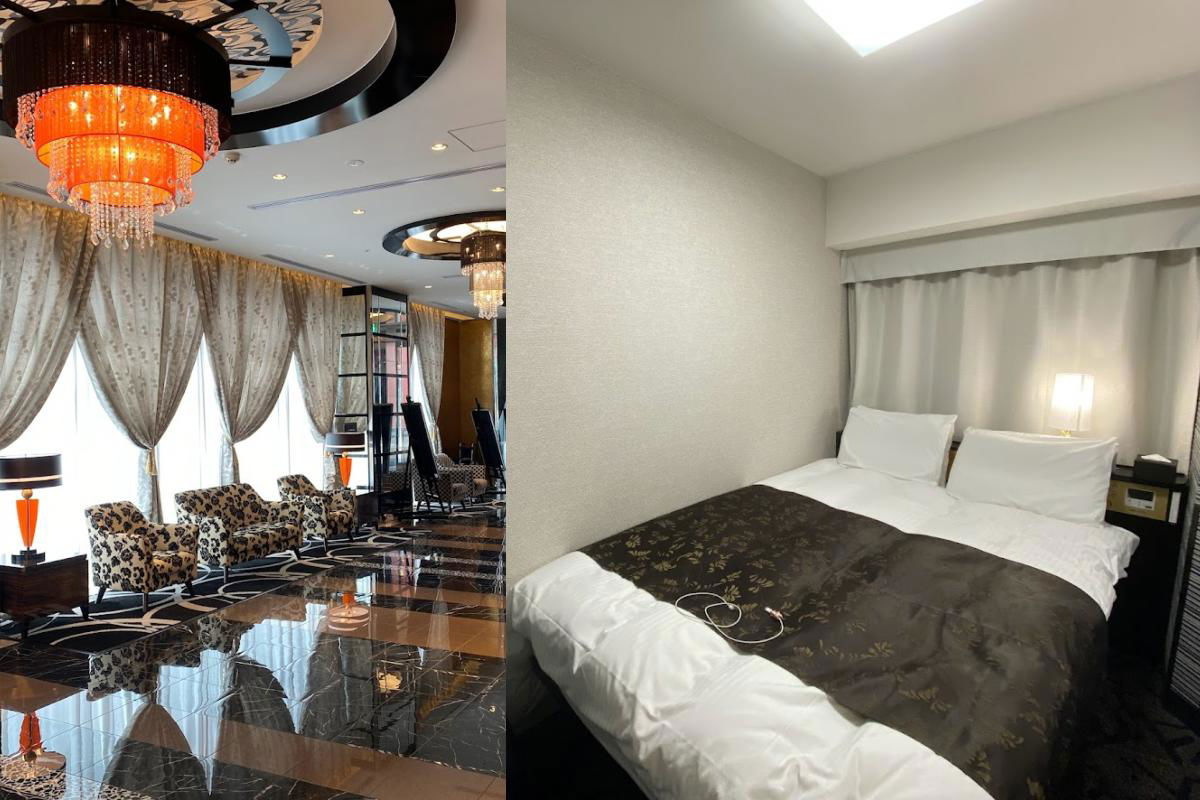
A side-by-side look at a Japanese business hotel. On the left, the lobby goes for glamour: a large chandelier with glowing orange shades and hanging crystals, mirrored circular ceiling panels, floor-to-ceiling patterned curtains, and leopard-print armchairs arranged on a highly polished black and beige marble floor that reflects everything above it. On the right, a guest room is far simpler, with a double bed dressed in white linens and a dark brown throw with a gold leaf pattern, pillows propped against a white curtain that runs behind the headboard, and a small lit lamp on the nightstand beside it. The pairing captures the hotel's split personality: a showy entrance area and a plain, functional room, in this case the APA Hotel Takaoka Ekimae in Toyama.
A side-by-side look at a Japanese business hotel. On the left, the lobby goes for glamour: a large chandelier with glowing orange shades and hanging crystals, mirrored circular ceiling panels, floor-to-ceiling patterned curtains, and leopard-print armchairs arranged on a highly polished black and beige marble floor that reflects everything above it. On the right, a guest room is far simpler, with a double bed dressed in white linens and a dark brown throw with a gold leaf pattern, pillows propped against a white curtain that runs behind the headboard, and a small lit lamp on the nightstand beside it. The pairing captures the hotel's split personality: a showy entrance area and a plain, functional room, in this case the APA Hotel Takaoka Ekimae in Toyama.
Texto visible en la imagen
No text is clearly readable in the image.
El histórico pueblo de Gokayama
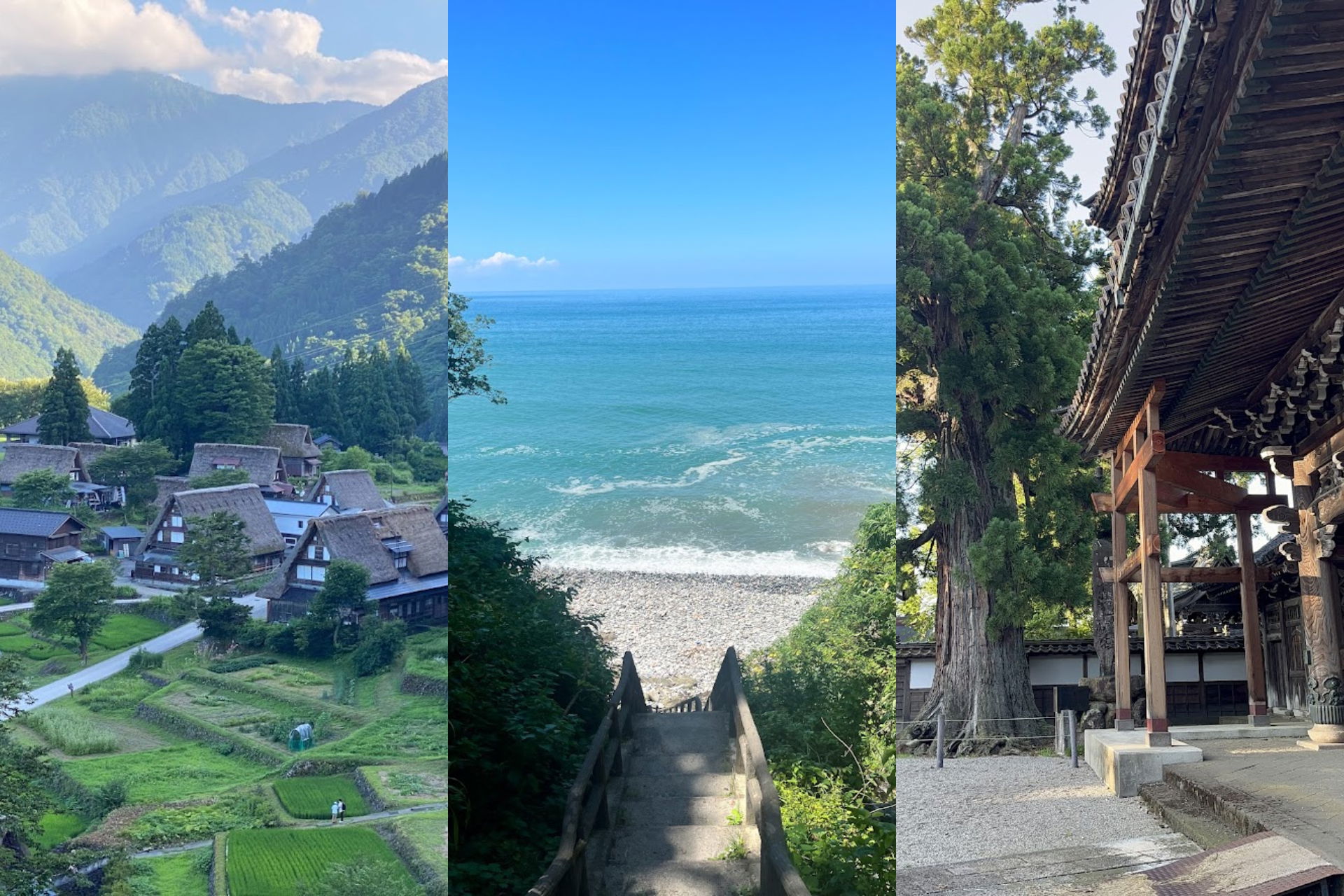
En la prefectura de Toyama se encuentra el pintoresco pueblo de Gokayama, conocido por su importancia histórica. Situado en una remota región montañosa, es rico en casas tradicionales de agricultores construidas con el único estilo arquitectónico Gasshō. Este estilo particular está profundamente arraigado en la cultura local y constituye una de las principales atracciones para los visitantes que viajan a esta región cada año. Gokayama tiene su propio encanto en cada época del año: en primavera y verano se queda cautivado por el vibrante paisaje verde, mientras que en otoño ofrece un panorama de coloridas hojas. Los meses de invierno envuelven el pueblo en un mágico paisaje nevado que ejerce un irresistible encanto. Cabe destacar que no hay que pagar entrada para disfrutar de esta impresionante experiencia.
Al llegar, nos alimentamos con Udon , elaborado con ingredientes locales como tofu, setas y diversos vegetales. Por supuesto, no podía faltar un helado raspado - el Kakigori -. El helado se servía con Mochi y judías rojas.
También aquí te recomiendo llegar en coche. Aunque hay una conexión con el autobús público desde Takaoka, el tiempo de viaje es muy largo.
Google Maps: https://maps.app.goo.gl/dSzJTKPkB6s74V5TA


Johanabetsuin-Zentokuji Temple
En nuestro camino de regreso desde el pueblo de Gokayama, hicimos una parada en el templo Zentokuji de Nanto. Este templo budista tiene más de 500 años de antigüedad e impresiona por su hermosa arquitectura. La artesanía en madera del templo, artísticamente elaborada, es particularmente admirable y sin duda merece una visita.
Horario de apertura diario: 09:00 - 17:00
Google Maps: https://goo.gl/maps/fRSv416vu2PwHzxV6
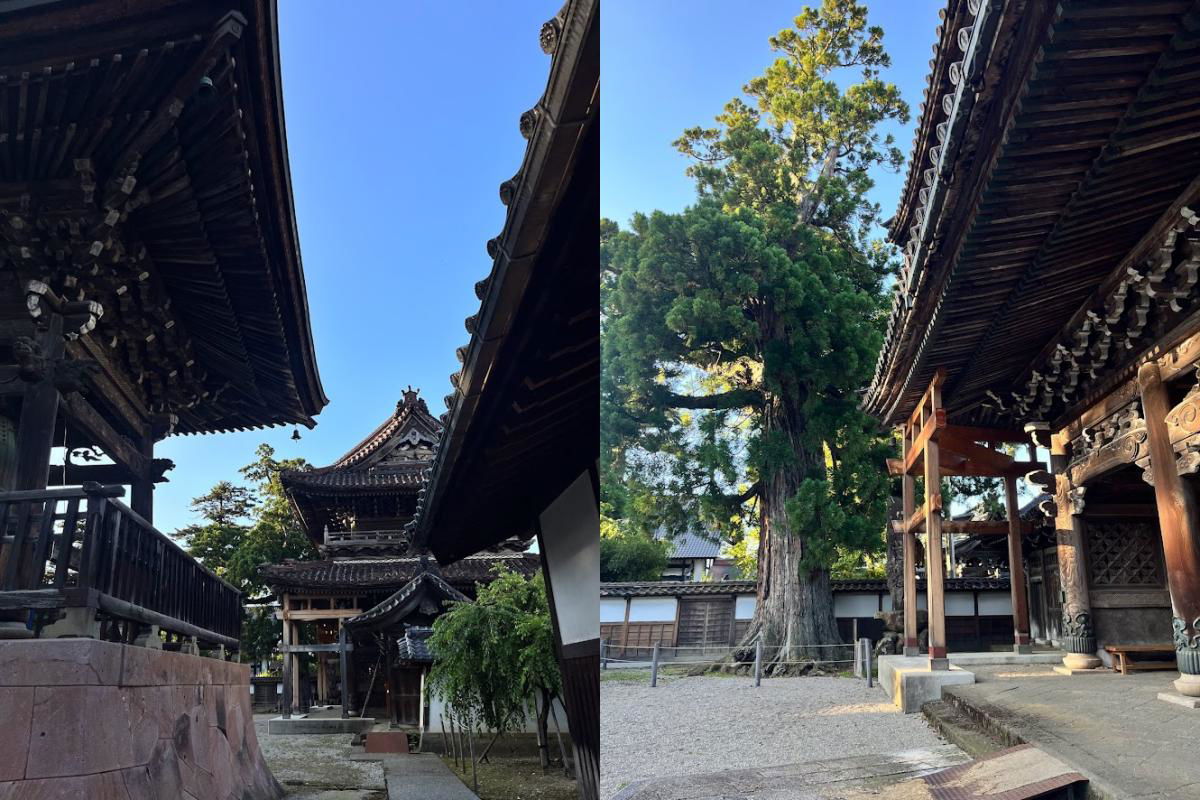
A two-photo side-by-side view of Zentokuji, a Buddhist temple in Toyama, Japan, shot on a clear sunny day. The left photo looks across the temple grounds from the edge of a wooden veranda toward the main hall, a dark timber structure with a layered tiled roof and carved details, framed by the deep eaves of adjacent buildings under a bright blue sky. The right photo shows a different angle along the temple corridor, where a massive old cedar tree towers over the grounds, its trunk thicker than anything around it and roped off near the base. Warm late-afternoon light hits the intricately carved wooden beams and pillars of the covered walkway on the right, contrasting with the deep green of the tree filling the background.
A two-photo side-by-side view of Zentokuji, a Buddhist temple in Toyama, Japan, shot on a clear sunny day. The left photo looks across the temple grounds from the edge of a wooden veranda toward the main hall, a dark timber structure with a layered tiled roof and carved details, framed by the deep eaves of adjacent buildings under a bright blue sky.
The right photo shows a different angle along the temple corridor, where a massive old cedar tree towers over the grounds, its trunk thicker than anything around it and roped off near the base. Warm late-afternoon light hits the intricately carved wooden beams and pillars of the covered walkway on the right, contrasting with the deep green of the tree filling the background.
Texto visible en la imagen
No clearly readable text is present in the image.
Pesca en Toyama
Como la prefectura de Toyama se encuentra justo en el Mar de Japón, es el lugar perfecto para pescar. Hay numerosos lugares que puedes explorar y disfrutar. Si llegas en coche, puedes disfrutar de muchos aparcamientos económicos o incluso gratuitos. En principio, recomendaría llegar en coche, ya que muchos puntos de pesca no son accesibles con el transporte público. En nuestro lugar de pesca incluso había pies de baño gratuitos.
Durante nuestra excursión de pesca, capturamos algunos peces fascinantes, entre ellos una platija japonesa, una platija y un pulpo. La pesca fue una experiencia inolvidable que no olvidaremos jamás. Pero lo mejor estaba por venir: compramos un asador por 2.500 yenes y convertimos el pescado que habíamos capturado en pescado frito. El sabor era increíblemente bueno y nos entusiasmó aún más con Toyama.
Para completar nuestra cena, compramos un bento-box en el konbini.
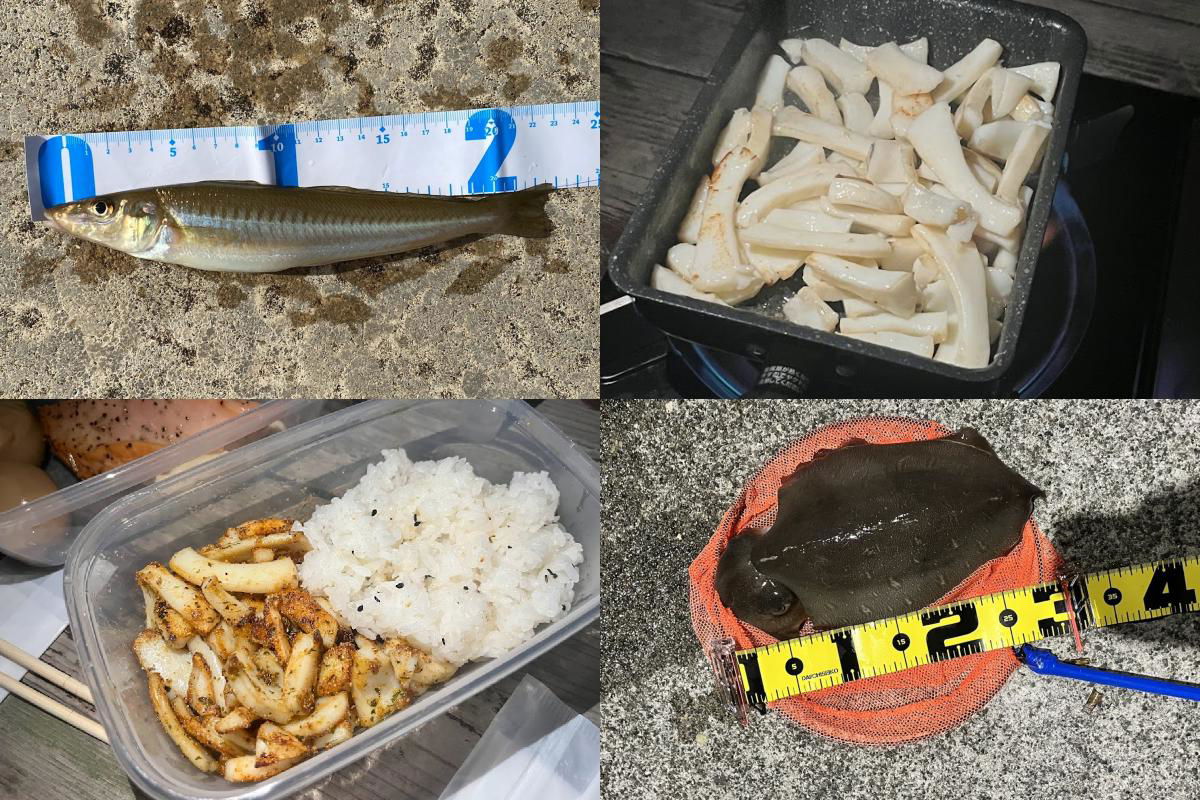
A four-photo collage from a fishing trip in Toyama, Japan. In the top left, a slender silver-green fish about 22 cm long lies on wet sand beside a white and blue measuring tape. The top right shows strips of white fish meat grilling in a black square pan on a portable gas stove. The bottom left panel shows the finished meal packed in a clear plastic container: seasoned, golden-grilled fish pieces next to a mound of white rice sprinkled with furikake. In the bottom right, a dark flatfish rests in an orange landing net on wet gravel, stretched out with a yellow measuring tape that reads roughly 36 cm.
A four-photo collage from a fishing trip in Toyama, Japan. In the top left, a slender silver-green fish about 22 cm long lies on wet sand beside a white and blue measuring tape. The top right shows strips of white fish meat grilling in a black square pan on a portable gas stove.
The bottom left panel shows the finished meal packed in a clear plastic container: seasoned, golden-grilled fish pieces next to a mound of white rice sprinkled with furikake. In the bottom right, a dark flatfish rests in an orange landing net on wet gravel, stretched out with a yellow measuring tape that reads roughly 36 cm.
Texto visible en la imagen
1 5 10 15 17 20 22 2
1 5 2 3 4 25 30 35 5 15
Acantilados de Oyashirazu
La costa del Mar de Japón ofrece un impresionante paisaje rodeado de acantilados rocosos. Estos acantilados están cubiertos de exuberante vegetación verde y una escalera conduce a una singular playa de guijarros. Lo especial de esta playa son las numerosas piedras redondas que el agua ha ido puliendo a lo largo de los años. Cuando las piedras son movidas por las olas, producen un sonido único y "crujiente".
La combinación del sonido de las olas y el sonido de las piedras crea una atmósfera relajante y relajante, incomparable. Este lugar de Toyama fue uno de los que más me gustó.
Google Maps: https://goo.gl/maps/TMf1fsvv8ukeUWQt9
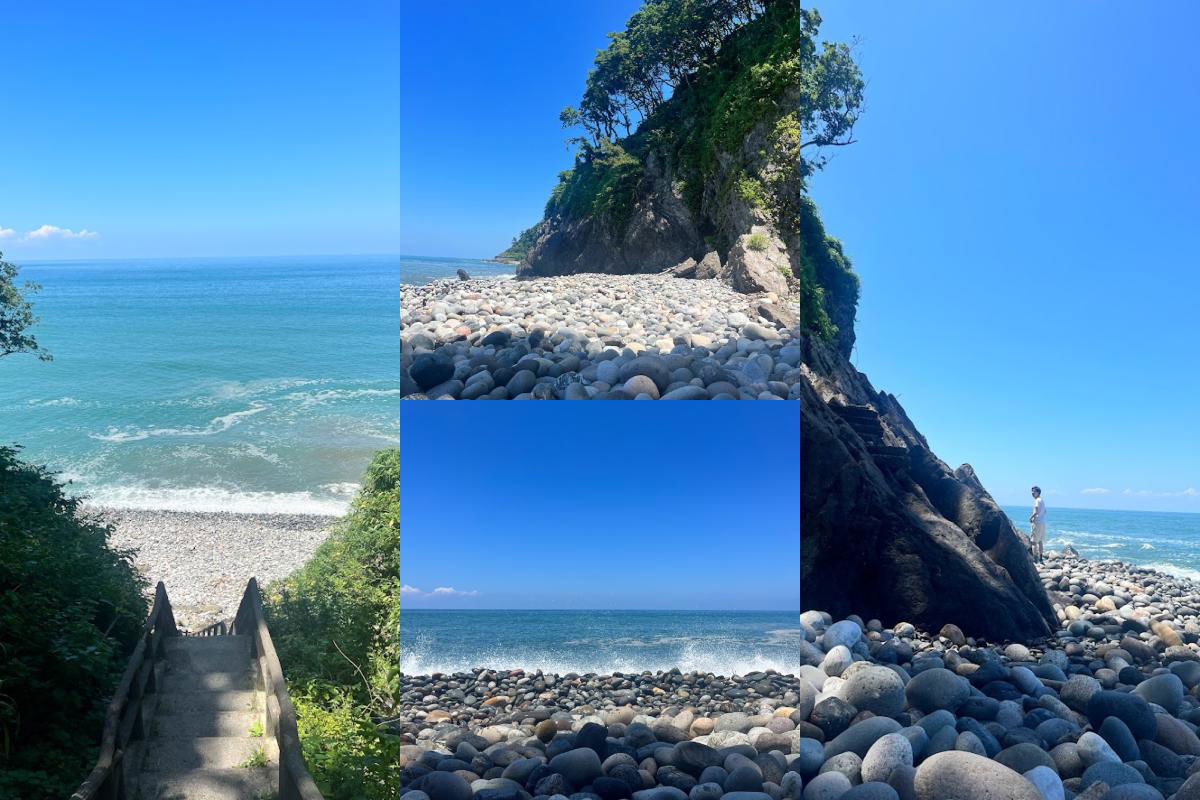
A four-photo collage of the Oyashirazu coast in Toyama Prefecture, where steep cliffs drop straight to a pebble beach on the Sea of Japan. On the left, a narrow concrete staircase with a simple handrail descends between thick green shrubs toward the shore, opening onto pale pebbles and turquoise water with small waves breaking under a clear blue sky. The top middle photo looks along the beach to a rocky cliff crowned with dense trees. Below it, waves wash up onto a shore of smooth, rounded stones in shades of grey, white, and rust. The right photo shows the cliff at close range: a dark, rugged rock face with steps carved into it, and a person in a white shirt and light shorts standing on the pebbles beneath it, facing the sea.
A four-photo collage of the Oyashirazu coast in Toyama Prefecture, where steep cliffs drop straight to a pebble beach on the Sea of Japan.
On the left, a narrow concrete staircase with a simple handrail descends between thick green shrubs toward the shore, opening onto pale pebbles and turquoise water with small waves breaking under a clear blue sky. The top middle photo looks along the beach to a rocky cliff crowned with dense trees. Below it, waves wash up onto a shore of smooth, rounded stones in shades of grey, white, and rust. The right photo shows the cliff at close range: a dark, rugged rock face with steps carved into it, and a person in a white shirt and light shorts standing on the pebbles beneath it, facing the sea.
Texto visible en la imagen
No clearly readable text is present in the image.
Una especialidad de Toyama: Masuzushi
Nos adaptamos al paisaje y comimos sushi fresco. Es conocido que el pescado del Mar de Japón tiene un sabor más fresco que en otros lugares, lo que podemos confirmar. Probamos sushi con huevas de pescado y dos tipos de salmón del supermercado local, pero también una verdadera especialidad de la prefectura de Toyama.
Se trata del Masuzushi, un sushi prensado de trucha y arroz, marinado en sal, envuelto en hojas de bambú y empaquetado en un recipiente de madera llamado Wagemono. Con un pequeño cuchillo de bambú que se incluye, el sushi redondo se corta en trozos en forma de abanico.
El sabor de la trucha es más bien ácido debido al marinado, lo que da a esta especialidad una nota especial. El embalaje de madera del Masuzushi no sólo es bonito de ver, sino también práctico para transportarlo y disfrutarlo en cualquier lugar.
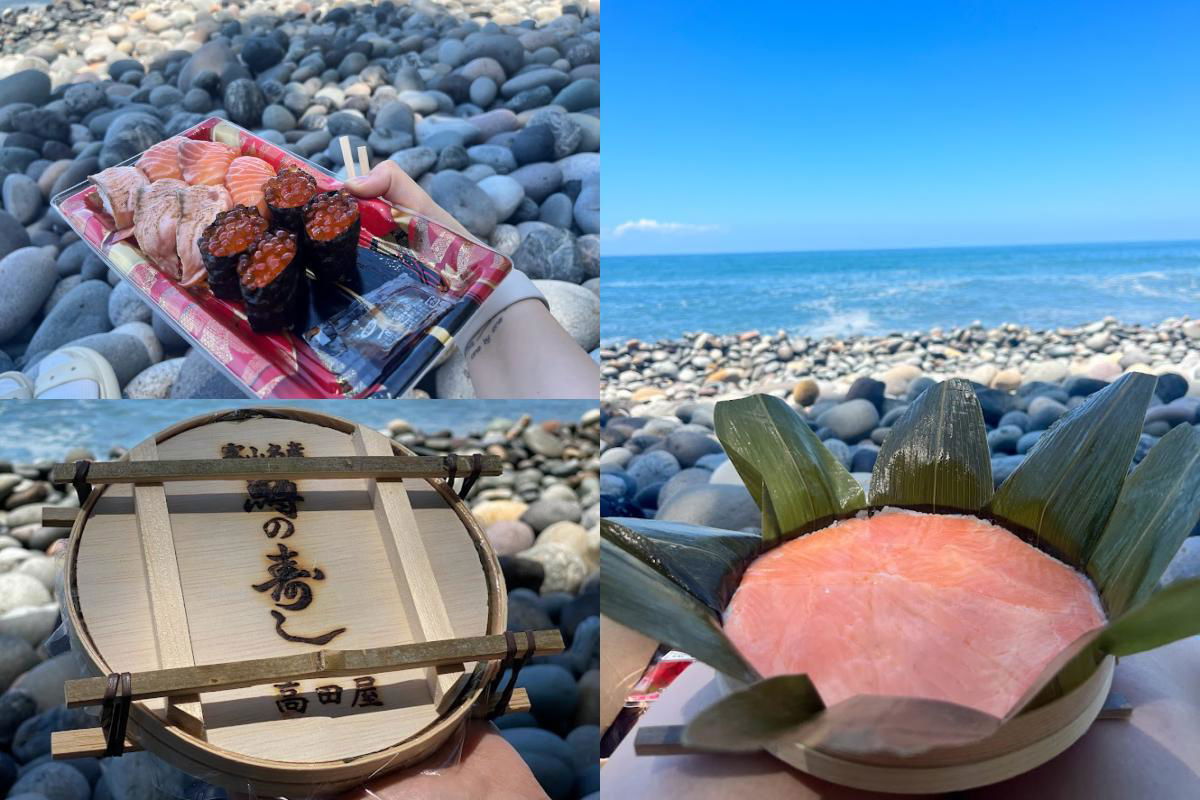
A four-photo collage of a sushi picnic on a pebble beach in Toyama. In the top left, a hand holds up a plastic takeout tray of nigiri: salmon slices, seared salmon, and ikura gunkan rolls filled with orange salmon roe. Smooth grey and white stones fill the whole background. The top right photo shows the setting itself, a deep blue sky over a choppy sea washing onto the rocky shore. The bottom two photos feature Masu no Sushi from Takadaya, a round cedar box of pressed trout sushi that is a Toyama specialty. One shot shows the wooden lid, its burned-in Japanese calligraphy naming the dish and the shop. In the other, the box is open and held above the pebbles, revealing a disc of pale pink fish pressed over rice and framed by folded bamboo leaves.
A four-photo collage of a sushi picnic on a pebble beach in Toyama. In the top left, a hand holds up a plastic takeout tray of nigiri: salmon slices, seared salmon, and ikura gunkan rolls filled with orange salmon roe. Smooth grey and white stones fill the whole background. The top right photo shows the setting itself, a deep blue sky over a choppy sea washing onto the rocky shore.
The bottom two photos feature Masu no Sushi from Takadaya, a round cedar box of pressed trout sushi that is a Toyama specialty. One shot shows the wooden lid, its burned-in Japanese calligraphy naming the dish and the shop. In the other, the box is open and held above the pebbles, revealing a disc of pale pink fish pressed over rice and framed by folded bamboo leaves.
Texto visible en la imagen
鮭の壽し
高田屋
Conclusión del viaje a Toyama
Toyama es una preciosa prefectura japonesa que convencerá especialmente a los amantes de la naturaleza y a los aficionados a la pesca. Sin embargo, recomiendo encarecidamente viajar en coche, ya que Toyama no tiene una buena red de transporte público. El singular paisaje, el histórico pueblo de Gokayama y el paisaje costero alrededor de los acantilados de Oyashirazu son lugares que sin duda merecen una visita. También es un destino de pesca popular con muchas posibilidades culinarias. Tanto en época cálida como fría, Toyama siempre muestra su mejor cara y convence para visitar la prefectura varias veces y conocerla de las formas más diversas.


Comentarios