Tabla de contenidos:
TL;DR
El viaje de Tokyo a Kyoto es una experiencia memorable, destacando la comodidad de conducir por las bien mantenidas autopistas japonesas, con paradas agradables en lugares como Hamamatsu y su hermoso Hamana See. A lo largo del trayecto, la madre y el autor disfrutan de una variada y relajante naturaleza. Se menciona la preferencia por viajar en automóvil a pesar de las alternativas más sostenibles como el tren, debido a los costos. Al optar por el Shinkansen, se puede llegar a Kyoto en menos de tres horas, disfrutando de un viaje cómodo y moderno. Al llegar, las recomendaciones para explorar la ciudad incluyen el tranquilo bosque de bambú en Arashiyama y el vibrante Nishiki Market, donde se pueden degustar delicias locales y adquirir souvenirs. Esta guía invita a los viajeros a descubrir la belleza y cultura de Kyoto, asegurando una experiencia inolvidable.Nuestro viaje por carretera de Tokio a Kioto
Hoy salimos en coche de Tokio rumbo a Kioto. Aunque el trayecto total fue de nueve horas, resultó agradable porque mi madre y yo nos turnamos para conducir.
Las autopistas en Japón están muy bien desarrolladas y señalizadas. Además, hay muchas áreas de descanso a lo largo de la ruta donde pudimos refrescarnos.
Durante el viaje, pudimos disfrutar del hermoso paisaje. A lo largo de la autopista siempre había valles verdes, lagos y montañas que íbamos atravesando. Esto hizo que el trayecto fuera muy relajante y variado.
Sin embargo, debo decir que es un poco triste que conducir un coche siga siendo más barato que tomar el tren, especialmente en el contexto del cambio climático. En comparación con el coche, el tren es casi el doble o incluso triple de caro, lo que significa que mucha gente sigue prefiriendo conducir, aunque exista una alternativa más ecológica.
Por otro lado, también debo decir que aprecio la comodidad del coche. Pudimos descansar cuando quisimos, parar cuando necesitábamos una pausa y siempre teníamos nuestras cosas a mano. Eso no siempre es así cuando se viaja en tren.
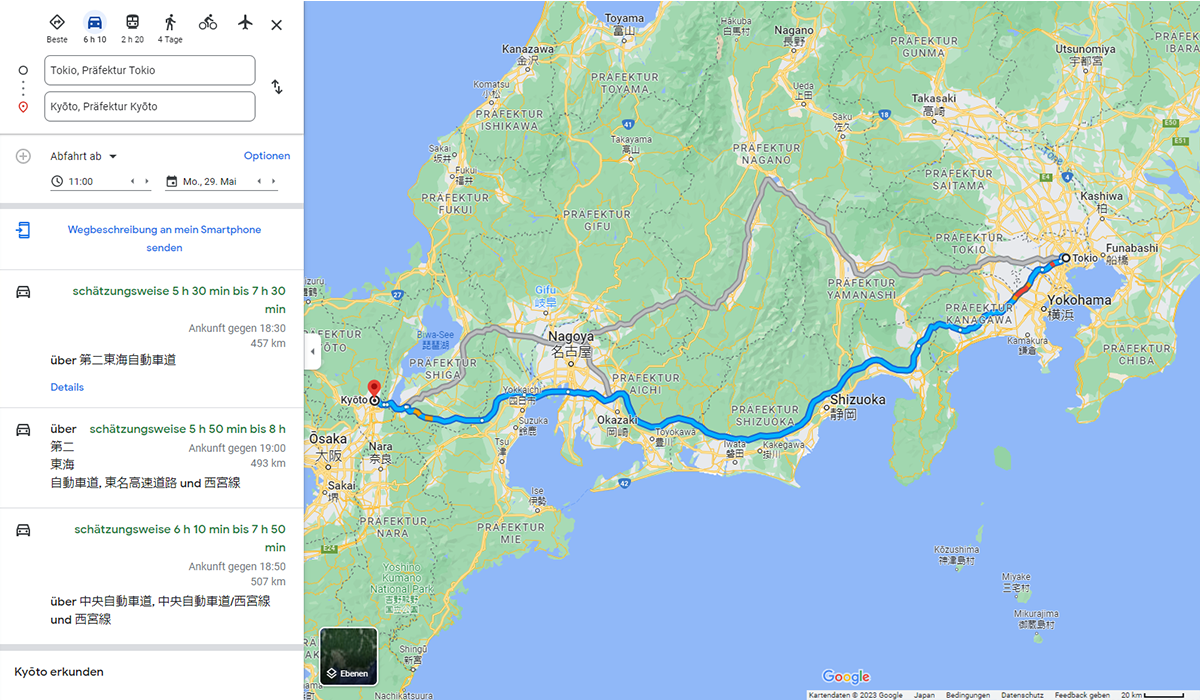
A Google Maps route planning screenshot in German shows the drive from Tokio to Kyōto. The left panel lists three route options with travel times: about 5 h 30 min to 7 h 30 min (457 km), 5 h 50 min to 8 h (493 km), and 6 h 10 min to 7 h 50 min (507 km), all departing Monday, May 29 at 11:00. The driving mode is selected, and each option names the expressways used, such as 第二東海自動車道 and 東名高速道路. The map on the right covers central Japan, with the recommended route drawn as a thick blue line running from Tokio past Yokohama, along the Pacific coast through Shizuoka, then west via Nagoya to a red destination pin at Kyōto, with Osaka and Nara nearby. A gray alternative route swings inland north of the mountains through the Nagano region. City labels like Toyama, Kanazawa, Takasaki and Utsunomiya mark the surrounding prefectures.
A Google Maps route planning screenshot in German shows the drive from Tokio to Kyōto. The left panel lists three route options with travel times: about 5 h 30 min to 7 h 30 min (457 km), 5 h 50 min to 8 h (493 km), and 6 h 10 min to 7 h 50 min (507 km), all departing Monday, May 29 at 11:00. The driving mode is selected, and each option names the expressways used, such as 第二東海自動車道 and 東名高速道路.
The map on the right covers central Japan, with the recommended route drawn as a thick blue line running from Tokio past Yokohama, along the Pacific coast through Shizuoka, then west via Nagoya to a red destination pin at Kyōto, with Osaka and Nara nearby. A gray alternative route swings inland north of the mountains through the Nagano region. City labels like Toyama, Kanazawa, Takasaki and Utsunomiya mark the surrounding prefectures.
Texto visible en la imagen
Beste
6 h 10
2 h 20
4 Tage
Tokio, Präfektur Tokio
Kyōto, Präfektur Kyōto
Abfahrt ab
Optionen
11:00
Mo., 29. Mai
Wegbeschreibung an mein Smartphone senden
schätzungsweise 5 h 30 min bis 7 h 30 min
Ankunft gegen 18:30
457 km
über 第二東海自動車道
Details
über 東海
schätzungsweise 5 h 50 min bis 8 h
Ankunft gegen 19:00
493 km
自動車道, 東名高速道路 und 西宮線
schätzungsweise 6 h 10 min bis 7 h 50 min
Ankunft gegen 18:50
507 km
über 中央自動車道, 中央自動車道/西宮線 und 西宮線
Kyōto erkunden
Toyama
Kanazawa
Nagano
Takasaki
Utsunomiya
Kashiwa
Tokio
Funabashi
Yokohama
Nagoya
Kyōto
Shizuoka
Ōsaka
Nara
Sakai
Biwa-See
PRAFEKTUR TOYAMA
PRAFEKTUR ISHIKAWA
PRAFEKTUR FUKUI
PRAFEKTUR GIFU
PRAFEKTUR NAGANO
PRAFEKTUR SAITAMA
PRAFEKTUR YAMANASHI
PRAFEKTUR TOKIO
PRAFEKTUR SHIGA
PRAFEKTUR AICHI
PRAFEKTUR CHIBA
PRAFEKTUR NARA
PRAFEKTUR MIE
Kōzushima
Miyake
Mikurajima
Hachijō-jima
Google
Kartendaten © 2023 Google Japan Bedingungen Datenschutz Feedback geben 20 km
Ebisen
Parada en Hamamatsu: relajándonos en el lago Hamana
Si vas de Tokio a Kioto, merece la pena hacer una parada en Hamamatsu. Nosotros especialmente fuimos a ver el precioso lago Hamana, un lugar de paz y relajación.
Lo que resulta especialmente curioso del lago es que tiene una parte de agua dulce y otra de agua salada. Por esta razón, aquí también se crían anguilas, lo que lo hace muy popular para los amantes del pescado.
Después de caminar por la orilla del lago, fuimos al restaurante cercano Shibuki. El restaurante incluso ofrece menús en inglés, lo que facilitó pedir la comida. Mi madre y mi hermano probaron la famosa anguila a la parrilla y yo elegí el plato con Shirasu (sardinillas o crías de sardina).
Así que, si buscas un lugar para relajarte y desconectar, recomiendo totalmente hacer una parada en Hamamatsu y en el lago Hamana. Aquí no solo puedes disfrutar la naturaleza, sino también descubrir la gastronomía y cultura locales.
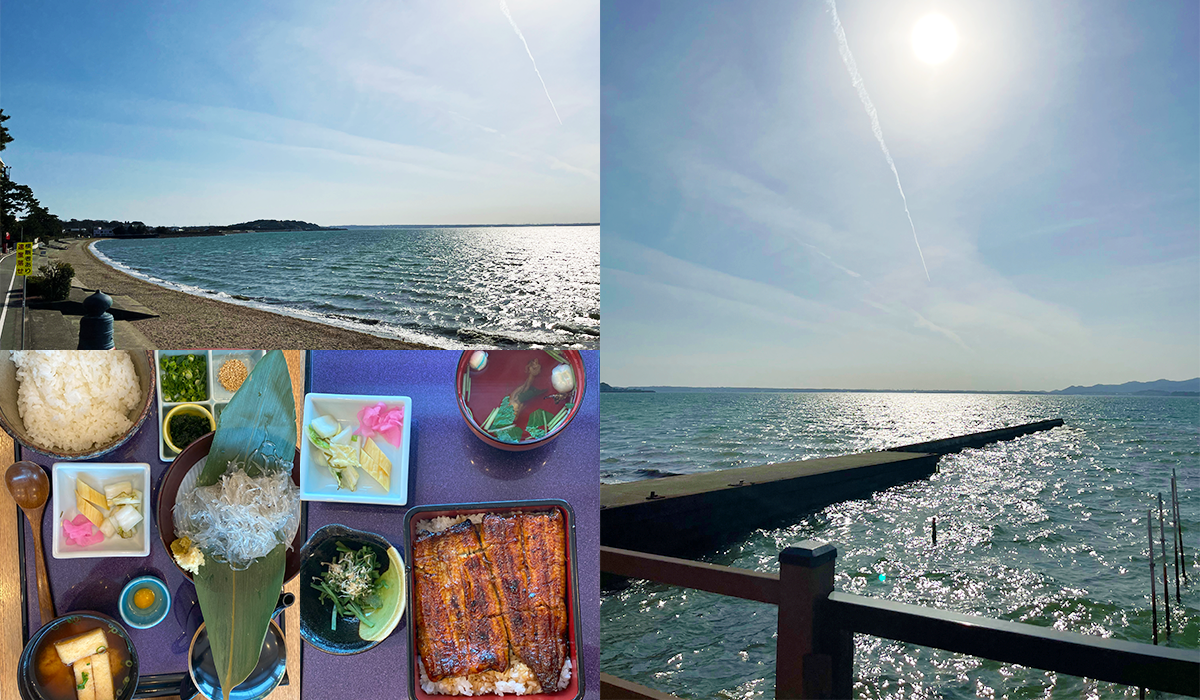
A three-photo collage from a stop in Hamamatsu on the drive from Tokyo to Kyoto. The top left photo shows a sandy beach curving along calm, sun-glittered water, with a quiet road and pine trees at the shore's edge. The large photo on the right looks out from a wooden terrace over a wide, sparkling bay, where a long concrete breakwater juts into the water under a bright sun and a single contrail. The bottom left photo looks straight down at a Japanese meal spread across a table. The centerpiece is unagi: broiled eel glazed a deep caramel brown, served over rice in a red and black lacquered box. Around it are a bowl of white rice, miso soup with tofu, cold soba noodles on a big green leaf, a raw egg yolk in a small cup, and little dishes of pickles and greens.
A three-photo collage from a stop in Hamamatsu on the drive from Tokyo to Kyoto. The top left photo shows a sandy beach curving along calm, sun-glittered water, with a quiet road and pine trees at the shore's edge. The large photo on the right looks out from a wooden terrace over a wide, sparkling bay, where a long concrete breakwater juts into the water under a bright sun and a single contrail.
The bottom left photo looks straight down at a Japanese meal spread across a table. The centerpiece is unagi: broiled eel glazed a deep caramel brown, served over rice in a red and black lacquered box. Around it are a bowl of white rice, miso soup with tofu, cold soba noodles on a big green leaf, a raw egg yolk in a small cup, and little dishes of pickles and greens.
Texto visible en la imagen
No clearly readable text.
Ir a Kioto en Shinkansen
Si tienes pensado ir a Kioto, definitivamente deberías tomar el Shinkansen, el tren bala japonés. Con velocidades de hasta 320 km/h, llegas de Tokio a Kioto en menos de tres horas. Una vez a bordo, notarás enseguida lo espaciosos y cómodos que son los asientos. Con Wi-Fi y tomas de corriente en cada asiento, puedes seguir trabajando o simplemente relajarte durante el trayecto.
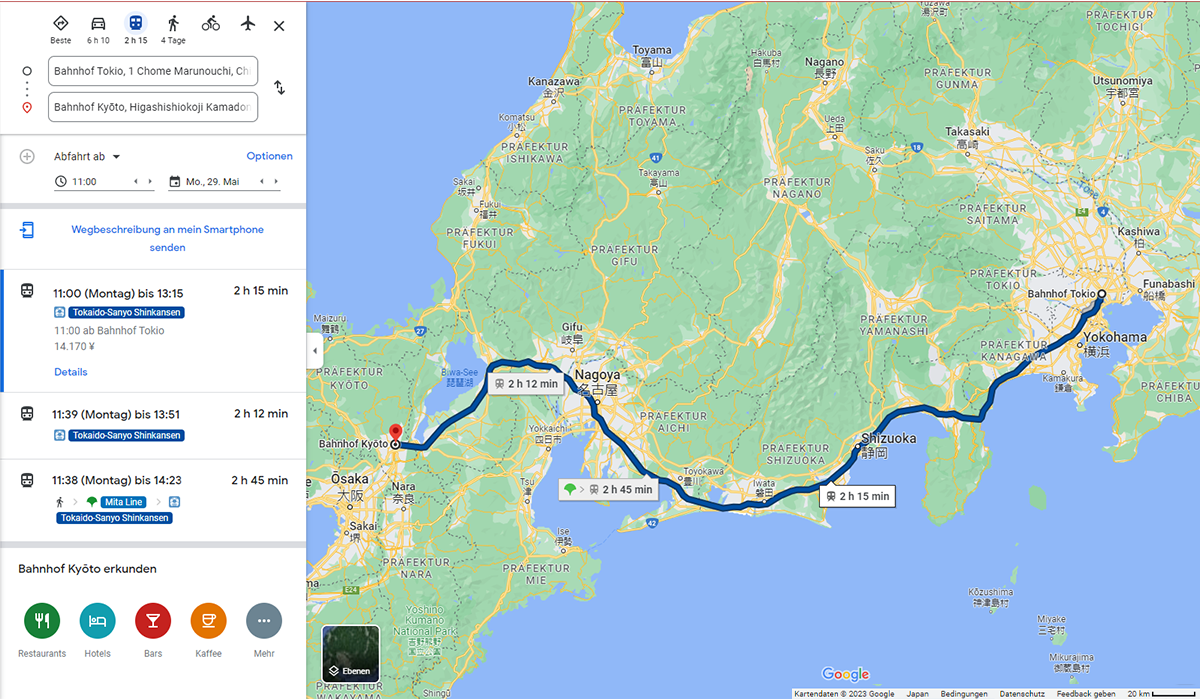
A Google Maps route planning screenshot showing the Shinkansen connection from Tokyo to Kyoto. The map fills most of the frame, covering central Japan from Tokyo Bay to the Osaka area, with prefecture labels such as Präfektur Shizuoka, Präfektur Aichi, and Präfektur Kyōto. A thick dark blue line traces the rail route along the Pacific coast, passing Yokohama, Shizuoka, and Nagoya before ending at a red pin at Kyoto Station. Small white badges along the route mark travel times of 2h 15 min, 2h 12 min, and 2h 45 min for different segments. The sidebar on the left is in German. At the top, mode icons compare options: car at 6h 10, train at 2h 15, walking at 4 days, plus cycling and flights. The start and destination fields read "Bahnhof Tokio, 1 Chome Marunouchi" and "Bahnhof Kyōto, Higashishiojokamado", with departure set to 11:00 on Monday, May 29. Below, three itinerary cards list Tokaido-Sanyo Shinkansen departures, the first running 11:00 to 13:15 for 2h 15 min at a fare of 14,170 ¥. At the bottom, a "Bahnhof Kyōto erkunden" section offers icons for restaurants, hotels, bars, and coffee near the destination.
A Google Maps route planning screenshot showing the Shinkansen connection from Tokyo to Kyoto. The map fills most of the frame, covering central Japan from Tokyo Bay to the Osaka area, with prefecture labels such as Präfektur Shizuoka, Präfektur Aichi, and Präfektur Kyōto. A thick dark blue line traces the rail route along the Pacific coast, passing Yokohama, Shizuoka, and Nagoya before ending at a red pin at Kyoto Station. Small white badges along the route mark travel times of 2h 15 min, 2h 12 min, and 2h 45 min for different segments.
The sidebar on the left is in German. At the top, mode icons compare options: car at 6h 10, train at 2h 15, walking at 4 days, plus cycling and flights. The start and destination fields read "Bahnhof Tokio, 1 Chome Marunouchi" and "Bahnhof Kyōto, Higashishiojokamado", with departure set to 11:00 on Monday, May 29. Below, three itinerary cards list Tokaido-Sanyo Shinkansen departures, the first running 11:00 to 13:15 for 2h 15 min at a fare of 14,170 ¥. At the bottom, a "Bahnhof Kyōto erkunden" section offers icons for restaurants, hotels, bars, and coffee near the destination.
Texto visible en la imagen
Beste
6 h 10
2 h 15
4 Tage
Bahnhof Tokio, 1 Chome Marunouchi, Ch
Bahnhof Kyōto, Higashiokioki Kamado
Abfahrt ab
Optionen
11:00
Mo., 29. Mai
Wegbeschreibung an mein Smartphone
senden
11:00 (Montag) bis 13:15
2 h 15 min
Tokaido-Sanyo Shinkansen
11:00 ab Bahnhof Tokio
14.170 ¥
Details
11:39 (Montag) bis 13:51
2 h 12 min
Tokaido-Sanyo Shinkansen
11:38 (Montag) bis 14:23
2 h 45 min
Mifa Line
Tokaido-Sanyo Shinkansen
Bahnhof Kyōto erkunden
Restaurants
Hotels
Bars
Kaffee
Mehr
Toyama
Hakuba
Nagano
Kanazawa
Komatsu
PRAFEKTUR TOYAMA
Utsunomiya
PRAFEKTUR TOCHIGI
PRAFEKTUR GUNMA
PRAFEKTUR ISHIKAWA
Takasaki
PRAFEKTUR FUKUI
Takayama
PRAFEKTUR NAGANO
PRAFEKTUR SAITAMA
Kashiwa
PRAFEKTUR GIFU
PRAFEKTUR YAMANASHI
Bahnhof Tokio
Funabashi
Gifu
Yokohama
PRAFEKTUR KANAGAWA
PRAFEKTUR KYOTO
Biwa-See
2 h 12 min
Nagoya
PRAFEKTUR AICHI
Bahnhof Kyōto
Yokkaichi
Shizuoka
PRAFEKTUR SHIZUOKA
Ōsaka
Nara
2 h 45 min
Toyokawa
2 h 15 min
Iwata
Sakai
PRAFEKTUR NARA
PRAFEKTUR MIE
Yoshino
Kumano Natio
nal Park
Kōzushima
Miyake
Mikurajima
Ebenen
Google
Kartendaten ©2023 Google Japan Bedingungen Datenschutz Feedback geben 20 km
Los mejores lugares para visitar en Kioto
¿Por fin llegaste a Kioto y te preguntas qué lugares tienes que visitar sí o sí? Aquí tienes nuestras 5 recomendaciones principales:
Arashiyama: el bosque de bambú
Si buscas naturaleza y tranquilidad, Arashiyama es el lugar ideal para ti. Aquí encontrarás un bosque de bambú por donde puedes pasear.
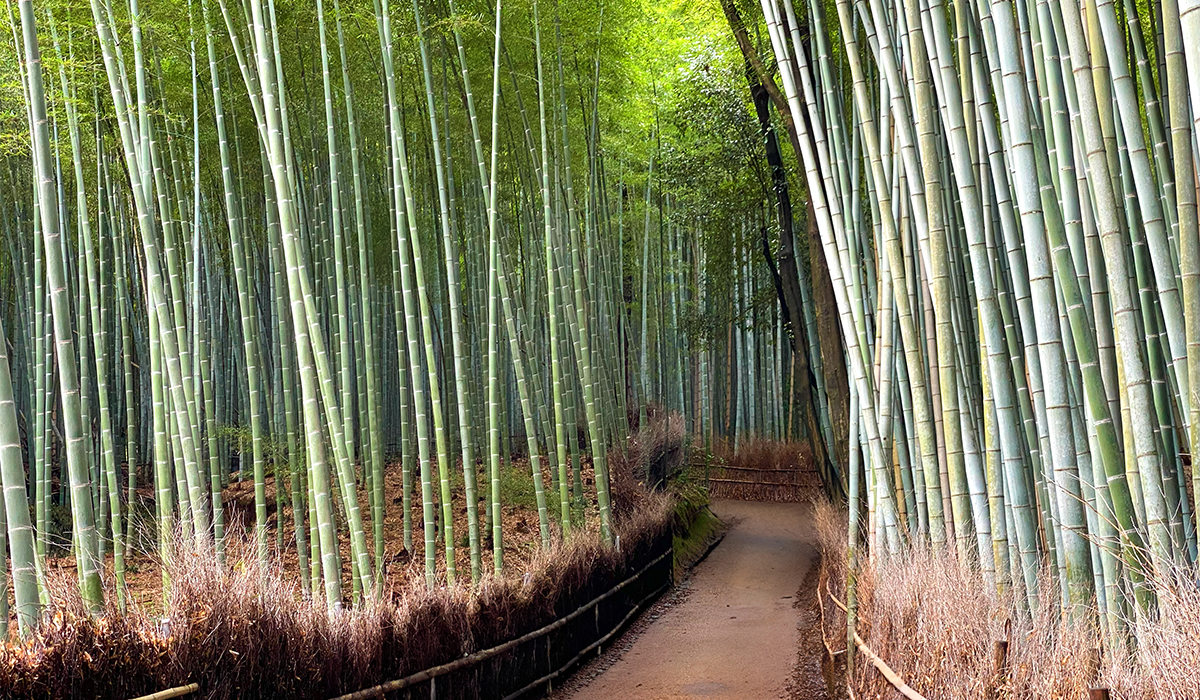
A narrow dirt path curves through the dense bamboo grove of Arashiyama in Kyoto. Tall, pale green bamboo stalks rise on both sides, leaning slightly inward and closing over the walkway so their leaves filter the light into a soft green glow. The path itself is empty and fades into the thicket a short distance ahead, while low fences woven from dried brush and bamboo line its edges.
A narrow dirt path curves through the dense bamboo grove of Arashiyama in Kyoto. Tall, pale green bamboo stalks rise on both sides, leaning slightly inward and closing over the walkway so their leaves filter the light into a soft green glow. The path itself is empty and fades into the thicket a short distance ahead, while low fences woven from dried brush and bamboo line its edges.
Texto visible en la imagen
There is no clearly readable text in this image.
Tour a pie por Arashiyama – Bambú, templos y monos
Descubre el barrio de Arashiyama en Kioto en una visita guiada: pasea por el famoso bosque de bambú, visita el templo Tenryu-ji y sube hasta el parque de los monos con vistas a la ciudad. Ideal para amantes de la naturaleza y la cultura. (Agoda)
*Enlace de afiliado: Si reservas una actividad a través de mi widget o del enlace en viator.com, recibo una pequeña comisión. No tiene ningún coste adicional para ti y apoyas mi blog. Te lo agradezco mucho y te deseo un viaje genial (^_^)
Mercado Nishiki: el famoso mercado de comida y souvenirs
Si buscas una experiencia auténtica, visita el Mercado Nishiki. Aquí encontrarás especialidades locales y recuerdos para llevarte a casa.
Esperamos que nuestras 5 recomendaciones principales te ayuden a hacer tu viaje a Kioto inolvidable.
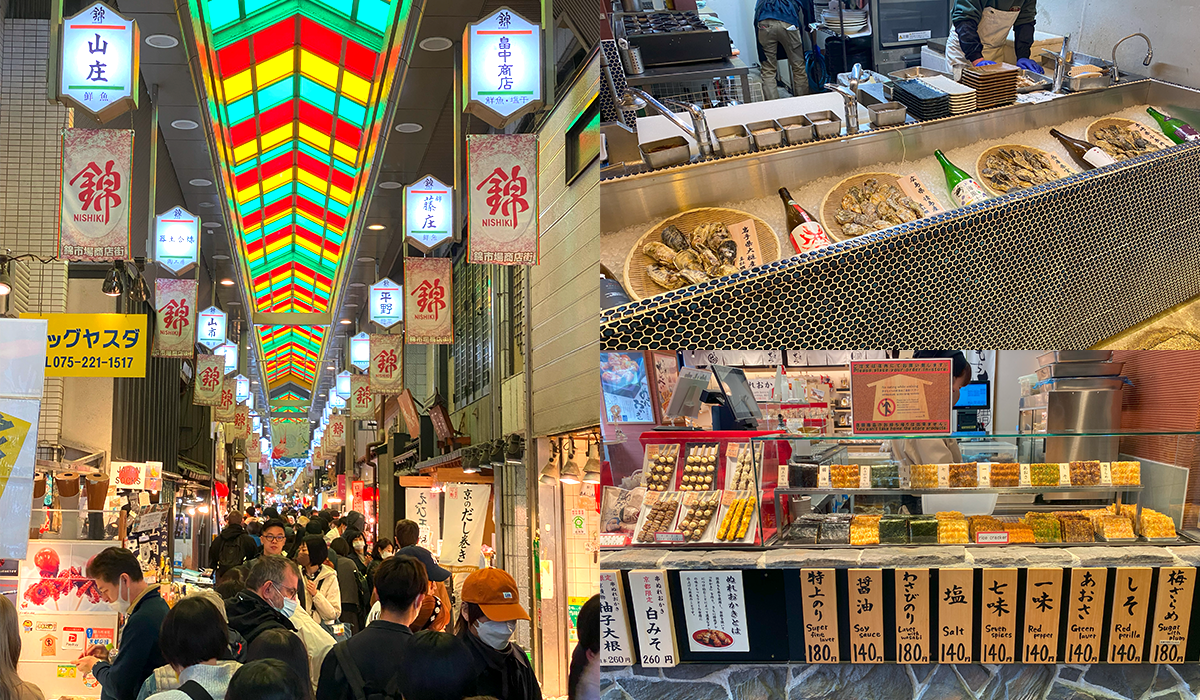
A side-by-side view of Nishiki Market in Kyoto, the covered shopping street known as "Kyoto's kitchen." The left photo looks down the narrow arcade, packed with shoppers in jackets, several wearing face masks. Overhead, the ceiling is lined with striking red, green, and yellow chevron-patterned light panels, and red-and-white fabric banners reading "NISHIKI" with the kanji 錦 hang alongside shop signs and paper lanterns on both sides. The right photo shows one of the market's food stalls up close. An ice-filled counter displays oysters and other shellfish on woven trays next to bottles of sake, with a vendor in an apron working behind it. In front, glass cases hold skewers and neat rows of bite-sized cubes in soy, seaweed, and sesame coatings, and a handwritten price board lists flavors like soy sauce, wasabi, salt, seven spice, and perilla starting at 140 yen.
A side-by-side view of Nishiki Market in Kyoto, the covered shopping street known as "Kyoto's kitchen." The left photo looks down the narrow arcade, packed with shoppers in jackets, several wearing face masks. Overhead, the ceiling is lined with striking red, green, and yellow chevron-patterned light panels, and red-and-white fabric banners reading "NISHIKI" with the kanji 錦 hang alongside shop signs and paper lanterns on both sides.
The right photo shows one of the market's food stalls up close. An ice-filled counter displays oysters and other shellfish on woven trays next to bottles of sake, with a vendor in an apron working behind it. In front, glass cases hold skewers and neat rows of bite-sized cubes in soy, seaweed, and sesame coatings, and a handwritten price board lists flavors like soy sauce, wasabi, salt, seven spice, and perilla starting at 140 yen.
Texto visible en la imagen
錦
山庄
鮮魚
錦
NISHIKI
錦市場商店街
昌早商店
鮮魚
グヤスタ
075-221-1517
京だし巻
白みそ 260円
特上 Sweet soy 180円
醬油 Soy sauce 140円
塩 Salt 140円
七味 Seven spices 140円
一味 Red pepper 140円
あさつき Green leek 140円
しそ Red perilla 140円
Sweet perilla 180円
Río Kamo 鴨川
Si buscas un lugar de belleza y tranquilidad en Kioto, definitivamente deberías visitar el río Kamo. Es una agradable alternativa a los templos, santuarios y el bullicio de la ciudad.
Especialmente en primavera, hay algunos puntos a lo largo del río con preciosos cerezos que convierten el paisaje en un mar de colores rosas y blancos.
Aunque hay muchos lugares maravillosos en Kioto, el río Kamo merece mucho la pena. Ya sea que te animes a andar en bici por la orilla o simplemente pasear, seguramente te impresionará la belleza de este sitio.
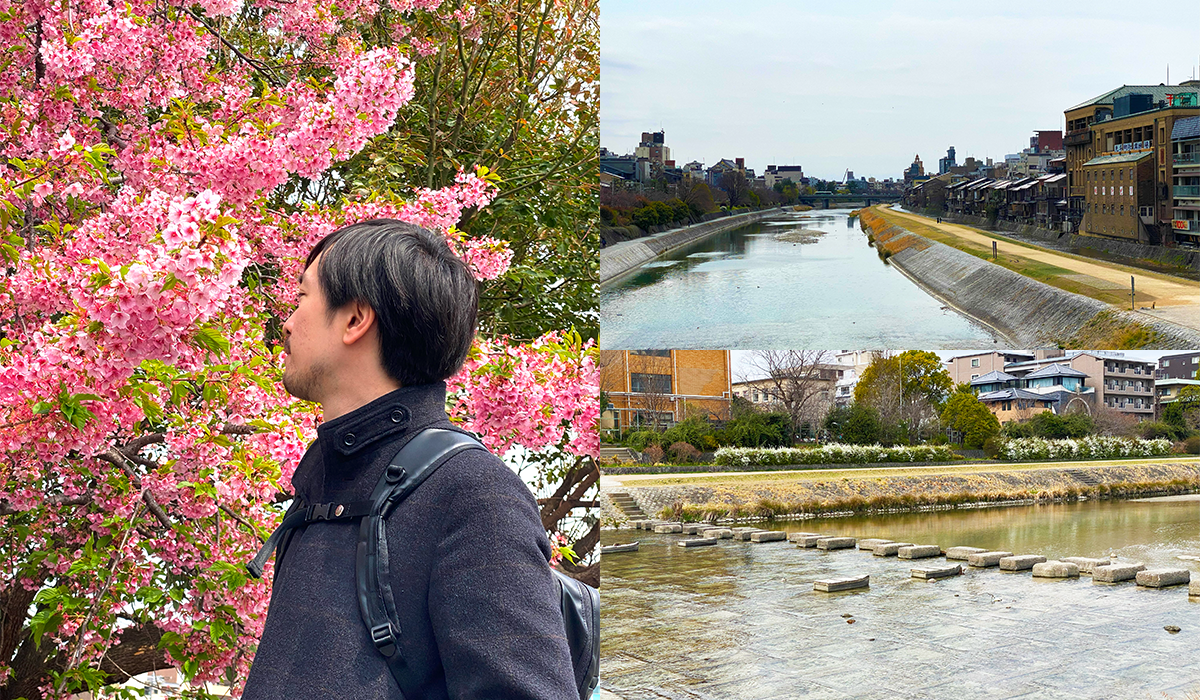
A collage of three photos from the Kamo River in Kyoto. On the left, a man in a dark wool coat with a black backpack stands in profile among dense clusters of pink cherry blossoms, looking up into the flowers. The right side shows the river itself in two views. The upper shot looks along the channelized river toward the city skyline, with sloped concrete embankments, a walking path, and low buildings lining the banks under an overcast sky. The lower shot captures the shallow water near the bank, where rows of square stepping stones cross the river, backed by apartment buildings, bare trees, and a strip of riverside greenery.
A collage of three photos from the Kamo River in Kyoto. On the left, a man in a dark wool coat with a black backpack stands in profile among dense clusters of pink cherry blossoms, looking up into the flowers.
The right side shows the river itself in two views. The upper shot looks along the channelized river toward the city skyline, with sloped concrete embankments, a walking path, and low buildings lining the banks under an overcast sky. The lower shot captures the shallow water near the bank, where rows of square stepping stones cross the river, backed by apartment buildings, bare trees, and a strip of riverside greenery.
Texto visible en la imagen
No clearly readable text.
Visitando templos y santuarios en Kioto
Goju-no-to Kioto
Goju-no-to Kioto es una construcción impresionante en la ciudad. Es una pagoda de cinco pisos que forma parte del templo Tō-ji. La torre fue construida en 1644 y es una parte importante del patrimonio cultural de la ciudad. Es conocida por su tamaño y belleza, así como por las numerosas estatuas budistas que alberga en su interior. Si estás en Kioto, deberías visitar Goju-no-to Kioto para ver este monumento destacado.
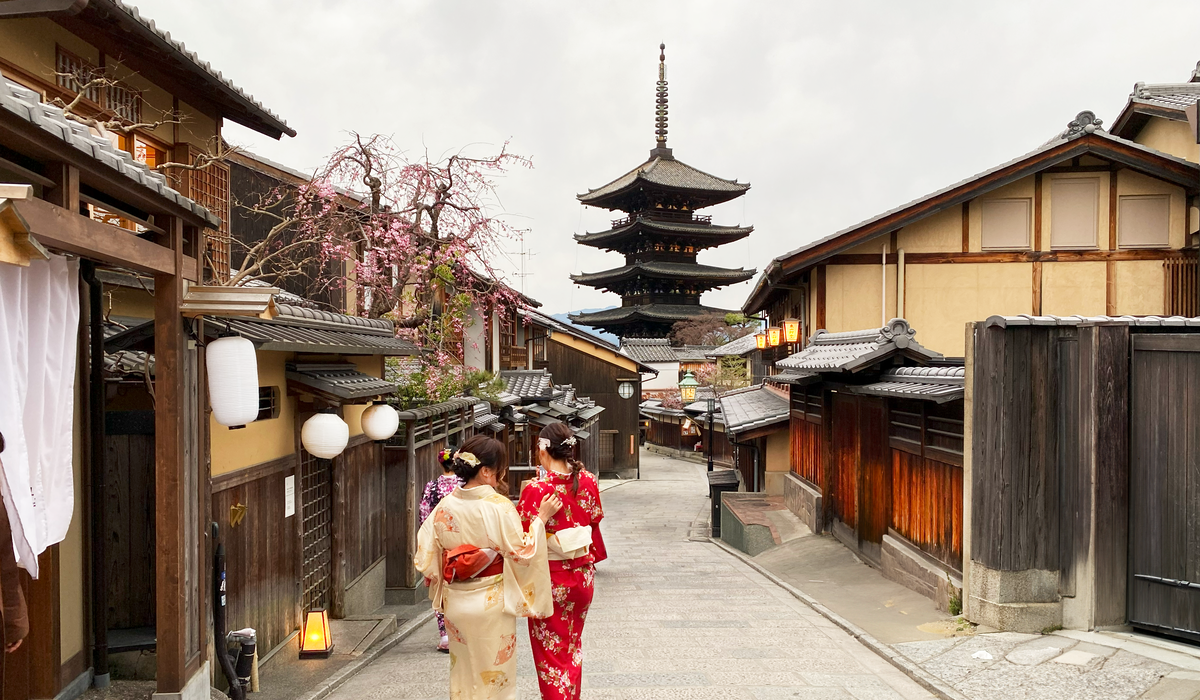
Fushimi Inari-Taisha: el famoso santuario con miles de puertas Torii
¿Te apetece una caminata impresionante? Entonces visita Fushimi Inari-Taisha, el famoso santuario con miles de puertas Torii rojas. La caminata toma unas dos horas, pero las vistas y la atmósfera única lo convierten en una experiencia inolvidable.
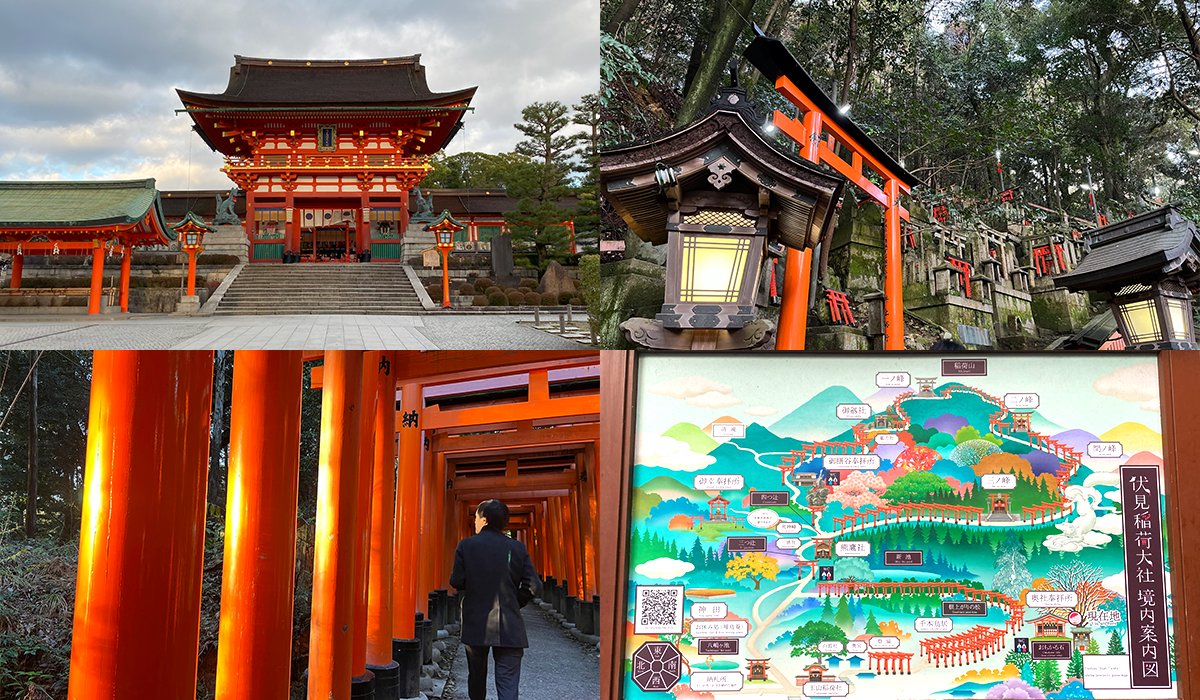
A four-photo collage from Fushimi Inari Taisha, the famous vermilion shrine in Kyoto. The top left photo shows the shrine's grand entrance gate, a two-story red structure with a sweeping dark roof, stone steps leading up to it, and lanterns flanking the approach under a cloudy sky. Top right, a tall torii gate rises from a wooded hillside dotted with small stone shrines and glowing lanterns tucked into the slope. The bottom left photo takes you inside the signature tunnel of closely packed orange torii gates, with a visitor in a dark coat walking away down the gravel path. The bottom right photo is an illustrated grounds map of the shrine complex, drawn in bright greens and reds, showing the hiking trails, sub-shrines, and the three peaks of Mount Inari with labels in Japanese.
A four-photo collage from Fushimi Inari Taisha, the famous vermilion shrine in Kyoto.
The top left photo shows the shrine's grand entrance gate, a two-story red structure with a sweeping dark roof, stone steps leading up to it, and lanterns flanking the approach under a cloudy sky. Top right, a tall torii gate rises from a wooded hillside dotted with small stone shrines and glowing lanterns tucked into the slope. The bottom left photo takes you inside the signature tunnel of closely packed orange torii gates, with a visitor in a dark coat walking away down the gravel path. The bottom right photo is an illustrated grounds map of the shrine complex, drawn in bright greens and reds, showing the hiking trails, sub-shrines, and the three peaks of Mount Inari with labels in Japanese.
Texto visible en la imagen
内
納
伏見稲荷大社境内案内図
稲荷山
一ノ峰
二ノ峰
三ノ峰
間ノ峰
四辻
手水舎
Fushimi Inari Taisha – Tour privado de medio día en Kioto
Vive la icónica Fushimi Inari Taisha con sus interminables túneles de Torii rojos en un tour privado de medio día. Un guía local te acompañará por los caminos históricos, te contará las historias de las estatuas de zorros (Kitsune) y te llevará hasta rincones escondidos lejos de las multitudes turísticas. Perfecto para quienes desean descubrir el corazón espiritual de Kioto de forma intensa y personal.
Kinkaku-ji: el Pabellón Dorado
El Pabellón Dorado, también conocido como Kinkaku-ji, es uno de los monumentos más famosos de Kioto. El templo está recubierto de pan de oro y se refleja en las tranquilas aguas del lago. Es un escenario precioso y lleno de paz que no debes perderte.
Visitas guiadas en el Templo Kinkaku-ji
También hay visitas guiadas disponibles. Si quieres descubrir el Templo Kinkaku-ji con un guía local, puedes contratarlas directamente en el lugar.
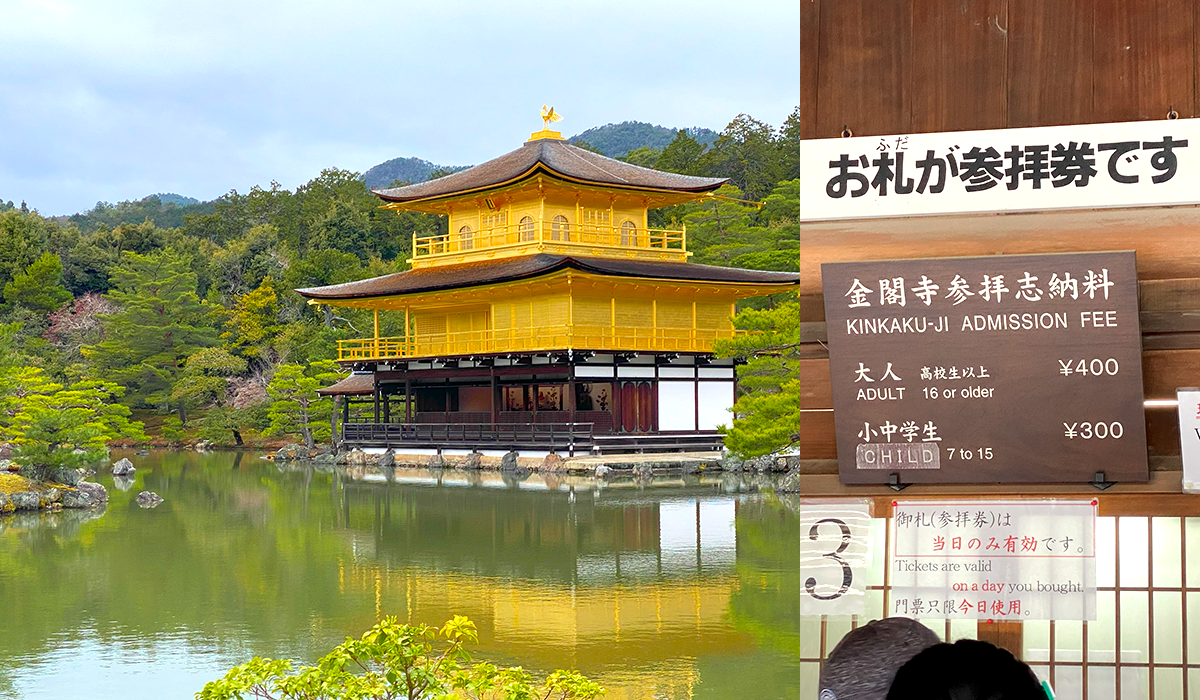
The photo is split into two scenes from a visit to Kinkaku-ji, the Golden Pavilion in Kyoto. On the left, the temple's top two floors gleam in gold leaf above a white-plastered ground level, standing at the edge of a still pond that mirrors the building almost perfectly. Dark tiled roofs stack in tiers, crowned by a small golden phoenix, and forested hills rise behind it under a grey sky. Pines and autumn-touched trees frame the shoreline. The right half shows the ticket counter. A wooden board lists the admission fee in Japanese and English: ¥400 for adults 16 and older, ¥300 for children 7 to 15. Above it, a white banner explains in Japanese that your receipt doubles as the admission ticket, and below, a smaller multilingual notice states tickets are valid only on the day of purchase. The top of a visitor's head is just visible at the bottom edge, waiting at window number 3.
The photo is split into two scenes from a visit to Kinkaku-ji, the Golden Pavilion in Kyoto. On the left, the temple's top two floors gleam in gold leaf above a white-plastered ground level, standing at the edge of a still pond that mirrors the building almost perfectly. Dark tiled roofs stack in tiers, crowned by a small golden phoenix, and forested hills rise behind it under a grey sky. Pines and autumn-touched trees frame the shoreline.
The right half shows the ticket counter. A wooden board lists the admission fee in Japanese and English: ¥400 for adults 16 and older, ¥300 for children 7 to 15. Above it, a white banner explains in Japanese that your receipt doubles as the admission ticket, and below, a smaller multilingual notice states tickets are valid only on the day of purchase. The top of a visitor's head is just visible at the bottom edge, waiting at window number 3.
Texto visible en la imagen
ふだ
お札が参拝券です
金閣寺参拝志納料
KINKAKU-JI ADMISSION FEE
大人 高校生以上 ¥400
ADULT 16 or older
小中学生 ¥300
CHILD 7 to 15
3
御札(参拝券)は
当日のみ有効です。
Tickets are valid
on a day you bought.
門票只限今日使用。
Kiyomizu-dera: el templo en pilares
El templo Kiyomizu-dera es otra joya de Kioto. Fue construido sin clavos ni tornillos y se apoya sobre pilares. Desde aquí tienes una vista impresionante de toda la ciudad.
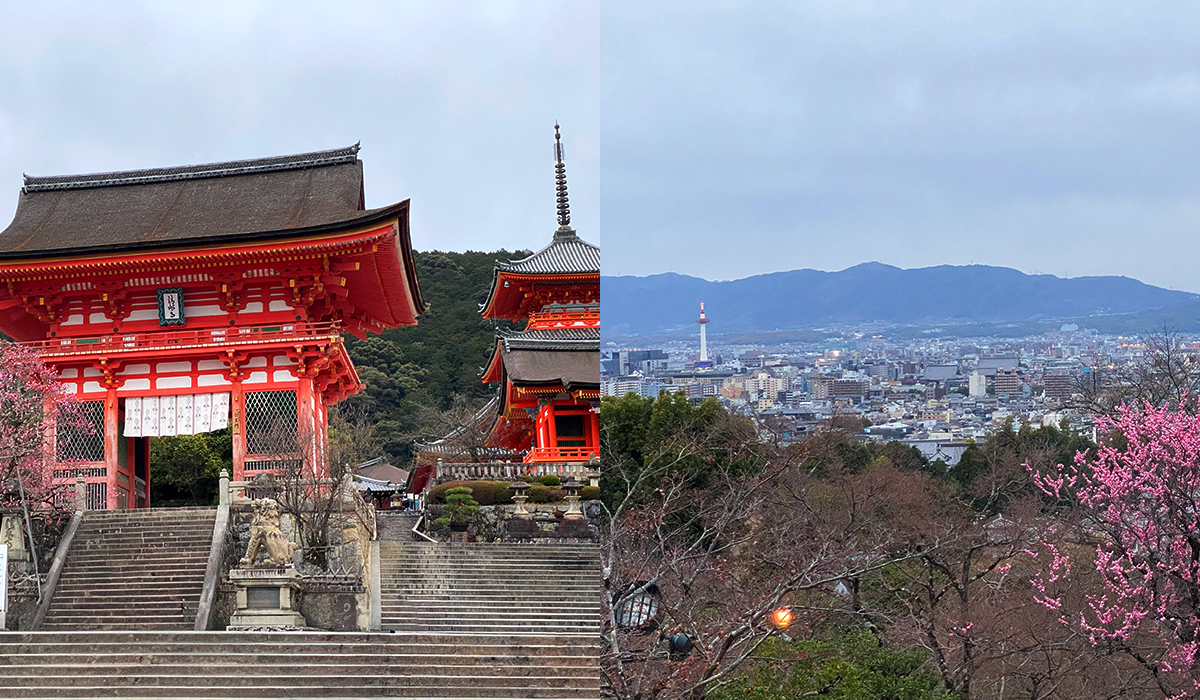
A two-part photo from Kyoto. On the left, the vermilion-red gate of Kiyomizu-dera temple rises above a wide flight of stone stairs. A guardian statue sits in a stone niche beside the steps, white banners hang in the gate's lower level, and the temple's three-storied pagoda stands on the slope behind it under an overcast sky, framed by dark green trees and pink blossoms. The right half shows the view from the hillside looking down over Kyoto: a dense spread of low city buildings stretching toward a band of blue-grey mountains, with the slender white-and-red Kyoto Tower rising near the center. Bare winter branches and bright pink plum blossoms fill the foreground.
A two-part photo from Kyoto. On the left, the vermilion-red gate of Kiyomizu-dera temple rises above a wide flight of stone stairs. A guardian statue sits in a stone niche beside the steps, white banners hang in the gate's lower level, and the temple's three-storied pagoda stands on the slope behind it under an overcast sky, framed by dark green trees and pink blossoms.
The right half shows the view from the hillside looking down over Kyoto: a dense spread of low city buildings stretching toward a band of blue-grey mountains, with the slender white-and-red Kyoto Tower rising near the center. Bare winter branches and bright pink plum blossoms fill the foreground.
Texto visible en la imagen
No text is clearly readable in the image.
Descubriendo Kioto en bicicleta
Si quieres explorar Kioto de una manera especial, entonces un paseo en bicicleta es ideal para ti. Con una bicicleta puedes desplazarte rápida y cómodamente de un lugar de interés a otro y experimentar la belleza de la ciudad desde otra perspectiva. Te recomendamos alquilar una bici y seguir una de las tantas rutas ciclistas por la ciudad. Así puedes visitar los templos y santuarios más famosos, recorrer callecitas estrechas y vivir la cultura japonesa de cerca. Un tour en bici por Kioto siempre es inolvidable y una excelente forma de descubrir la ciudad.
Kioto y los cerezos en flor: Hanami en la antigua capital
Kioto es bonito en cualquier época del año, pero durante la floración de los cerezos la ciudad se convierte en un auténtico cuento de hadas.
Hay muchos lugares en Kioto desde los que puedes admirar los cerezos en flor. Uno de los más conocidos es el Camino del Filósofo, donde puedes pasear bajo los cerezos y contemplar la belleza de la naturaleza. El camino toma su nombre en honor al filósofo Nishida Kitaro, que solía caminar aquí para pensar y meditar.
Descubre Kioto con un local – Tour privado a medida
Descubre Kioto como un local: este tour privado se adapta completamente a tus intereses, ya sea templos famosos, callejones escondidos o lo mejor de la gastronomía. Tu guía planificará la ruta contigo para que explores la ciudad a tu manera. Perfecto para quienes quieren vivir Kioto de forma auténtica y flexible.
Lo más destacado de Kioto – Tour privado de un día
Lo más destacado de Kioto – Tour privado de un día: descubre los lugares más emblemáticos de Kioto en un solo día con un guía privado: desde el Pabellón Dorado hasta el bosque de bambú de Arashiyama, pasando por Fushimi Inari y el barrio Gion. Perfecto para conocer la ciudad de forma compacta y sin estrés.
*Enlace de afiliado: Si reservas una actividad a través de mi widget o del enlace en viator.com, recibo una pequeña comisión. No tiene ningún coste adicional para ti y apoyas mi blog. Te lo agradezco mucho y te deseo un viaje genial (^_^)
*Enlace de afiliado: Si reservas una actividad a través de mi widget o del enlace en viator.com, recibo una pequeña comisión. No tiene ningún coste adicional para ti y apoyas mi blog. Te lo agradezco mucho y te deseo un viaje genial (^_^)



Comentarios