
The detailed experience report from RyuKoch
Table of contents:
Bibimcup at a Glance
The Bibimcup Restaurant has been expanded by the owners and now offers more seating and a wider selection of Korean food. We haven't visited the renovated premises yet!
Opening Hours
- Mon - Wed: 11:30 am - 9:30 pm
- Thu - Sat: 11:30 am - 10:00 pm
- Sun: Closed
Rating
- Ryusei: 4.5/5
- Matthias: 4.6/5
Price
- €10 for a small menu
- €11 for a large menu
Summarized Conclusion
Bibimcup is a small restaurant that offers the Korean national dish Bibimbap in various variations. Bibimcup is very fair in terms of price and offers you a menu with a bowl of Bibimbap including toppings, a side dish and a drink for between €9.50 and €11. Taste-wise, Bibimcup is in the delicious category.
If you're looking for a cheap, tasty and healthy meal in Düsseldorf, we definitely recommend a visit to this small restaurant.
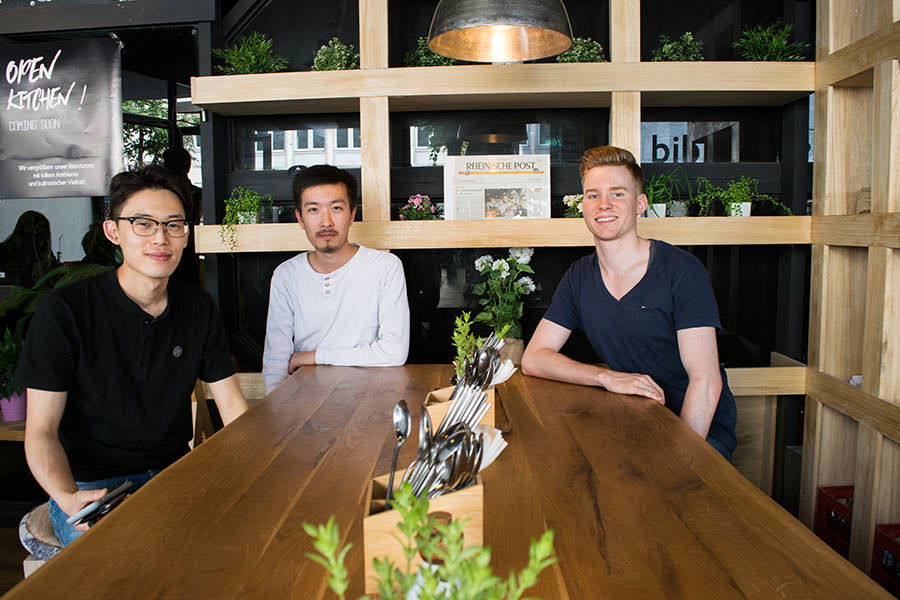
Three young men sit side by side at a long communal wooden table inside Bibimcup, a Korean bibimbap restaurant in Düsseldorf, all three smiling toward the camera. The man on the left wears glasses and a black polo shirt and holds a phone in his lap. In the middle is a man with a mustache in a white henley shirt, arms resting on the table edge. The man on the right has reddish blond hair, wears a navy v-neck t-shirt, and leans forward on his forearms. The room behind them has a light wood shelf wall dotted with small green plants and white flowers, topped by a large metal dome pendant lamp. A copy of the Rheinische Post newspaper stands upright on one of the shelves, and to the left a black poster reads "OPEN KITCHEN! COMING SOON." On the table in the foreground, a wooden caddy holds spoons and forks wrapped in napkins, with a few sprigs of fresh herbs beside it. The overall feel is bright, modern, and welcoming, like a portrait of the team in their newly opened restaurant.
Three young men sit side by side at a long communal wooden table inside Bibimcup, a Korean bibimbap restaurant in Düsseldorf, all three smiling toward the camera. The man on the left wears glasses and a black polo shirt and holds a phone in his lap. In the middle is a man with a mustache in a white henley shirt, arms resting on the table edge. The man on the right has reddish blond hair, wears a navy v-neck t-shirt, and leans forward on his forearms.
The room behind them has a light wood shelf wall dotted with small green plants and white flowers, topped by a large metal dome pendant lamp. A copy of the Rheinische Post newspaper stands upright on one of the shelves, and to the left a black poster reads "OPEN KITCHEN! COMING SOON." On the table in the foreground, a wooden caddy holds spoons and forks wrapped in napkins, with a few sprigs of fresh herbs beside it. The overall feel is bright, modern, and welcoming, like a portrait of the team in their newly opened restaurant.
Visible text in the image
OPEN
KITCHEN !
COMING SOON
RHEINISCHE POST
bil
Bibimbap - South Korea's National Dish
Bibimbap is a Korean rice dish where the taste can be individually determined by different ingredients. Any conceivable combination of meat, vegetables and sauce is possible. If you would like to learn more about Bibimbap or want to cook the basic recipe yourself, then take a look at our matching recipe >> Bibimbap Rice Bowl with Dreamy Toppings Before you can eat your Bibimbap, you should mix it up very well with a spoon. Only by mixing do the ingredients combine with each other and unfold a different and wonderful taste each time.
What We Ordered
During our visit, we ordered 2 Bibimbaps with 2 different side dishes. The side dishes (Kimbap and Mandu) are handmade and freshly prepared. In addition to rice, the main ingredients include mung bean sprout salad, mushrooms in sauce, carrot salad, zucchini pieces, iceberg lettuce and spring onions. You can then refine your Bibimbap with the Korean sauce Ssamchang, which adds a certain sharpness to the dish. We chose 2 different toppings.

A generous serving of beef bibimbap fills a wide speckled ceramic bowl with a brown band around its base, set on a light wooden table. The rice is buried under crumbled bulgogi-style beef dusted with sesame seeds and topped with a scatter of chopped scallions, with slices of zucchini and shredded carrot visible around the edge. Behind the bowl, a small plate holds pieces of gimbap, the seaweed rolls showing rice, greens and egg in the cross-section. Further back on a wooden tray sit a white ceramic sauce bottle, a dark lidded pot with a spoon resting on top, and a little glass jar sprouting fresh greens. The warm, casual table setting reads as a Korean restaurant meal, photographed at Bibimcup in Düsseldorf.
A generous serving of beef bibimbap fills a wide speckled ceramic bowl with a brown band around its base, set on a light wooden table. The rice is buried under crumbled bulgogi-style beef dusted with sesame seeds and topped with a scatter of chopped scallions, with slices of zucchini and shredded carrot visible around the edge. Behind the bowl, a small plate holds pieces of gimbap, the seaweed rolls showing rice, greens and egg in the cross-section. Further back on a wooden tray sit a white ceramic sauce bottle, a dark lidded pot with a spoon resting on top, and a little glass jar sprouting fresh greens. The warm, casual table setting reads as a Korean restaurant meal, photographed at Bibimcup in Düsseldorf.
Visible text in the image
No clearly readable text is present in the image.

A large grey ceramic bowl of spicy squid bibimbap sits front and center on a wooden restaurant table, photographed from just above the rim. The rice bowl is topped with sesame seeds, chopped green onions, bean sprouts, shredded lettuce, and chunks of squid coated in red chili sauce. Around it, the rest of the meal is arranged: two pan-fried dumplings on a rectangular plate behind the bowl, a row of maki sushi rolls to the left, and a blue-and-white patterned cup of tea on the right. The setting reads as a casual Korean restaurant table, with the bibimbap as the clear centerpiece.
A large grey ceramic bowl of spicy squid bibimbap sits front and center on a wooden restaurant table, photographed from just above the rim. The rice bowl is topped with sesame seeds, chopped green onions, bean sprouts, shredded lettuce, and chunks of squid coated in red chili sauce. Around it, the rest of the meal is arranged: two pan-fried dumplings on a rectangular plate behind the bowl, a row of maki sushi rolls to the left, and a blue-and-white patterned cup of tea on the right. The setting reads as a casual Korean restaurant table, with the bibimbap as the clear centerpiece.
Visible text in the image
No clearly readable text is present in the image.
The Value for Money
The Bibimcup menu is hanging large behind the counter. Alternatively, you can look at the small hand cards. Bibimcup is very good in terms of price and offers a fair menu for just €10 - €11. We paid just €22 for our two menus. In Düsseldorf, it is difficult to find such a delicious and healthy menu at such reasonable prices.

A handwritten chalkboard menu from Bibimcup, a Korean bibimbap restaurant in Düsseldorf, photographed straight on. The header, "Choose your bibimcup," is picked out in green chalk while everything else is white. The menu walks through a two-step ordering system: Step 1 is the classic bibimcup, rice with six vegetable variations and a sauce of chili paste or soy, priced at 6 euros for a small and 7 for a large. Step 2 lists toppings: tofu (dubu), glass noodles (jap-chae), and spicy pork (jae-yuk) at 1.50 euros each, with beef bulgogi and spicy squid (o-jinger) at 2.00 euros. A boxed "Vegan (topping)" section on the right highlights the bibimcup, jap-chae, and dubu as the plant-based picks, each add-on 1.50 euros. Below that, cold drinks run 2.20 euros for cola, Fanta, Sprite, apple spritzer, and orange juice, with water at 2.00, all in 0.33-liter bottles with a 10-cent deposit. Hot drinks finish the board: coffee 2.00, cappuccino 2.30, espresso 1.80, and Korean tea at 2.20 in green, quince, ginger, or yuja lemon.
A handwritten chalkboard menu from Bibimcup, a Korean bibimbap restaurant in Düsseldorf, photographed straight on. The header, "Choose your bibimcup," is picked out in green chalk while everything else is white. The menu walks through a two-step ordering system: Step 1 is the classic bibimcup, rice with six vegetable variations and a sauce of chili paste or soy, priced at 6 euros for a small and 7 for a large. Step 2 lists toppings: tofu (dubu), glass noodles (jap-chae), and spicy pork (jae-yuk) at 1.50 euros each, with beef bulgogi and spicy squid (o-jinger) at 2.00 euros.
A boxed "Vegan (topping)" section on the right highlights the bibimcup, jap-chae, and dubu as the plant-based picks, each add-on 1.50 euros. Below that, cold drinks run 2.20 euros for cola, Fanta, Sprite, apple spritzer, and orange juice, with water at 2.00, all in 0.33-liter bottles with a 10-cent deposit. Hot drinks finish the board: coffee 2.00, cappuccino 2.30, espresso 1.80, and Korean tea at 2.20 in green, quince, ginger, or yuja lemon.
Visible text in the image
# CHOOSE YOUR bibimcup
\* **Step 1** (classic)
**BIBIMCUP** Klein Grob
6 € 7 €
Reis mit 6 verschiedenen
Gemüsevariationen
(inkl. scharfe Chilipaste/Soja)
\* **Step 2** (TOPPING)
+ 1,50€
- DUBU (Tofu)
- JAP-CHAE (Glasnudeln)
- JAE-YUK scharf (Schweinefleisch)
+ 2,00€
- BULGOGI (Rindfleisch)
- O-JINGER scharf (Tintenfisch)
**VEGAN** (TOPPING)
- BIBIMCUP
- DUBU +1.50 (Tofu)
- JAP-CHAE +1.50€ (Glasnudeln)
**Getränke** (0,33l, 0,2l, Pfand 10 cent)
- Cola 2.20
- Fanta 2.20
- Sprite 2.20
- Apfelschorle 2.20
- Orangensaft 2.20
- Wasser 2.00
**heipe Getränke**
Kaffee 2.00 Tee (koreanisch) 2.20
Cappuccino 2.30 Grün/Quitten/Ingwer
Espresso 1.80 Yuja (zitronen)
Sung-Ryul Choi told us that Bibimcup will be expanding in the near future. The still small restaurant will be expanded with an additional room and will then offer a wider selection of Korean dishes. We are excited and will visit Bibimcup again and look forward to the expansion of the restaurant.
Our Conclusion
We felt comfortable at Bibimcup. Both the atmosphere, the food and the service. The cheap price of a full meal is perfect. Of course, the price is based on the composition of the ingredients like mushrooms and iceberg lettuce, but the Bibimbap is delicious.
Comments
My goodness... hollow phrases, unnecessary empty sentences, far too uncritical. An example: "...fits into the category of tasty..." or "...very fair in terms of price...". What kind of category is that, what exactly is tasty, and who decides what's a fair price? Why isn't any of this explained or compared? And then there's a photo with the restaurant owner – that's anything but objective. You really don't know what proper restaurant criticism is.... and that also shows when you read the review for BB4U.... ("...the presumably house-made sauce..."). What does presumably mean here – either you know it, or you should skip the sentence because it helps no one. Plus, the name of the sauce is missing. Am I supposed to order it like this? "I'd like the presumably house-made sauce with no name"? Better to write fewer reviews and actually review them properly.
Hi Matthias, thanks for your comment, yes indeed, we're not restaurant critics or professional reviewers, we mostly just share our experiences :) But because we don't want to do it half-heartedly either, we're not doing restaurant reviews anymore, exactly for the reasons you mentioned :) Best regards Matthias
Comment has not yet been verified.