Table of contents:
TL;DR
Kyōto (京都市) Trip - Reise Guide offers a comprehensive overview of traveling from Tokyo to Kyoto, highlighting an enjoyable nine-hour car journey marked by well-maintained highways and picturesque landscapes dotted with valleys, lakes, and mountains. It discusses the convenience of driving, including rest stops and personal comfort, while also addressing the environmental impact compared to train travel. A suggested stop in Hamamatsu features the serene Hamana Lake, known for its unique freshwater and saltwater mix, and includes a dining experience at the local restaurant Shibuki. The guide also highly recommends taking the Shinkansen for a quick and comfortable ride to Kyoto, emphasizing the spacious seating and amenities. Finally, it lists the top five must-visit attractions in Kyoto, including the tranquil Arashiyama Bamboo Grove and the vibrant Nishiki Market for an authentic culinary experience.Our Road Trip from Tokyo to Kyoto
Today we set out to drive from Tokyo to Kyoto. Although the trip took a total of nine hours, it was still pleasant, because my mother and I took turns driving.
The highways in Japan are very well developed and well signposted. There are also plenty of rest stops along the route where we could freshen up.
During the drive we were able to enjoy the beautiful scenery. Along the highway there were always green valleys, lakes, and mountains we passed by. This made the drive very relaxing and varied.
However, I must say, it's a bit unfortunate that driving a car is still cheaper than taking the train, especially in light of climate change. Compared to the car, the train is almost twice or even three times as expensive, which means that many people still prefer to drive, even though there’s a more eco-friendly alternative.
On the other hand, I also have to say that I appreciate the comfort of a car. We could rest whenever we wanted, stop whenever we needed a break, and always had our own things with us. That’s not necessarily the case when traveling by train.
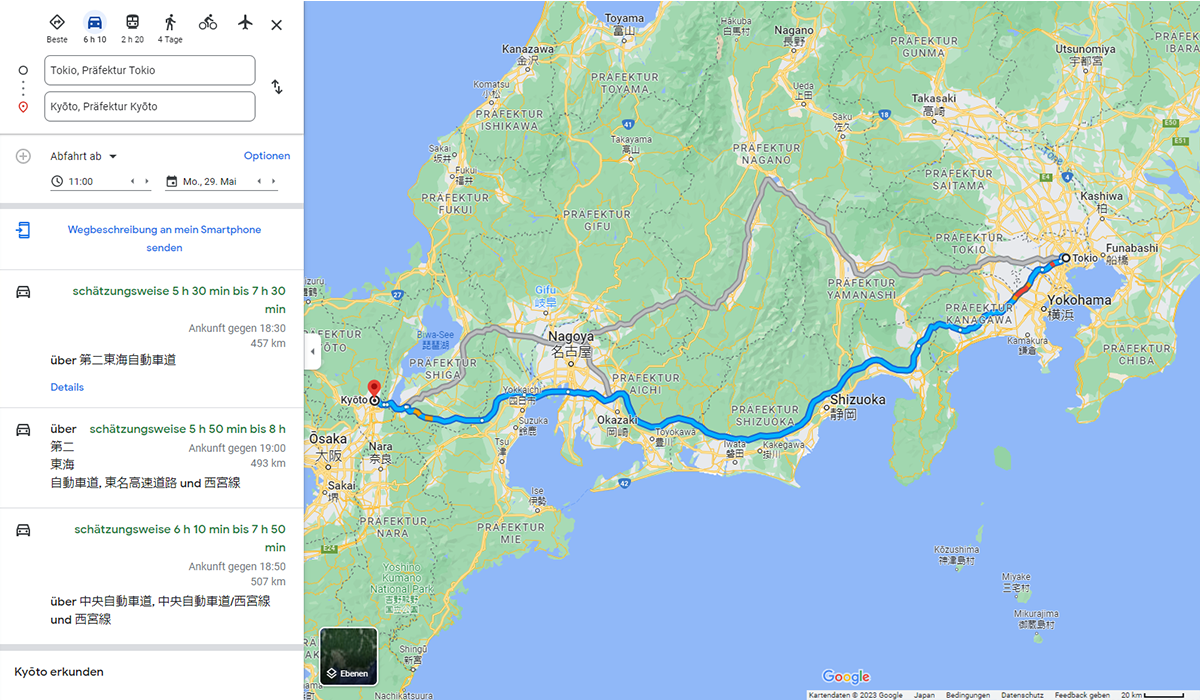
A Google Maps route planning screenshot in German shows the drive from Tokio to Kyōto. The left panel lists three route options with travel times: about 5 h 30 min to 7 h 30 min (457 km), 5 h 50 min to 8 h (493 km), and 6 h 10 min to 7 h 50 min (507 km), all departing Monday, May 29 at 11:00. The driving mode is selected, and each option names the expressways used, such as 第二東海自動車道 and 東名高速道路. The map on the right covers central Japan, with the recommended route drawn as a thick blue line running from Tokio past Yokohama, along the Pacific coast through Shizuoka, then west via Nagoya to a red destination pin at Kyōto, with Osaka and Nara nearby. A gray alternative route swings inland north of the mountains through the Nagano region. City labels like Toyama, Kanazawa, Takasaki and Utsunomiya mark the surrounding prefectures.
A Google Maps route planning screenshot in German shows the drive from Tokio to Kyōto. The left panel lists three route options with travel times: about 5 h 30 min to 7 h 30 min (457 km), 5 h 50 min to 8 h (493 km), and 6 h 10 min to 7 h 50 min (507 km), all departing Monday, May 29 at 11:00. The driving mode is selected, and each option names the expressways used, such as 第二東海自動車道 and 東名高速道路.
The map on the right covers central Japan, with the recommended route drawn as a thick blue line running from Tokio past Yokohama, along the Pacific coast through Shizuoka, then west via Nagoya to a red destination pin at Kyōto, with Osaka and Nara nearby. A gray alternative route swings inland north of the mountains through the Nagano region. City labels like Toyama, Kanazawa, Takasaki and Utsunomiya mark the surrounding prefectures.
Visible text in the image
Beste
6 h 10
2 h 20
4 Tage
Tokio, Präfektur Tokio
Kyōto, Präfektur Kyōto
Abfahrt ab
Optionen
11:00
Mo., 29. Mai
Wegbeschreibung an mein Smartphone senden
schätzungsweise 5 h 30 min bis 7 h 30 min
Ankunft gegen 18:30
457 km
über 第二東海自動車道
Details
über 東海
schätzungsweise 5 h 50 min bis 8 h
Ankunft gegen 19:00
493 km
自動車道, 東名高速道路 und 西宮線
schätzungsweise 6 h 10 min bis 7 h 50 min
Ankunft gegen 18:50
507 km
über 中央自動車道, 中央自動車道/西宮線 und 西宮線
Kyōto erkunden
Toyama
Kanazawa
Nagano
Takasaki
Utsunomiya
Kashiwa
Tokio
Funabashi
Yokohama
Nagoya
Kyōto
Shizuoka
Ōsaka
Nara
Sakai
Biwa-See
PRAFEKTUR TOYAMA
PRAFEKTUR ISHIKAWA
PRAFEKTUR FUKUI
PRAFEKTUR GIFU
PRAFEKTUR NAGANO
PRAFEKTUR SAITAMA
PRAFEKTUR YAMANASHI
PRAFEKTUR TOKIO
PRAFEKTUR SHIGA
PRAFEKTUR AICHI
PRAFEKTUR CHIBA
PRAFEKTUR NARA
PRAFEKTUR MIE
Kōzushima
Miyake
Mikurajima
Hachijō-jima
Google
Kartendaten © 2023 Google Japan Bedingungen Datenschutz Feedback geben 20 km
Ebisen
A Stopover in Hamamatsu: Relaxing at Lake Hamana
If you're on your way from Tokyo to Kyoto, it's worth making a stop in Hamamatsu. We especially checked out the beautiful Lake Hamana there—a place of peace and relaxation.
What’s especially interesting about the lake is the fact that it has both a freshwater and a saltwater part. For this reason, eels are also bred here, which makes it very popular among fish lovers.
After a walk along the lake shore, we went to the nearby restaurant Shibuki. The restaurant even offers English menus, which made ordering easier. My mother and brother tried the famous grilled eel there, while I chose the dish with Shirasu (baby sardines).
So if you’re looking for a place to relax and unwind, I can highly recommend a stop in Hamamatsu and at Lake Hamana. Here you can not only enjoy nature, but also discover local cuisine and culture.
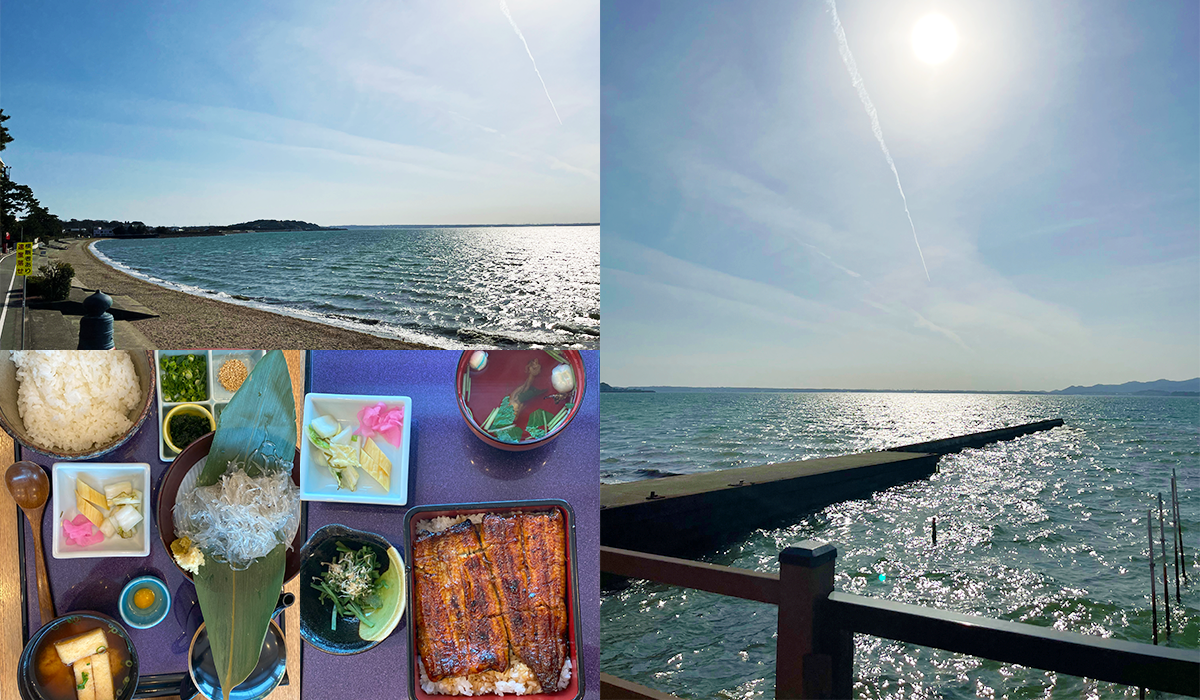
A three-photo collage from a stop in Hamamatsu on the drive from Tokyo to Kyoto. The top left photo shows a sandy beach curving along calm, sun-glittered water, with a quiet road and pine trees at the shore's edge. The large photo on the right looks out from a wooden terrace over a wide, sparkling bay, where a long concrete breakwater juts into the water under a bright sun and a single contrail. The bottom left photo looks straight down at a Japanese meal spread across a table. The centerpiece is unagi: broiled eel glazed a deep caramel brown, served over rice in a red and black lacquered box. Around it are a bowl of white rice, miso soup with tofu, cold soba noodles on a big green leaf, a raw egg yolk in a small cup, and little dishes of pickles and greens.
A three-photo collage from a stop in Hamamatsu on the drive from Tokyo to Kyoto. The top left photo shows a sandy beach curving along calm, sun-glittered water, with a quiet road and pine trees at the shore's edge. The large photo on the right looks out from a wooden terrace over a wide, sparkling bay, where a long concrete breakwater juts into the water under a bright sun and a single contrail.
The bottom left photo looks straight down at a Japanese meal spread across a table. The centerpiece is unagi: broiled eel glazed a deep caramel brown, served over rice in a red and black lacquered box. Around it are a bowl of white rice, miso soup with tofu, cold soba noodles on a big green leaf, a raw egg yolk in a small cup, and little dishes of pickles and greens.
Visible text in the image
No clearly readable text.
Taking the Shinkansen to Kyoto
If you’re heading to Kyoto, you should definitely take the Shinkansen—Japan’s super-fast train. With top speeds up to 320 km/h, it gets you to Kyoto in less than three hours. Once on board, you’ll immediately notice how spacious and comfortable the seats are. With Wi-Fi and power outlets at every seat, you can keep working or just relax during the journey.
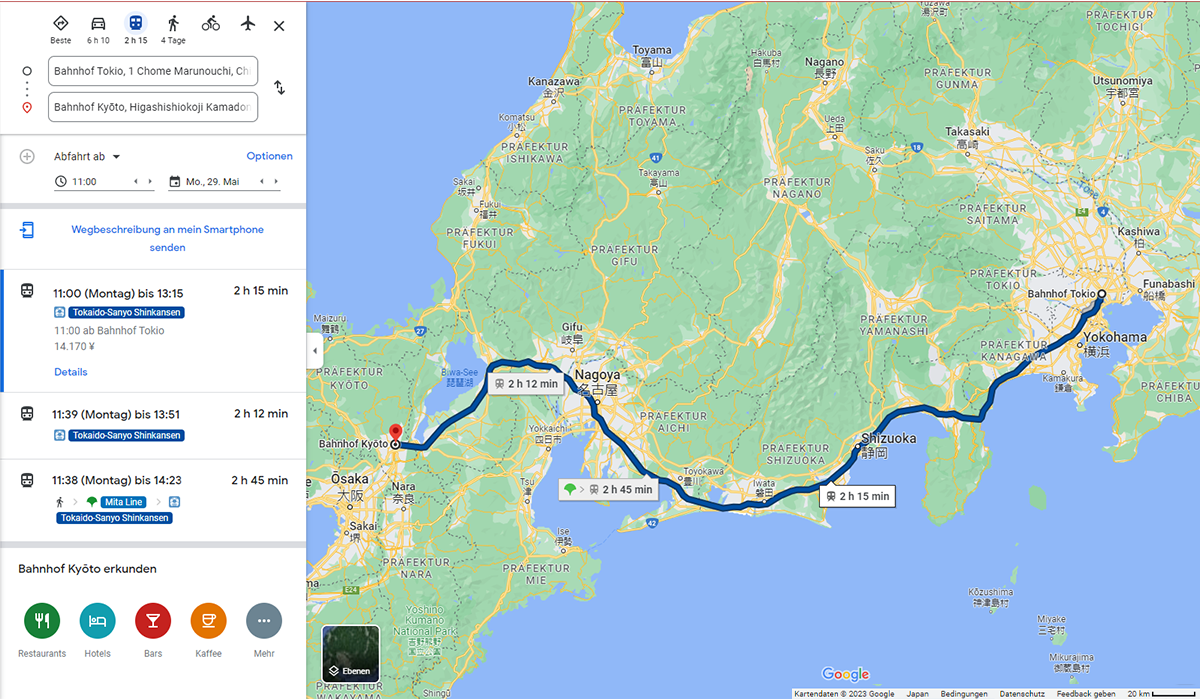
A Google Maps route planning screenshot showing the Shinkansen connection from Tokyo to Kyoto. The map fills most of the frame, covering central Japan from Tokyo Bay to the Osaka area, with prefecture labels such as Präfektur Shizuoka, Präfektur Aichi, and Präfektur Kyōto. A thick dark blue line traces the rail route along the Pacific coast, passing Yokohama, Shizuoka, and Nagoya before ending at a red pin at Kyoto Station. Small white badges along the route mark travel times of 2h 15 min, 2h 12 min, and 2h 45 min for different segments. The sidebar on the left is in German. At the top, mode icons compare options: car at 6h 10, train at 2h 15, walking at 4 days, plus cycling and flights. The start and destination fields read "Bahnhof Tokio, 1 Chome Marunouchi" and "Bahnhof Kyōto, Higashishiojokamado", with departure set to 11:00 on Monday, May 29. Below, three itinerary cards list Tokaido-Sanyo Shinkansen departures, the first running 11:00 to 13:15 for 2h 15 min at a fare of 14,170 ¥. At the bottom, a "Bahnhof Kyōto erkunden" section offers icons for restaurants, hotels, bars, and coffee near the destination.
A Google Maps route planning screenshot showing the Shinkansen connection from Tokyo to Kyoto. The map fills most of the frame, covering central Japan from Tokyo Bay to the Osaka area, with prefecture labels such as Präfektur Shizuoka, Präfektur Aichi, and Präfektur Kyōto. A thick dark blue line traces the rail route along the Pacific coast, passing Yokohama, Shizuoka, and Nagoya before ending at a red pin at Kyoto Station. Small white badges along the route mark travel times of 2h 15 min, 2h 12 min, and 2h 45 min for different segments.
The sidebar on the left is in German. At the top, mode icons compare options: car at 6h 10, train at 2h 15, walking at 4 days, plus cycling and flights. The start and destination fields read "Bahnhof Tokio, 1 Chome Marunouchi" and "Bahnhof Kyōto, Higashishiojokamado", with departure set to 11:00 on Monday, May 29. Below, three itinerary cards list Tokaido-Sanyo Shinkansen departures, the first running 11:00 to 13:15 for 2h 15 min at a fare of 14,170 ¥. At the bottom, a "Bahnhof Kyōto erkunden" section offers icons for restaurants, hotels, bars, and coffee near the destination.
Visible text in the image
Beste
6 h 10
2 h 15
4 Tage
Bahnhof Tokio, 1 Chome Marunouchi, Ch
Bahnhof Kyōto, Higashiokioki Kamado
Abfahrt ab
Optionen
11:00
Mo., 29. Mai
Wegbeschreibung an mein Smartphone
senden
11:00 (Montag) bis 13:15
2 h 15 min
Tokaido-Sanyo Shinkansen
11:00 ab Bahnhof Tokio
14.170 ¥
Details
11:39 (Montag) bis 13:51
2 h 12 min
Tokaido-Sanyo Shinkansen
11:38 (Montag) bis 14:23
2 h 45 min
Mifa Line
Tokaido-Sanyo Shinkansen
Bahnhof Kyōto erkunden
Restaurants
Hotels
Bars
Kaffee
Mehr
Toyama
Hakuba
Nagano
Kanazawa
Komatsu
PRAFEKTUR TOYAMA
Utsunomiya
PRAFEKTUR TOCHIGI
PRAFEKTUR GUNMA
PRAFEKTUR ISHIKAWA
Takasaki
PRAFEKTUR FUKUI
Takayama
PRAFEKTUR NAGANO
PRAFEKTUR SAITAMA
Kashiwa
PRAFEKTUR GIFU
PRAFEKTUR YAMANASHI
Bahnhof Tokio
Funabashi
Gifu
Yokohama
PRAFEKTUR KANAGAWA
PRAFEKTUR KYOTO
Biwa-See
2 h 12 min
Nagoya
PRAFEKTUR AICHI
Bahnhof Kyōto
Yokkaichi
Shizuoka
PRAFEKTUR SHIZUOKA
Ōsaka
Nara
2 h 45 min
Toyokawa
2 h 15 min
Iwata
Sakai
PRAFEKTUR NARA
PRAFEKTUR MIE
Yoshino
Kumano Natio
nal Park
Kōzushima
Miyake
Mikurajima
Ebenen
Google
Kartendaten ©2023 Google Japan Bedingungen Datenschutz Feedback geben 20 km
The Best Sights in Kyoto
You’ve finally made it to Kyoto and you’re wondering which sights you absolutely have to visit? Here are our top 5 recommendations:
Arashiyama: The Bamboo Grove
If you’re longing for nature and tranquility, Arashiyama is the perfect place for you. Here you’ll find a bamboo grove you can stroll through.
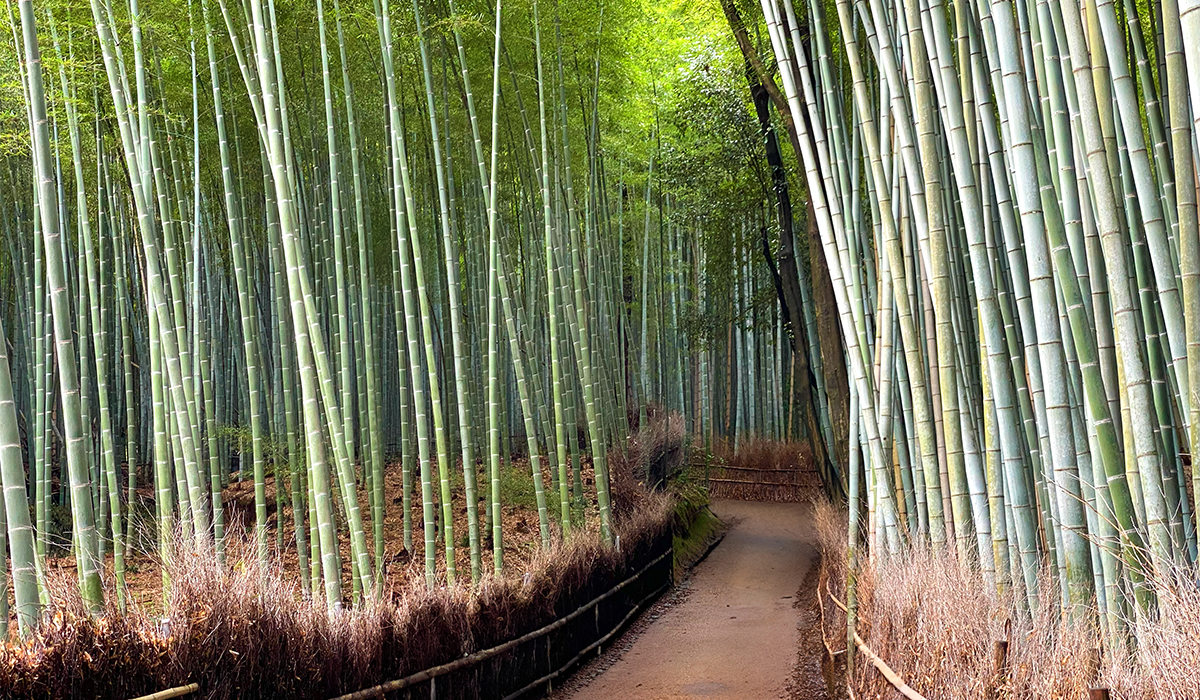
A narrow dirt path curves through the dense bamboo grove of Arashiyama in Kyoto. Tall, pale green bamboo stalks rise on both sides, leaning slightly inward and closing over the walkway so their leaves filter the light into a soft green glow. The path itself is empty and fades into the thicket a short distance ahead, while low fences woven from dried brush and bamboo line its edges.
A narrow dirt path curves through the dense bamboo grove of Arashiyama in Kyoto. Tall, pale green bamboo stalks rise on both sides, leaning slightly inward and closing over the walkway so their leaves filter the light into a soft green glow. The path itself is empty and fades into the thicket a short distance ahead, while low fences woven from dried brush and bamboo line its edges.
Visible text in the image
There is no clearly readable text in this image.
Arashiyama Walking Tour – Bamboo, Temples & Monkeys
Discover Kyoto’s Arashiyama district on a guided tour: Stroll through the famous bamboo forest, visit Tenryu-ji temple, and hike up to the monkey park with city views. Ideal for nature and culture lovers. (Agoda)
*Affiliate link: If you book an activity through my widget or my link at viator.com, I receive a small commission. There are no additional costs for you and you support my blog. I’m very grateful and wish you lots of fun traveling (^_^)
Nishiki Market: The famous market for food and souvenirs
If you’re looking for an authentic experience, visit Nishiki Market. Here you’ll find local delicacies and souvenirs you can bring home.
We hope our top 5 recommendations help make your trip to Kyoto unforgettable.
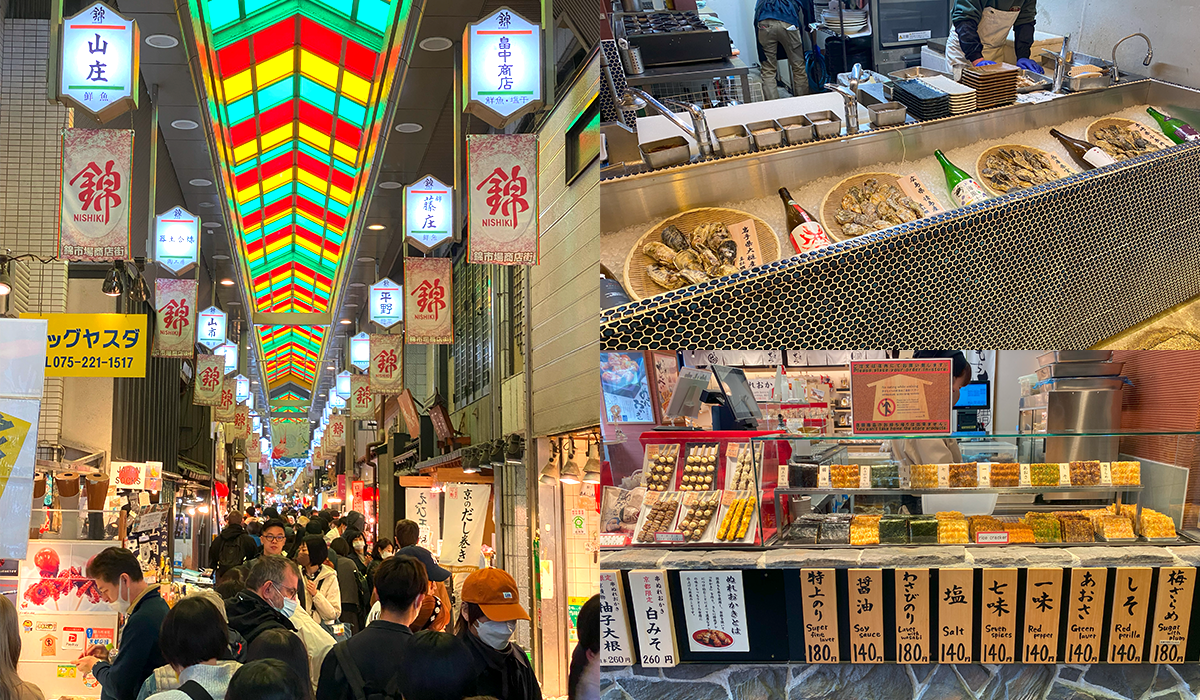
A side-by-side view of Nishiki Market in Kyoto, the covered shopping street known as "Kyoto's kitchen." The left photo looks down the narrow arcade, packed with shoppers in jackets, several wearing face masks. Overhead, the ceiling is lined with striking red, green, and yellow chevron-patterned light panels, and red-and-white fabric banners reading "NISHIKI" with the kanji 錦 hang alongside shop signs and paper lanterns on both sides. The right photo shows one of the market's food stalls up close. An ice-filled counter displays oysters and other shellfish on woven trays next to bottles of sake, with a vendor in an apron working behind it. In front, glass cases hold skewers and neat rows of bite-sized cubes in soy, seaweed, and sesame coatings, and a handwritten price board lists flavors like soy sauce, wasabi, salt, seven spice, and perilla starting at 140 yen.
A side-by-side view of Nishiki Market in Kyoto, the covered shopping street known as "Kyoto's kitchen." The left photo looks down the narrow arcade, packed with shoppers in jackets, several wearing face masks. Overhead, the ceiling is lined with striking red, green, and yellow chevron-patterned light panels, and red-and-white fabric banners reading "NISHIKI" with the kanji 錦 hang alongside shop signs and paper lanterns on both sides.
The right photo shows one of the market's food stalls up close. An ice-filled counter displays oysters and other shellfish on woven trays next to bottles of sake, with a vendor in an apron working behind it. In front, glass cases hold skewers and neat rows of bite-sized cubes in soy, seaweed, and sesame coatings, and a handwritten price board lists flavors like soy sauce, wasabi, salt, seven spice, and perilla starting at 140 yen.
Visible text in the image
錦
山庄
鮮魚
錦
NISHIKI
錦市場商店街
昌早商店
鮮魚
グヤスタ
075-221-1517
京だし巻
白みそ 260円
特上 Sweet soy 180円
醬油 Soy sauce 140円
塩 Salt 140円
七味 Seven spices 140円
一味 Red pepper 140円
あさつき Green leek 140円
しそ Red perilla 140円
Sweet perilla 180円
Kamo River 鴨川
If you’re looking for a place of relaxation and beauty in Kyoto, then you should definitely check out the Kamo River. It’s a welcome change from the temples, shrines, and the city.
Especially in spring, there are some spots along the river with beautiful Sakura trees that transform the landscape into a colorful sea of pink and white.
Even though there are many great sights in Kyoto, the Kamo River is definitely worth a visit. Whether you want to cycle along the river or just take a walk, you’ll surely be impressed by the beauty of this place.
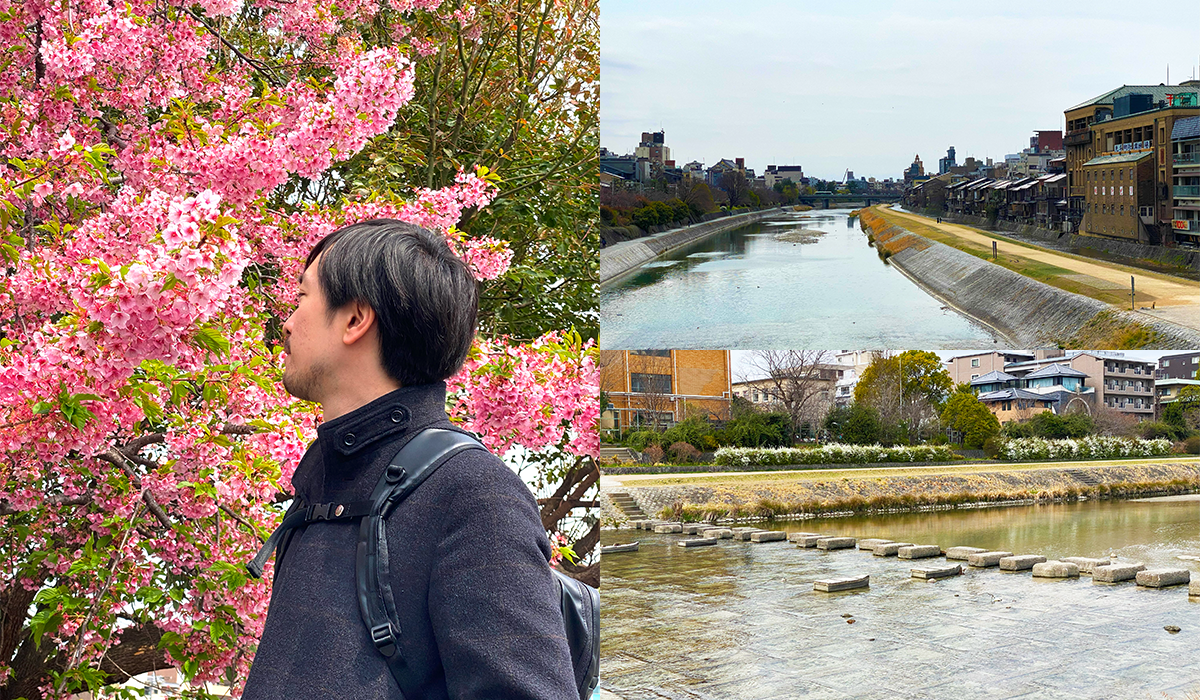
A collage of three photos from the Kamo River in Kyoto. On the left, a man in a dark wool coat with a black backpack stands in profile among dense clusters of pink cherry blossoms, looking up into the flowers. The right side shows the river itself in two views. The upper shot looks along the channelized river toward the city skyline, with sloped concrete embankments, a walking path, and low buildings lining the banks under an overcast sky. The lower shot captures the shallow water near the bank, where rows of square stepping stones cross the river, backed by apartment buildings, bare trees, and a strip of riverside greenery.
A collage of three photos from the Kamo River in Kyoto. On the left, a man in a dark wool coat with a black backpack stands in profile among dense clusters of pink cherry blossoms, looking up into the flowers.
The right side shows the river itself in two views. The upper shot looks along the channelized river toward the city skyline, with sloped concrete embankments, a walking path, and low buildings lining the banks under an overcast sky. The lower shot captures the shallow water near the bank, where rows of square stepping stones cross the river, backed by apartment buildings, bare trees, and a strip of riverside greenery.
Visible text in the image
No clearly readable text.
Visiting Temples and Shrines in Kyoto
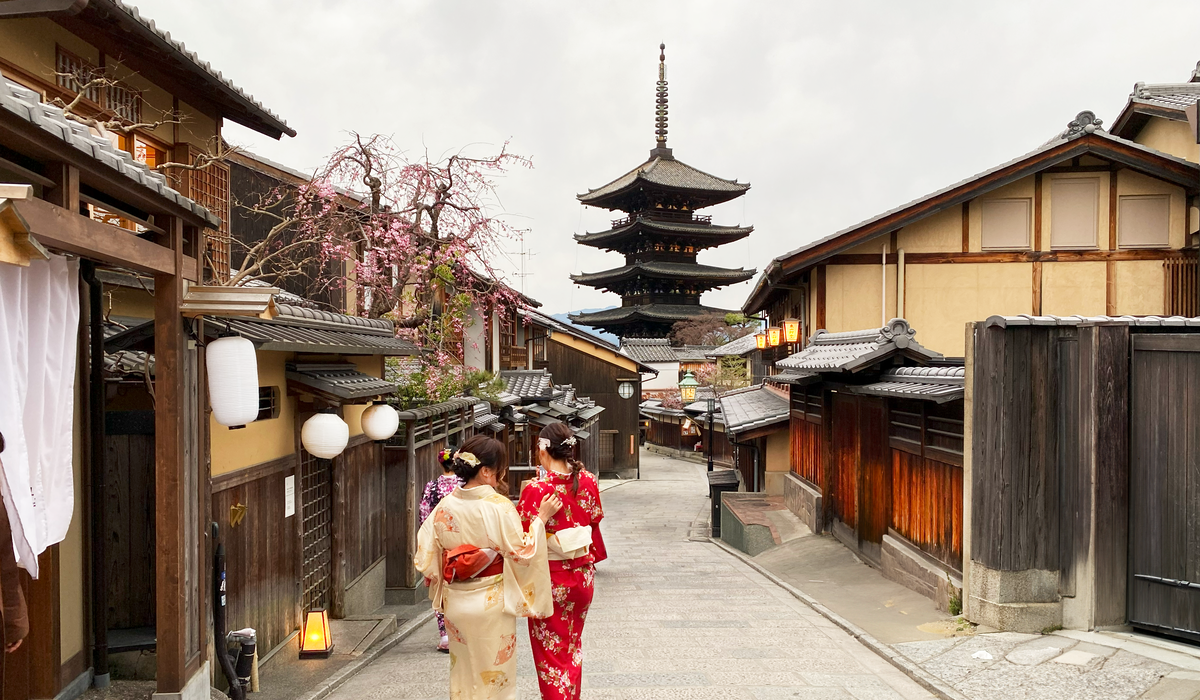
Goju-no-to Kyoto
Goju-no-to Kyoto is an impressive building in Kyoto. It is a five-story pagoda tower that’s part of the Tō-ji temple. The tower was built in 1644 and is an important part of the city’s cultural heritage. The tower is best known for its size and beauty, as well as for the many Buddhist statues kept inside. If you’re in Kyoto, you should definitely visit the Goju-no-to Kyoto to see this impressive landmark.
Fushimi Inari-Taisha: The famous shrine with thousands of Torii gates
Ready for an impressive hike? Then visit Fushimi Inari-Taisha, the famous shrine with thousands of Torii gates. The hike takes about two hours, but the breathtaking view and the unique atmosphere make it an unforgettable experience.
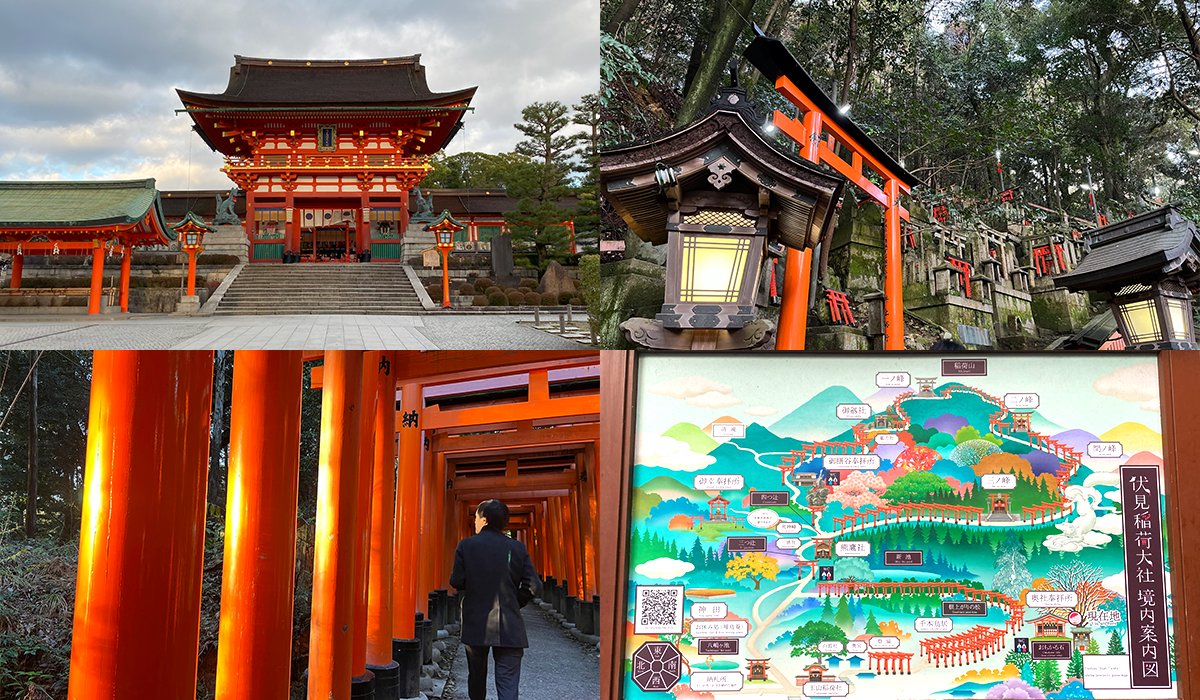
A four-photo collage from Fushimi Inari Taisha, the famous vermilion shrine in Kyoto. The top left photo shows the shrine's grand entrance gate, a two-story red structure with a sweeping dark roof, stone steps leading up to it, and lanterns flanking the approach under a cloudy sky. Top right, a tall torii gate rises from a wooded hillside dotted with small stone shrines and glowing lanterns tucked into the slope. The bottom left photo takes you inside the signature tunnel of closely packed orange torii gates, with a visitor in a dark coat walking away down the gravel path. The bottom right photo is an illustrated grounds map of the shrine complex, drawn in bright greens and reds, showing the hiking trails, sub-shrines, and the three peaks of Mount Inari with labels in Japanese.
A four-photo collage from Fushimi Inari Taisha, the famous vermilion shrine in Kyoto.
The top left photo shows the shrine's grand entrance gate, a two-story red structure with a sweeping dark roof, stone steps leading up to it, and lanterns flanking the approach under a cloudy sky. Top right, a tall torii gate rises from a wooded hillside dotted with small stone shrines and glowing lanterns tucked into the slope. The bottom left photo takes you inside the signature tunnel of closely packed orange torii gates, with a visitor in a dark coat walking away down the gravel path. The bottom right photo is an illustrated grounds map of the shrine complex, drawn in bright greens and reds, showing the hiking trails, sub-shrines, and the three peaks of Mount Inari with labels in Japanese.
Visible text in the image
内
納
伏見稲荷大社境内案内図
稲荷山
一ノ峰
二ノ峰
三ノ峰
間ノ峰
四辻
手水舎
Fushimi Inari Taisha – Private Half-Day Tour in Kyoto
Experience the iconic Fushimi Inari Taisha with its endless red Torii tunnels on a private half-day tour. A local guide will accompany you along the historic paths, tell you the stories behind the fox statues (Kitsune) and lead you to hidden corners away from the tourist crowds. Perfect for anyone who wants to discover the spiritual heart of Kyoto in an intense and personal way.
Kinkaku-ji: The Golden Pavilion
The Golden Pavilion, also known as Kinkaku-ji, is one of the most famous landmarks in Kyoto. The temple is covered in gold leaf and reflects in the calm water of the pond. It’s a beautiful and peaceful setting you shouldn’t miss.
Guided Tours at Kinkaku-ji Temple
Guided tours are also available. If you’d like to explore Kinkaku-ji Temple with a local guide, you can book them directly on-site.
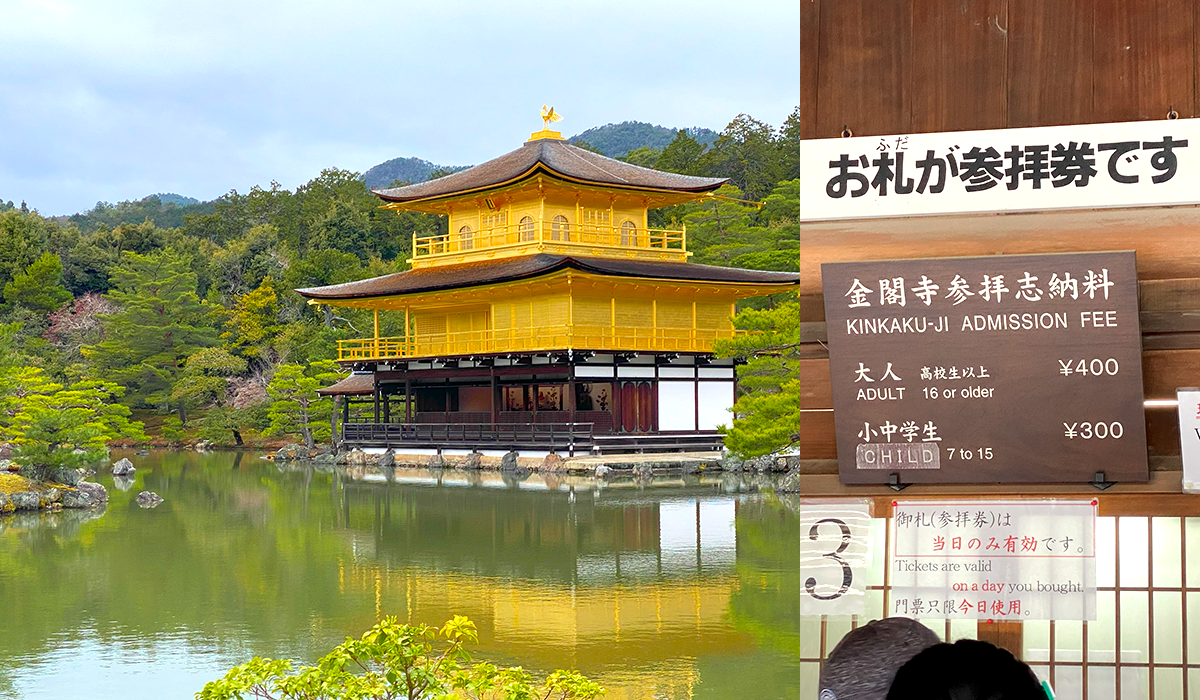
The photo is split into two scenes from a visit to Kinkaku-ji, the Golden Pavilion in Kyoto. On the left, the temple's top two floors gleam in gold leaf above a white-plastered ground level, standing at the edge of a still pond that mirrors the building almost perfectly. Dark tiled roofs stack in tiers, crowned by a small golden phoenix, and forested hills rise behind it under a grey sky. Pines and autumn-touched trees frame the shoreline. The right half shows the ticket counter. A wooden board lists the admission fee in Japanese and English: ¥400 for adults 16 and older, ¥300 for children 7 to 15. Above it, a white banner explains in Japanese that your receipt doubles as the admission ticket, and below, a smaller multilingual notice states tickets are valid only on the day of purchase. The top of a visitor's head is just visible at the bottom edge, waiting at window number 3.
The photo is split into two scenes from a visit to Kinkaku-ji, the Golden Pavilion in Kyoto. On the left, the temple's top two floors gleam in gold leaf above a white-plastered ground level, standing at the edge of a still pond that mirrors the building almost perfectly. Dark tiled roofs stack in tiers, crowned by a small golden phoenix, and forested hills rise behind it under a grey sky. Pines and autumn-touched trees frame the shoreline.
The right half shows the ticket counter. A wooden board lists the admission fee in Japanese and English: ¥400 for adults 16 and older, ¥300 for children 7 to 15. Above it, a white banner explains in Japanese that your receipt doubles as the admission ticket, and below, a smaller multilingual notice states tickets are valid only on the day of purchase. The top of a visitor's head is just visible at the bottom edge, waiting at window number 3.
Visible text in the image
ふだ
お札が参拝券です
金閣寺参拝志納料
KINKAKU-JI ADMISSION FEE
大人 高校生以上 ¥400
ADULT 16 or older
小中学生 ¥300
CHILD 7 to 15
3
御札(参拝券)は
当日のみ有効です。
Tickets are valid
on a day you bought.
門票只限今日使用。
Kiyomizu-dera: The Temple on Stilts
The Kiyomizu-dera Temple is another gem in Kyoto. The temple was built without nails or screws and stands on stilts. From here you have a breathtaking view over Kyoto.
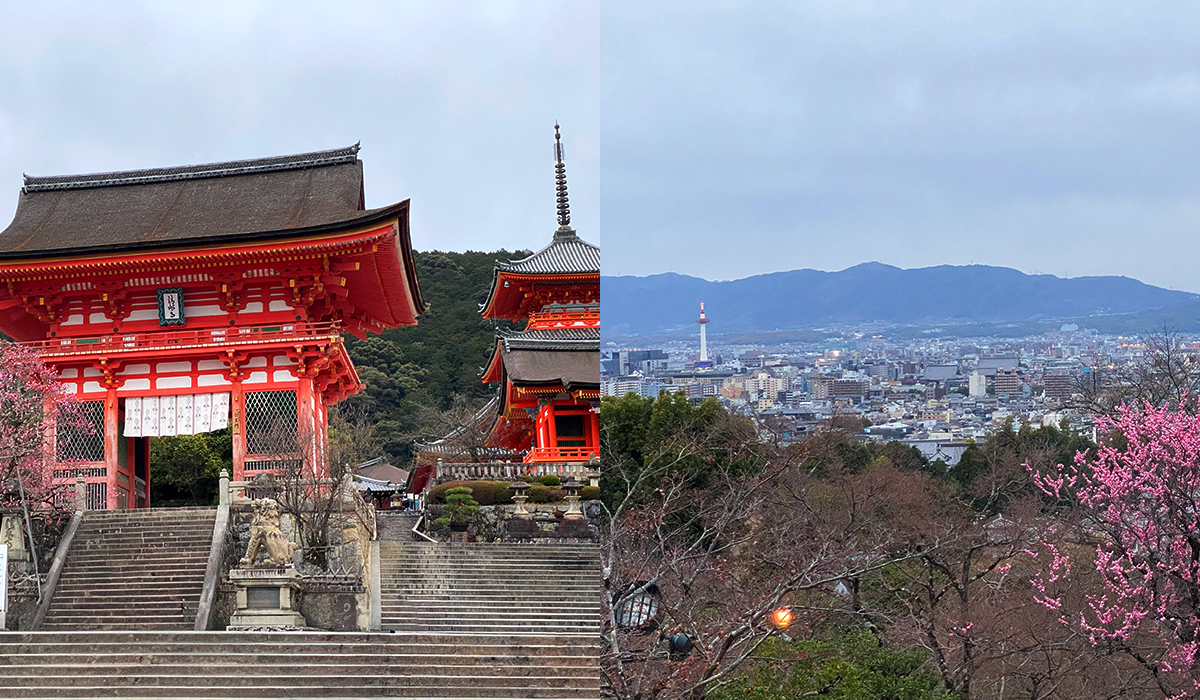
A two-part photo from Kyoto. On the left, the vermilion-red gate of Kiyomizu-dera temple rises above a wide flight of stone stairs. A guardian statue sits in a stone niche beside the steps, white banners hang in the gate's lower level, and the temple's three-storied pagoda stands on the slope behind it under an overcast sky, framed by dark green trees and pink blossoms. The right half shows the view from the hillside looking down over Kyoto: a dense spread of low city buildings stretching toward a band of blue-grey mountains, with the slender white-and-red Kyoto Tower rising near the center. Bare winter branches and bright pink plum blossoms fill the foreground.
A two-part photo from Kyoto. On the left, the vermilion-red gate of Kiyomizu-dera temple rises above a wide flight of stone stairs. A guardian statue sits in a stone niche beside the steps, white banners hang in the gate's lower level, and the temple's three-storied pagoda stands on the slope behind it under an overcast sky, framed by dark green trees and pink blossoms.
The right half shows the view from the hillside looking down over Kyoto: a dense spread of low city buildings stretching toward a band of blue-grey mountains, with the slender white-and-red Kyoto Tower rising near the center. Bare winter branches and bright pink plum blossoms fill the foreground.
Visible text in the image
No text is clearly readable in the image.
Exploring Kyoto by Bicycle
If you want to explore Kyoto in a special way, then a bike ride through the city is just what you need. With a bicycle, you can quickly and easily get from one attraction to the next and experience the city’s beauty from a different perspective. We recommend renting a bike and taking one of the many bike routes through the city. This way, you can visit the famous temples and shrines, cycle through narrow alleys, and experience Japanese culture up close. A bike tour through Kyoto is an unforgettable experience and a great way to explore the city.
Kyoto and the Cherry Blossom: Hanami in the Ancient Capital
Kyoto is beautiful at any time of year, but during cherry blossom season, the city turns into a real fairytale land.
There are many places in Kyoto where you can admire the cherry blossoms. One of the best known is the Philosopher’s Path, where you can walk under blooming cherry trees and enjoy the beauty of nature. The path is named after philosopher Nishida Kitaro, who often walked here to think and meditate.
Discover Kyoto with a Local – Custom Private Tour
Experience Kyoto like a local: This private tour is individually tailored to your interests—whether famous temples, hidden alleys, or culinary highlights. Your guide will plan the route with you so you can explore the city just the way you like. Perfect for anyone who wants to experience Kyoto authentically and flexibly.
Kyoto Highlights – Private Day Tour
Kyoto Highlights – Private Day Tour: Explore the most famous places in Kyoto in one day with a private guide—from the Golden Pavilion to the Arashiyama bamboo forest to Fushimi Inari and the Gion district. Perfect for getting to know the city in a compact and stress-free way.
*Affiliate link: If you book an activity through my widget or my link at viator.com, I receive a small commission. There are no additional costs for you and you support my blog. I’m very grateful and wish you lots of fun traveling (^_^)
*Affiliate link: If you book an activity through my widget or my link at viator.com, I receive a small commission. There are no additional costs for you and you support my blog. I’m very grateful and wish you lots of fun traveling (^_^)



Comments