
Table of contents:
TL;DR
The blog "Fertiggerichte in Japan" explores the significance of food in Japanese culture and the convenience of ready-made meals amid Japan's demanding work environment. It highlights the UNESCO-recognized culinary heritage of Japan and the minimal cooking time many working singles experience due to long hours. The site contrasts the rich variety of take-out options available in Japanese cities, from noodle shops and sushi restaurants to convenient supermarket offerings, against the limited dining experiences in smaller German towns. Moreover, it emphasizes the availability of high-quality ready meals in Japanese supermarkets, featuring freshly prepared dishes that differ significantly from the fast food and frozen meals typically found in Germany. Additionally, the blog discusses buffet restaurants, which offer diverse meals for dine-in or take-away, promoting an accessible approach to enjoying quality food without extensive preparation.Plenty of good food, and above all, is an essential part of Japanese culture and in the life of every Japanese person. Japanese cuisine is even listed as a UNESCO World Heritage Site! But very long working hours are also part of everyday Japanese life. For this reason, working singles in particular have little time to cook for themselves - and they need an alternative to expensive restaurant meals and homemade meals. That's why there are a wide variety of food stalls and restaurants in Japanese cities that prepare take-away dishes and fast food to restaurant standards. In these snack bars, you can buy ready-made meat, vegetables and sauces very easily. At home, all you have to do is cook some rice - and even that is available for quick microwave preparation. This way you have a warm dish every day even without cooking and eating out. If this concept existed in Germany, I would probably - unfortunately - eat almost exclusively like this! Because I also have very long working hours, with my two jobs and the blog. But the situation here is a little different: In larger cities, such as Düsseldorf, where I lived for a long time, there is naturally something to eat on every corner - but usually it's kebab shops, which I definitely don't want to visit every day. At the moment I live in a small village where the "restaurant offer" consists of a bakery, a Burger King, Subway and McDonalds - and that's it! In the nearest larger town there are a few pubs with home-cooked food, pizzerias and of course kebab shops - nothing more.

A white foam takeaway tray holds a portion of golden Japanese fried chicken, the crispy pieces piled loosely across the tray. A small sauce packet sits in the right corner alongside the chicken. Wooden chopsticks rest on the dark tabletop beside the tray, ready for the meal. It is a typical convenience store ready-to-eat dish, packed and served cold-counter style for a quick meal.
A white foam takeaway tray holds a portion of golden Japanese fried chicken, the crispy pieces piled loosely across the tray. A small sauce packet sits in the right corner alongside the chicken. Wooden chopsticks rest on the dark tabletop beside the tray, ready for the meal. It is a typical convenience store ready-to-eat dish, packed and served cold-counter style for a quick meal.
Visible text in the image
No text is clearly readable.
Various fast food restaurants
A city in Japan, on the other hand - this also applies to small towns - offers a wide range of fast food restaurants: There are noodle restaurants, grill restaurants, chicken roasts, Gyūdon restaurants (Gyūdon consists of rice with fried beef and onions and is served with minimal waiting time) and sushi restaurants (mostly Kaiten-Sushi, which works according to the concept of running sushi and is slightly cheaper than sushi ordered à la carte). The various dishes all cost between 3 and 10 euros. What you hardly find, however, are Western restaurants, kebab shops (which are more likely to come in the form of food trucks) or pizzerias.
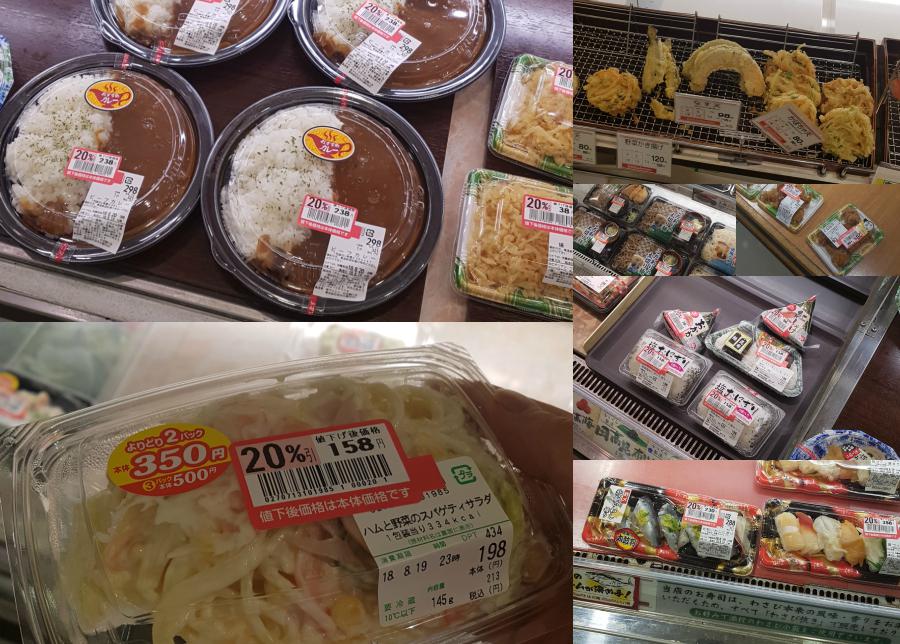
This is a collage of photos taken in a Japanese supermarket, all showing discounted ready-made meals. The largest photo, in the lower left, is a close-up of a plastic container of potato salad with a bright red discount sticker reading "20%" and a sale price of 158 yen, down from 198. A yellow tag notes a two-item deal for 350 yen. The other photos show more of the chilled food section: packaged curry rice dishes in clear plastic bowls, each marked with 20%-off stickers, trays of noodles and side dishes, a refrigerated shelf of triangle-shaped onigiri rice balls in wrappers, and bento boxes and sushi packs lined up on shelves with red price tags and discount labels. One photo shows a display of tempura and fried items on a wire rack. The overall scene is a typical Japanese supermarket at discount time, when fresh prepared foods get marked down with percentage-off stickers late in the day.
This is a collage of photos taken in a Japanese supermarket, all showing discounted ready-made meals.
The largest photo, in the lower left, is a close-up of a plastic container of potato salad with a bright red discount sticker reading "20%" and a sale price of 158 yen, down from 198. A yellow tag notes a two-item deal for 350 yen. The other photos show more of the chilled food section: packaged curry rice dishes in clear plastic bowls, each marked with 20%-off stickers, trays of noodles and side dishes, a refrigerated shelf of triangle-shaped onigiri rice balls in wrappers, and bento boxes and sushi packs lined up on shelves with red price tags and discount labels. One photo shows a display of tempura and fried items on a wire rack.
The overall scene is a typical Japanese supermarket at discount time, when fresh prepared foods get marked down with percentage-off stickers late in the day.
Visible text in the image
20%引 298
20%引 398
20%引 348
20%引 348
120
80
塩むすび
塩むすび
よくばり2パック
350円
500円
20%引 158
値下げ後価格
198
値下げ商品は本体価格です
1963
145g
10:05P
298
348
Full at the supermarket
But even in the supermarket there are excellent ready-made meals in Japan, which surprised me very much. If you want to buy ready-made food in the supermarket in Germany, you have the choice of sandwiches and, of course, frozen meals and packet soups, which you still have to "cook" yourself. Occasionally you can now also find salad bars where you can put together your own salad. In Japan, on the other hand, every supermarket offers a variety of freshly fried, hot dishes - from meat to fish to vegetables. Of course, there are also the most diverse cup noodles, to which only hot water needs to be added. But the selection of different flavors is much larger than in Germany. Ramen is the most common, but there are also buckwheat noodles and fried noodles, for example. And then every supermarket has a section where there are pre-prepared, packaged meals. These are, for example, rice, meat, vegetables, sauce and salad, but also soups. This is virtually non-existent in Germany!
Buffets - Take what you like
There are also buffet restaurants that have both seating and packaging for take-away. Here you can get a variety of dishes with rice, noodles, fish, meat, salad and sauces. You pay by weight - so you can take exactly the right amount.
Comments