
Inhaltsverzeichnis:
TL;DR
Daikon, auch bekannt als japanischer oder chinesischer Rettich, ist ein zentraler Bestandteil der ostasiatischen Küche und wird häufig in verschiedenen Zubereitungsarten verwendet, um seinen einzigartigen Geschmack hervorzuheben. Die Hauptsaison für Daikon ist der Herbst, und er wird oft in Form von Salaten oder als Beilage zu Sashimi serviert, wobei er in sehr dünne Streifen geschnitten werden sollte, um eine zu scharfe Note zu vermeiden. Eine beliebte Variante ist Kiriboshi Daikon, bei dem der Rettich geschnitten und getrocknet wird, was die Aromen intensiviert. Auch die Blätter des Daikons finden in der Küche Verwendung. Daikon ist mittlerweile in vielen deutschen Supermärkten erhältlich, wobei frische und feste Exemplare bevorzugt werden, um ein angenehmes Geschmackserlebnis zu garantieren.| Hauptsaison: | Herbst |
|---|---|
| Kategorie: | Gemüse |
| Andere Bezeichungen: | Daikon-Rettich, japanischer oder chinesischer Rettich, Winterrettich |
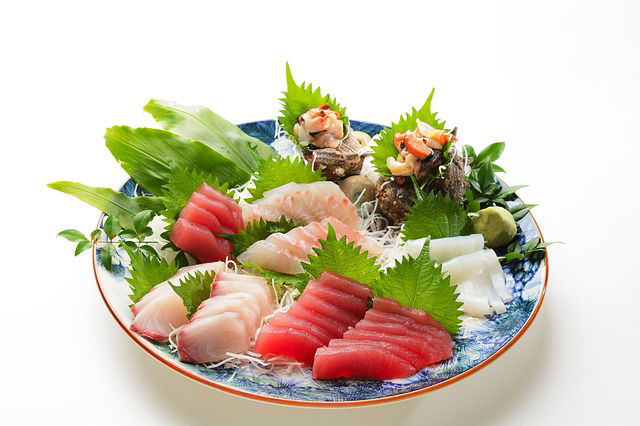
A round plate of assorted sashimi sits on a white surface. The plate is decorated in blue and white patterns with an orange rim, and its base is covered with fine shredded daikon radish. On top are slices of raw fish arranged in small fanned groups: deep red tuna, pale pink and white fish, and translucent squares of squid. Two pieces near the back are topped with a small seafood mixture, and a mound of green wasabi rests at the right edge. Jagged-edged green shiso leaves are tucked between the fish, with a few broader leaves and sprigs filling out the arrangement.
A round plate of assorted sashimi sits on a white surface. The plate is decorated in blue and white patterns with an orange rim, and its base is covered with fine shredded daikon radish. On top are slices of raw fish arranged in small fanned groups: deep red tuna, pale pink and white fish, and translucent squares of squid. Two pieces near the back are topped with a small seafood mixture, and a mound of green wasabi rests at the right edge. Jagged-edged green shiso leaves are tucked between the fish, with a few broader leaves and sprigs filling out the arrangement.
Sichtbarer Text im Bild
No text is clearly readable in the image.
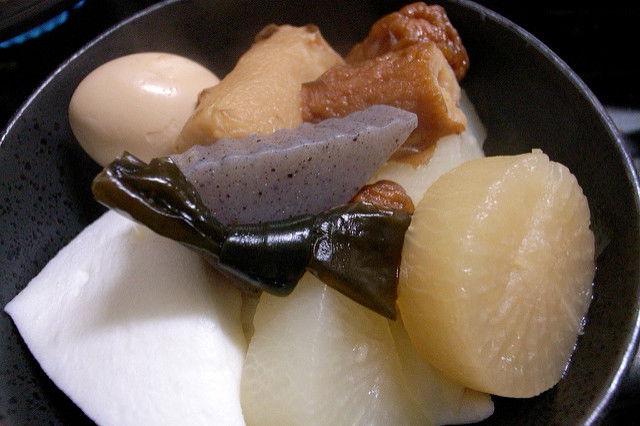
A close-up of a dark bowl filled with oden, the Japanese simmered dish, packed so the pieces nearly fill the frame. A thick round slice of daikon radish sits on the right, cooked to a translucent pale yellow, with a wedge of white daikon at the lower left. Beside them rest a whole boiled egg tinted light brown from the broth, a gray speckled triangle of konjac, a folded piece of dark kombu seaweed tied like a knot, and several browned fish cakes crowded at the top. Everything glistens with simmering broth, giving the dish a soft, stewed look.
A close-up of a dark bowl filled with oden, the Japanese simmered dish, packed so the pieces nearly fill the frame. A thick round slice of daikon radish sits on the right, cooked to a translucent pale yellow, with a wedge of white daikon at the lower left. Beside them rest a whole boiled egg tinted light brown from the broth, a gray speckled triangle of konjac, a folded piece of dark kombu seaweed tied like a knot, and several browned fish cakes crowded at the top. Everything glistens with simmering broth, giving the dish a soft, stewed look.
Sichtbarer Text im Bild
No text is clearly readable in this image.
Daikon (jap. だいこん oder auch 大根 heißt Wörtlich „Größe Wurzel“) ist ein Rettich der in Ostasien verbreitet ist. Er ist ein Hauptbestandteil der japanischen Küche und ist nicht wegzudenken. Deswegen hat dieser Rettich auch viele Namen wie: Daikon-Rettich, Japanischer oder Chinesischer Rettich oder auch Winterrettich. Es gibt sehr viele Zubereitungsarten die den Geschmack des Daikons in verschiedenste Arten hervorhebt. Beispielsweise wird Daikon geschnetzelt und anschließend getrocknet was dann Kiriboshi Daikon (切干大根, „geschnittener und getrockneter Daikon“). heißt. Dabei verliehrt der Rettich sehr viel Wasser, sodass die Aromen noch stärker zum Vorscheinen kommen. Als Salat oder beilage als Sashimi eignet sich Diakon ebenfalls super. Dabei ist es wichtig das der Daikon in sehr dünne Streifen geschnitten wird. Denn wenn die Streifen zu dick sind, schmeckt der Salat sehr scharf. Die Schärfe ist auch saisonal abhängig, nach meiner Erfahrung sind die Daikons in Winter milder und schmecken auch besser. Die Blätter des Daikons können ebenfalls verarbeitet werden. Dieser kann auch nachwachen, sofern man ein Stück des Kopfs ca. 3cm behält und anschießend in Wasser lässt. Mittlerweile ist Daikon auch in deutschen Supermärkten zu finden. Dabei ist es wichtig das dieser straf und nicht gummiartig ist, sonst schmeckt er nicht mehr.
Kommentare