
Inhaltsverzeichnis:
TL;DR
Erlebe die faszinierende Reise nach Sapporo, der Hauptstadt der nordjapanischen Insel Hokkaido, in diesem umfassenden Reiseführer. Der Bericht bietet wertvolle Tipps zur Anreise, sei es mit dem Flugzeug, Auto oder Zug, und hebt die Vorteile eines Inlandsflugs hervor, um Zeit zu sparen. Nach der Ankunft in Sapporo wird das Mieten eines Autos empfohlen, um die Region flexibel zu erkunden, da die öffentlichen Verkehrsmittel nicht so gut ausgebaut sind. Die Autorin teilt ihre Erfahrungen mit Toyota Rent a Car und betont die kostengünstige Mobilität, die ein Hybridfahrzeug bietet. Genießen Sie die einzigartigen kulinarischen Spezialitäten und die beeindruckende Landschaft Hokkaidos, während Sie gleichzeitig praktische Informationen und persönliche Eindrücke zu dieser besonderen Destination erhalten.In diesem Reisebericht zeige ich dir alles über meine mehrtägige Reise zur nördlichsten Insel Japans – Hokkaido! Ich teile meine Tipps und Erfahrungen dazu, wie du nach Sapporo kommst und welche lokalen kulinarischen Spezialitäten dich hier erwarten. Hokkaido bietet eine einzigartige Landschaft, ein frostiges Klima und großartige Sehenswürdigkeiten, die diese Präfektur wirklich besonders machen.
Von Tokio nach Sapporo
Mit dem Flugzeug
Sapporo liegt auf Hokkaido, der nördlichsten Insel Japans. Für unsere Reise nach Hokkaido sind wir deshalb mit dem Flugzeug von Haneda nach Sapporo gereist. Der Preis für ein Hin-und-Rückflugticket lag bei 37.000 Yen (etwa 228 Euro) pro Person. Der Flug dauerte etwa 1,5 Stunden, und ich empfehle, etwa 1–2 Stunden vor Abflug am Flughafen zu sein. Die Sicherheitskontrolle ging schnell, weil es ein Inlandsflug war, und die Gates waren gut zu erreichen. Das Essen direkt bei den Gates war allerdings nicht zu empfehlen. Vor der Sicherheitskontrolle des internationalen Haneda Flughafens gibt es eine gute Auswahl an Restaurants – aber da wir einen Inlandsflug hatten, war es ein anderes Terminal und wir konnten diesmal dort nicht essen.
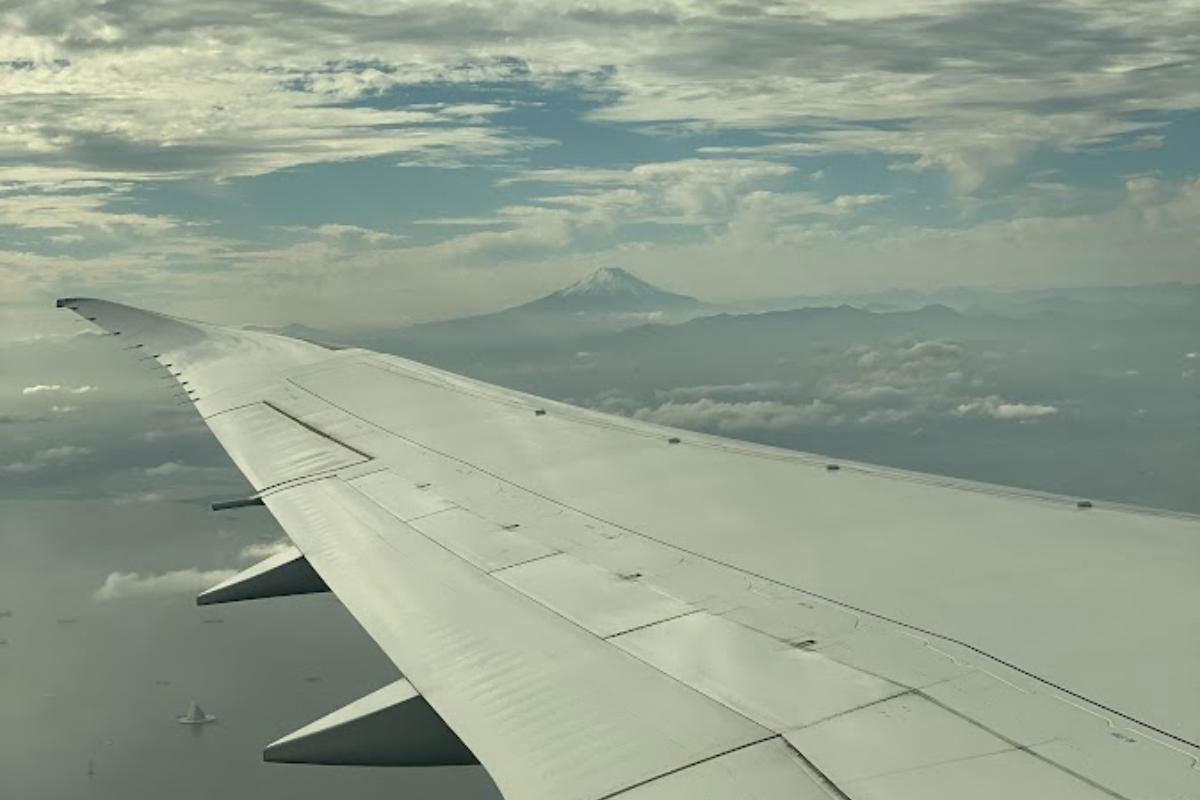
View from an airplane window, with the aircraft's long white wing sweeping across the lower half of the frame from the left edge toward the bottom right. Beyond the wing, the unmistakable snow-capped cone of Mount Fuji rises above a thick layer of haze and scattered clouds, its summit the only point breaking the horizon. Patches of blue sky show through broken clouds overhead, while the ground and water far below are softened by the cloudy veil. A quiet moment on a flight over Japan, the kind of view travelers catch on the way north to Hokkaido.
View from an airplane window, with the aircraft's long white wing sweeping across the lower half of the frame from the left edge toward the bottom right. Beyond the wing, the unmistakable snow-capped cone of Mount Fuji rises above a thick layer of haze and scattered clouds, its summit the only point breaking the horizon. Patches of blue sky show through broken clouds overhead, while the ground and water far below are softened by the cloudy veil. A quiet moment on a flight over Japan, the kind of view travelers catch on the way north to Hokkaido.
Sichtbarer Text im Bild
No clearly readable text.
Mit dem Auto
Es besteht auch grundsätzlich die Möglichkeit, von Tokio nach Hokkaido zu fahren . Allerdings ist das eine sehr lange Strecke – laut Google Maps etwa 17 Stunden. Unterwegs gibt es mehrere Mautstationen und man muss eine Fähre nehmen, was zusätzliche Kosten verursacht. Deshalb empfehle ich, zu fliegen und vor Ort ein Auto zu mieten.
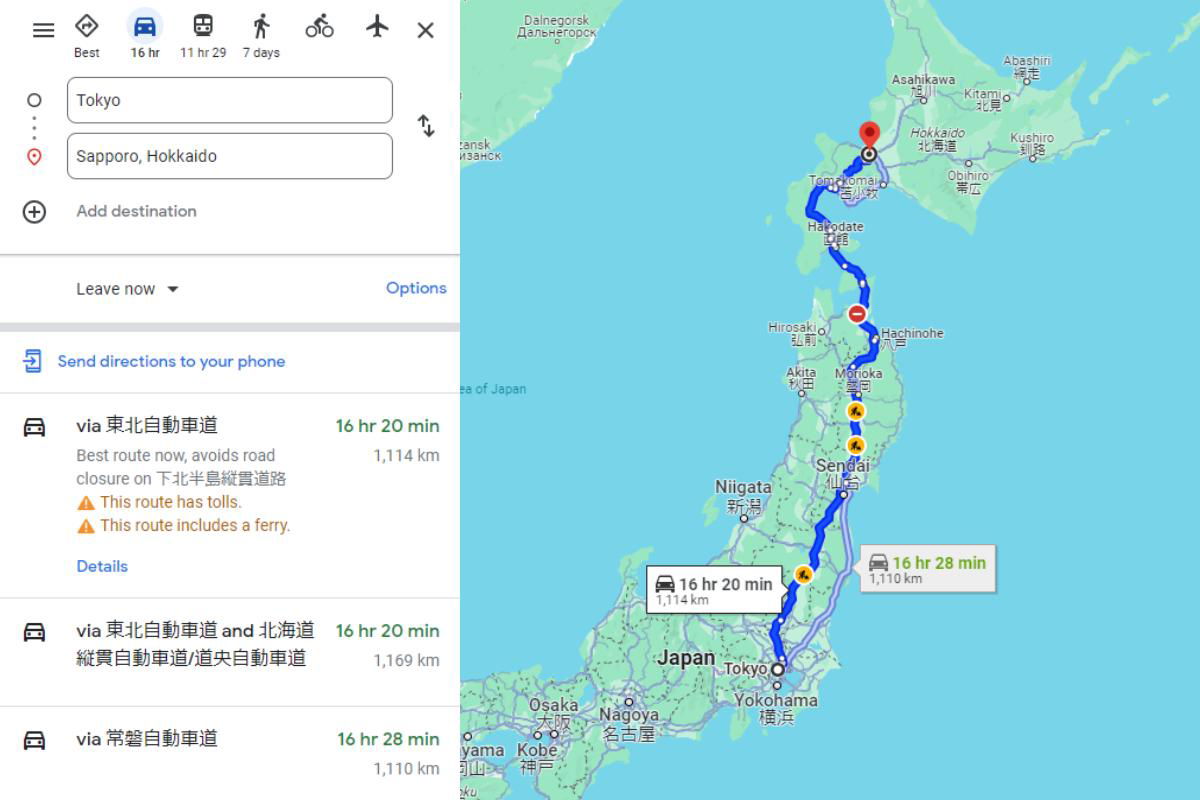
A Google Maps screenshot showing driving directions from Tokyo to Sapporo, Hokkaido. The left panel lists route options, the fastest being 16 hr 20 min over 1,114 km via the Tohoku Expressway, with warnings that the route has tolls and includes a ferry. Two alternative routes are listed below, each around 16 hr 20 to 28 min. The map on the right shows Japan with a blue route line running from Tokyo northward through Sendai, Aomori, and Hakodate up to Sapporo on Hokkaido, where a red pin marks the destination.
A Google Maps screenshot showing driving directions from Tokyo to Sapporo, Hokkaido. The left panel lists route options, the fastest being 16 hr 20 min over 1,114 km via the Tohoku Expressway, with warnings that the route has tolls and includes a ferry. Two alternative routes are listed below, each around 16 hr 20 to 28 min.
The map on the right shows Japan with a blue route line running from Tokyo northward through Sendai, Aomori, and Hakodate up to Sapporo on Hokkaido, where a red pin marks the destination.
Sichtbarer Text im Bild
Best
16 hr
11 hr 29
7 days
Tokyo
Sapporo, Hokkaido
Add destination
Leave now
Options
Send directions to your phone
via 東北自動車道
16 hr 20 min
Best route now, avoids road
closure on 下北半島縦貫道路
1,114 km
This route has tolls.
This route includes a ferry.
Details
via 東北自動車道 and 北海
縦貫自動車道/道央自動車道
16 hr 20 min
1,169 km
via 常磐自動車道
16 hr 28 min
1,110 km
Dalnegorsk
Дальнегорск
Abashiri
網走
Asahikawa
旭川
Kitami
北見
Hakodate
北海道
Kushiro
釧路
Tomakomai
苫小牧
Obihiro
帯広
Hakodate
函館
Hachinohe
八戸
Hirosaki
弘前
Akita
秋田
Morioka
盛岡
Sendai
仙台
Niigata
新潟
Japan
Tokyo
Yokohama
横浜
Osaka
大阪
Nagoya
名古屋
yama
Kobe
神戸
16 hr 28 min
1,110 km
16 hr 20 min
1,114 km
ea of Japan
Mit dem Zug
Es gibt auch die Möglichkeit, mit dem Shinkansen bis nach Hokkaido zu fahren. Die Fahrtzeit ab Tokio Station beträgt aber etwa 8 Stunden. Bis Shin-Hakodate-Hokuto Station kommt man mit dem Shinkansen, danach muss man in einen Regionalzug nach Sapporo umsteigen. Von allen Optionen empfehle ich auf jeden Fall, das Geld zu investieren und zu fliegen – alleine schon um Zeit zu sparen.
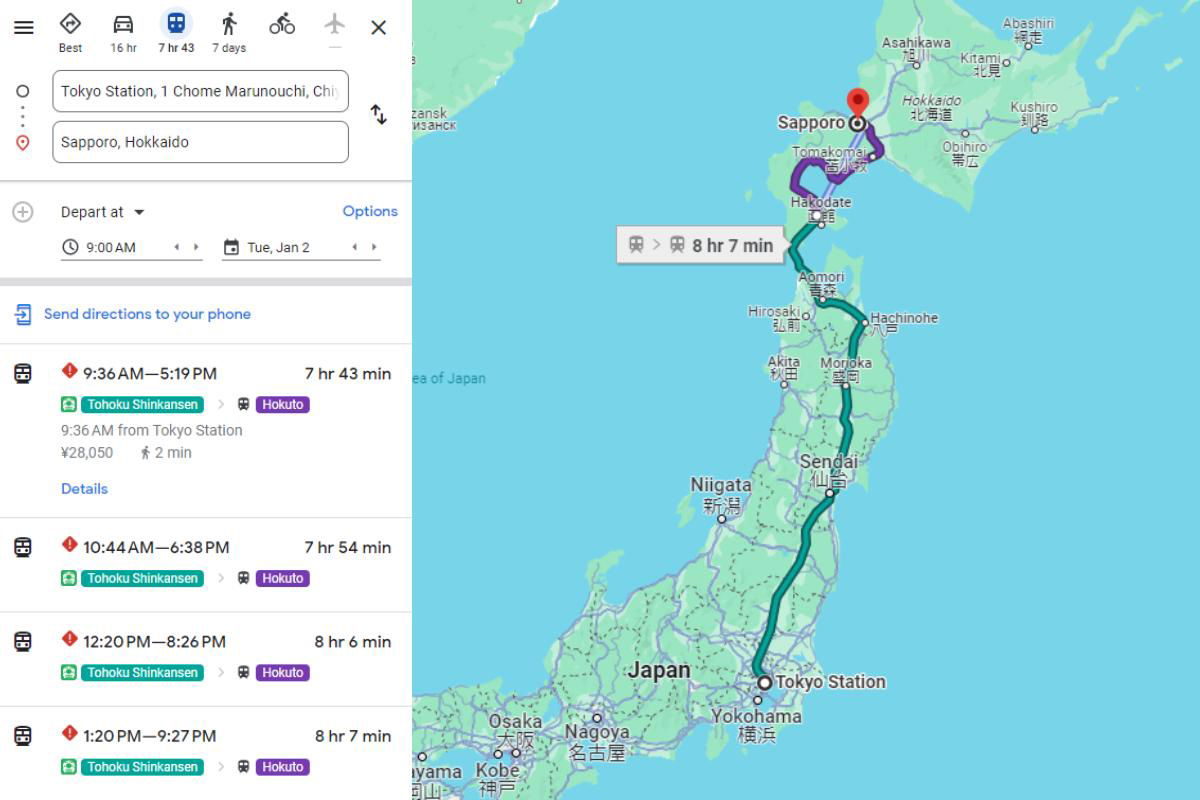
This is a screenshot of a Google Maps route search for a train trip from Tokyo Station to Sapporo, Hokkaido. The left panel lists four departure options on Tuesday, January 2, each combining the Tohoku Shinkansen and the Hokuto limited express, with journey times ranging from about 7 hr 43 min to 8 hr 7 min and a fare of ¥28,050. The map on the right shows the route as a line running north from Tokyo through Sendai, Morioka, and Aomori, crossing to Hokkaido via Hakodate and Tomakomai before ending with a red pin in Sapporo.
This is a screenshot of a Google Maps route search for a train trip from Tokyo Station to Sapporo, Hokkaido. The left panel lists four departure options on Tuesday, January 2, each combining the Tohoku Shinkansen and the Hokuto limited express, with journey times ranging from about 7 hr 43 min to 8 hr 7 min and a fare of ¥28,050. The map on the right shows the route as a line running north from Tokyo through Sendai, Morioka, and Aomori, crossing to Hokkaido via Hakodate and Tomakomai before ending with a red pin in Sapporo.
Sichtbarer Text im Bild
Best 16 hr 7 hr 43 7 days
Tokyo Station, 1 Chome Marunouchi, Chi
Sapporo, Hokkaido
Depart at
Options
9:00 AM Tue, Jan 2
Send directions to your phone
9:36 AM—5:19 PM 7 hr 43 min
Tohoku Shinkansen > Hokuto
9:36 AM from Tokyo Station
¥28,050 2 min
Details
10:44 AM—6:38 PM 7 hr 54 min
Tohoku Shinkansen > Hokuto
12:20 PM—8:26 PM 8 hr 6 min
Tohoku Shinkansen > Hokuto
1:20 PM—9:27 PM 8 hr 7 min
Tohoku Shinkansen > Hokuto
8 hr 7 min
Abashiri
綾走
Asahikawa
旭川
Kitami
北見
Kushiro
釧路
Hokkaido
北海道
Sapporo
札幌
Tomakomai
苫小牧
Obihiro
帯広
Hakodate
函館
Aomori
青森
Hirosaki
弘前
Hachinohe
八戸
Akita
秋田
Morioka
盛岡
Sea of Japan
Sendai
仙台
Niigata
新潟
Japan
Tokyo Station
Yokohama
横浜
Osaka
大阪
Nagoya
名古屋
yama Kobe
神戸
岡山
So mietest du ein Auto
Nach unserer Ankunft in Sapporo haben wir uns dazu entschieden, ein Auto zu mieten . So bist du flexibel und nicht auf öffentliche Verkehrsmittel angewiesen, die auf Hokkaido nicht so gut ausgebaut sind wie zum Beispiel in Tokio.
Für unsere Erkundungen rund um Hokkaido haben wir bei Toyota Rent a Car ein Auto gemietet. Direkt am Flughafen konnten wir zum Schalter gehen und haben eine Nummer bekommen. Anschließend wurden wir mit einem eigenen Bus zum Counter gebracht, wo wir bezahlt und das Auto gezeigt bekamen. Weil wir einen Hybrid angemietet hatten, haben wir für Sprit/Fahrten insgesamt nur 4.000 Yen zusätzlich auf der gesamten Reise ausgegeben, obwohl wir keine öffentlichen Verkehrsmittel benutzt haben. Ein großes Plus für alle, die kein Japanisch können: Das Personal am Toyota Rent a Car Schalter in Sapporo sprach auch Englisch!
Offizielle Website (Englisch): https://rent.toyota.co.jp/eng/
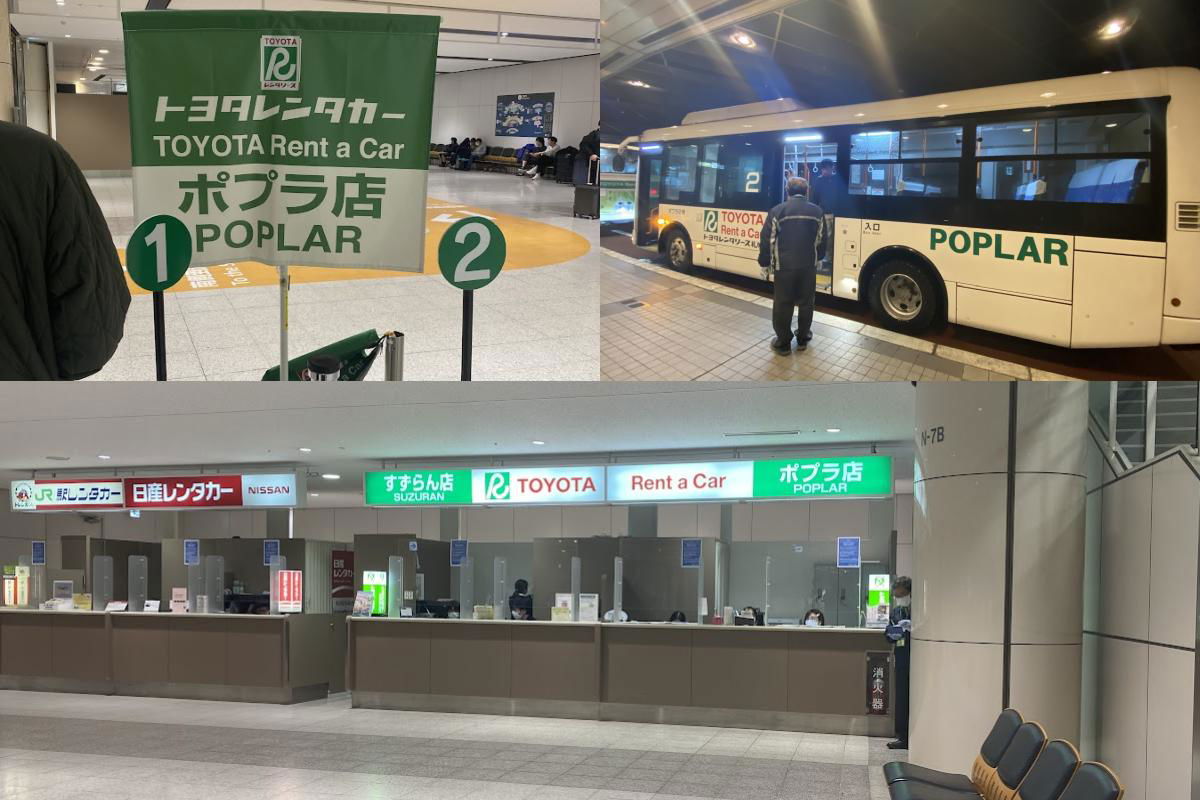
A three-part collage documenting a car rental pickup in Hokkaido, Japan. In the top left photo, a green Toyota Rent a Car banner hangs in an airport arrivals hall, reading "TOYOTA Rent a Car" in English and Japanese with "POPLAR" underneath, the branch name. Two numbered posts marked 1 and 2 stand beside it, marking the shuttle stop. Travelers with luggage sit on benches in the background. The top right photo shows the shuttle itself at night: a white bus with "POPLAR" and Toyota Rent a Car branding along its side, its door open as a uniformed staff member steps aboard at a lit curbside platform. The bottom photo stretches across the airport's rental car counter row. Illuminated signs sit above a long service counter: JR, Nippon with Nissan, and a large green Toyota Rent a Car sign flanked by its Suzuran and Poplar branches in both Japanese and English. The counters are quiet, with a couple of staff visible behind protective screens and empty seating in the foreground.
A three-part collage documenting a car rental pickup in Hokkaido, Japan.
In the top left photo, a green Toyota Rent a Car banner hangs in an airport arrivals hall, reading "TOYOTA Rent a Car" in English and Japanese with "POPLAR" underneath, the branch name. Two numbered posts marked 1 and 2 stand beside it, marking the shuttle stop. Travelers with luggage sit on benches in the background. The top right photo shows the shuttle itself at night: a white bus with "POPLAR" and Toyota Rent a Car branding along its side, its door open as a uniformed staff member steps aboard at a lit curbside platform.
The bottom photo stretches across the airport's rental car counter row. Illuminated signs sit above a long service counter: JR, Nippon with Nissan, and a large green Toyota Rent a Car sign flanked by its Suzuran and Poplar branches in both Japanese and English. The counters are quiet, with a couple of staff visible behind protective screens and empty seating in the foreground.
Sichtbarer Text im Bild
トヨタレンタカー
TOYOTA Rent a Car
ポプラ店
POPLAR
1
2
TOYOTA Rent a Car
入口
POPLAR
JR 駅レンタカー 日産レンタカー NISSAN
すずらん店
SUZURAN
TOYOTA
Rent a Car
ポプラ店
POPLAR
Unsere Unterkunft – das "Sapporo Granbell" Hotel
Während unseres Aufenthalts in Sapporo waren wir im "Sapporo Granbell" Hotel * untergebracht. Wir hatten ein etwas größeres Zimmer gebucht und das Hotel hatte für uns ein ganz besonderes Erlebnis: Ein Onsen, kostenlos verfügbar für Hotelgäste auf dem Dach des Gebäudes. Gerade im Winter ist das eine wunderbare Erfahrung.
Das Hotel bietet zudem ein Parkhaus, in dem ein Roboter das Auto einlagert. Während deines Aufenthalts kannst du so oft du willst ein- und ausparken. Die Kosten liegen bei 2.000 Yen pro Tag, was günstiger ist als die meisten Parkplätze in der Umgebung. Beim Check-out um 11:00 Uhr muss man sein Auto direkt danach abholen, da sonst 200 Yen pro weiterer Stunde berechnet werden. Unser Gepäck konnten wir am Abreisetag kostenlos einlagern, sodass wir den letzten Tag entspannt ohne Koffer genießen konnten.
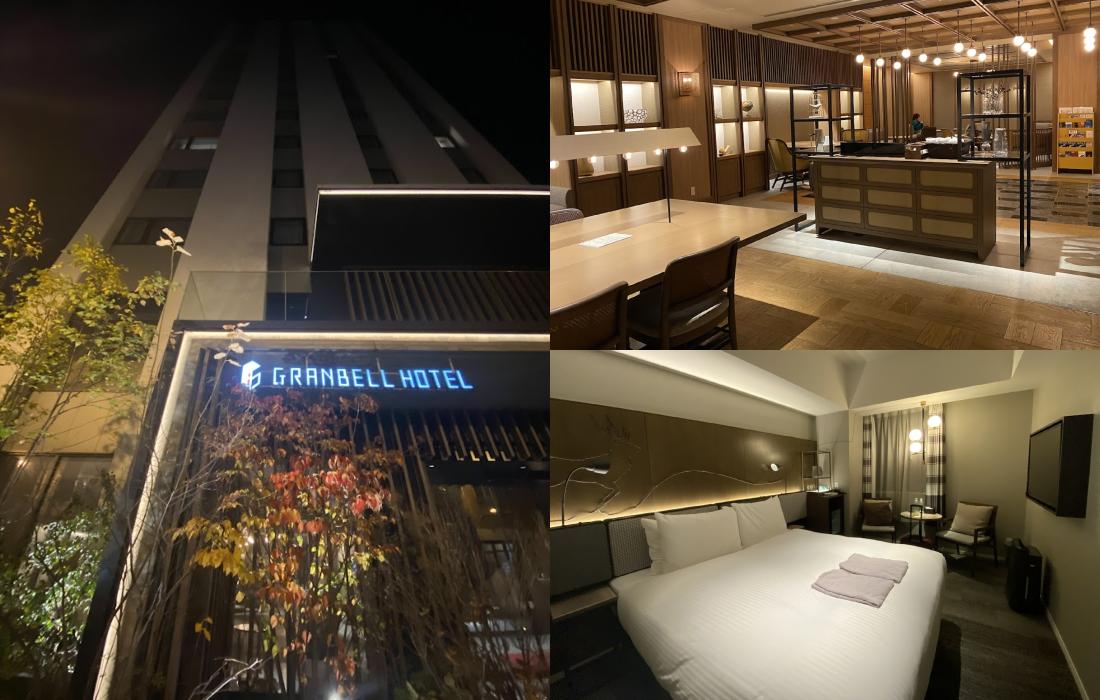
A three-part collage showing the Granbell Hotel in Sapporo. On the left, a nighttime view looking up the tower's dark facade, with a glowing blue "GRANBELL HOTEL" sign above the entrance and autumn-colored branches in the foreground. The right side shows two interior shots. The top one is a warmly lit lounge with wood-panelled walls, hanging pendant bulbs, a long communal table, and a bar counter with a staff member behind it. The bottom one is a guest room with a wide bed dressed in white linens, folded towels laid across it, a wall-mounted TV, and a pair of armchairs beside a curtained window.
A three-part collage showing the Granbell Hotel in Sapporo. On the left, a nighttime view looking up the tower's dark facade, with a glowing blue "GRANBELL HOTEL" sign above the entrance and autumn-colored branches in the foreground.
The right side shows two interior shots. The top one is a warmly lit lounge with wood-panelled walls, hanging pendant bulbs, a long communal table, and a bar counter with a staff member behind it. The bottom one is a guest room with a wide bed dressed in white linens, folded towels laid across it, a wall-mounted TV, and a pair of armchairs beside a curtained window.
Sichtbarer Text im Bild
GRANBELL HOTEL
*Affiliate-Link
Affiliate-Link: Wenn du ein Hotel über mein Widget oder meinen Link auf Booking.com buchst, erhalte ich eine kleine Provision. Für dich entstehen dadurch keine zusätzlichen Kosten und du unterstützt meinen Blog. Ich bin sehr dankbar und wünsche dir viel Spaß beim Reisen (^_^)Finde weitere Hotels in Sapporo
Google Maps: https://maps.app.goo.gl/giPB9PZK1MJAVZ579
Essen auf Hokkaido
Unsere mehrtägige Reise nach Hokkaido war eine perfekte Gelegenheit, so viele lokale kulinarische Spezialitäten wie möglich zu probieren. Welche Gerichte wir ausprobiert haben, erfährst du in den nächsten Abschnitten.
Sushi mit Jakobsmuscheln
Durch die Lage ist Hokkaido bekannt für die Auswahl an Meeresfrüchten und vor allem für super frisches Sushi. Besonders empfehlen kann ich die sehr großen Jakobsmuscheln, die man hier bekommt. Sushi mit Jakobsmuscheln ist auf Hokkaido auch besonders beliebt. Wir haben natürlich verschiedene Sushi-Sorten gegessen, um alles zu probieren.
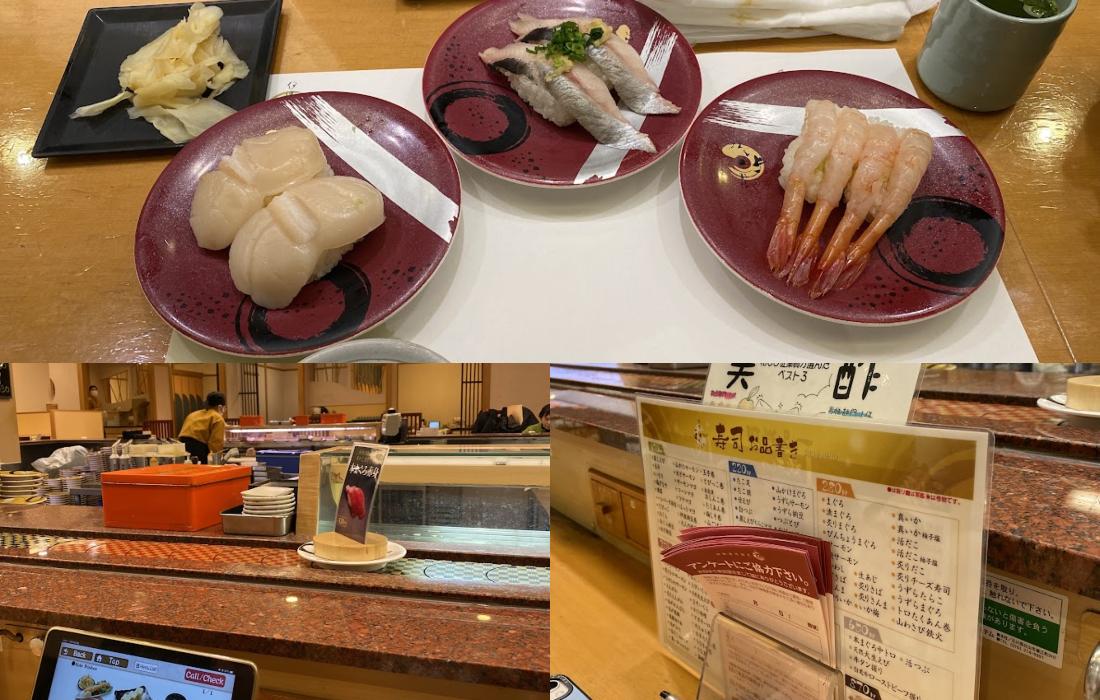
A collage of three photos from a conveyor-belt sushi restaurant in Sapporo, Hokkaido. The top photo is the star: three small red plates with black brushstroke designs, each holding two pieces of nigiri. One plate has thick, pearly scallops draped over rice, another white fish topped with chopped green onion, and the third shrimp with their tails curled up over the rice. A black dish of pickled ginger and a cup of green tea sit at the edges of the wooden table. The bottom two photos show the restaurant itself. On the left, the counter runs alongside a glass-fronted refrigerated case and a conveyor belt, with a staff member in a yellow top working behind it and a tablet ordering screen at the seat showing a "Call / Check" button. On the right, a laminated Japanese menu stand at the counter lists the different sushi items and prices, with a rotation of plates sliding past behind it.
A collage of three photos from a conveyor-belt sushi restaurant in Sapporo, Hokkaido. The top photo is the star: three small red plates with black brushstroke designs, each holding two pieces of nigiri. One plate has thick, pearly scallops draped over rice, another white fish topped with chopped green onion, and the third shrimp with their tails curled up over the rice. A black dish of pickled ginger and a cup of green tea sit at the edges of the wooden table.
The bottom two photos show the restaurant itself. On the left, the counter runs alongside a glass-fronted refrigerated case and a conveyor belt, with a staff member in a yellow top working behind it and a tablet ordering screen at the seat showing a "Call / Check" button. On the right, a laminated Japanese menu stand at the counter lists the different sushi items and prices, with a rotation of plates sliding past behind it.
Sichtbarer Text im Bild
Goto
Call / Check
Hokkaido-Krabbe
Wenn du Krabben liebst, musst du unbedingt die Hokkaido-Krabbe probieren. Ich empfehle als Adresse das Kaniya Sapporo Crab House (Main Branch). Der Preis pro Person variiert je nach Menü und liegt zwischen 6.000 Yen und 20.000 Yen. Es ist auf der teureren Seite, aber ein Besuch lohnt sich auf jeden Fall! Neben der Qualität des Essens überzeugt auch die Atmosphäre im Restaurant.
Kaniya Sapporo Crab House (Main Branch): https://maps.app.goo.gl/89WZdyCgMknxE7PG8
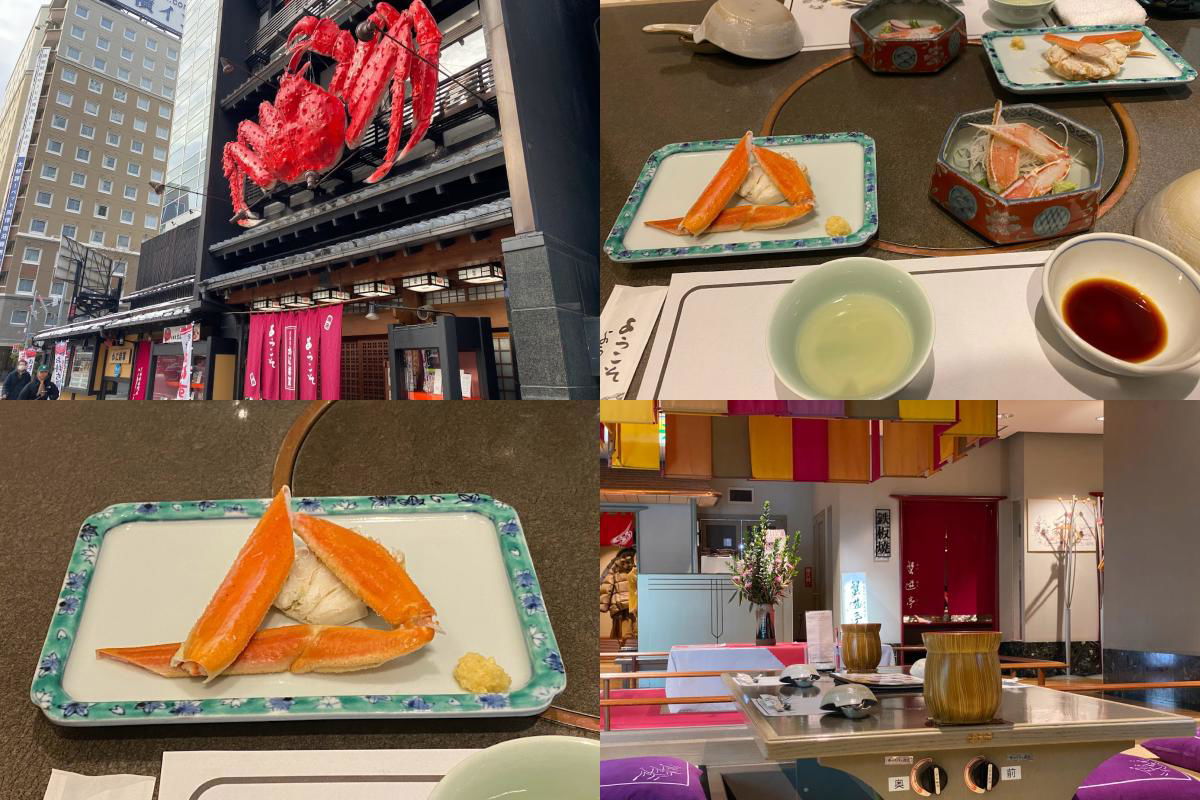
A four-photo collage from a crab feast in Sapporo, Hokkaido. In the top left, a huge bright red king crab is mounted on the dark wooden facade of a restaurant, its legs spread wide above the entrance where red curtains hang. A tall pale hotel tower rises right beside it, showing the restaurant sits on a downtown street. The other three photos move inside to the meal itself. The top right shows a low table set with king crab legs fanned across a rectangular plate with a green floral border, a red lacquered box holding more crab over noodles or vegetables, green tea, and a small dish of soy sauce. The bottom left zooms in on that plate: orange crab legs arranged over a mound of meat or rice with a small dab of roe beside them. The bottom right captures the dining room, with bright fabric panels in pink, orange, and yellow hanging from the ceiling, a glossy red door, flowers on the counter, and wooden tea canisters on the table in front of purple floor cushions.
A four-photo collage from a crab feast in Sapporo, Hokkaido.
In the top left, a huge bright red king crab is mounted on the dark wooden facade of a restaurant, its legs spread wide above the entrance where red curtains hang. A tall pale hotel tower rises right beside it, showing the restaurant sits on a downtown street. The other three photos move inside to the meal itself. The top right shows a low table set with king crab legs fanned across a rectangular plate with a green floral border, a red lacquered box holding more crab over noodles or vegetables, green tea, and a small dish of soy sauce. The bottom left zooms in on that plate: orange crab legs arranged over a mound of meat or rice with a small dab of roe beside them. The bottom right captures the dining room, with bright fabric panels in pink, orange, and yellow hanging from the ceiling, a glossy red door, flowers on the counter, and wooden tea canisters on the table in front of purple floor cushions.
Sichtbarer Text im Bild
HOTEL
よしもと
Jingisukan Yakiniku
Eine weitere lokale Spezialität, die du auf Hokkaido unbedingt probieren musst, ist Jingisukan Yakiniku (ジンギスカン, „Genghis Khan“-Yakiniku). Das ist ein gegrilltes Lammgericht, das auf einer gewölbten Metallpfanne oder einem anderen Grill zubereitet wird. Oft wird es gemeinsam mit Sojasprossen, Pilzen, Zwiebeln und Paprika gebraten und mit einer Sauce auf Basis von Sojasauce oder Sake serviert. Es ist super lecker, aber wegen des Lammfleischs sehr deftig – für meinen Geschmack war es ein wenig zu fettig. Aber es sollte auf jeden Fall probiert werden, wenn man auf Hokkaido ist.
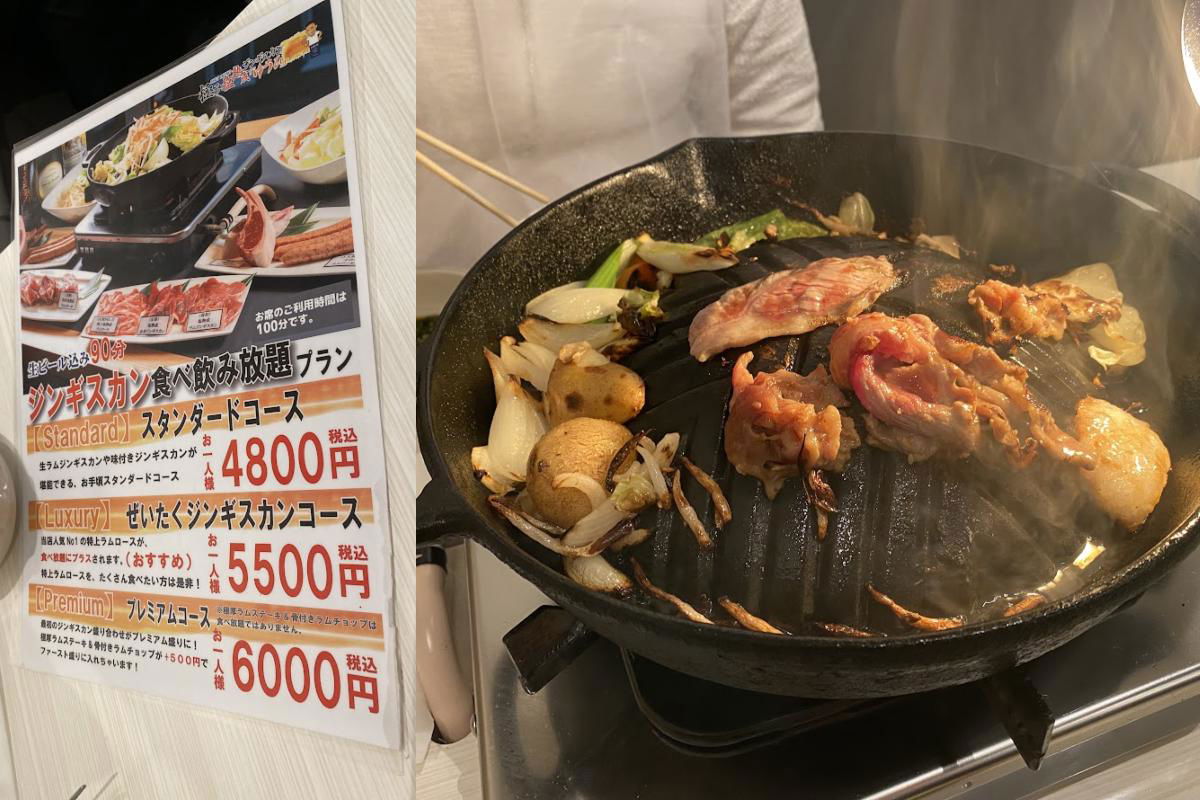
A two-part photo from a Sapporo restaurant showing jingisukan, Hokkaido's grilled mutton dish. On the right, a dome-shaped cast iron griddle steams over a portable burner, with thin slices of lamb browning among softening onions, cabbage, and green pepper. A pair of chopsticks reaches in from above, and a diner in a white shirt sits just behind the rising steam. On the left, the menu board lists all-you-can-eat plans in Japanese: a Standard course at 4800 yen, a Luxury lamb-loin course at 5500 yen, and a Premium course at 6000 yen per person, tax included, with a 100-minute time limit. Small photos on the board show the same dome pan piled with raw lamb and vegetables, matching the meal being cooked in the picture.
A two-part photo from a Sapporo restaurant showing jingisukan, Hokkaido's grilled mutton dish. On the right, a dome-shaped cast iron griddle steams over a portable burner, with thin slices of lamb browning among softening onions, cabbage, and green pepper. A pair of chopsticks reaches in from above, and a diner in a white shirt sits just behind the rising steam.
On the left, the menu board lists all-you-can-eat plans in Japanese: a Standard course at 4800 yen, a Luxury lamb-loin course at 5500 yen, and a Premium course at 6000 yen per person, tax included, with a 100-minute time limit. Small photos on the board show the same dome pan piled with raw lamb and vegetables, matching the meal being cooked in the picture.
Sichtbarer Text im Bild
お席のご利用時間は100分です。
生ビール込 90分
ジンギスカン食べ飲み放題プラン
【Standard】スタンダードコース
お一人様 4800円 税込
【Luxury】ぜいたくジンギスカンコース
おすすめ
お一人様 5500円 税込
【Premium】プレミアムコース
お一人様 6000円 税込
プラス500円で
Miso-Ramen
Gerade wenn es draußen kalt und ungemütlich ist, Ramen (Nudelsuppe) ist besonders wohltuend. Während unserer Reise haben wir ein Restaurant (らーめん吉山商店 狸小路店) ausprobiert, das meiner Meinung nach zu den besten Ramen gehörte, die ich bisher hatte! Die Suppe war nicht zu salzig (was oft ein Problem ist, wie ich finde). Die Brühe war sehr rauchig und das Fleisch super zart. Auch die Bambussprossen waren viel frischer als in vielen anderen Standard-Ramen-Restaurants. Für diese sehr gute Qualität war der Preis recht durchschnittlich – wie fast immer in Japan. Man muss eben die richtigen Orte kennen.
Google Maps: https://maps.app.goo.gl/Tr2o8ZGV2MhBZSoz9?g_st=ic
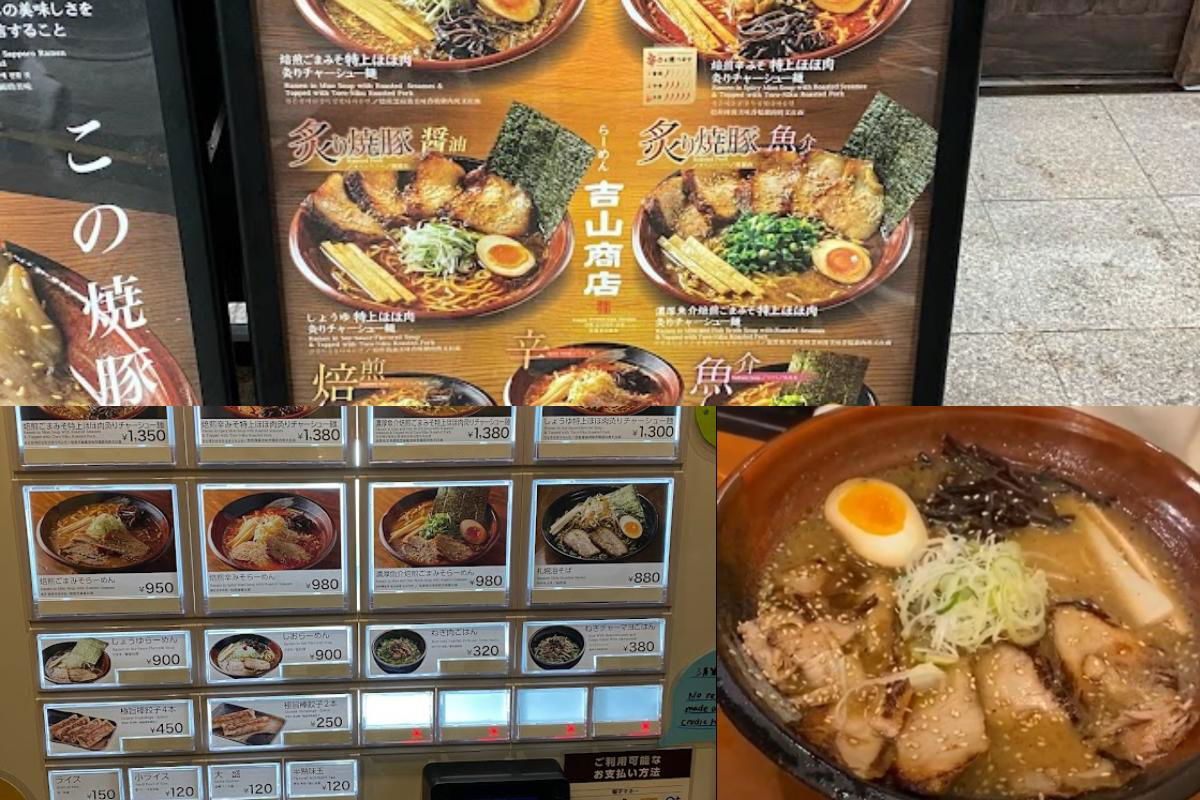
This collage captures a visit to a Sapporo ramen shop, from ordering to the finished bowl. The top shows a large backlit menu board for Yoshiyama Shoten, covered with appetizing photos of steaming ramen bowls: spicy miso ramen topped with seared chashu pork, a soy sauce version, and a fish broth variety, each piled with egg, greens, and sheets of nori. Below it sits the shop's ticket vending machine, its rows of backlit buttons displaying photos and prices for the different bowls and toppings, ranging from about ¥120 for extras up to ¥1,380 for the signature dishes. The bottom right photo shows the reward: a close-up of miso ramen in a brown ceramic bowl. A halved soft-boiled egg with a jammy orange yolk sits on top beside tender slices of chashu, a mound of shredded leek, sesame seeds, and wavy noodles in a rich, opaque broth. Together the three images tell the classic Sapporo ramen ritual: browse the picture menu, buy a ticket from the machine, then dig in.
This collage captures a visit to a Sapporo ramen shop, from ordering to the finished bowl. The top shows a large backlit menu board for Yoshiyama Shoten, covered with appetizing photos of steaming ramen bowls: spicy miso ramen topped with seared chashu pork, a soy sauce version, and a fish broth variety, each piled with egg, greens, and sheets of nori. Below it sits the shop's ticket vending machine, its rows of backlit buttons displaying photos and prices for the different bowls and toppings, ranging from about ¥120 for extras up to ¥1,380 for the signature dishes.
The bottom right photo shows the reward: a close-up of miso ramen in a brown ceramic bowl. A halved soft-boiled egg with a jammy orange yolk sits on top beside tender slices of chashu, a mound of shredded leek, sesame seeds, and wavy noodles in a rich, opaque broth. Together the three images tell the classic Sapporo ramen ritual: browse the picture menu, buy a ticket from the machine, then dig in.
Sichtbarer Text im Bild
の美味しさを
めること
こ
の
焼
豚
進化系つけ麺特上はん肉
Spicy Sesame Dipping Noodles with Roasted Pork & Seasoned Egg
炙り焼豚 醤油
全サイズ一律
らーめん
吉山商店
炙り焼豚 魚介
全サイズ一律
炙りチャーシュー麺
Braised Pork Shoulder Sirloin Roasting in a Sweet Soy-based Sauce
Spicy Sesame Dipping Noodle Soup with Seasoned Pork
Spicy Sesame Dipping Soup with Seasoned Pork
辛
焙煎
魚介
¥1,350
¥1,380
¥1,380
¥1,300
¥950
¥980
炙り特製ちゃーしゅーめん ¥980
¥880
ちゃーしゅーごはん ¥900
しおそば ¥900
お好み焼そば ¥320
¥380
¥450
極炙餃子2ケ ¥250
ライス ¥150
スープライス ¥120
大盛 ¥120
¥120
ご利用可能券をお買い求め
お釣り
Essen im Izakaya "rukku & uohei"
Wenn du auf der Suche nach einem richtig guten Izakaya in Sapporo bist, empfehle ich das Izakaya "rukku & uohei" . Dieses Restaurant im typischen Izakaya-Stil liegt mitten in Sapporo und wir haben dort richtig gut gegessen. Mehr zu den Gerichten, die wir dort hatten, in den nächsten Abschnitten.
Kaisendon
Ein weiteres kulinarisches Highlight auf Hokkaido war Kaisendon – ein Sashimi Donburi mit super frischem Fisch auf weichem, fluffigen Reis. Unser Kaisendon bestand aus verschiedenen lokalen Fischsorten, Garnelen und Lachsrogen – natürlich alles roh. Der Fisch schmeckt auf der Insel besonders frisch und Hokkaido ist berühmt für seine unglaubliche Qualität! Du solltest dir also ein Fischgericht auf keinen Fall entgehen lassen. Besonders empfehle ich die Sashimi -Gerichte!
Google Maps: https://maps.app.goo.gl/RnBqN2iEyVPUnSXf9
.jpg?width=1200)
This split image shows a small izakaya in Sapporo and the kind of meal it serves. On the left is the restaurant entrance, framed by a dark blue noren curtain with white Japanese lettering. A woman in a cream coat and black tights steps through the doorway, and outside stands a menu board advertising a lunch set for 750 yen along with other dishes priced around 580 to 780 yen. The right half is a close-up of a kaisendon, a seafood rice bowl, on a worn wooden table. The rice is nearly buried under sashimi: two whole sweet shrimp with long antennae, glistening orange salmon roe, slices of tuna, squid, and white fish, with a dollop of wasabi and a shiso leaf at the center. A glass of beer sits just behind the bowl.
This split image shows a small izakaya in Sapporo and the kind of meal it serves. On the left is the restaurant entrance, framed by a dark blue noren curtain with white Japanese lettering. A woman in a cream coat and black tights steps through the doorway, and outside stands a menu board advertising a lunch set for 750 yen along with other dishes priced around 580 to 780 yen.
The right half is a close-up of a kaisendon, a seafood rice bowl, on a worn wooden table. The rice is nearly buried under sashimi: two whole sweet shrimp with long antennae, glistening orange salmon roe, slices of tuna, squid, and white fish, with a dollop of wasabi and a shiso leaf at the center. A glass of beer sits just behind the bowl.
Sichtbarer Text im Bild
磯ちらし&魚平
クラシック
特
飲み
本日おすすめランチ(税込)
750円
メバルあずき丼 580円
ランチタイムメニ
のど黒定食 780円
(税込価格)
カレーライス 600円
日替わり定食 750円
ミニランチ 750円
うにいくら丼 650円
いくら丼 330円
330円
330円
280円
Lachs-Nabe
Ein weiteres Gericht, das wir im Izakaya "rukku & uohei" gegessen haben, war Lachs- Nabe . Das ist ein Eintopf, der an kalten Tagen besonders wärmt und mit Lachs und Gemüse serviert wird. Der Fisch im Eintopf wird direkt vor dir auf einer kleinen heißen Platte gegart. Das perfekte Gericht in der kalten Jahreszeit und ein echtes kulinarisches Highlight!
Google Maps: https://maps.app.goo.gl/RnBqN2iEyVPUnSXf9
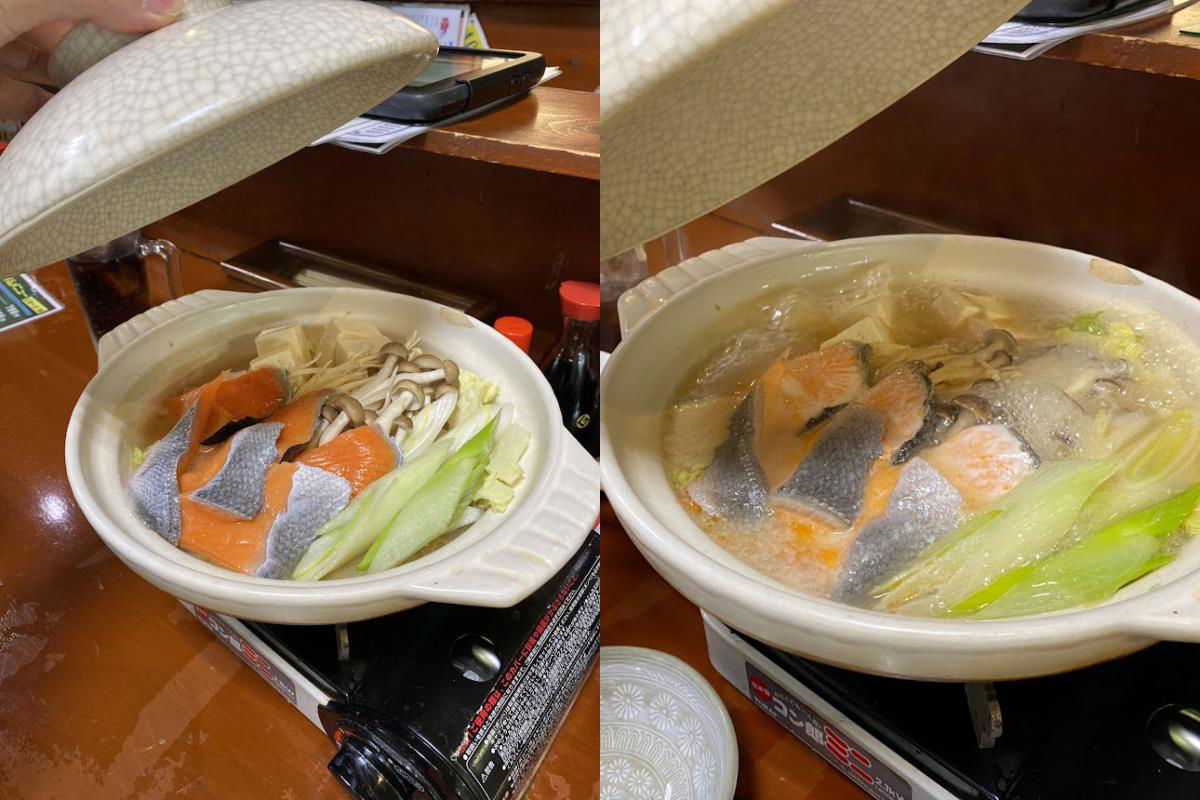
A two-photo spread of a salmon hot pot, Lachs Nabe, served in a round clay pot on a portable gas stove at a wooden restaurant counter. In the left photo, a hand lifts the speckled ceramic lid to reveal the pot's raw contents: orange salmon fillets with silvery skin laid across the center, surrounded by blocks of tofu, enoki mushrooms, napa cabbage, and leeks nestled in clear broth. The right photo shows the same pot after cooking, the salmon now paler and flaking, the vegetables wilted, everything bubbling in a cloudy, steaming broth. Soy sauce and other condiment bottles sit on the counter beside the stove, giving the scene the feel of a casual Japanese restaurant meal.
A two-photo spread of a salmon hot pot, Lachs Nabe, served in a round clay pot on a portable gas stove at a wooden restaurant counter. In the left photo, a hand lifts the speckled ceramic lid to reveal the pot's raw contents: orange salmon fillets with silvery skin laid across the center, surrounded by blocks of tofu, enoki mushrooms, napa cabbage, and leeks nestled in clear broth. The right photo shows the same pot after cooking, the salmon now paler and flaking, the vegetables wilted, everything bubbling in a cloudy, steaming broth. Soy sauce and other condiment bottles sit on the counter beside the stove, giving the scene the feel of a casual Japanese restaurant meal.
Sichtbarer Text im Bild
GB
うちのジン
Ikura Don
Wenn du Fan von Fischrogen bist, empfehle ich Ikura Don. Das ist ein Lachsrogen- Donburi – also eine Schale mit fluffigem, warmem Reis, belegt mit Lachsrogen. Das Gericht wurde hier als kleine Show serviert – der Service häuft dir mit einem großen Holzlöffel eine riesige Portion Rogen über die Schale, sodass sie fast überquillt vor Lachsrogen. Das war auf jeden Fall ein besonderes Erlebnis, das durch die Show unvergesslich wurde.
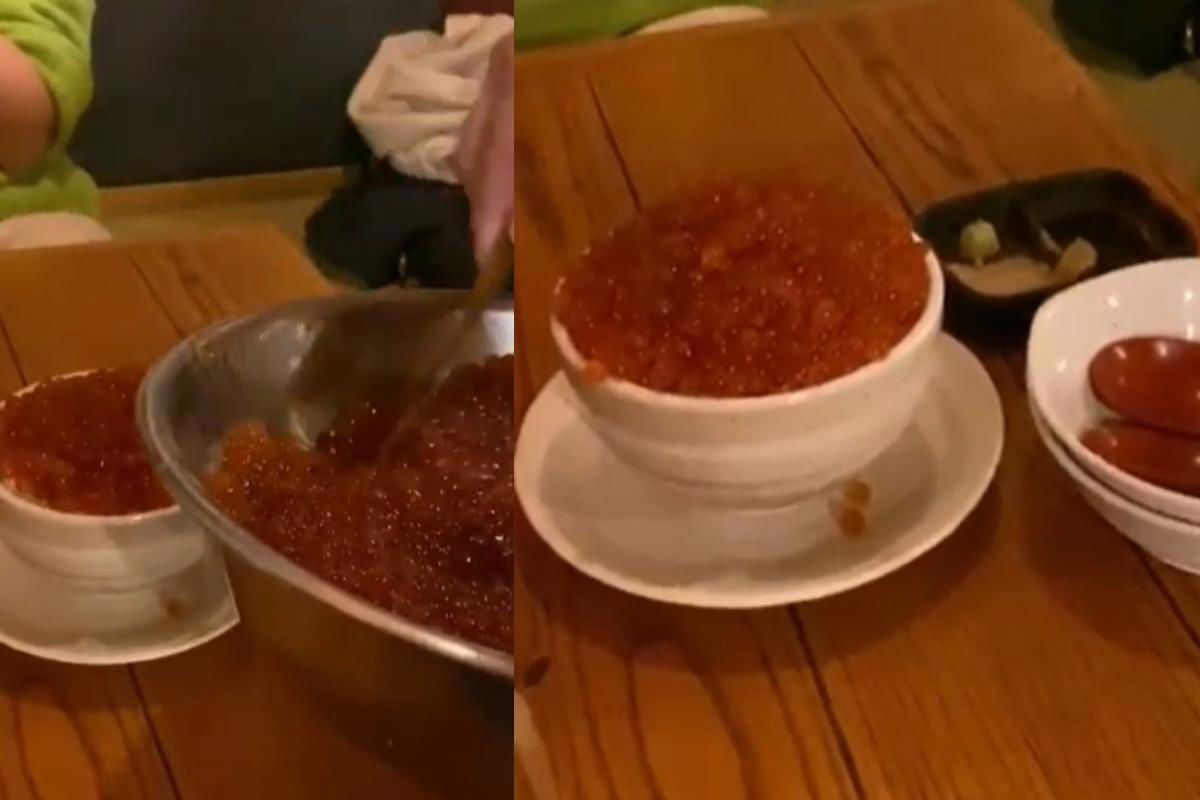
A two-part photo of an ikura don being served at a wooden restaurant table in Sapporo. On the right, a white bowl on a saucer is piled so high with glistening orange salmon roe that it domes well above the rim, with a few loose pearls on the plate. A small black dish of pickles and a stack of white bowls with red spoons sit beside it. The left half shows the serving step: a large metal bowl filled with salmon roe, a hand scooping more roe with a spoon, and an already topped rice bowl waiting nearby.
A two-part photo of an ikura don being served at a wooden restaurant table in Sapporo. On the right, a white bowl on a saucer is piled so high with glistening orange salmon roe that it domes well above the rim, with a few loose pearls on the plate. A small black dish of pickles and a stack of white bowls with red spoons sit beside it. The left half shows the serving step: a large metal bowl filled with salmon roe, a hand scooping more roe with a spoon, and an already topped rice bowl waiting nearby.
Sichtbarer Text im Bild
No clearly readable text is present in the image.
Sehenswürdigkeiten in der Präfektur Hokkaido
Jigokudani (Hell Valley) 登別地獄谷
Während unserer Hokkaido-Reise haben wir mehrere Sehenswürdigkeiten besucht. Eine davon ist Jigokudani (Hell Valley), eine faszinierende Landschaft mit heißen, blubbernden Seen und Flüssen, die wie von einer anderen Welt wirken. Durch Bakterien in der Umgebung entstehen verschiedene Farben wie weiß, grün und blau, was die Szenerie so besonders aussehen lässt.
Wenn es schneit, ist es besonders schön, aber auch ohne Schnee lohnt es sich auf jeden Fall! Mit dem Auto bist du in ca. 1,5 bis 2 Stunden dort, mit dem Bus dauert es etwa 2 bis 3 Stunden.
Google Maps: https://maps.app.goo.gl/29CTGfqYStRdip8Y8?g_st=ic
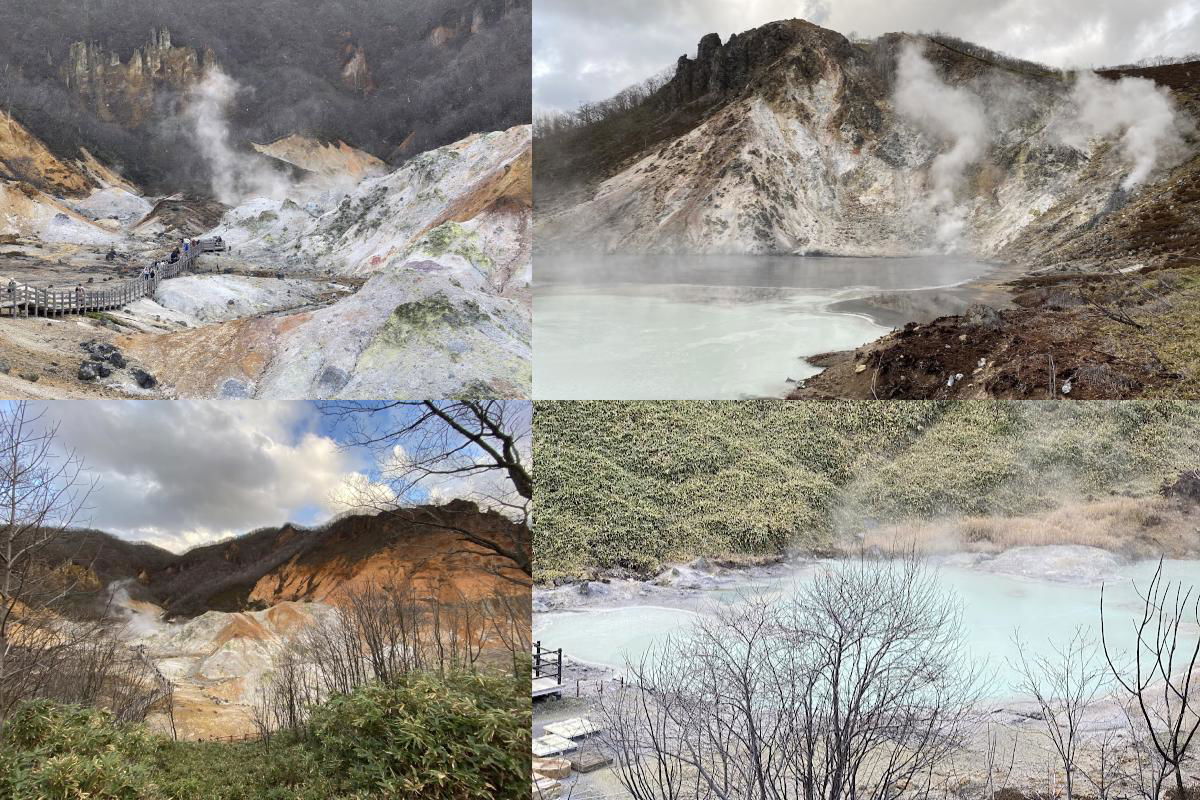
A four-photo collage of a steaming volcanic valley in Hokkaido, at Hell Valley (Jigokudani) near Noboribetsu. In every shot the hillsides are stripped of vegetation and stained pale gray, white, and rust orange by sulfur deposits, with thick plumes of steam rising from the ground. The four views cover different corners of the valley. The top left follows a wooden boardwalk where tiny figures of visitors wind between the mineral slopes, jagged dark rock spires looming above. The top right looks across a milky gray pond gathered at the base of a steep, eroded mountainside, steam drifting low over the water. The bottom two show an orange-stained hillside framed by bare branches under a partly cloudy sky, and a pale blue hot spring pool edged with dried grasses and leafless shrubs, a small wooden platform at its shore.
A four-photo collage of a steaming volcanic valley in Hokkaido, at Hell Valley (Jigokudani) near Noboribetsu. In every shot the hillsides are stripped of vegetation and stained pale gray, white, and rust orange by sulfur deposits, with thick plumes of steam rising from the ground.
The four views cover different corners of the valley. The top left follows a wooden boardwalk where tiny figures of visitors wind between the mineral slopes, jagged dark rock spires looming above. The top right looks across a milky gray pond gathered at the base of a steep, eroded mountainside, steam drifting low over the water. The bottom two show an orange-stained hillside framed by bare branches under a partly cloudy sky, and a pale blue hot spring pool edged with dried grasses and leafless shrubs, a small wooden platform at its shore.
Sichtbarer Text im Bild
No clearly readable text is present in the image.
Yubari-Region
Während unserer Reise haben wir auch die Yubari-Region besucht, die für ihre köstlichen Melonen bekannt ist. Diese Melonen sind eine Delikatesse und in ganz Japan hoch geschätzt. Durch ihren süßen Geschmack sind sie etwas Besonderes. Viele Bauern in der Yubari-Region sind auf den Anbau dieser besonderen Melonensorte spezialisiert. Leider hatten wir Pech mit dem Wetter und es hat stark geschneit. Deshalb konnten wir die lokale Sehenswürdigkeit mit der Brücke sowie den Chidorigataki-Wasserfall nicht sehen. Dennoch war es spannend, diese Region mit dem Mietwagen zu erkunden.
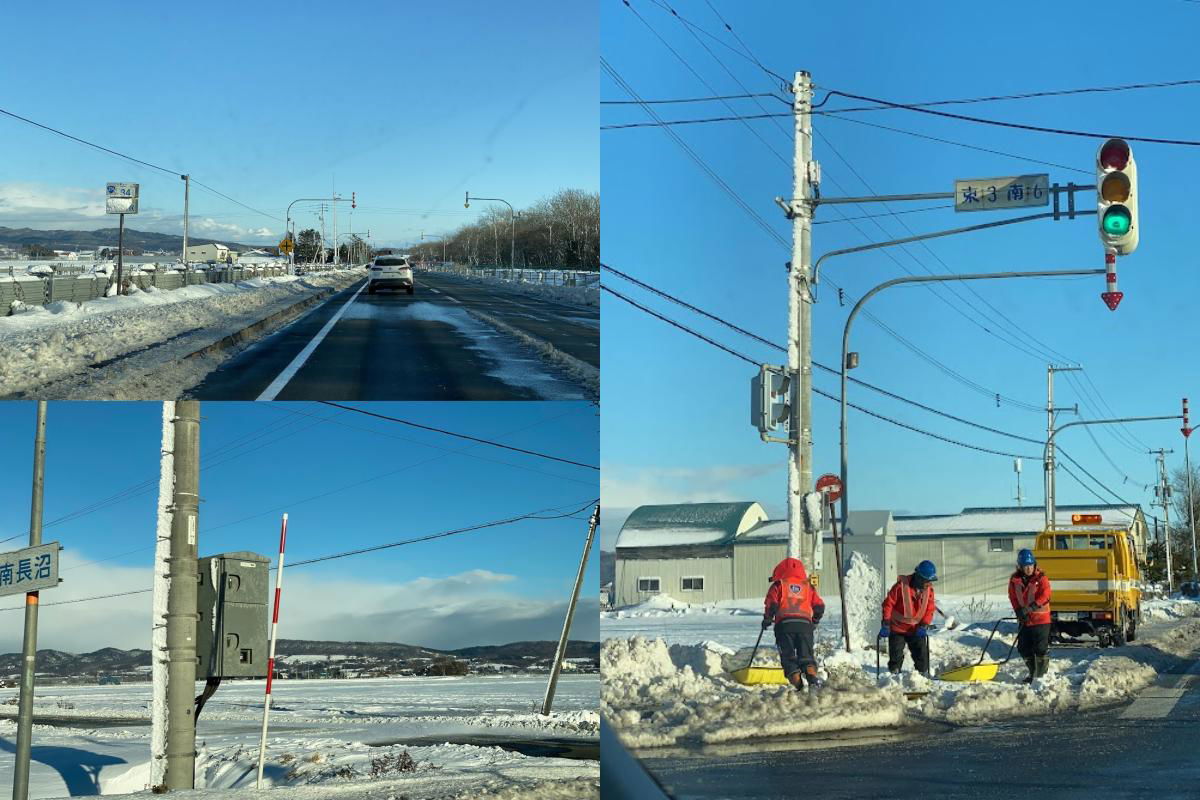
A three-photo collage of winter road scenes around Yubari in Hokkaido, all under a clear blue sky. The largest photo, on the right, shows three snow-clearing workers in bright orange and red winter jackets and helmets shoveling deep, dirty snow at a roadside intersection. They work with yellow shovels next to a small yellow utility truck, with a metal barn-like building and a traffic light on green above them. The top left photo looks down a long, wet two-lane highway cleared of snow, with high snowbanks on both shoulders, a white car driving ahead, and low mountains on the horizon. The bottom left photo shows a snowy field stretching toward distant hills, with a utility pole and a gray utility cabinet in the foreground and a street sign with Japanese characters at the edge of the frame. Together the photos capture the feel of a Hokkaido winter day: bright sun, deep snow, and crews keeping the roads open.
A three-photo collage of winter road scenes around Yubari in Hokkaido, all under a clear blue sky.
The largest photo, on the right, shows three snow-clearing workers in bright orange and red winter jackets and helmets shoveling deep, dirty snow at a roadside intersection. They work with yellow shovels next to a small yellow utility truck, with a metal barn-like building and a traffic light on green above them. The top left photo looks down a long, wet two-lane highway cleared of snow, with high snowbanks on both shoulders, a white car driving ahead, and low mountains on the horizon. The bottom left photo shows a snowy field stretching toward distant hills, with a utility pole and a gray utility cabinet in the foreground and a street sign with Japanese characters at the edge of the frame. Together the photos capture the feel of a Hokkaido winter day: bright sun, deep snow, and crews keeping the roads open.
Sichtbarer Text im Bild
3d
東3南6
南長沼
Mount Moiwa
Eine Sehenswürdigkeit mit atemberaubendem Blick auf die Region ist die Aussichtsplattform auf dem Mount Moiwa. Du erreichst sie über zwei Seilbahnen. Ein Ticket für die Fahrt/Aussichtsplattform kostet 1.400 Yen pro Person. Es gibt Ermäßigungen für Kinder, Studenten und Senioren. Je nach Jahreszeit ist die Plattform von 11:00 bis 22:00 Uhr geöffnet, im Sommer sogar eine halbe Stunde länger. Die letzte Seilbahn fährt um 21:30 Uhr nach oben. Egal ob tagsüber oder abends – der Ausblick ist einmalig. Wir waren abends oben und hatten einen tollen Blick auf das Lichtermeer.
Offizielle Website: https://mt-moiwa.jp/en/guide/
Google Maps: https://maps.app.goo.gl/igbe7sKEdtBnmeqc9
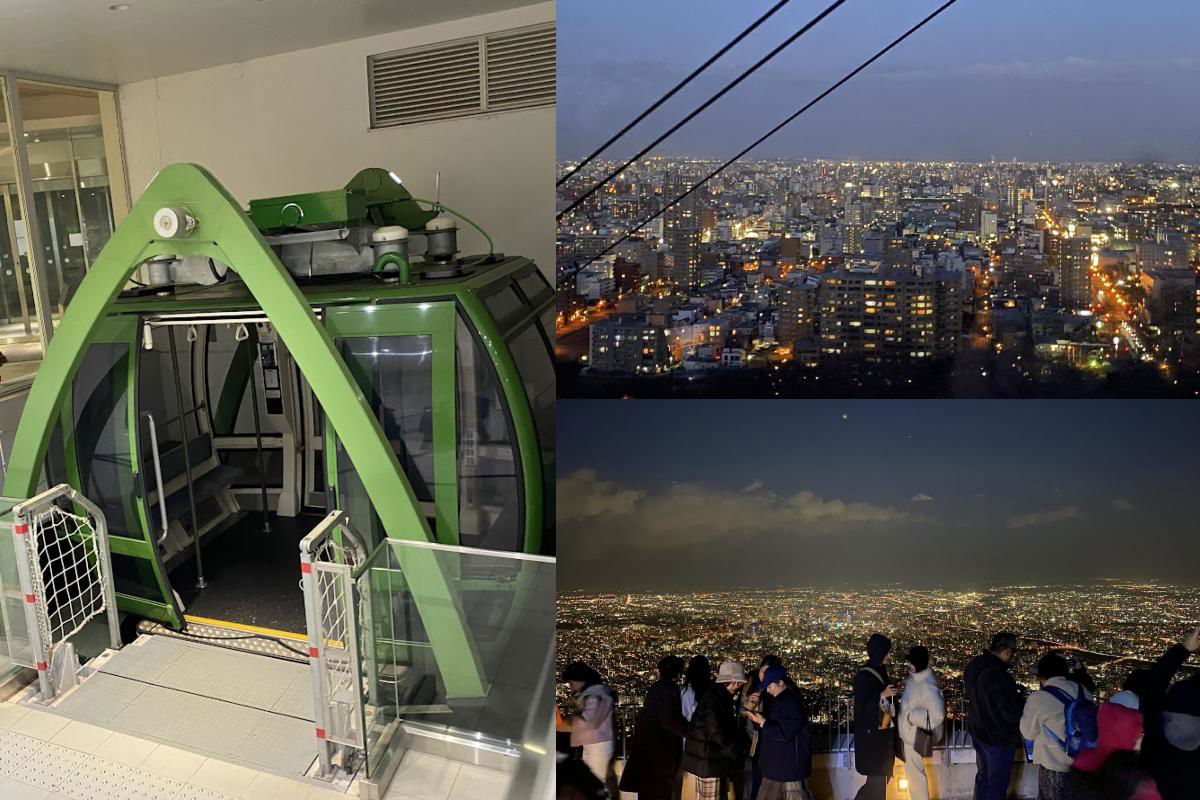
A three-photo collage from a visit to Mount Moiwa in Sapporo. On the left, a green ropeway cabin sits at its station with its doors open, showing the benches and hanging straps inside. The rounded green frame of the gondola dominates the shot, with a boarding platform and safety netting in front. The right side shows two night views from the mountain. The top photo looks straight down at Sapporo glowing after dark, office towers and apartment blocks lit up in orange and white, with the thick cables of the ropeway crossing the frame overhead. The bottom photo shows the observation deck itself: a crowd of visitors in winter jackets stands along the railing, silhouetted against an ocean of city lights spreading to the horizon under a dark, hazy sky.
A three-photo collage from a visit to Mount Moiwa in Sapporo. On the left, a green ropeway cabin sits at its station with its doors open, showing the benches and hanging straps inside. The rounded green frame of the gondola dominates the shot, with a boarding platform and safety netting in front.
The right side shows two night views from the mountain. The top photo looks straight down at Sapporo glowing after dark, office towers and apartment blocks lit up in orange and white, with the thick cables of the ropeway crossing the frame overhead. The bottom photo shows the observation deck itself: a crowd of visitors in winter jackets stands along the railing, silhouetted against an ocean of city lights spreading to the horizon under a dark, hazy sky.
Sichtbarer Text im Bild
No clearly readable text found.
Der Fernsehturm: Sapporo TV Tower
Eine bekannte Sehenswürdigkeit direkt in Sapporo ist der Fernsehturm. Von außen ist er sehr schön und zeigt auch die Uhrzeit an. Seine Form erinnert ein wenig an den Eiffelturm! Du kannst ihn nicht nur von unten anschauen, sondern auch von einer Aussichtsplattform oben den Blick auf Sapporo genießen. Allerdings war uns der Preis von 1.000 Yen pro Person diesmal zu teuer, daher haben wir auf den Aufstieg verzichtet.
Offizielle Website: https://www.tv-tower.co.jp/en/
Google Maps: https://maps.app.goo.gl/Lcevdjm3Ri9DS4Ug9
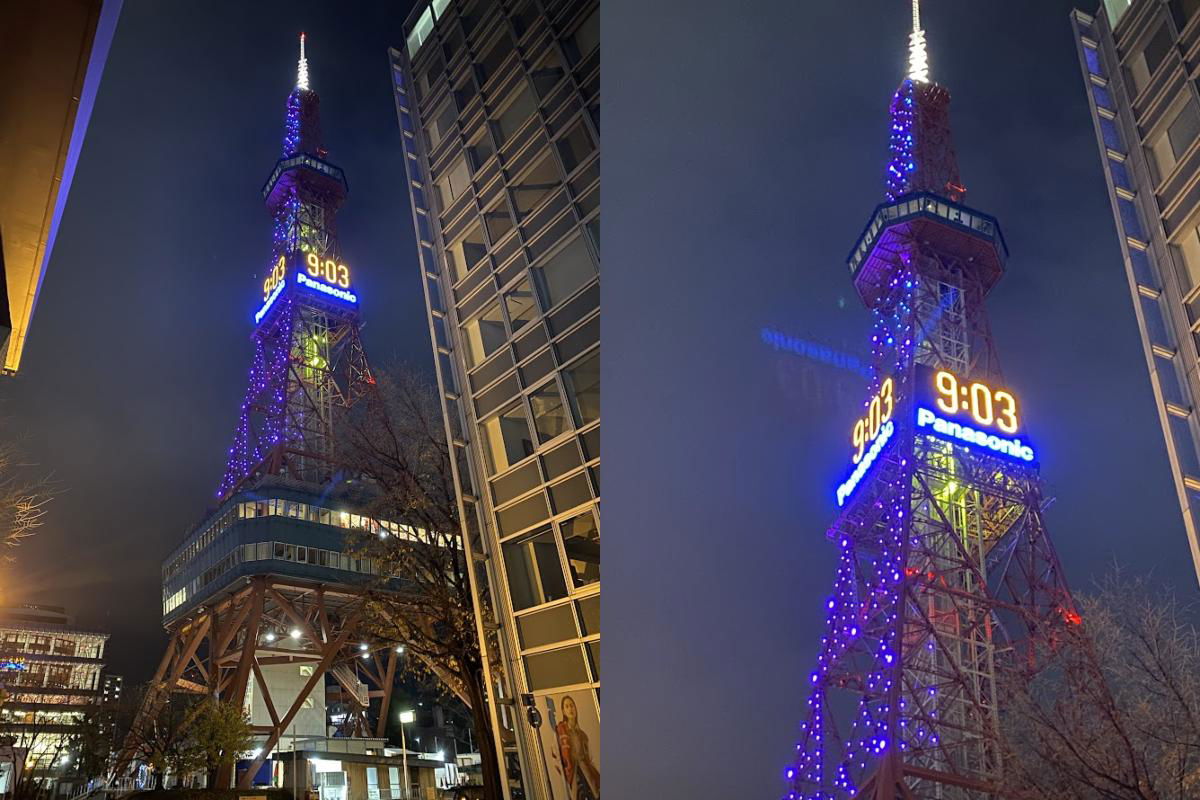
Two nighttime photos of the Sapporo TV Tower sit side by side. The tower is a red steel lattice structure modeled on the Eiffel Tower, and both shots show it glowing with strings of purple and blue lights against a dark sky. Its digital clock faces read 9:03 in bright orange, with "Panasonic" written below in blue. The left photo takes in the whole tower from street level, framed by a modern glass office building and the lit windows of its mid-level observation deck. The right photo zooms in on the upper half, where the clock, the enclosed top deck, and the antenna spire stand out more clearly. Bare tree branches at the edges suggest a cold season in this downtown Sapporo scene.
Two nighttime photos of the Sapporo TV Tower sit side by side. The tower is a red steel lattice structure modeled on the Eiffel Tower, and both shots show it glowing with strings of purple and blue lights against a dark sky. Its digital clock faces read 9:03 in bright orange, with "Panasonic" written below in blue. The left photo takes in the whole tower from street level, framed by a modern glass office building and the lit windows of its mid-level observation deck. The right photo zooms in on the upper half, where the clock, the enclosed top deck, and the antenna spire stand out more clearly. Bare tree branches at the edges suggest a cold season in this downtown Sapporo scene.
Sichtbarer Text im Bild
9:03
Panasonic
9:03
Panasonic
Weihnachtsmarkt am Sapporo TV Tower
Zu meiner Überraschung gab es direkt am Fuß des Sapporo TV Towers einen kleinen Weihnachtsmarkt! Passend zur Weihnachtszeit entstand so eine sehr schöne und gemütliche Atmosphäre. Es gab sogar deutschen Apfelwein, gebrannte Mandeln, Wein und Bier aus Deutschland sowie Eisbein und viele andere deutsche Produkte und Gerichte. Natürlich war das im Vergleich zum Original in Deutschland relativ teuer. Aber mit dem Anblick des beleuchteten Fernsehturms kam sofort Weihnachtsstimmung auf.
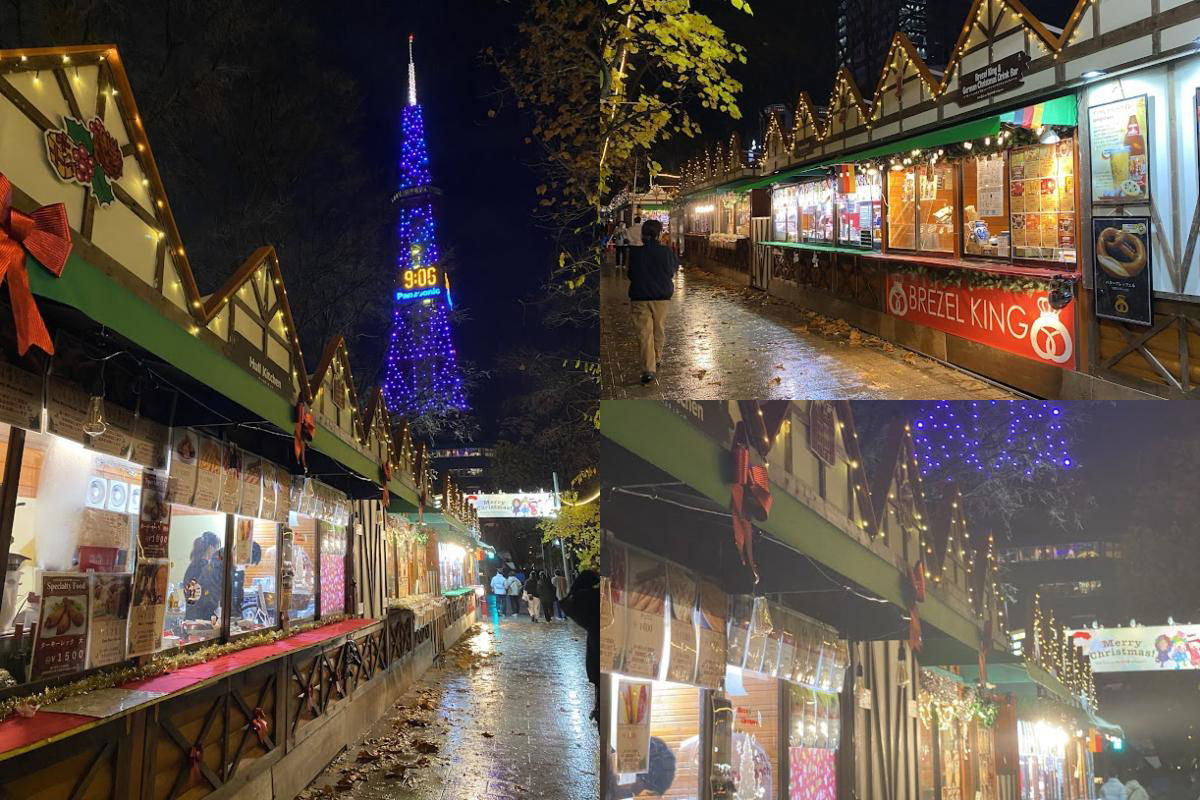
A four-photo collage shows a German-style Christmas market in Sapporo after dark. Wooden stalls built like half-timbered chalets line a rain-slicked walkway scattered with yellow leaves, their peaked roofs edged with warm fairy lights and big red ribbon bows. In one shot the Sapporo TV Tower rises behind the rooftops, wrapped in blue and white lights with a bright sign on its shaft. The other views move along the stalls themselves. A red Brezel King banner hangs across one counter, a sign advertises a German Christmas market bar, and menu boards crowd the lit service windows where vendors work. Visitors in winter jackets wander the path, and in the last frame a tree glows blue overhead next to a Merry Christmas sign decorated with Santa and a snowman.
A four-photo collage shows a German-style Christmas market in Sapporo after dark. Wooden stalls built like half-timbered chalets line a rain-slicked walkway scattered with yellow leaves, their peaked roofs edged with warm fairy lights and big red ribbon bows. In one shot the Sapporo TV Tower rises behind the rooftops, wrapped in blue and white lights with a bright sign on its shaft.
The other views move along the stalls themselves. A red Brezel King banner hangs across one counter, a sign advertises a German Christmas market bar, and menu boards crowd the lit service windows where vendors work. Visitors in winter jackets wander the path, and in the last frame a tree glows blue overhead next to a Merry Christmas sign decorated with Santa and a snowman.
Sichtbarer Text im Bild
9:05
PARCO
Brezel King
German Original Brezel Bar
BREZEL KING
Spätzle Toast
¥1,500
Merry Christmas!
Die Hafenstadt Otaru
Otaru ist eine Hafenstadt auf Hokkaido, nordwestlich von Sapporo an der Ishikari-Bucht. Die Stadt ist bekannt für ihre Glasproduktion und Destillerien. Leider ging es mir an dem Tag nicht gut, daher hat meine Freundin Otaru alleine erkundet. Besonders interessant ist der Kanal, der von umgebauten alten Lagerhäusern gesäumt ist, in denen heute Cafés und Läden untergebracht sind. Man kann sogar eine kleine Kanalfahrt machen, um sich alles anzuschauen. Besonders abends bietet sich ein toller Blick auf den beleuchteten Kanal.
Die Ticketpreise am Tag liegen bei 1.800 Yen (ca. 11 Euro) für Erwachsene, am Abend bei 2.000 Yen (ca. 13 Euro).
Google Maps: https://maps.app.goo.gl/6BwTE8P75c3Kj6Pp9
Otaru Canal Cruise (offizielle Website): https://otaru.cc/en/
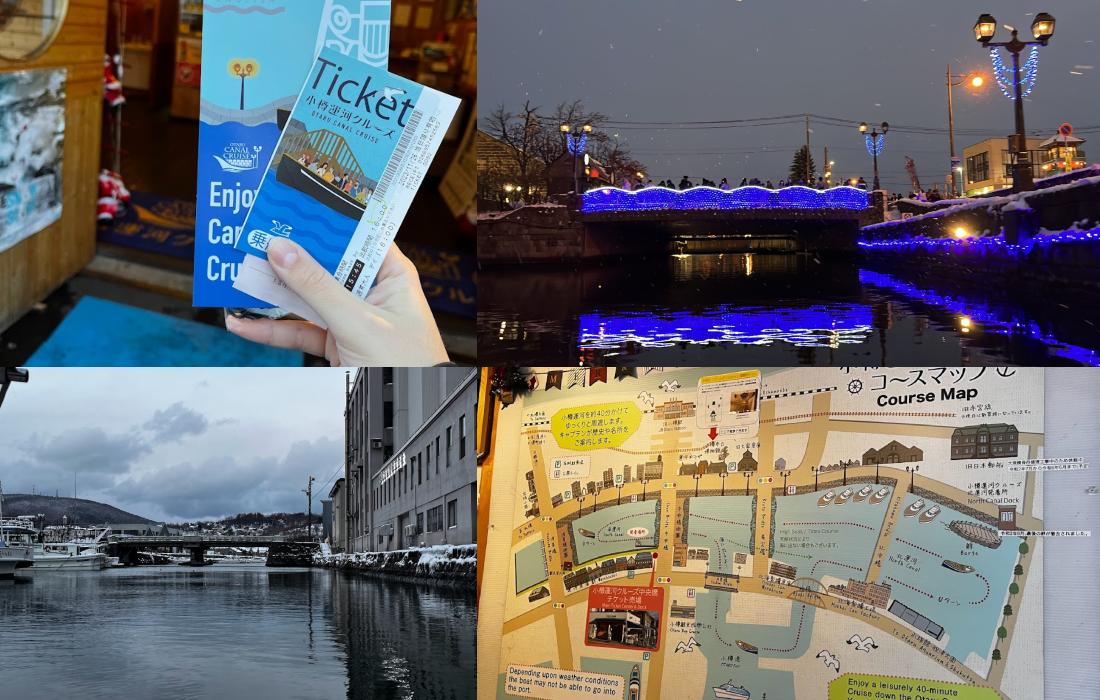
A four-photo collage captures a canal cruise experience in Otaru, Hokkaido. In the top left, a hand holds two blue-and-white tickets for the Otaru Canal Cruise, printed with a small illustration of a boat carrying passengers. The top right photo shows the canal at night: a bridge strung with vivid blue lights glows over the dark water, with snow piled on the stone banks and blue-lit street lamps lining the promenade. The bottom left photo shows the same canal by day under a gray winter sky, with stone warehouses along the water, snow at the edges, and small boats moored near a bridge. The bottom right photo is a colorful illustrated course map for the cruise, tracing boat routes along the canal with labeled stops and English notes, including one promising a leisurely 40-minute cruise.
A four-photo collage captures a canal cruise experience in Otaru, Hokkaido. In the top left, a hand holds two blue-and-white tickets for the Otaru Canal Cruise, printed with a small illustration of a boat carrying passengers. The top right photo shows the canal at night: a bridge strung with vivid blue lights glows over the dark water, with snow piled on the stone banks and blue-lit street lamps lining the promenade.
The bottom left photo shows the same canal by day under a gray winter sky, with stone warehouses along the water, snow at the edges, and small boats moored near a bridge. The bottom right photo is a colorful illustrated course map for the cruise, tracing boat routes along the canal with labeled stops and English notes, including one promising a leisurely 40-minute cruise.
Sichtbarer Text im Bild
Ticket
小樽運河クルーズ
OTARU CANAL CRUISE
CANAL CRUISE
Enjo
Can
Cru
コースマップ
Course Map
旧日本郵船
小樽運河クルーズ乗り場
Depending upon weather conditions
the boat may not be able to go into
the port
Enjoy a leisurely 40-minute
Cruise down the
Ein Tipp für jede Japan-Reise: Kuroneko Yamato
Ein echter Geheimtipp für jede Japanreise ist der Kuroneko Yamato Lieferservice. Mit diesem Service kannst du dein schweres und sperriges Gepäck von einem Hotel zum nächsten innerhalb Japans schicken – auch wenn es eine andere Präfektur ist! Die Formulare dazu findest du meist in Hotels in Japan, und kannst gleich vor Ort nach dem Service fragen. Die Preise richten sich nach Gewicht und Größe deines Gepäcks.
Offizielle Website: https://www.global-yamato.com/en/hands-free-travel/
Fazit
Die Präfektur Hokkaido und die Stadt Sapporo haben viel zu bieten. Die nördlichste Präfektur Japans überzeugt mit einzigartigen Sehenswürdigkeiten und Landschaften sowie kulinarischen Spezialitäten. Da sie im Norden liegt, solltest du darauf vorbereitet sein, dass es sehr kalt wird und oft schneit. Besonders der Winter beginnt hier früher als im Rest des Landes. Gute Schuhe sind Pflicht, da viele Straßen weder gestreut noch geräumt werden und es deshalb extrem rutschig werden kann. Es wird auch kein Salz verwendet. Ich war überrascht, dass es hier scheinbar keine Räum-Pflicht gibt und die Stadt wenig macht, um den Schnee zu entfernen. Am besten vorbereiten, dann steht dem Hokkaido-Trip nichts mehr im Wege.
Entdecke Sapporo mit einem Local – du entscheidest, was du sehen willst: berühmte Highlights oder eher Geheimtipps, ganz wie du möchtest.
*Affiliate-Link: Wenn du eine Aktivität über mein Widget oder meinen Link bei viator.com buchst, erhalte ich eine kleine Provision. Für dich entstehen dabei keine Mehrkosten und du unterstützt meinen Blog. Ich bin sehr dankbar und wünsche dir viel Spaß beim Reisen (^_^)


Kommentare