Inhaltsverzeichnis:
TL;DR
Entdecke die Präfektur Toyama mit diesem umfassenden Reiseguide, der dir wertvolle Tipps zur Anreise, Unterkunft und spannenden Aktivitäten bietet. Von Tokio aus kannst du entweder mit dem Auto die atemberaubende Landschaft genießen, was etwa 5 1/2 Stunden dauert, oder du entscheidest dich für eine schnellere Zugfahrt mit dem Shinkansen, die nur 2 1/2 Stunden in Anspruch nimmt. Bei der Unterkunft empfehlen sich die APA Hotels, speziell das APA Hotel Takaoka Ekimae, das günstige Übernachtungen in unmittelbarer Bahnhofsnähe bietet. Zusätzlich erfährst du mehr über das historische Dorf Gokayama, das für seine charmevollen Landschaften und Traditionen bekannt ist. Lass dich von der einzigartigen Natur und den kulturellen Schätzen Toyamas begeistern!In diesem Beitrag zu der Präfektur Toyama zeige ich dir zahlreiche Tipps und Informationen rund zur Anreise, Unterkunft und spannenden Aktivitäten vor Ort. Toyama ist ein unvergleichliches Reiseziel mit atemberaubender Landschaft, einzigartigen Steinstränden, historischen Dörfern und wunderschöner Natur zu jeder Jahreszeit.
Von Tokio nach Toyama
Mit dem Auto
Es gibt verschiedene Möglichkeiten, um nach Toyama zu gelangen. Die beste Option ist auf jeden Fall mit dem Auto. Man kann sich dafür ein Auto bei den vielen Mietwagenfirmen in Tokyo mieten. Es gibt auch andere Möglichkeiten wie den Hochgeschwindigkeitszug ( Shinkansen[/link] ), aber das ist nicht so empfehlenswert wie das Auto, da man dadurch unflexibler vor Ort ist. Wenn du dich für die Autofahrt entscheidest, beträgt die Fahrzeit etwa 5 1/2 Stunden. Während der Fahrt kannst du die wunderschöne Landschaft genießen und an verschiedenen Rastplätzen anhalten, um eine Pause einzulegen. Es fallen während der Fahrt Mautgebühren an, aber du kannst dich bereits im Vorfeld über die Kosten informieren. Du kannst beispielsweise Google Maps verwenden, um die Mautgebühren einschätzen zu können.
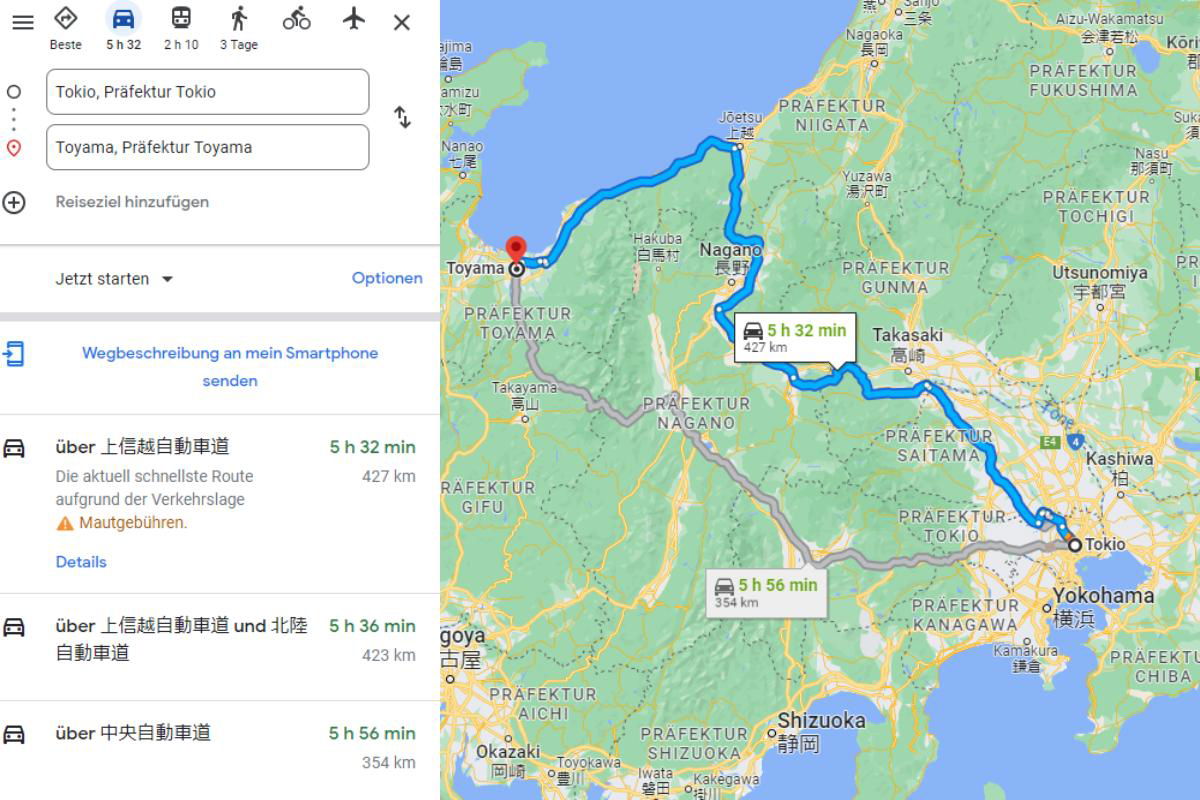
A Google Maps route screenshot in German shows a driving route from Tokio to Toyama. The left panel lists the starting point and destination input fields, plus three route options with travel times and distances: the fastest route via the Jōshin-etsu Expressway takes 5 hours 32 minutes and covers 427 km, with a note about toll charges. Two alternatives come in at 5 h 36 min and 5 h 56 min. The map itself covers central Japan, with the highlighted blue route winding north from Tokio through Gunma and Nagano before reaching Toyama on the coast. A second, shorter route (354 km, 5 h 56 min) is shown in gray along a more southern path. Prefecture labels like Nagano, Gunma, and Niigata are visible, and mode-of-travel icons at the top show the car option selected alongside train, walking, cycling, and flight.
A Google Maps route screenshot in German shows a driving route from Tokio to Toyama. The left panel lists the starting point and destination input fields, plus three route options with travel times and distances: the fastest route via the Jōshin-etsu Expressway takes 5 hours 32 minutes and covers 427 km, with a note about toll charges. Two alternatives come in at 5 h 36 min and 5 h 56 min.
The map itself covers central Japan, with the highlighted blue route winding north from Tokio through Gunma and Nagano before reaching Toyama on the coast. A second, shorter route (354 km, 5 h 56 min) is shown in gray along a more southern path. Prefecture labels like Nagano, Gunma, and Niigata are visible, and mode-of-travel icons at the top show the car option selected alongside train, walking, cycling, and flight.
Sichtbarer Text im Bild
Beste
5 h 32
2 h 10
3 Tage
Tokio, Präfektur Tokio
Toyama, Präfektur Toyama
Reiseziel hinzufügen
Jetzt starten
Optionen
Wegbeschreibung an mein Smartphone senden
über 上信越自動車道
5 h 32 min
427 km
Die aktuell schnellste Route aufgrund der Verkehrslage
Mautgebühren.
Details
über 上信越自動車道 und 北陸自動車道
5 h 36 min
423 km
über 中央自動車道
5 h 56 min
354 km
Aizu-Wakamatsu
会津若松
Kōr
PRAFEKTUR FUKUSHIMA
Nagaoka
長岡
Sanj
PRAFEKTUR NIIGATA
Jōetsu
上越
Nanao
七尾
Yuzawa
湯沢町
Nasu
PRAFEKTUR TOCHIGI
Hakuba
白馬村
Nagano
長野
Toyama
PRAFEKTUR TOYAMA
Utsunomiya
宇都宮
PRAFEKTUR GUNMA
Takasaki
高崎
5 h 32 min
427 km
Takayama
高山
PRAFEKTUR NAGANO
PRAFEKTUR SAITAMA
Kashiwa
柏
PRAFEKTUR TOKIO
Tokio
RAFEKTUR GIFU
5 h 56 min
354 km
goya
古屋
Yokohama
横浜
PRAFEKTUR KANAGAWA
Kamakura
鎌倉
PRAFEKTU
CHIBA
Shizuoka
静岡
PRAFEKTUR AICHI
Okazaki
岡崎
Toyokawa
豊川
PRAFEKTUR SHIZUOKA
Iwata
磐田
Kakegawa
掛川
Mit dem Zug
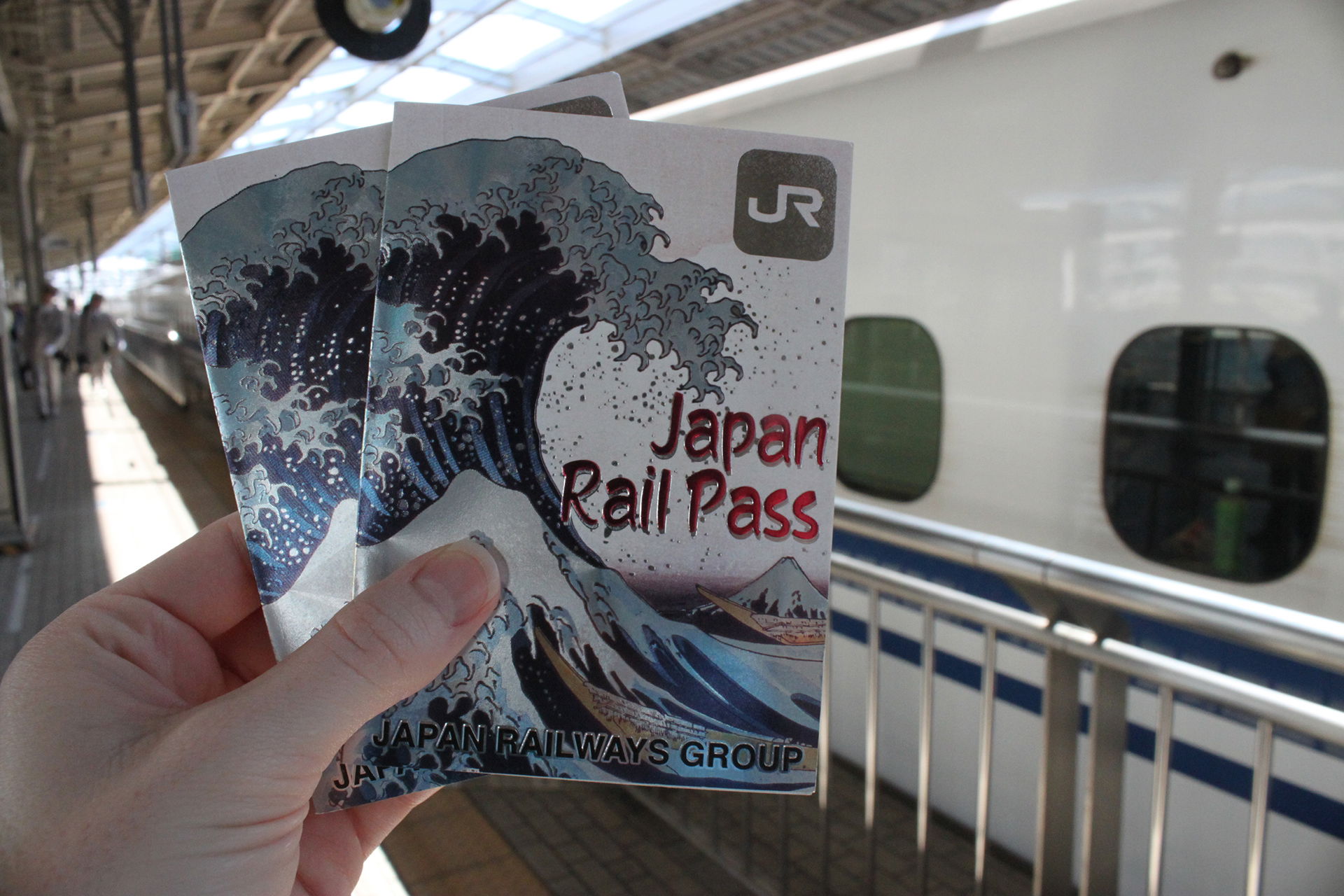
Es gibt prinzipiell die Möglichkeit, mit dem Hochgeschwindigkeitszug, dem Shinkansen[/link] , nach Toyama zu reisen. Die Fahrtzeit beträgt ungefähr 2 1/2 Stunden, was wesentlich kürzer als mit dem Auto ist. Die Kosten belaufen sich laut Google Maps auf circa 12.750 Yen pro Fahrt. Alternativ kannst du als Tourist den Japan Rail Pass nutzen. Allerdings fährt der Shinkansen nur direkt in die Stadt Toyama. Wenn man jedoch die gesamte Präfektur Toyama erkunden möchte, benötigt man auf jeden Fall ein Auto vor Ort, da es kaum öffentliche Transportmöglichkeiten gibt. Ein Auto bietet letztlich nicht nur mehr Flexibilität, sondern ermöglicht es auch, die Präfektur vollständig zu erkunden und die malerischen Landschaften der Region zu genießen.
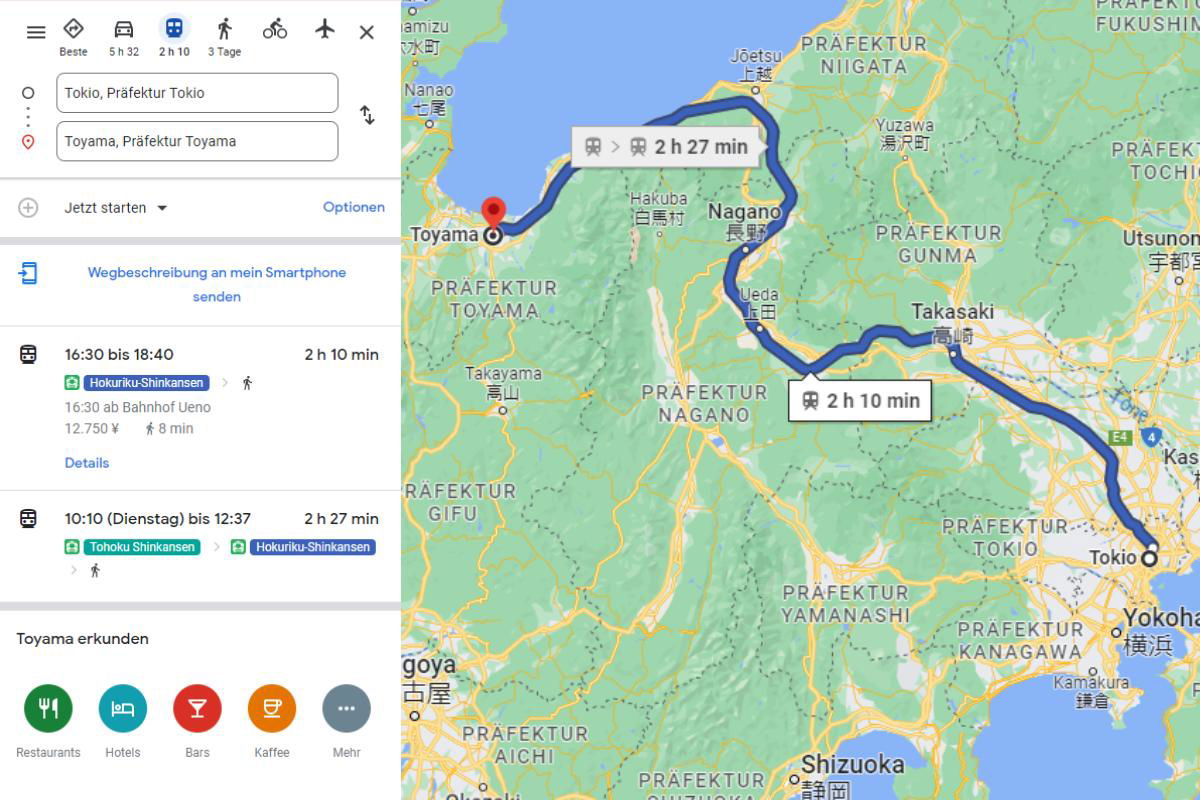
This is a Google Maps screenshot, set to German, showing train directions from Tokio to Toyama. A blue route line traces the path across central Japan, running from Tokyo northwest through Takasaki and Ueda to Nagano, then north past Jōetsu before ending at a red pin in Toyama on the coast. White badges on the map mark travel times of 2 h 27 min and 2 h 10 min, and prefecture labels such as Präfektur Nagano, Präfektur Toyama, and Präfektur Gunma cover the green terrain. The left sidebar lists the two route options. The faster one runs from 16:30 to 18:40, takes 2 h 10 min on the Hokuriku-Shinkansen departing from Bahnhof Ueno, costs 12.750 ¥, and includes an 8-minute walk. The second leaves at 10:10 on Tuesday and arrives at 12:37, taking 2 h 27 min with a transfer from the Tohoku-Shinkansen to the Hokuriku-Shinkansen. Above the routes are mode selectors with driving at 5 h 32 and transit at 2 h 10, the address fields for origin and destination, and a link to send the directions to a smartphone. At the bottom, a "Toyama erkunden" section offers category buttons for Restaurants, Hotels, Bars, Kaffee, and Mehr.
This is a Google Maps screenshot, set to German, showing train directions from Tokio to Toyama. A blue route line traces the path across central Japan, running from Tokyo northwest through Takasaki and Ueda to Nagano, then north past Jōetsu before ending at a red pin in Toyama on the coast. White badges on the map mark travel times of 2 h 27 min and 2 h 10 min, and prefecture labels such as Präfektur Nagano, Präfektur Toyama, and Präfektur Gunma cover the green terrain.
The left sidebar lists the two route options. The faster one runs from 16:30 to 18:40, takes 2 h 10 min on the Hokuriku-Shinkansen departing from Bahnhof Ueno, costs 12.750 ¥, and includes an 8-minute walk. The second leaves at 10:10 on Tuesday and arrives at 12:37, taking 2 h 27 min with a transfer from the Tohoku-Shinkansen to the Hokuriku-Shinkansen. Above the routes are mode selectors with driving at 5 h 32 and transit at 2 h 10, the address fields for origin and destination, and a link to send the directions to a smartphone. At the bottom, a "Toyama erkunden" section offers category buttons for Restaurants, Hotels, Bars, Kaffee, and Mehr.
Sichtbarer Text im Bild
Beste
5 h 32
2 h 10
3 Tage
Tokio, Präfektur Tokio
Toyama, Präfektur Toyama
Jetzt starten
Optionen
Wegbeschreibung an mein Smartphone
senden
16:30 bis 18:40 2 h 10 min
Hokuriku-Shinkansen
16:30 ab Bahnhof Ueno
12.750 ¥ 8 min
Details
10:10 (Dienstag) bis 12:37 2 h 27 min
Tohoku Shinkansen
Hokuriku-Shinkansen
Toyama erkunden
Restaurants
Hotels
Bars
Kaffee
Mehr
PRÄFEKTUR FUKUSHIM
水町
PRÄFEKTUR NIIGATA
Jōetsu
上越
Nanao
七尾
Yuzawa
湯沢町
2 h 27 min
PRÄFEKT
TOCHI
Hakuba
白馬村
Nagano
長野
Toyama
Utsunom
宇都
PRÄFEKTUR TOYAMA
PRÄFEKTUR GUNMA
Ueda
上田
Takasaki
高崎
2 h 10 min
E4
4
Kas
Takayama
高山
PRÄFEKTUR NAGANO
RÄFEKTUR
GIFU
PRÄFEKTUR TOKIO
Tokio
PRÄFEKTUR YAMANASHI
goya
古屋
PRÄFEKTUR AICHI
Oki
PRÄFEKTUR KANAGAWA
Yokoha
横浜
Kamakura
鎌倉
Shizuoka
静岡
PRÄFEKTUR
SHIZUOKA
Unsere Unterkunft: APA Hotel Takaoka Ekimae
Wir haben uns für eine Unterkunft in Takaoka entschieden, da die Lage praktisch und die Kosten für die Übernachtung relativ günstig waren. Hier haben wir im APA Hotel Takaoka Ekimae * geschlafen und für zwei Personen pro Nacht circa 7.000 Yen gezahlt (Kosten via Google Maps). Es ist ein 3-Sterne-Hotel, das direkt am Takaoka Bahnhof gelegen ist. Die Hotelkette bietet jederzeit einen konstanten Standard und wir können es jedem empfehlen, der eine komfortable und günstige Unterkunft sucht.
Google Maps: https://goo.gl/maps/pPg5kNtkN3yHaM7M9
Booking.com: Takaoka Eki APA Hotel
*Affiliate Link
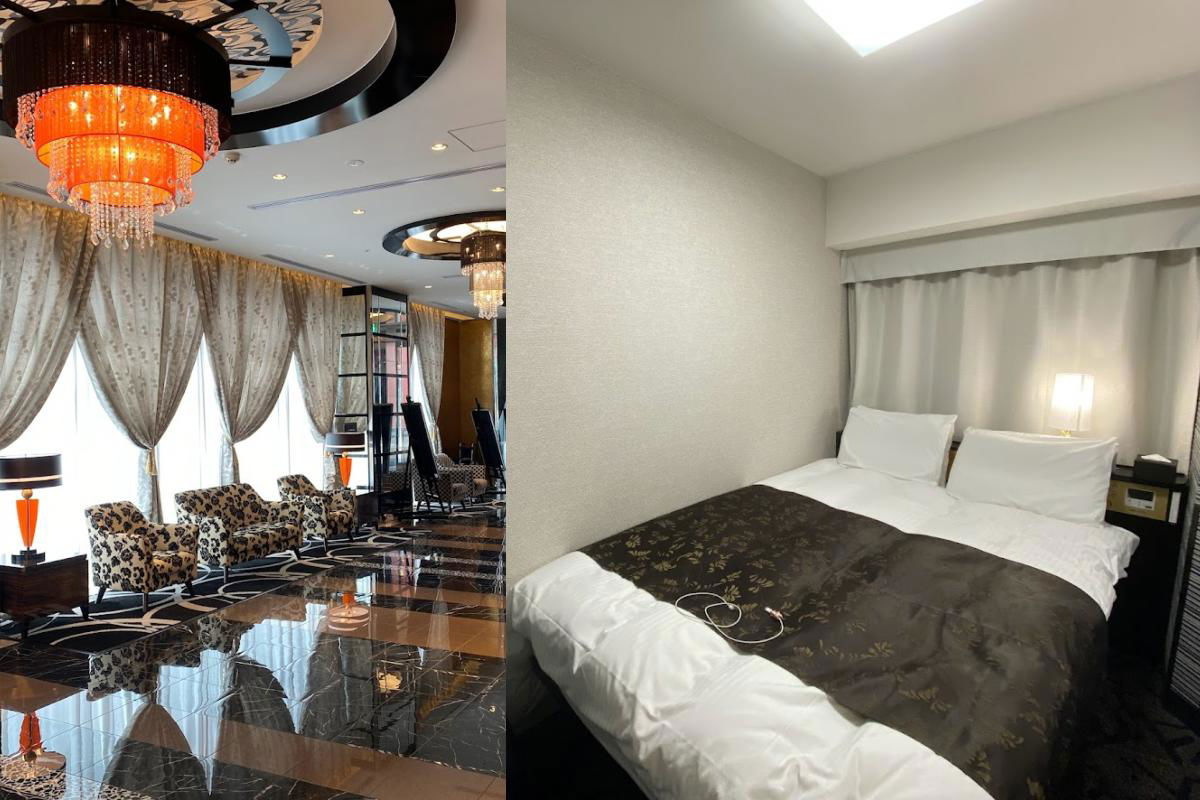
A side-by-side look at a Japanese business hotel. On the left, the lobby goes for glamour: a large chandelier with glowing orange shades and hanging crystals, mirrored circular ceiling panels, floor-to-ceiling patterned curtains, and leopard-print armchairs arranged on a highly polished black and beige marble floor that reflects everything above it. On the right, a guest room is far simpler, with a double bed dressed in white linens and a dark brown throw with a gold leaf pattern, pillows propped against a white curtain that runs behind the headboard, and a small lit lamp on the nightstand beside it. The pairing captures the hotel's split personality: a showy entrance area and a plain, functional room, in this case the APA Hotel Takaoka Ekimae in Toyama.
A side-by-side look at a Japanese business hotel. On the left, the lobby goes for glamour: a large chandelier with glowing orange shades and hanging crystals, mirrored circular ceiling panels, floor-to-ceiling patterned curtains, and leopard-print armchairs arranged on a highly polished black and beige marble floor that reflects everything above it. On the right, a guest room is far simpler, with a double bed dressed in white linens and a dark brown throw with a gold leaf pattern, pillows propped against a white curtain that runs behind the headboard, and a small lit lamp on the nightstand beside it. The pairing captures the hotel's split personality: a showy entrance area and a plain, functional room, in this case the APA Hotel Takaoka Ekimae in Toyama.
Sichtbarer Text im Bild
No text is clearly readable in the image.
Das Historische Dorf Gokayama
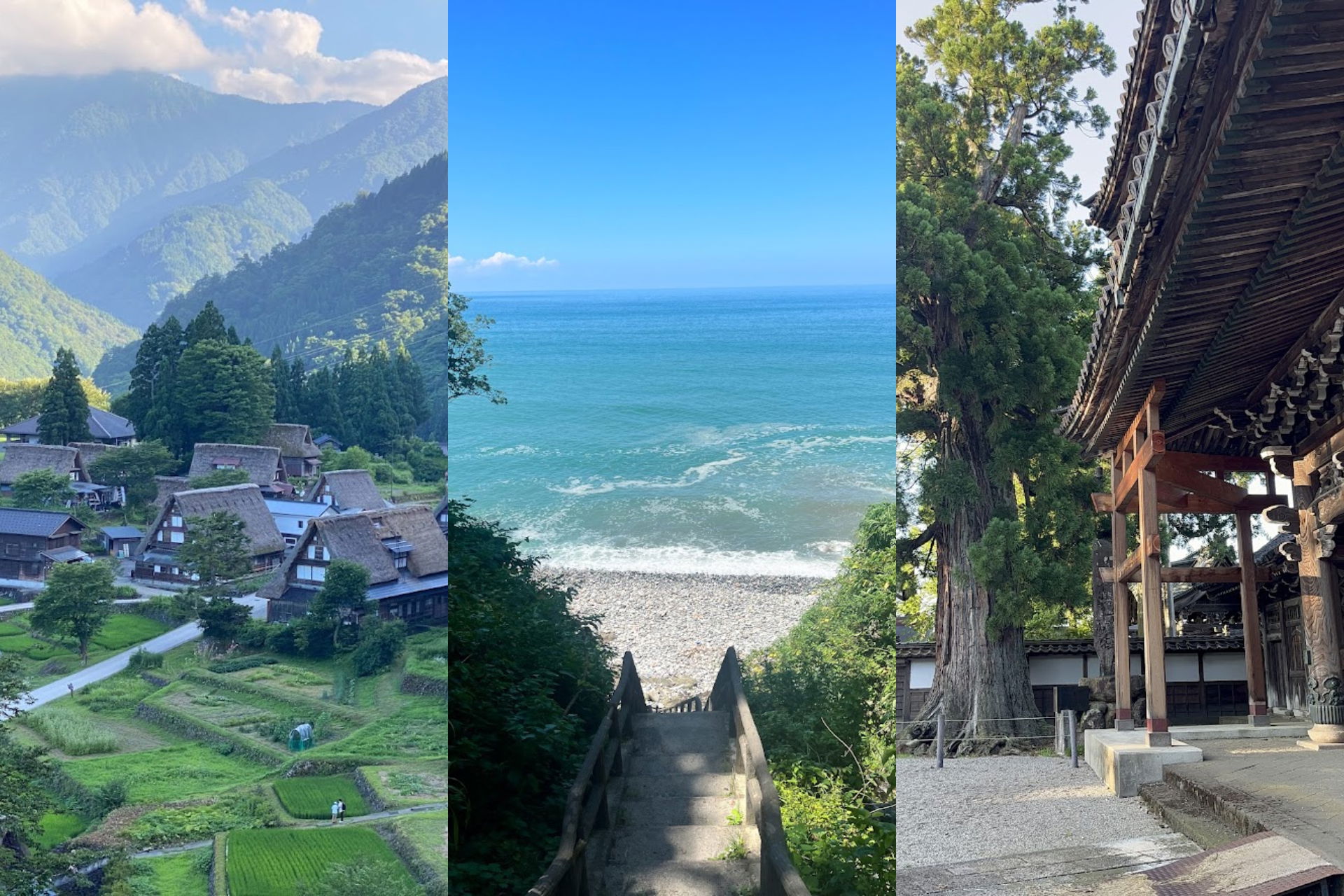
In der Präfektur Toyama befindet sich das malerische Dorf Gokayama, welches für seine historische Bedeutung bekannt ist. Es liegt in einer abgelegenen Bergregion und ist reich an traditionellen Bauernhäusern, die im einzigartigen Gasshō-Architekturstil erbaut wurden. Dieser besondere Stil ist tief in der lokalen Kultur verwurzelt und stellt eine Hauptattraktion für Besucher dar, die jährlich in diese Region reisen. Gokayama hat zu jeder Jahreszeit einen eigenen Charme: Im Frühling und Sommer wird man von der lebendigen grünen Landschaft verzaubert, während der Herbst ein farbenfrohes Laubpanorama bietet. Die Wintermonate hüllen das Dorf in eine märchenhafte Schneelandschaft, die einen unvergleichlichen Reiz ausübt. Bemerkenswerterweise ist für dieses eindrucksvolle Erlebnis kein Eintrittspreis zu entrichten.
Dort angekommen haben wir uns mit Udon , welches mit lokalen Zutaten wie Tofu, Pilzen und verschiedenen Gemüsesorten zubereitet wurde, gestärkt. Ein geschabtes Eis - das Kakigori - durfte natürlich auch nicht fehlen. Das Eis wurde mit Mochi und roten Bohnen serviert.
Auch hier empfehle ich dir die Anreise mit dem Auto. Es gibt zwar eine Verbindung mit dem öffentlichen Bus von Takaoka aus, jedoch ist die Fahrzeit sehr lang.
Google Maps: https://maps.app.goo.gl/dSzJTKPkB6s74V5TA


Johanabetsuin-Zentokuji Temple
Auf unserem Rückweg vom Gokayama Dorf haben wir einen Zwischenstopp bei dem Zentokuji-Tempel in Nanto gemacht. Dieser buddhistische Tempel ist über 500 Jahre alt und beeindruckt mit seiner wunderschönen Architektur. Besonders die kunstvoll gestaltete Holzarbeit des Tempels ist bewundernswert und definitiv einen Besuch wert.
Tägliche Öffnungszeiten: 09:00 - 17:00
Google Maps: https://goo.gl/maps/fRSv416vu2PwHzxV6
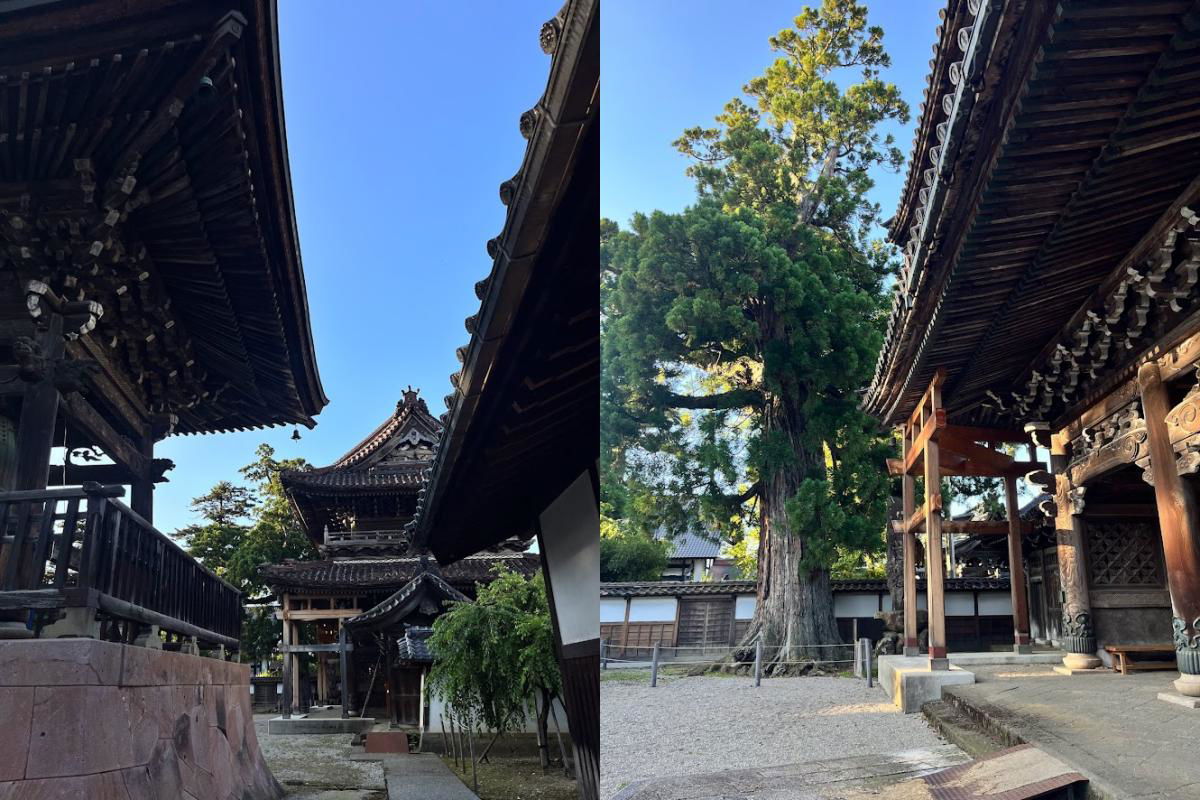
A two-photo side-by-side view of Zentokuji, a Buddhist temple in Toyama, Japan, shot on a clear sunny day. The left photo looks across the temple grounds from the edge of a wooden veranda toward the main hall, a dark timber structure with a layered tiled roof and carved details, framed by the deep eaves of adjacent buildings under a bright blue sky. The right photo shows a different angle along the temple corridor, where a massive old cedar tree towers over the grounds, its trunk thicker than anything around it and roped off near the base. Warm late-afternoon light hits the intricately carved wooden beams and pillars of the covered walkway on the right, contrasting with the deep green of the tree filling the background.
A two-photo side-by-side view of Zentokuji, a Buddhist temple in Toyama, Japan, shot on a clear sunny day. The left photo looks across the temple grounds from the edge of a wooden veranda toward the main hall, a dark timber structure with a layered tiled roof and carved details, framed by the deep eaves of adjacent buildings under a bright blue sky.
The right photo shows a different angle along the temple corridor, where a massive old cedar tree towers over the grounds, its trunk thicker than anything around it and roped off near the base. Warm late-afternoon light hits the intricately carved wooden beams and pillars of the covered walkway on the right, contrasting with the deep green of the tree filling the background.
Sichtbarer Text im Bild
No clearly readable text is present in the image.
Angeln in Toyama
Da sich die Präfektur Toyama direkt am Japanischen Meer befindet, ist es der perfekte Ort zum Angeln. Es gibt zahlreiche Spots, die man erkunden und genießen kann. Wenn man mit dem Auto anreist, kann man sich über viele günstige oder sogar kostenlose Parkplätze freuen. Prinzipiell würde ich empfehlen, mit dem Auto anzureisen, da viele Angelspots nicht mit öffentlichen Transportmitteln zu erreichen sind. An unserem Angelspot gab es sogar kostenfreie Fußonsen!
Während unseres Angelausflugs haben wir einige faszinierende Fische gefangen, darunter einen Japanischen Weißling, eine Flunder und einen Tintenfisch. Das Angeln war eine unvergessliche Erfahrung, die uns noch lange in Erinnerung bleiben wird. Doch das Beste kam erst noch: wir haben kurzerhand einen Gasgrill für 2.500 Yen gekauft und den gefangenen Fisch zu Bratfisch verarbeitet. Der Geschmack war unglaublich gut und hat uns noch mehr für Toyama begeistert.
Um unser Abendessen perfekt zu machen, haben wir uns eine Bento-Box aus dem Konbini gekauft.
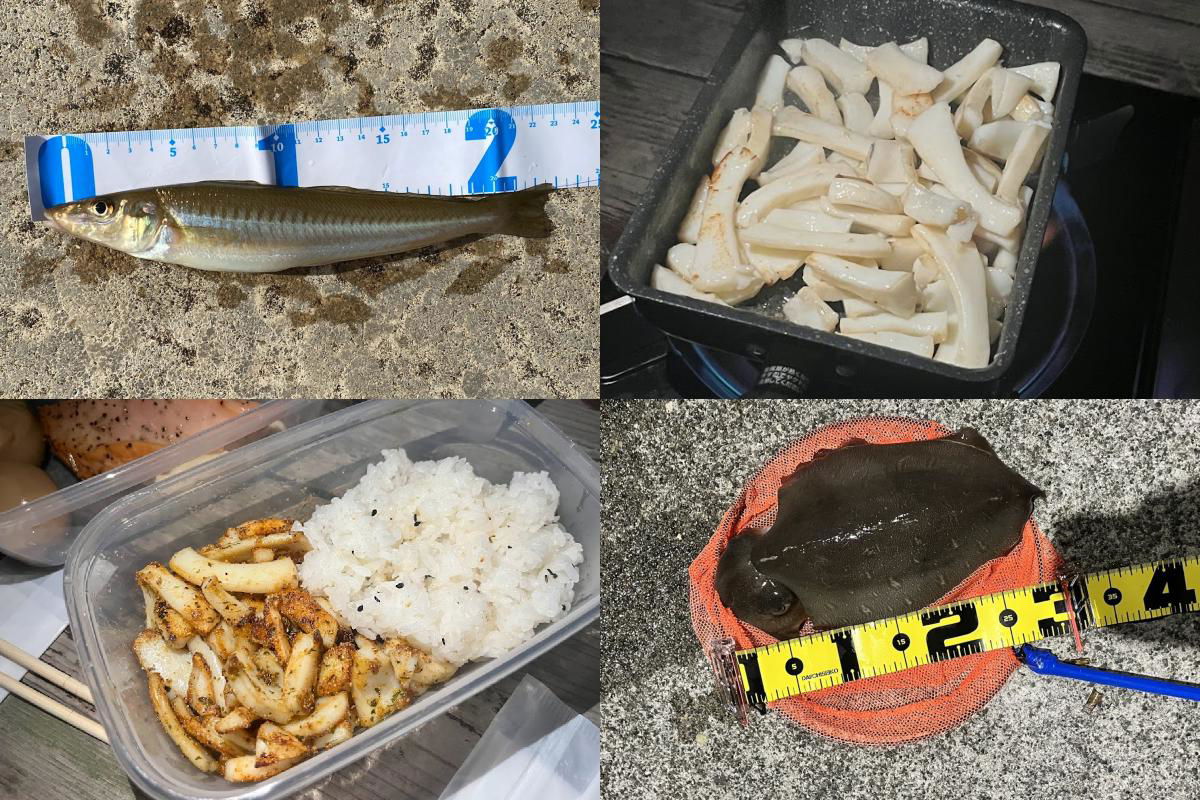
A four-photo collage from a fishing trip in Toyama, Japan. In the top left, a slender silver-green fish about 22 cm long lies on wet sand beside a white and blue measuring tape. The top right shows strips of white fish meat grilling in a black square pan on a portable gas stove. The bottom left panel shows the finished meal packed in a clear plastic container: seasoned, golden-grilled fish pieces next to a mound of white rice sprinkled with furikake. In the bottom right, a dark flatfish rests in an orange landing net on wet gravel, stretched out with a yellow measuring tape that reads roughly 36 cm.
A four-photo collage from a fishing trip in Toyama, Japan. In the top left, a slender silver-green fish about 22 cm long lies on wet sand beside a white and blue measuring tape. The top right shows strips of white fish meat grilling in a black square pan on a portable gas stove.
The bottom left panel shows the finished meal packed in a clear plastic container: seasoned, golden-grilled fish pieces next to a mound of white rice sprinkled with furikake. In the bottom right, a dark flatfish rests in an orange landing net on wet gravel, stretched out with a yellow measuring tape that reads roughly 36 cm.
Sichtbarer Text im Bild
1 5 10 15 17 20 22 2
1 5 2 3 4 25 30 35 5 15
Oyashirazu-Klippen
Die Küste zum Japanischen Meer bietet eine atemberaubende Landschaft, die von steinigen Klippen umgeben ist. Diese Klippen sind mit sattgrünen Pflanzen bewachsen und eine Treppe führt zu einem einzigartigen Steinstrand. Das Besondere an diesem Strand sind die vielen runden Steine, die von dem Wasser über viele Jahre hinweg rund geschliffen wurden. Wenn die Steine durch die Wellen in Bewegung gesetzt werden, erzeugt es ein einzigartiges, “knackendes” Geräusch.
Die Kombination aus dem Rauschen der Wellen und dem Klang der Steine schafft eine beruhigende und entspannende Atmosphäre, die so unvergleichlich ist. Mir hat dieser Ort in Toyama mitunter am Besten gefallen.
Google Maps: https://goo.gl/maps/TMf1fsvv8ukeUWQt9
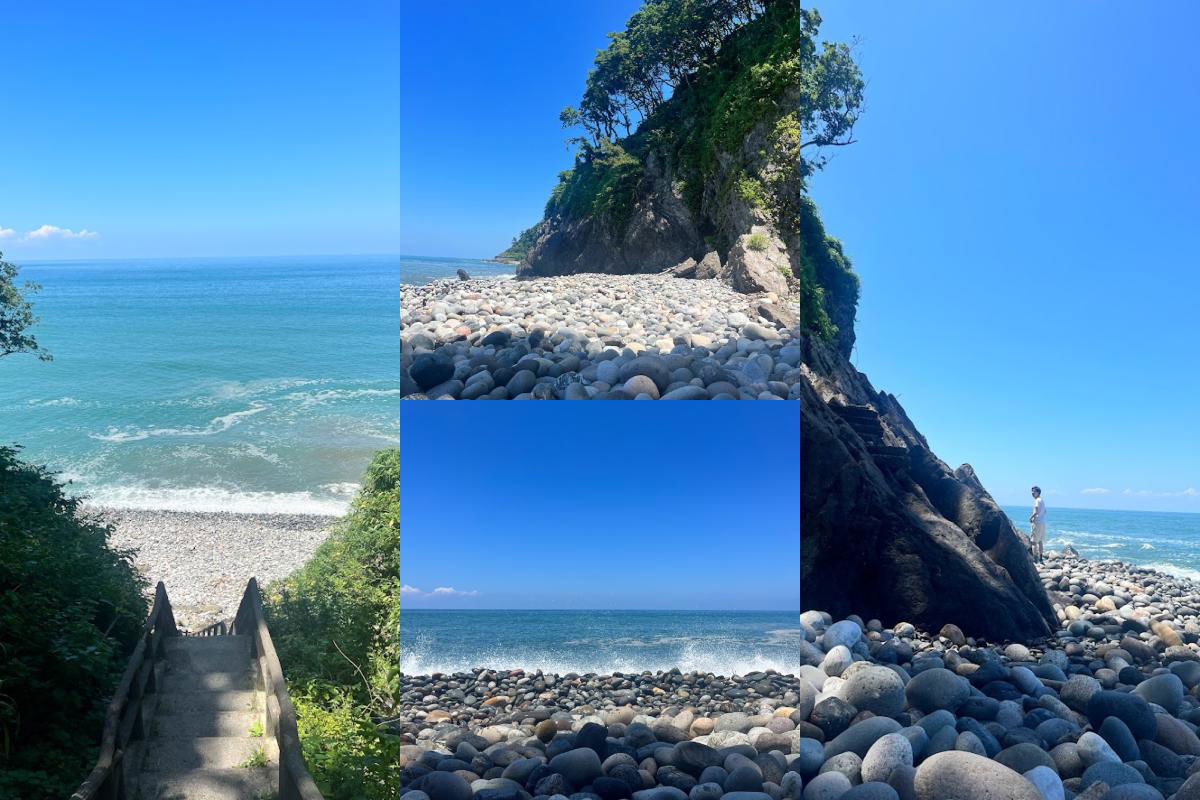
A four-photo collage of the Oyashirazu coast in Toyama Prefecture, where steep cliffs drop straight to a pebble beach on the Sea of Japan. On the left, a narrow concrete staircase with a simple handrail descends between thick green shrubs toward the shore, opening onto pale pebbles and turquoise water with small waves breaking under a clear blue sky. The top middle photo looks along the beach to a rocky cliff crowned with dense trees. Below it, waves wash up onto a shore of smooth, rounded stones in shades of grey, white, and rust. The right photo shows the cliff at close range: a dark, rugged rock face with steps carved into it, and a person in a white shirt and light shorts standing on the pebbles beneath it, facing the sea.
A four-photo collage of the Oyashirazu coast in Toyama Prefecture, where steep cliffs drop straight to a pebble beach on the Sea of Japan.
On the left, a narrow concrete staircase with a simple handrail descends between thick green shrubs toward the shore, opening onto pale pebbles and turquoise water with small waves breaking under a clear blue sky. The top middle photo looks along the beach to a rocky cliff crowned with dense trees. Below it, waves wash up onto a shore of smooth, rounded stones in shades of grey, white, and rust. The right photo shows the cliff at close range: a dark, rugged rock face with steps carved into it, and a person in a white shirt and light shorts standing on the pebbles beneath it, facing the sea.
Sichtbarer Text im Bild
No clearly readable text is present in the image.
Eine Spezialität aus Toyama: Masuzushi
Wir haben uns an die Kulisse angepasst und frisches Sushi gegessen. Es ist bekannt, dass der Fisch aus dem Japanischen Meer frischer schmeckt als anderswo, was wir bestätigen können. Wir haben unter anderem Sushi mit Fischrogen und zweierlei Lachs aus dem lokalen Supermarkt probiert, aber auch eine wahre Spezialität der Präfektur Toyama.
Dabei handelt es sich um Masuzushi, ein gepresstes Sushi aus Forelle und Reis, das in Salz mariniert, in Bambusblätter eingewickelt und in einem Holzbehälter namens Wagemono verpackt wird. Mit einem mitgelieferten kleinen Bambusmesser wird das runde Sushi in fächerförmige Stücke geschnitten.
Der Geschmack der Forelle ist aufgrund der Marinierung eher säuerlich und verleiht dieser Spezialität dadurch eine besondere Note. Die Holzverpackung des Masuzushi ist nicht nur schön anzusehen, sondern auch praktisch für den Transport und den Genuss unterwegs.
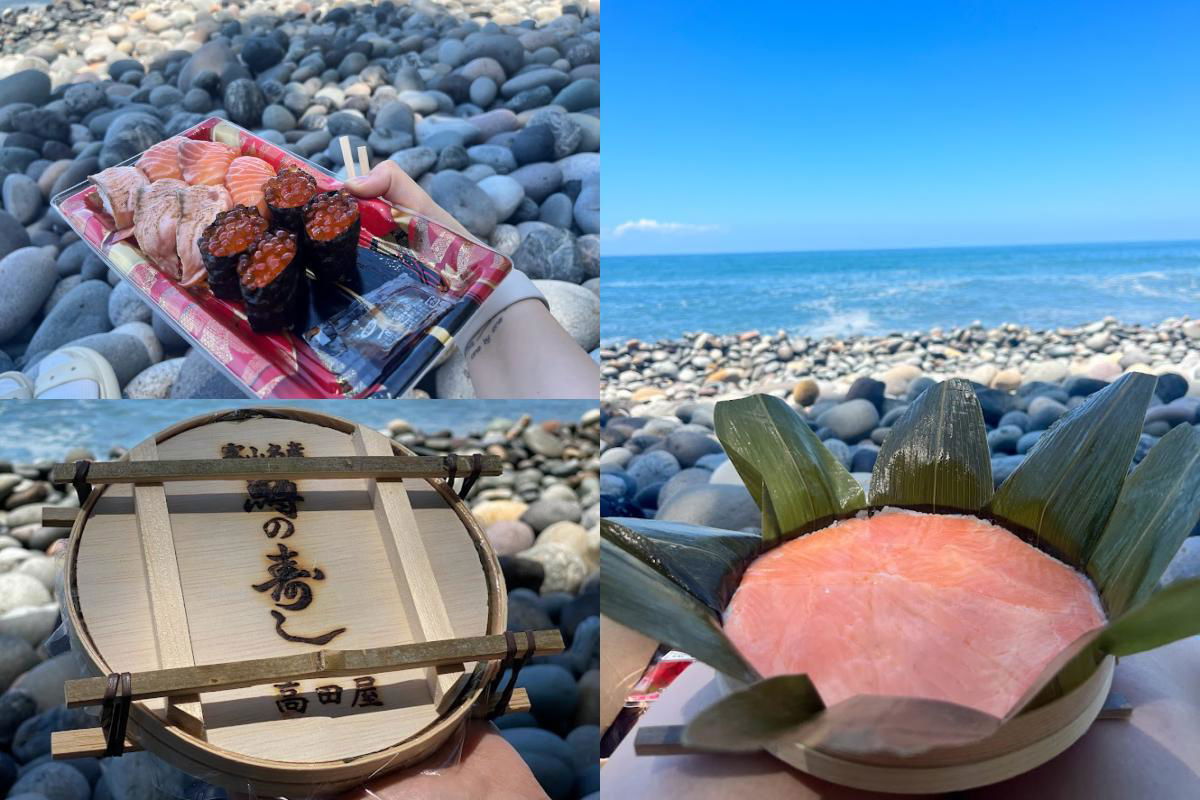
A four-photo collage of a sushi picnic on a pebble beach in Toyama. In the top left, a hand holds up a plastic takeout tray of nigiri: salmon slices, seared salmon, and ikura gunkan rolls filled with orange salmon roe. Smooth grey and white stones fill the whole background. The top right photo shows the setting itself, a deep blue sky over a choppy sea washing onto the rocky shore. The bottom two photos feature Masu no Sushi from Takadaya, a round cedar box of pressed trout sushi that is a Toyama specialty. One shot shows the wooden lid, its burned-in Japanese calligraphy naming the dish and the shop. In the other, the box is open and held above the pebbles, revealing a disc of pale pink fish pressed over rice and framed by folded bamboo leaves.
A four-photo collage of a sushi picnic on a pebble beach in Toyama. In the top left, a hand holds up a plastic takeout tray of nigiri: salmon slices, seared salmon, and ikura gunkan rolls filled with orange salmon roe. Smooth grey and white stones fill the whole background. The top right photo shows the setting itself, a deep blue sky over a choppy sea washing onto the rocky shore.
The bottom two photos feature Masu no Sushi from Takadaya, a round cedar box of pressed trout sushi that is a Toyama specialty. One shot shows the wooden lid, its burned-in Japanese calligraphy naming the dish and the shop. In the other, the box is open and held above the pebbles, revealing a disc of pale pink fish pressed over rice and framed by folded bamboo leaves.
Sichtbarer Text im Bild
鮭の壽し
高田屋
Fazit der Toyama Reise
Toyama ist eine wunderschöne Präfektur Japans, die besonders Naturliebhaber und Angelfreunde überzeugen wird. Ich empfehle jedoch dringend die Anreise mit dem Auto, da Toyama über kein gut ausgebautes öffentliches Verkehrsnetz verfügt. Die einzigartige Landschaft, das historische Dorf Gokayama, sowie die Küstenlandschaft rund um die Oyashirazu-Klippen sind Orte, die definitiv einen Besuch wert sind. Es ist auch ein beliebtes Angelziel mit vielen kulinarischen Möglichkeiten. Ob zur warmen oder kalten Jahreszeit - Toyama zeigt sich sets von seiner besten Seite und überzeugt davon, die Präfektur mehrfach zu besuchen, um sie auf die unterschiedlichsten Arten kennenzulernen.


Kommentare